

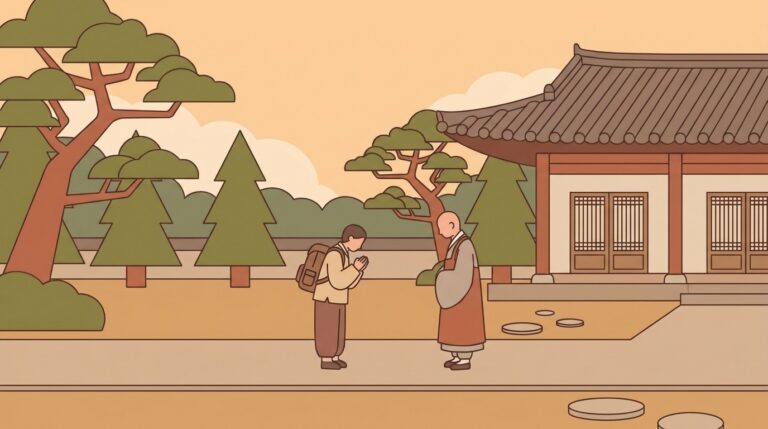
When Walking the Grounds: Master Chasu and Temple Greetings Like a Local
Phase 1: Empathy (Immersive Story Opening)
안녕하세요! 매일한글 에디터입니다. (Hello! I’m your Daily Hangul editor.)
Picture this: You wake up at 5:30 AM to crisp mountain mist wrapping around towering pine trees. Wooden wind chimes (punggyeong) tinkle softly in the breeze. You are walking through the stone courtyard of a 1,000-year-old Buddhist temple on your very first Korean Templestay. You feel completely serene—until suddenly, a monk in flowing grey robes (dongsam) turns the corner, walking directly toward you.
Instinct takes over. Do you wave? “Hey!” Too casual. Do you reach out for an awkward handshake? Definitely not. Do you frantically bow at a 90-degree angle while swinging your arms around? Or worse, freeze with both hands shoved deep inside your hoodie pockets?
Take a deep breath! Almost every international visitor experiences this exact freeze-frame moment of “hand paralysis” at a temple. In Korean Buddhist spaces, physical posture and silence speak much louder than spoken words. In this guide, based on real feedback from over 2,000 global travelers, you will learn the exact non-verbal manners—the respectful 차수 (Chasu) posture and 합장 (Hapjang) greeting—and natural Korean phrases so you feel centered, confident, and deeply culturally connected.
Phase 2: Core Expressions Deep Dive
1. 성불하세요 (Seongbulhaseyo)
- Pronunciation: [Seong-bul-ha-se-yo] (Think: “Seong” rhymes with “song”, “bul” like “bull”, “ha-se-yo” like the polite Korean ending)
- Meaning:
- Literal: “May you achieve Buddhahood / enlightenment.”
- Actual Nuance: A warm, deeply respectful temple greeting used to say hello, goodbye, or express goodwill to monks and fellow temple guests.
- K-Culture Moment: In healing travel variety shows like Three Meals a Day or temple-visit episodes in K-Dramas, visitors quietly whisper this phrase with palms pressed together when encountering a monk on a mountain path.
- Editor’s Insight: You do not have to be a Buddhist to say this! It functions as the temple equivalent of “Peace be with you” or “Have a blessed day.”
- Situation Spectrum: Casual 🚫 | Semi-formal ✅ | Formal ✅ (Temple contexts only)
- 🤔 Think About It: In many Western cultures, greetings focus on the moment (“Good morning”). Why do you think traditional Korean temple greetings wish personal spiritual peace and awakening instead?
2. 차수하고 걸으세요 (Chasuhago georeuseyo)
- Pronunciation: [Cha-su-ha-go geo-reu-se-yo] (Cha like “chai tea”, su like “suit”, geo-reu-se-yo sounds like “guh-roo-say-yo”)
- Meaning:
- Literal: “Please fold your hands and walk.”
- Actual Nuance: “Please walk with your hands folded respectfully over your lower belly.”
- K-Culture Moment: During orientation on popular temple stay YouTube vlogs, the monastic coordinator (team leader) gently shows guests how to hold their hands while touring the grounds.
- Editor’s Insight: 차수 (叉手 / Chasu) literally means “crossed hands.” It symbolizes bringing your scattered energy and thoughts together into one unified, calm center (Danjeon).
- Situation Spectrum: Casual 🚫 | Semi-formal ✅ | Formal ✅
- 🤔 Think About It: How does deliberately placing your hands in a resting position change your walking pace and posture compared to swinging your arms freely?
3. 스님, 안녕하세요 (Seunim, annyeonghaseyo)
- Pronunciation: [Seu-nim, an-nyeong-ha-se-yo] (Seu like the “su” in “support”, nim like “team” with an N)
- Meaning:
- Literal: “Monk, are you at peace?”
- Actual Nuance: “Hello, Venerable Monk.”
- K-Culture Moment: Seen in historical and modern dramas alike whenever a character visits a temple seeking wisdom or refuge (such as in Extraordinary Attorney Woo).
- Editor’s Insight: Never call a Buddhist monk 아저씨 (Ajeossi) or just 선생님 (Seonsaengnim)! Always address them as 스님 (Seunim). The title itself carries deep honorific respect.
- Situation Spectrum: Casual 🚫 | Semi-formal ✅ | Formal ✅
- 🤔 Think About It: Why does Korean culture attach specific occupational and spiritual honorific titles directly to a person rather than addressing them by name?
Phase 3: Textbook Korean vs. Real Korean
Situation 1: Meeting a monk on the courtyard trail
- 📖 교과서 한국어 (Textbook):
- 스님, 만나서 반갑습니다. (Seunim, mannaseo bangapseumnida.) – “Venerable monk, it is nice to meet you.”
- 🗣️ 진짜 한국어 (Real-life Native):
- (합장하며 고개 숙여) 성불하십시오. (Seongbulhasipsio.) or 안녕하세요, 스님. (Annyeonghaseyo, seunim.)
- 💡 왜 다를까? (Why the difference?):
Temples are sanctuaries of quiet mindfulness. Long, formal social banalities sound jarring. A calm, soft greeting accompanied by folded palms communicates far more respect than an upbeat textbook conversation.
Situation 2: Monastic guide advising posture during walking meditation
- 📖 교과서 한국어 (Textbook):
- 손을 주머니에 넣지 마세요. (Soneul jumeonie neotji maseyo.) – “Do not put your hands in your pockets.”
- 🗣️ 진짜 한국어 (Real-life Native):
- 손은 단전 앞에 차수해 주세요. (Soneun danjeon ape chasuhae juseyo.) – “Please keep your hands in Chasu position over your lower belly.”
- 💡 왜 다를까? (Why the difference?):
Korean etiquette focuses on positive, affirmative direction rather than purely negative commands (“don’t do X”). Specifying the exact posture (Chasu) gently reminds you to collect your thoughts.
Phase 4: K-Culture Deep Dive & Non-Verbal Manners
4-1. 눈치 (Nunchi) & The Art of Chasu and Hapjang
When stepping through the Iljumun (One Pillar Gate) of a Korean temple, the body communicates before the tongue ever moves.
- The ‘Chasu’ (차수) Posture: When walking or standing quietly on the grounds (경내 / Gyeongnae), place your right hand over your left hand (or vice versa), interlocking or resting your fingers gently over the lower abdomen just below the navel (the Danjeon center). Keep your elbows slightly curved away from your body, not pinned rigidly against your ribs. Never swing your arms loosely, cross them over your chest, or tuck your hands into pockets.
- The ‘Hapjang’ (합장) Bow: When you see a monk or an elder practitioner, stop walking. Bring both palms together flat in front of your chest at heart level, fingers pointing upward without gaps. Lower your head and upper body smoothly at about a 45-degree angle. Keep your eyes cast gently downward toward the ground rather than staring directly into the monk’s eyes.
4-2. Culture Code: The “Temple Stay” Detox Phenomenon
In hyper-fast South Korea, temple stays have transformed from purely religious pilgrimages into the ultimate mental health refuge. Even K-Pop icons like BTS’s RM have shared photos of temple visits to appreciate quiet architecture and calm their minds. The physical discipline of Chasu (folding hands) and 108 배 (108 bows) serves as a physical grounding technique, slowing down the racing pulse of modern life.
Phase 5: Real-Life Roleplay Scenario
Setting: A quiet gravel pathway outside the main prayer hall (Daeungjeon) at Woljeongsa temple. Sunim Jeong-an is gently raking fallen pine needles. Alex, an international guest, approaches.
- Turn 1 (Alex):
- 🎭 Walking with hands swinging freely, then abruptly stopping 3 steps away.
- 저기요… 스님? (Jeogiyo… seunim?)
- “Excuse me… monk?”
- Turn 2 (Sunim Jeong-an):
- 🎭 Sets the rake down softly, stands upright, and places palms together in Hapjang.
- 네, 보살님. 좋은 아침입니다. (Ne, bosalnim. Joeun achimimnida.)
- “Yes, seeker. Good morning.”
- Turn 3 (Alex):
- 🎭 Quickly realizes his hands are dangling awkwardly, brings palms together in Hapjang, and bows.
- 안녕하세요, 스님! 성불하세요! (Annyeonghaseyo, seunim! Seongbulhaseyo!)
- “Hello, Monk! May you find enlightenment!”
- Turn 4 (Sunim Jeong-an):
- 🎭 Smiles warmly and returns a gentle nod.
- 성불하십시오. 절이 처음이신가요? (Seongbulhasipsio. Jeori cheoeum-isingayo?)
- “May you attain Buddhahood. Is this your first time at a temple?”
- Turn 5 (Alex):
- 🎭 Maintains an attentive, relaxed posture.
- 네, 템플스테이는 처음이라 조금 긴장돼요. (Ne, tempeulseuteineun cheoeum-ira jogeum ginjangdwaeyo.)
- “Yes, it is my first templestay, so I’m a little nervous.”
- Turn 6 (Sunim Jeong-an):
- 🎭 Demonstrates placing one hand over the other across the lower belly.
- 긴장할 것 없습니다. 경내를 걸을 때는 이렇게 차수를 하시면 마음이 편안해집니다. (Ginjanghal geot eopseumnida. Gyeongnaereul georeul ttaeneun ireoke chasureul hasimyeon maeumi pyeon-anhaejimnida.)
- “Nothing to worry about. When walking the grounds, doing Chasu like this will bring ease to your mind.”
- Turn 7 (Alex):
- 🎭 Copies the posture, placing right hand over left hand at the navel.
- 아, 이렇게요? 정말 마음이 차분해지네요. (A, ireokeyo? Jeongmal maeumi chabunhaejineyo.)
- “Ah, like this? It really makes my heart feel calm.”
- Turn 8 (Sunim Jeong-an):
- 🎭 Nods in approval.
- 아주 잘하셨습니다. 편안한 쉼이 되길 바랍니다. (Aju jalhasyeotseumnida. Pyeon-an-han swim-i doegil baramnida.)
- “Very well done. I hope you find peaceful rest here.”
🔀 Interactive Choice Point
You see the Head Abbot (Jujiseunim) walking toward you in the corridor. What do you do?
* Choice A: Step to the side of the path, fold your hands in Hapjang, bow softly at 45 degrees, and whisper: 성불하십시오. (Seongbulhasipsio.)
* Choice B: Walk up briskly, smile brightly, wave one hand, and shout: 하이 스님! (Hai seunim!)
* Choice C: Panic, shove both hands into your pockets, turn around 180 degrees, and sprint the other way.
Feedback:
* Choice A (Best): Perfect! Stepping to the side shows consideration, and the Hapjang bow acknowledges the Abbot’s presence with monastic grace.
* Choice B (Bad): High risk of severe second-hand embarrassment! Loud waving and casual slang shatter the quiet atmosphere.
* Choice C (Risk): While funny in a sitcom, running on temple stone walkways is unsafe and makes monks worry that you are lost or in distress!
Phase 6: 10-Second Emotion Shadowing Drill
Practice matching the exact rhythm, intonation, and breath control:
[🙏 차분하고 경건하게 / Calm and reverent]- 성불하세요. / 편안한 하루 되세요.
- (Seongbulhaseyo. / Pyeon-an-han haru doeseyo.)
- “May you attain Buddhahood. / Have a peaceful day.”
[🌿 부드럽고 공손하게 / Soft and polite]- 스님, / 경내에서는 / 이렇게 차수하면 될까요?
- (Seunim, / gyeongnae-eseoneun / ireoke chasuhamyeon doelkkayo?)
- “Monk, / on temple grounds, / is it correct to do Chasu like this?”
[😌 감사와 평온함을 담아 / Full of gratitude and serenity]- 좋은 가르침 / 감사합니다, / 성불하십시오.
- (Joeun gareuchim / gamsahamnida, / seongbulhasipsio.)
- “For your kind teaching, / thank you, / may you find enlightenment.”
Phase 7: K-Culture Mini Dictionary
- 차수 (叉手 / Chasu): The posture of lightly crossing hands over the lower stomach (Danjeon). Used whenever walking or standing quietly in temple grounds to project humility and inner calm.
- 합장 (合掌 / Hapjang): Pressing palms flat together in front of the chest. The primary non-verbal greeting and bow used in Buddhist culture, signifying that the greeter and receiver are one in spirit.
- 경내 (境內 / Gyeongnae): The internal grounds/premises of the temple complex. Once you cross under the gate into the Gyeongnae, loud voices and running are strictly discouraged.
- 공양 (供養 / Gongyang): Traditionally offering nourishment; in a temple stay, it refers to monastic meals (such as Baru Gongyang, traditional bowl dining) eaten in complete, grateful silence.
Phase 8: Traveler’s Survival Kit
Survival Expressions TOP 3
합장 인사는 어떻게 해요?(Hapjang insaneun eotteoke haeyo?)- How do I perform the Hapjang greeting?
- Pro Tip: Ask this to your temple stay coordinator during check-in if you want to verify your hand alignment!
신발을 벗고 들어가나요?(Sinbareul beotgo deureoganayo?)- Do I take off my shoes before entering?
- Pro Tip: Korean temple prayer halls (Beopdang) always require removing shoes at the outer wooden platform.
사진을 찍어도 되나요?(Sajineul jjigeodo doenayo?)- May I take photos?
- Pro Tip: Exterior grounds are usually fine, but photographing inside active prayer halls or during chanting is almost always restricted.
Editor’s Travel Note
- Booking Portal: Reserve directly through the verified Official Templestay Reservation Portal to find English-friendly programs throughout Korea.
- Footwear & Clothing: Pack clean, neutral-colored socks! Bare feet are considered inappropriate inside Buddha halls. Slip-on shoes are a lifesaver because you will take your shoes off and on constantly.
Phase 9: Going One Step Deeper (Reflection)
In contemporary life, our hands are practically glued to smartphones, keyboards, and coffee cups. When was the last time your hands simply rested quietly?
In Korean temple culture, Chasu is not a rule designed to restrict your freedom. Rather, it is an invitation to put down external distractions and reconnect with yourself. By gathering your hands gently at your center, your mind stops wandering outward into past regrets or future anxiety.
💬 Your Turn: Have you ever experienced a cultural space where silence and physical posture took the place of spoken greetings? How did it feel compared to regular small talk? Share your thoughts below!
Phase 10: FAQ & Common Mistakes
Q: Can I shake hands with a Buddhist monk if they greet me?
A: Avoid initiating handshakes. Physical touch between monastics and laypeople is traditionally avoided. If a monk approaches you, simply bring both palms together in Hapjang and bow slightly.
Q: Do I need to chant or bow if I am not Buddhist?
A: Not at all. Korean templestay programs welcome people of all faiths or no faith. Participating in Chasu or the Hapjang bow is seen as cultural respect and mindfulness, not a religious conversion.
Q: Which hand goes on top during Chasu?
A: In traditional Korean Buddhist etiquette for everyday walking, men typically place the left hand over the right, while women place the right hand over the left. However, during templestay, doing the gesture with sincerity and stillness matters far more than obsessing over which thumb is on top!
🚨 Common Mistakes Alert
- ❌ Mistake 1: Walking into the main Buddha hall through the central door.
- 👉 Correct Action: The center door is reserved for monks. Lay guests and visitors should enter and exit through the side doors (좌우 측문).
- ❌ Mistake 2: Stepping directly on the raised wooden door threshold (Mun-teok).
- 👉 Correct Action: Never step on the threshold; always step cleanly over it. Stepping on it is believed to bring bad luck and damages traditional woodwork.
- ❌ Mistake 3: Talking on speakerphone or wearing earbuds on temple pathways.
- 👉 Correct Action: Set devices to silent mode. Monastic grounds are spaces of deep listening to natural sounds.
Phase 11: Action Missions
- 🥉 Bronze Mission (Solo Practice): Stand in front of your mirror right now. Form Chasu with relaxed shoulders, take 3 deep belly breaths, and practice the smooth 45-degree Hapjang bow.
- 🥈 Silver Mission (Social Challenge): Post a short clip or photo practicing your Chasu walking posture with the hashtag
#DailyHangulTempleStay. - 🥇 Gold Mission (Real-world Execution): On your next visit to a Korean temple, walk across the entire courtyard in Chasu without checking your phone once, and offer a quiet
성불하세요to the first monk you pass. - 🎮 K-Culture Mission: Watch a travel vlog or drama scene featuring a Korean temple (like Extraordinary Attorney Woo, Ep. 13-14). Spot whether the actors correctly execute Chasu while walking!
Phase 12: Interactive Quiz Challenge
- Situational Judgment: You are walking between temple halls and a monk walks past carrying meditation cushions. What is the most appropriate action?
- (A) High-five the monk to show foreign friendliness.
- (B) Pause, fold palms in Hapjang, bow quietly, and whisper “성불하세요”.
- (C) Shout “안녕하세요!” loudly across the yard.
- Fill in the Blank:
경내를 걸을 때는 두 손을 가지런히 모으는 [ ____ ] 자세를 합니다.- (Hint: Two syllables, sounds like “Cha-su”)
- True or False (Cultural Etiquette):
Inside a temple prayer hall, it is completely acceptable to step directly on the raised wooden threshold (Mun-teok) as long as your shoes are off. (True / False)
👉 Click here for Answers & Explanations
- Answer: (B) Monks appreciate quiet mindfulness. A calm Hapjang bow with folded hands is the ideal greeting.
- Answer: 차수 (Chasu). Crossing the hands calmly over the Danjeon centers your posture.
- Answer: False! You must always step over the threshold, never directly on it, out of respect for the temple boundary and preservation of wooden architecture.







