

Phase 1: Empathy & Story Immersion
안녕하세요! 매일한글 에디터입니다. (Hello! I’m your Daily Hangul editor.) Picture this: you just landed in Seoul, grabbed those gorgeous idol-style color lenses from a trendy shop in Hongdae, and stayed up until 3 AM binge-watching K-dramas with the floor heating (ondol) on high. The next morning, you wake up, blink, and gasp—it feels like someone rubbed coarse sand straight across your eyeballs! Your eyes are bloodshot, scratchy, and painful. You know you need to visit a local eye clinic (안과 – Angwa), but your palms sweat thinking: How do I explain contact lens irritation in Korean? Don’t worry! Hundreds of our beginner students have felt that exact panic. With this handy A2-level guide, you will master the exact conversational tools you need to walk into any Korean eye clinic, get soothing drops, and step back outside into the Seoul sunlight with crystal-clear vision.
Phase 2: Core Expressions Deep Dive
1. 눈이 뻑뻑해요 (Nun-i ppeok-ppeok-hae-yo)
- Pronunciation: [Nun-i ppeok-ppeok-hae-yo] (Sound analogy: Say “noon” like 12:00 PM, then “puck-puck” with a crisp pop on the ‘P’, ending in “heh-yo”)
- Meaning: Literally “My eyes are stiff/rough,” but naturally means “My eyes feel dry and gritty.”
- K-Culture Moment: You will hear exhausted webtoon artists or idol trainees on variety shows rub their temples and sigh this phrase after 14-hour work sessions under studio ring lights.
- Editor’s Insight: English speakers often translate dry eyes as “건조해요” (geon-jo-hae-yo). While grammatically correct, native speakers almost always use the onomatopoeic texture word “뻑뻑해요” (ppeok-ppeok-hae-yo) to convey that sticky, sandpapery friction.
- Situation Spectrum: Casual: ✅ | Semi-formal: ✅ | Formal: ✅
- 🤔 Think About It: Notice how Korean captures physical sensations through sensory mimetic words (uitaeeo). Why do you think Korean expresses physical discomfort through vivid texture words rather than abstract medical terms?
2. 렌즈를 오래 꼈어요 (Ren-jeu-reul o-rae kkeo-sseo-yo)
- Pronunciation: [Ren-jeu-reul o-rae kkeo-sseo-yo] (Sound analogy: “Ren-zoo-reul” + “oh-ray” + “kko” as in a sharp ‘co-‘ followed by “so-yo”)
- Meaning: Literally “I wore lenses for a long time.”
- K-Culture Moment: In K-dramas, whenever characters pull an all-nighter studying at a 24-hour study café (dokseosil), they take off their cosmetic lenses and say this while blinking at their friends.
- Editor’s Insight: The verb “끼다” (kkida) is used specifically for things that fit snugly, like rings, gloves, and contact lenses. You don’t “wear” (ipda) lenses; you kkida them!
- Situation Spectrum: Casual: ✅ | Semi-formal: ✅ | Formal: ✅
- 🤔 Think About It: English uses the universal verb “to wear” for clothes, glasses, rings, and hats, whereas Korean requires distinct action verbs for each item. What does this tell you about Korean attention to spatial interactions?
3. 인공눈물 처방해 주세요 (In-gong-nun-mul cheo-bang-hae ju-se-yo)
- Pronunciation: [In-gong-nun-mul cheo-bang-hae ju-se-yo] (Sound analogy: “Inn-gong-noon-mool” + “chuh-bahng-heh” + “joo-seh-yo”)
- Meaning: “Please prescribe me artificial tears.”
- K-Culture Moment: Anyone who works in Korea’s digital-heavy offices keeps a neat row of single-use artificial tear vials right next to their monitor.
- Editor’s Insight: Over-the-counter eye drops in Korean pharmacies are fast to buy, but getting an official prescription (처방전 – cheobangjeon) at an eye clinic gives you higher-grade lubricating drops in bulk at a significantly reduced price.
- Situation Spectrum: Casual: ⚠️ | Semi-formal: ✅ | Formal: ✅
- 🤔 Think About It: Adding “-해 주세요” (-hae ju-se-yo) softens requests into polite directives. How does politeness marking change your confidence when communicating with medical professionals?
Phase 3: Textbook Korean vs. Real-Life Korean
Situation 1: Describing Eye Dryness
- 📖 교과서 한국어 (Textbook): 제 눈이 건조합니다. (Je nun-i geon-jo-ham-ni-da. / My eyes are dry.)
- 🗣️ 진짜 한국어 (Real-Life): 렌즈 때문에 눈이 너무 뻑뻑해요. (Ren-jeu ttae-mun-e nun-i neo-mu ppeok-ppeok-hae-yo. / Because of lenses, my eyes feel super gritty.)
- 💡 왜 다를까? (Why the difference?): “건조합니다” sounds like a sterile lab report. Real Koreans use “뻑뻑해요” to describe the tactile feeling of blinking against dry friction.
Situation 2: Asking for Eyedrops
- 📖 교과서 한국어 (Textbook): 안약이 필요합니다. (An-yag-i pir-yo-ham-ni-da. / I require eyedrops.)
- 🗣️ 진짜 한국어 (Real-Life): 일회용 인공눈물 처방해 주세요. (Il-hoe-yong in-gong-nun-mul cheo-bang-hae ju-se-yo. / Please prescribe single-use artificial tears.)
- 💡 왜 다를까? (Why the difference?): Specifying “일회용 인공눈물” (single-use artificial tears) guarantees preservative-free, hygienic drops safe for contact lens wearers.
Phase 4: K-Culture Deep Dive & Non-Verbal Manners
4-1. 눈치 (Nunchi) & Clinic Etiquette
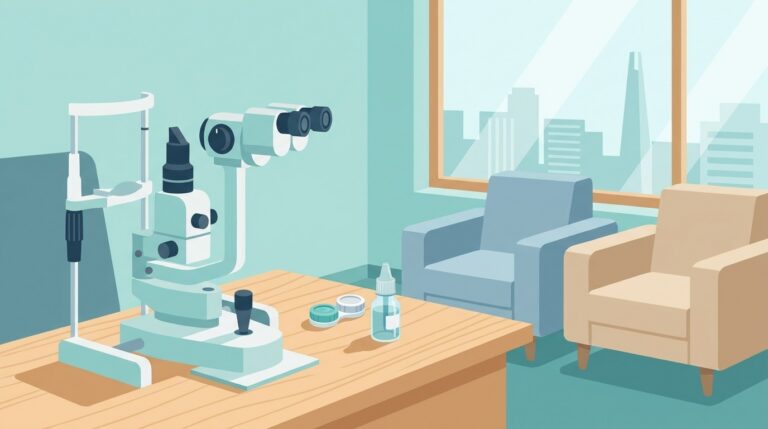
When arriving at a Korean clinic (안과 – Angwa), never vigorously rub your eyes in the waiting room—it alarms the medical staff! Instead, close your eyes gently or use a tissue to dab excess tears. When the doctor examines your eyes under the slit lamp microscope, rest your chin and forehead firmly against the bars without pulling away. If you are currently wearing contact lenses, notify the nurse before entering the consultation room so they can provide you with saline solution and a lens case (렌즈통).
4-2. Culture Code: Korea’s Contact Lens Craze
Korea leads global trends in circle lenses and cosmetic eye-styling, popularized by K-pop idols. Brands like Olens and Lens-Me have boutiques on every shopping avenue. However, Korea’s hyper-dry winter heating systems (ondol and overhead hot-air blowers) combined with 12-hour contact lens use make dry eye syndrome (안구건조증) an everyday national struggle. You are definitely not alone!
Phase 5: Real-Life Roleplay Scenario
Setting: Clean, modern eye clinic near Sinchon Station. Friendly nurse Min-ji is at the reception counter, and Dr. Park sits in the examination room.
- Turn 1 (Receptionist Min-ji): 어서 오세요. 어디가 불편하세요? (Eo-seo o-se-yo. Eo-di-ga bul-pyeon-ha-se-yo?)
🎭 Smiling warmly behind the desk.(Welcome! What brings you in today?) - Turn 2 (You): 렌즈를 오래 꼈더니 눈이 너무 뻑뻑해요. (Ren-jeu-reul o-rae kkeot-deo-ni nun-i neo-mu ppeok-ppeok-hae-yo.)
🎭 Blinking uncomfortably and pointing near eyes.(I wore contacts for too long, and my eyes feel so gritty.) - Turn 3 (Receptionist Min-ji): 지금도 렌즈 끼고 계세요? (Ji-geum-do ren-jeu kki-go gye-se-yo?)
🎭 Handing you a small sterile tray.(Are you still wearing your lenses right now?) - Turn 4 (You): 네, 아직 끼고 있어요. (Ne, a-jik kki-go it-seo-yo.)
🎭 Nodding apologetically.(Yes, I’m still wearing them.) - Turn 5 (Doctor Park): 이쪽에 턱 올려주세요. 렌즈 때문에 결막이 좀 부었네요. (I-jjok-e teok ol-lyeo-ju-se-yo. Ren-jeu ttae-mun-e gyeol-mag-i jom bu-eot-ne-yo.)
🎭 Adjusting the slit-lamp light.(Please rest your chin here. Your conjunctiva is slightly swollen from the lenses.) - Turn 6 (You): 많이 심한가요? (Man-i sim-han-ga-yo?)
🎭 Asking with a slightly concerned look.(Is it very serious?) - Turn 7 (Doctor Park): 며칠 쉬면 괜찮아요. 인공눈물 처방해 드릴게요. (Myeo-chil swi-myeon gwaen-chan-a-yo. In-gong-nun-mul cheo-bang-hae deu-ril-ge-yo.)
🎭 Typing notes into the computer.(It will be fine with a few days of rest. I will prescribe artificial tears.) - Turn 8 (You): 네, 감사합니다! (Ne, gam-sa-ham-ni-da!)
🎭 Bowing head slightly with relief.(Yes, thank you!)
🔀 Interactive Choice Point: When the doctor asks if you will wear lenses tomorrow:
- Option A: “당분간 안경 쓸게요.” (Dang-bun-gan an-gyeong sseul-ge-yo. / I’ll wear glasses for the time being.)
- Feedback: [BEST] 🌟 The doctor will smile in relief! Shows you understand resting your cornea.
- Option B: “내일 콘서트 가야 해서 렌즈 낄래요!” (Nae-il kon-seo-teu ga-ya hae-seo ren-jeu kkil-lae-yo! / I have a concert tomorrow so I will wear lenses!)
- Feedback: [RISK] ⚠️ The doctor will strongly lecture you against corneal ulcers!
- Option C: “안 아파요!” (An a-pa-yo! / It doesn’t hurt!)
- Feedback: [BAD] 🚫 Dismissive and confuses the doctor after you just complained of grittiness.
Phase 6: 10-Second Emotional Shadowing Drill
[🥺 지치고 아프게 - Weary and in discomfort]
렌즈를 / 너무 오래 꼈더니 / 눈이 뻑뻑해요.
(Ren-jeu-reul / neo-mu o-rae kkeot-deo-ni / nun-i ppeok-ppeok-hae-yo.)-
[🩺 정중하고 조심스럽게 - Polite and cautious]
일회용 / 인공눈물로 / 처방해 주세요.
(Il-hoe-yong / in-gong-nun-mul-ro / cheo-bang-hae ju-se-yo.) -
[😊 안도하며 감사하게 - Relieved and appreciative]
당분간 / 안경 끼고 다닐게요. / 감사합니다!
(Dang-bun-gan / an-gyeong kki-go da-nil-ge-yo. / Gam-sa-ham-ni-da!)
Phase 7: K-Culture Mini Dictionary
- 안구건조증 (An-gu-geon-jo-jeung) | Dry Eye Syndrome
- Usage: The standard medical term written on receipts and clinic charts throughout Korea.
- 인공눈물 (In-gong-nun-mul) | Artificial Tears
- Usage: Essential daily purchase. Available in small single-use vials (일회용) or multi-use bottles.
- 렌즈통 (Ren-jeu-tong) | Contact Lens Case
- Usage: When clinics ask you to remove lenses before an exam, ask: “렌즈통 있어요?” (Do you have a lens case?).
- 처방전 (Cheo-bang-jeon) | Medical Prescription Slip
- Usage: Hand this slip directly to the adjacent pharmacy (약국) right after paying your clinic fee.
Phase 8: Traveler’s Survival Kit
Survival Expressions TOP 3
- “렌즈 빼야 하나요?” (Ren-jeu ppae-ya ha-na-yo?)
- Meaning: Do I need to take out my contact lenses?
- Pro Tip: Always ask this right before stepping in to see the doctor.
- “일회용으로 처방해 주세요.” (Il-hoe-yong-eu-ro cheo-bang-hae ju-se-yo.)
- Meaning: Please prescribe them in single-use packets.
- Pro Tip: Single-use vials are preservative-free and super portable for travel bags.
- “진료비 영수증 끊어 주세요.” (Jin-ryo-bi yeong-su-jeung kkeun-eo ju-se-yo.)
- Meaning: Please give me an itemized medical receipt.
- Pro Tip: Necessary for claiming refunds from travel insurance back home!
Editor’s Travel Note
Most Korean clinics operate on a walk-in basis! Simply open the 네이버 지도 앱 다운로드 (Naver Map app), search “안과” (Angwa), pick a clinic nearby, and walk straight to the reception desk (접수처). Korean clinics are incredibly fast; you will usually see a specialist within 15 to 20 minutes, pay around 10,000–15,000 KRW for consultation without Korean National Health Insurance, and find the dispensing pharmacy located in the very same building.
Phase 9: “One Step Deeper” (Reflective Prompt)
In Korean culture, caring for physical discomfort is deeply tied to mutual consideration. Rather than using cold, distant clinical jargon, native speakers use intuitive texture words like “뻑뻑하다” (gritty/stiff) or “촉촉하다” (moist/dewy). Sharing these physical sensations with your doctor or friends invites warmth, care, and immediate empathy (Jeong).
💬 Your Turn: How does your native language describe eye dryness? Do you use a medical term like “dry eyes,” or do you have a sensory idiom like “sand in the eyes”? Share your language’s phrase in the comments below!
Phase 10: FAQ & Avoiding Misunderstandings
Q: Can I visit an eye clinic in Korea without an appointment?
A: Yes! Most Korean neighborhood eye clinics (안과 의원) welcome walk-in patients. Simply bring your physical passport or Alien Registration Card (ARC), register at the front desk, and wait for your name to be called.
Q: Why should I go to an eye clinic instead of just buying drops at a pharmacy?
A: Pharmacists in Korea can only sell general over-the-counter soothing drops. A certified ophthalmologist can inspect your cornea for dangerous scratches caused by dry contacts and prescribe specialized hyaluronic acid drops at a fraction of the cost.
Q: What if I don’t speak enough Korean to explain complex symptoms?
A: Stick to the golden pattern: “[Body part] + 이/가 + [Symptom]”. Saying “눈이 뻑뻑해요” (My eyes are gritty) and pointing is 100% understood by every medical professional in the country.
🚨 Common Mistakes Alert
- Mistake: Saying “렌즈를 입었어요” (I wore lenses).
- Correct Action: Use “꼈어요” (kkeo-sseo-yo). Lenses fit snugly, so the verb is always 끼다.
- Mistake: Throwing away the pharmacy paper receipt before claiming insurance.
- Correct Action: Keep both the clinic receipt (진료비 영수증) and pharmacy receipt (약제비 영수증) for international travel insurance claims.
- Mistake: Wearing cosmetic lenses back into the clinic for your follow-up exam.
- Correct Action: Wear your glasses (안경) so the doctor can evaluate your healing cornea clearly.
Phase 11: Action Mission & Engagement
- 🥉 Bronze Level: Stand before a mirror, practice blinking tiredly, and say “눈이 뻑뻑해요” out loud 3 times with realistic feeling.
- 🥈 Silver Level: Screenshot your favorite K-pop idol wearing colored lenses, and write a caption in your Korean study notes: “렌즈를 오래 꼈더니 눈이 뻑뻑해요!”
- 🥇 Gold Level: Visit an eye clinic or walk into a Korean pharmacy (약국) and order single-use artificial tears using “인공눈물 주세요!”
- 🎮 K-Culture Mission: Look out for eye drop endorsements by famous K-drama actors on subway screen doors across Seoul, and notice if the word “촉촉” (hydrated) or “뻑뻑” (gritty) appears!
Phase 12: Interactive Quiz Challenge
- Situational Judgment: You have worn circle lenses for 10 hours at a music festival and your eyes sting with dryness. Which phrase should you say to the pharmacist?
- A) 배가 아파요. (Bae-ga a-pa-yo.)
- B) 눈이 뻑뻑해서 인공눈물 주세요. (Nun-i ppeok-ppeok-hae-seo in-gong-nun-mul ju-se-yo.)
- C) 안경을 사고 싶어요. (An-gyeong-eul sa-go sip-eo-yo.)
- Fill in the Blank: Complete the natural expression:
- “렌즈를 너무 오래 ______ 눈이 아파요.” (Because I wore lenses too long, my eyes hurt.)
- Hint: The verb for putting on lenses in past tense connective form.
- True / False: In Korea, you must always make an eye clinic appointment weeks in advance via telephone.
Click here for answers and explanations!
- Answer: B. “눈이 뻑뻑해서 인공눈물 주세요.” clearly explains that your eyes feel gritty and you need artificial tears. (A means stomach ache, C means wanting to buy glasses).
- Answer: 꼈더니 (or 껴서). “렌즈를 너무 오래 꼈더니/껴서 눈이 아파요.” 끼다 is the essential verb for lenses.
- Answer: False. Neighborhood Korean clinics are famous for seamless walk-in service! Just walk in with your identification.







