

Phase 1: Empathy & Story Opening
안녕하세요! 매일한글 에디터입니다. (Hello! It’s your Daily Hangul editor here.)
Picture this: You are exploring Seoul, rushing down the steep stairs of Hongik University Station to catch the Line 2 green subway train after a delicious dinner of Korean pork belly. The cheerful departure chimes begin to play, you take a hurried step, and suddenly—crunch. Your sneaker catches the edge of a step, your ankle rolls inward with all your body weight, and a sharp burst of pain shoots straight up your leg. You collapse onto the landing, holding your ankle while commuters stream past.
You have probably seen this dramatic scene in countless K-dramas, where the romantic lead suddenly appears to lift the protagonist and carry them to safety. But back in reality, you are sitting alone on a Seoul subway landing, your right ankle swelling by the second, wondering: Where do I go, and how on earth do I explain this in Korean?
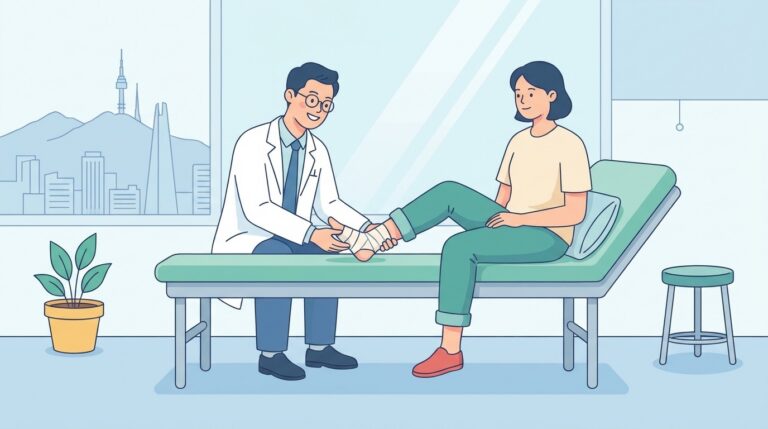
Don’t worry! Medical care in Korea is fast, high-tech, and incredibly accessible—even for travelers. In this lesson, designed from real classroom feedback from dozens of our expat learners, you will master the exact phrases you need to walk (or hop!) into a Korean neighborhood orthopedic clinic (정형외과), explain your stair mishap clearly, and get soothing physical therapy without breaking a sweat.
Phase 2: 3 Key Expressions Deep Dive
1. 계단 내려오다가 발을 헛디뎠어요 (Gedan naeryeoodaga bareul heotdideyeosseoyo)
- Pronunciation: [Gye-dan nae-ryeo-o-da-ga ba-reul heot-di-dyeo-sseo-yo] (Sound tip: ‘heot-di’ sounds like the American football shout ‘hut!’ combined with ‘deep’ without the p: ‘hut-dee’.)
- Meaning: Literal: “While coming down the stairs, I mis-stepped with my foot.” / Actual: “I missed a step walking down the stairs.”
- K-Culture Moment: The staple trigger of every drama meet-cute! In Crash Landing on You or Business Proposal, a missed step on stairs or high heels creates an instant dramatic crisis.
- Editor’s Insight: The prefix 헛- (heot-) means “in vain” or “empty.” Combining it with 디디다 (didida – to step) creates 헛디디다 (to step into empty air / to lose one’s footing). Using ~다가 (-daga) naturally shows that an unexpected interruption occurred in the middle of walking down.
- Situation Spectrum: Casual: ⚠️ (Use 헛디뎠어 with close peers) | Semi-formal: ✅ (Perfect for the clinic doctor) | Formal: ✅ (계단 내려오다가 발을 헛디뎠습니다)
- 🤔 Think About It: English speakers usually say “I tripped” or “I fell,” focusing on the fall itself. Korean speakers pinpoint the precise mechanics of the foot movement (stepping on empty air). How does this change the way you describe physical accidents?
2. 오른쪽 발목을 접질렸어요 (Oreunjjok balmogeul jeopjillyeosseoyo)
- Pronunciation: [O-reun-jjok bal-mo-geul jeop-jil-lyeo-sseo-yo] (Sound tip: ‘jeop’ sounds like the start of ‘jeopardy’, and ‘jil-lyeo’ sounds like ‘jill-yuh’.)
- Meaning: Literal: “I folded/sprained my right ankle.” / Actual: “I sprained / twisted my right ankle.”
- K-Culture Moment: Seen often in K-pop reality training shows when idols roll their ankles on dance studio floors during intense rehearsals and immediately yell out in pain.
- Editor’s Insight: While textbook terms like 염좌 (yeomjwa – medical sprain) exist, real Koreans almost exclusively say 발목을 접질리다 (balmogeul jeopjillida – to twist/sprain an ankle) or 발목을 삐다 (balmogeul ppida – to turn an ankle). 접질리다 sounds more descriptive of a sharp, bending sprain.
- Situation Spectrum: Casual: ⚠️ (접질렸어) | Semi-formal: ✅ (접질렸어요) | Formal: ✅ (접질렸습니다)
- 🤔 Think About It: 접- (jeop-) comes from the verb 접다 (to fold). Koreans conceptualize a sprain as an ankle being forcibly “folded” under the foot. Does your language visualize sprains as stretching, twisting, or folding?
3. 디딜 때마다 찌릿찌릿 아파요 (Didil ttaemada jjiritjjirit apayo)
- Pronunciation: [Di-dil ttae-ma-da jji-rit-jji-rit a-pa-yo] (Sound tip: ‘jjirit’ has a tense ‘jj’ sound like the sizzle of meat hitting a hot grill: ‘jjee-rit’.)
- Meaning: Literal: “Whenever I step, it hurts electric-tinglingly.” / Actual: “Every time I put weight on it, I feel a sharp, shooting pain.”
- K-Culture Moment: Korean variety shows love using the onomatopoeia 찌릿찌릿 (jjirit-jjirit) with cartoon lightning bolt graphics whenever someone gets shocked or feels sudden nerve pain.
- Editor’s Insight: Korean has hundreds of rich sensory words (의성어/의태어). 찌릿찌릿 describes an electric, shooting, nerve-twinging sensation. Saying this to a doctor instantly tells them you might have acute ligament distress rather than dull muscle ache.
- Situation Spectrum: Casual: ⚠️ (디딜 때마다 찌릿찌릿 아파) | Semi-formal: ✅ (디딜 때마다 찌릿찌릿 아파요) | Formal: ✅ (디딜 때마다 찌릿찌릿 아픕니다)
- 🤔 Think About It: English uses adjectives like “sharp” or “stabbing,” while Korean frequently relies on repetitive mimetic words like 찌릿찌릿 (electric shooting) or 욱신욱신 (throbbing). Which feels more visceral to you?
Phase 3: Textbook Korean vs. Real Korean
Situation 1: Describing the accident at the reception desk
- 📖 교과서 한국어 (Textbook Korean): 발목에 급성 염좌가 발생했습니다. (Balmoge geupseong yeomjwaga balsaenghaessseumnida.) – “An acute sprain has occurred in my ankle.”
- 🗣️ 진짜 한국어 (Real Korean): 발목을 삐어서 걸을 수가 없어요. (Balmogeul ppieoseo georeul suga eopseoyo.) – “I sprained my ankle and I can barely walk.”
- 💡 왜 다를까? (Why is it different?): 염좌 (yeomjwa) is a formal Sino-Korean clinical diagnosis written on doctor charts. Real patients simply use the native Korean verb 삐다 (ppida) or 접질리다 (jeopjillida), followed by their immediate practical handicap (cannot walk).
Situation 2: Asking for Physical Therapy
- 📖 교과서 한국어 (Textbook Korean): 물리치료 처방을 요구합니다. (Mullichiryo cheobangeul yoguhamnida.) – “I demand a prescription for physical therapy.”
- 🗣️ 진짜 한국어 (Real Korean): 오늘 물리치료도 같이 받을 수 있나요? (Oneul mullichiryodo gachi badeul su innayo?) – “Can I also get physical therapy done today?”
- 💡 왜 다를까? (Why is it different?): In Korean clinics, demanding (요구) sounds confrontational. Koreans ask politely with “~수 있나요?” (Can I…?), softening the request while still clearly signaling they want hot packs and electric stimulation.
Phase 4: K-Culture Deep Dive & Non-Verbal Manners
4-1. 눈치 (Nunchi) & Clinic Etiquette
When entering an orthopedic clinic (정형외과) in Korea:
1. The Slipper Swap: Look at the clinic entrance or physical therapy room. If you see rows of sterilized plastic slippers inside a shoe cabinet (신발장), slip off your outdoor shoes and slide into the slippers. If your foot hurts too much, inform the staff immediately.
2. Point With an Open Hand: When the doctor asks where it hurts, avoid pointing aggressively with a single finger right into your joint. Use an open palm or gently touch the outer ankle bone (복사뼈 / boksa-ppyeo) while explaining.
3. Roll Up Your Pant Leg First: Before sitting on the examination bed, politely pull your pant leg up past the calf so the doctor can immediately inspect both ankles for asymmetry and swelling.
4-2. The Korean Orthopedic Culture
In Western countries, seeing a specialist for a sprained ankle can take days, requiring GP referrals and expensive co-pays. In Korea, you can simply walk into any local neighborhood 정형외과 (Orthopedic Clinic) without an appointment!
Within 20 minutes, you will get registered, receive an X-ray to check for fractures, have an ultrasound scan, and head down the hall to the 물리치료실 (Physical Therapy Room). There, an assistant will wrap your ankle in warm clay packs, hook up electric frequency pads (TENS), and maybe give you a 반깁스 (ban-gipseu)—a lightweight removable splint secured with velcro. It is fast, efficient, and remarkably soothing!
Phase 5: Real-World Roleplay Scenario
Setting: Seoul Gangnam Orthopedic Clinic (강남정형외과). Alex walks in limping, leaning on the examination bed. Dr. Park sits facing the computer with an open X-ray monitor.
- 의사 (Doctor): 어서 오세요. 어디가 불편해서 오셨어요? (Eoseo oseyo. Eodiga bulpyeonhaeseo osyeosseoyo?) – “Welcome. What seems to be the problem today?”
- 알렉스 (Alex):
🎭 Grimacing slightly, pointing to his swollen right foot계단 내려오다가 발을 헛디뎌서 오른쪽 발목을 접질렸어요. (Gedan naeryeoodaga bareul heotdideyeosseoyo oreunjjok balmogeul jeopjillyeosseoyo.) – “I missed a step walking down the stairs and sprained my right ankle.” - 의사 (Doctor): 아이고, 많이 부었네요. 언제 다치셨어요? (Aigo, mani bueonneyo. Eonje dachisyeosseoyo?) – “Oh dear, it’s quite swollen. When did you hurt it?”
- 알렉스 (Alex): 오늘 아침 출근길에요. 디딜 때마다 찌릿찌릿 아파요. (Oneul achim chulgeun-gireyo. Didil ttaemada jjiritjjirit apayo.) – “This morning on my way to work. Every time I step on it, I feel a shooting pain.”
- 의사 (Doctor):
🎭 Gently pressing the outer bone of the ankle여기가 제일 아프신가요? (Yeogiga jeil apeusingayo?) – “Does it hurt most right here?” - 알렉스 (Alex):
🎭 Flinching instinctively네! 거기를 누르면 너무 아파요. (Ne! Geogireul nureumyeon neomu apayo.) – “Yes! If you press there, it hurts so much.” - 의사 (Doctor): 뼈에 이상이 있는지 엑스레이 먼저 찍어볼게요. 저쪽 촬영실로 가실게요. (Ppyeoe isangi inneunji ekseurei meonje jjigeobolgeyo. Jeojjjok chwallyeongsil-lo gasilgeyo.) – “Let’s take an X-ray first to check the bones. Please head over to the imaging room.”
- 알렉스 (Alex):
🎭 Bowing politely while standing up carefully네, 알겠습니다. 감사합니다. (Ne, algessseumnida. Gamsahamnida.) – “Yes, understood. Thank you.”
🔀 Interactive Decision Branch
What should Alex say after the X-ray confirms no broken bones, but the doctor recommends rest and treatments?
- Option A: 물리치료 받고 약 처방해 주세요. (Mullichiryo batgo yak cheobanghae juseyo.)
- Option B: 오늘 물리치료 받고 반깁스도 해야 하나요? (Oneul mullichiryo batgo ban-gipseudo haeya hanayo?)
- Option C: 뼈 안 부러졌으니까 그냥 운동하러 갈게요. (Ppyeo an bureojyeosseunikka geunyang undonghareo galgeyo.)
Feedback:
* Option A (Best): Polite, clear, and gets you right into the recovery process with therapy and anti-inflammatory pills.
* Option B (Safe & Smart): Asking proactively about a removable splint (반깁스) shows you understand recovery steps; the doctor will assess ligament stability.
* Option C (Risk – Bad Idea!): Sprains stretch delicate ligaments. Telling a Korean doctor you’ll jump straight into a workout after rolling your ankle will earn you an instant scolding!
Phase 6: 10-Second Emotion Shadowing Drill
Practice these natural clinic sentences using the pause slashes / and emotional milestones:
[😣 Painful & winced tone]계단 내려오다가 / 발을 헛디뎌서 / 발목을 접질렸어요. (Gedan naeryeoodaga / bareul heotdideyeoseo / balmogeul jeopjillyeosseoyo.)[⚡ Sharp flinch & grimace]디딜 때마다 / 찌릿찌릿 / 너무 아파요! (Didil ttaemada / jjiritjjirit / neomu apayo!)[🥺 Relieved & inquiring tone]혹시 뼈에 / 금이 갔나요? (Hoksi ppyeoe / geumi gannayo?) – “Did the bone get a hairline fracture?”[🙏 Grateful & cooperative]오늘 물리치료 / 바로 받을 수 있나요? (Oneul mullichiryo / baro badeul su innayo?)
Phase 7: K-Culture Mini Dictionary
- 정형외과 (Jeong-hyeong-oe-gwa) | Orthopedic Clinic
Everyday Usage: The first place Koreans sprint (or hobble) to whenever they pull a muscle, twist an ankle, or experience chronic neck and back pain from desk jobs. - 반깁스 (Ban-gip-seu) | Removable Half-Cast / Splint
Everyday Usage: Unlike a full fiberglass cast (통깁스), a 반깁스 is open on one side and secured with velcro straps so you can take it off to shower and sleep. - 물리치료 (Mul-li-chi-ryo) | Physical Therapy
Everyday Usage: Standard clinic aftercare in Korea that bundles hot packs (온찜질), transcutaneous electrical stimulation (전기치료), and ultrasound healing. - 파스 (Pa-seu) | Medicated Pain Relief Patch
Everyday Usage: Transdermal patches found at every Korean pharmacy and convenience store. The quintessential Korean self-care remedy for aches and strains.
Phase 8: Traveler’s Survival Kit
Top 3 Survival Phrases
- 발목을 삐었어요. (Balmogeul ppieosseoyo.) – “I sprained my ankle.” (Pro Tip: The shortest, most foolproof sentence to say the second you step into the clinic lobby).
- 냉찜질 해 주세요. (Naeng-jjimjil hae juseyo.) – “Please provide an ice pack / cold compress.” (Pro Tip: In the first 48 hours of an acute sprain, cold therapy prevents severe swelling).
- 처방전 어디로 가져가요? (Cheobangjeon eodiro gajyeogayo?) – “Where do I take the prescription?” (Pro Tip: Korean clinics do not dispense pills on-site; you hand the paper to the pharmacy right next door).
Editor’s Travel Note
- Clinic Finder: If you twist your ankle, open the Naver Map app download and search “정형외과” (Orthopedics). Look for clinics with high star reviews and walk straight in.
- Payment & Insurance: You do not need National Health Insurance (NHIS) to be treated. Foreign travelers without Korean insurance usually pay around 30,000 to 60,000 KRW (approx. $25–$45 USD) for a consultation, X-rays, and physical therapy combined! Keep the receipt (영수증) and medical certificate (진단서) for your travel insurance claim back home.
Phase 9: 한 발 더 깊이 (Cultural Reflection)
In many Western cultures, a simple twisted ankle is managed at home with ice, elevation, and over-the-counter painkillers. In Korea, however, stepping into a neighborhood clinic (정형외과) is viewed as an immediate, proactive act of self-care. Korean healthcare reflects the fast-paced, community-centered mindset known as Palli-Palli (Hurry-Hurry) paired with high clinical accessibility. Rather than waiting to see if an injury worsens, locals prefer instant reassurance through quick imaging and physical therapy. Taking care of your body swiftly is seen as a duty to keep your work and social life moving harmoniously.
💬 Your Turn: Have you ever injured yourself while traveling abroad? How does visiting a doctor in Korea compare to your home country’s healthcare system? Drop your thoughts below!
Phase 10: FAQ & Common Mistakes
Q: Do I need to book an appointment beforehand at a Korean orthopedic clinic?
A: No! The vast majority of local neighborhood clinics (의원/정형외과) operate on a walk-in basis. Just take a number or present your passport at the counter between 9:00 AM and 6:30 PM on weekdays.
Q: Will Korean doctors speak English?
A: Most Korean medical professionals studied English medical terminology extensively in school. Even if their conversational English is modest, they understand terms like X-ray, ligament, sprain, and painkiller immediately.
Q: Can I buy crutches (목발) at the clinic?
A: Yes! If your sprain is severe, ask: “목발 구매할 수 있나요?” (Mokbal gumaehal su innayo? / Can I purchase crutches?). They will fit them for you on the spot.
🚨 Common Mistakes Alert
- Mistake: Going to a large university hospital (대학병원) for a simple sprain.
Correct Action: Big general hospitals require long emergency room waits and huge non-referral fees. Always head to a local neighborhood 정형외과 (Clinic) first. - Mistake: Saying “다리가 부러졌어요” (My leg is broken) when you only sprained your ankle.
Correct Action: 부러지다 means fractured/snapped. If you aren’t sure, stick to: “발목을 심하게 접질렸어요” (I twisted my ankle severely). - Mistake: Putting a hot pack on a freshly swollen ankle.
Correct Action: For the first 24–48 hours, ask for cold therapy (냉찜질 / naeng-jjimjil) to calm acute swelling.
Phase 11: Action Missions
- 🥉 Bronze Mission (Solo Practice): Stand in front of a mirror, gently point to your ankle, and say out loud three times with feeling: “계단 내려오다가 발목을 접질렸어요!”
- 🥈 Silver Mission (Community Share): Write down your preferred treatment phrase (e.g., 물리치료 받고 싶어요) in your study journal or share it in an Instagram story tagging @DailyHangul.
- 🥇 Gold Mission (Real-life Execution): Walk past a local Korean pharmacy or clinic on your next trip, spot the green cross or “정형외과” sign, and read the letters out loud with confidence!
🎮 K-Culture Mission: Watch an episode of a high-energy K-pop dance show (like Street Woman Fighter) or a sports variety show (like Shooting Stars). Listen closely for the moments when athletes point to an ice pack and say “냉찜질” or talk about “발목 부상” (ankle injury)!
Phase 12: Interactive Quiz Challenge
Test your clinic communication skills! Check your answers below.
Question 1: Situational Judgment
You missed a step coming out of a cafe and your ankle is throbbing. You arrive at the reception desk. What is the most natural sentence to explain what happened?
* (A) 계단에서 발목 수술을 해주세요. (Please perform ankle surgery on the stairs.)
* (B) 계단 내려오다가 발을 헛디뎌서 발목을 접질렸어요. (I missed a step coming down the stairs and sprained my ankle.)
* (C) 계단에서 발을 디뎠기 때문에 기분이 아주 좋아요. (Because I stepped on the stairs, I feel very great.)
Question 2: Fill-in-the-Blank
Every time you put weight on your foot, you feel an electric, stinging pain. Complete the sentence:
“발을 디딜 때마다 ____________ 아파요.”
* (A) 반짝반짝 (Bling-bling)
* (B) 찌릿찌릿 (Electric / shooting)
* (C) 덜컹덜컹 (Rattling)
Question 3: True or False (Culture Check)
In Korea, you must always schedule an appointment two weeks in advance with a primary care physician before you are permitted to visit a neighborhood orthopedic clinic.
* (True / False)
👉 Click to reveal answers & explanations!
- Q1 Answer: (B)
Explanation: (B) accurately explains the cause (헛디뎌서 – mis-stepping) and the condition (접질렸어요 – twisted/sprained). (A) asks for surgery immediately, and (C) absurdly claims you feel fantastic! - Q2 Answer: (B) 찌릿찌릿
Explanation: 찌릿찌릿 is the iconic Korean onomatopoeia for shooting, tingling nerve or ligament pain. 반짝반짝 means twinkling, and 덜컹덜컹 means clattering or rattling. - Q3 Answer: False
Explanation: Korea boasts remarkable walk-in access! You can simply walk into any local neighborhood 정형외과 during operating hours and see a specialist within minutes without a prior referral.






