

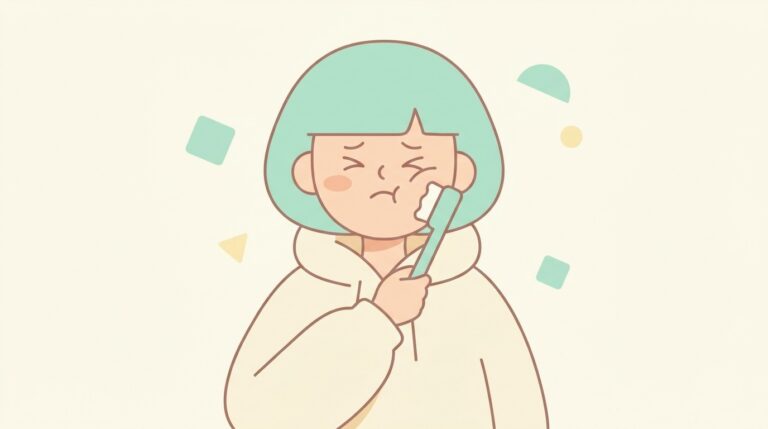
When Brushing Hurts: How to Talk About Sensitive Teeth in Korea
Phase 1: Empathy (Real-Life Seoul Clinic Opening)
안녕하세요! 매일한글 에디터입니다. (Hello! This is your Daily Hangul editor.)
Picture this: you are having the dream vacation in Seoul. After a delicious bowl of piping hot Kimchi Jjigae in Ikseon-dong, you grab an ‘Ah-Ah’ (아이스 아메리카노 – Iced Americano) like a true local. But the moment you head back to your hotel, grab your toothbrush, and rinse with cold tap water—ZING! A lightning bolt of cold pain shoots straight through your molars. You clasp your jaw, staring in the mirror, wondering: How on earth do I say ‘sensitive teeth’ in Korean?
If you try looking up “sensitive” in a standard dictionary app, you might end up with words like 민감해요 (mingamhaeyo), which Koreans use for emotional personality or sensitive skin—not teeth! At our tutoring desk at Daily Hangul, this exact scenario comes up every single season. Foreign travelers and students find themselves stranded at a local pharmacy or dental clinic, frantically miming brushing motions with tears in their eyes.
Don’t worry, my friend. By the end of this guide, you will master the exact beginner-friendly phrases native speakers use to describe sensitive teeth, buy the right soothing toothpaste at Olive Young or the neighborhood pharmacy, and navigate a dental desk with zero stress. Let’s dive in!
Phase 2: Top 3 Core Expressions
1. 이가 시려요 (I-ga siryeoyo)
- Pronunciation: [I-ga si-ryeo-yo] (Sounds like: “Ee-gah she-ryuh-yo” — rhyme ‘she’ with ‘ship’, and ‘ryuh’ with ‘run’)
- Meaning: Literal: “Teeth are cold/chilled” vs. Real Nuance: “My teeth feel sensitive / ache from cold.”
- K-Culture Moment: Seen in countless Korean variety shows when cast members binge-eat icy shaved ice (빙수 – Bingsoo) during winter penalty games and instantly clutch their cheeks in hilarious agony.
- Editor’s Insight: English speakers think of sensitivity as “reactive nerves.” Koreans think of sensitivity as a sensation of icy chill invading the bone. The verb 시리다 (sirida) specifically describes that shivering, cold ache. If you say 이가 아파요 (I-ga apayo), the dentist thinks you have a cavity. If you say 이가 시려요 (I-ga siryeoyo), they know it is cold enamel sensitivity!
- Situation Spectrum:
- Casual (Friends): 이 시려 (I siryeo) ✅
- Semi-Formal (Daily default / Clinic staff): 이가 시려요 (I-ga siryeoyo) ✅
- Formal (Official consultation): 치아가 시립니다 (Chia-ga sirimnida) ✅
- 🤔 Think About It: Does your native tongue have a dedicated, single verb for pain caused specifically by cold temperatures, or do you rely on adjectives like “cold” and “sensitive”?
2. 이를 닦아요 (I-reul dakk-ayo)
- Pronunciation: [I-reul dak-ka-yo] (Sounds like: “Ee-reul dahk-kah-yo” — ‘dahk’ rhymes with ‘lock’)
- Meaning: Literal: “Wipe/polish teeth” vs. Real Nuance: “I brush my teeth.”
- K-Culture Moment: The iconic cute phrase 치카치카 (chika-chika) comes from the sound of brushing in children’s songs and K-Dramas, but grown adults use 이를 닦아요 (I-reul dakk-ayo) when speaking naturally.
- Editor’s Insight: In English, we focus on the tool (“brushing”). In Korean, the verb 닦다 (dakkda) means to wipe, buff, or shine clean. When you say 이를 닦을 때 (i-reul dakk-eul ttae), it means “when I brush my teeth.”
- Situation Spectrum:
- Casual: 이 닦아 (I dakka) ✅
- Semi-Formal: 이를 닦아요 (I-reul dakk-ayo) ✅
- Formal: 양치질을 합니다 (Yangchijireul hamnida) ✅
- 🤔 Think About It: Why do you think Korean emphasizes the outcome (cleaning/polishing) over the physical tool (the brush)?
3. 치과에 가야 해요 (Chigwa-e gaya haeyo)
- Pronunciation: [Chi-gwa-e ga-ya hae-yo] (Sounds like: “Chee-gwah-eh gah-yah hae-yo”)
- Meaning: Literal: “Must go to tooth department” vs. Real Nuance: “I need to visit the dentist.”
- K-Culture Moment: Whenever a character in a K-Drama eats sticky traditional taffy (엿 – Yeot) and suddenly loses a dental crown, this is the very first line they utter with a wide-eyed look of dread!
- Editor’s Insight: In Western countries, people often say “I’m going to the doctor/dentist” (the person). In Korea, you almost always mention the specialized place: 치과 (chigwa = dental clinic), 안과 (angwa = eye clinic), 내과 (naegwa = internal medicine).
- Situation Spectrum:
- Casual: 치과 가야 해 (Chigwa gaya hae) ✅
- Semi-Formal: 치과에 가야 해요 (Chigwa-e gaya haeyo) ✅
- Formal: 치과에 내원해야 합니다 (Chigwa-e naewonhaeya hamnida) ✅
- 🤔 Think About It: How does naming the specialty clinic directly change how quickly patients can access medical care in Korea compared to your home country?
Phase 3: Textbook Korean vs. Real Korean
Situation 1: Describing Tooth Sensitivity at a Local Pharmacy
- 📖 교과서 한국어 (Textbook): 치통이 심해서 참기 힘듭니다. (Chitongi simhaeseo chamgi himdeumnida. / My dental neuralgia is severe and difficult to bear.)
- 🗣️ 진짜 한국어 (Real Life): 찬물 마실 때 이가 너무 찌릿하고 시려요. (Chanmul masil ttae i-ga neomu jjirit-hago siryeoyo. / When I drink cold water, my tooth zings and feels super sensitive.)
- 💡 왜 다를까? (Why the difference?): Nobody says 치통 (chitong – toothache) unless reciting a medical pamphlet. Real Koreans describe the tactile feeling: 찌릿하다 (jjirit-hada – zapping/tingling) and 시리다 (sirida – cold aching).
Situation 2: Buying Sensitive Toothpaste
- 📖 교과서 한국어 (Textbook): 지각과민 완화용 세폭제를 보여주십시오. (Jigak-gwamin wanhwayong sepokjereul boyeojusipsio. / Please present dentifrice designed for alleviating sensory hypersensitivity.)
- 🗣️ 진짜 한국어 (Real Life): 시린이 전용 치약 있어요? (Sirin-i jeonyong chiyak isseoyo? / Do you have toothpaste for sensitive teeth?)
- 💡 왜 다를까? (Why the difference?): Medical packaging uses the ultra-formal Sino-Korean word 지각과민 (hypersensitivity), but everyday shoppers and pharmacists simply say 시린이 (sirin-i), which literally means “chilled/sensitive tooth”!
Phase 4: K-Culture Deep Dive & Non-Verbal Manners
4-1. 눈치 (Nunchi) & Body Language
When expressing dental discomfort in Korea, do not wave your hands around or raise your voice. Instead, gently press the palm of your hand against your lower cheek, tilt your head slightly at a 15-degree angle, and squint with a light inward breath (similar to sucking air through your teeth). In Korean body language, this universal posture instantly signals toothache without you needing to explain a single complex sentence. At clinic reception desks, doing this while saying 이가 시려요 (I-ga siryeoyo) prompts instant recognition and immediate triage.
4-2. The Famous Korean “Lunchtime Toothbrushing Culture”
If you enter an office building, university campus, or co-working space in Seoul around 1:00 PM, you will witness an astonishing sight: lines of stylish men and women standing in front of the bathroom mirrors, vigorously brushing their teeth!
In Korea, brushing three times a day—especially within three minutes after eating lunch—is considered basic personal hygiene and consideration for colleagues. Koreans frequently carry a sleek toothbrush pouch equipped with a portable UV sterilizer. If your teeth feel sensitive, being prepared with specialized sensitive toothpaste (시린이 치약 – sirin-i chiyak) in your daytime bag will make you blend right in with the Seoul working crowd.
Phase 5: Real-World Roleplay Scenario
- Location: 서울 미소 치과 (Seoul Smile Dental Clinic) in Hongdae
- Characters:
- Alex (알렉스): An exchange student experiencing sharp sensitivity when brushing.
- Minji (민지): The warm and efficient clinic receptionist.
민지: 어서 오세요! 어디가 불편하세요?
(Eoseo oseyo! Eodiga bulpyeonhaseyo?)
"Welcome! What brings you in today?"
🎭 [Hands over a patient registration clip with a welcoming smile]

알렉스: 안녕하세요. 이를 닦을 때 이가 시려요.
(Annyeonghaseyo. I-reul dakk-eul ttae i-ga siryeoyo.)
"Hello. When I brush my teeth, my teeth feel sensitive."
🎭 [Gently presses one hand to the right cheek with an apologetic wince]

민지: 아, 시리시군요. 찬물 마실 때도 시려우세요?
(A, sirisigunyo. Chanmul masil ttae-do siryeouseyo?)
"Ah, sensitive. Does it also sting when you drink cold water?"
🎭 [Taps the chart with her pen and looks up with caring eyes]

알렉스: 네, 찬물 마실 때 찌릿해요.
(Ne, chanmul masil ttae jjirit-haeyo.)
"Yes, it zings with sharp cold when I drink cold water."
🎭 [Nods slowly while showing slight discomfort]

민지: 언제부터 그러셨어요?
(Eonjebuteo geureosyeosseoyo?)
"Since when has it been like this?"
🎭 [Hovers her pen over the medical history sheet]

알렉스: 3일 전부터요. 오른쪽 아래가 아파요.
(Sam-il jeonbuteoyo. Oreunjjok araega apayo.)
"Since three days ago. The lower right side hurts."
🎭 [Carefully points toward the lower right jawline with an index finger]

민지: 알겠습니다. 잠시 앉아 계시면 원장님이 바로 봐주실게요.
(Algetseumnida. Jamsi anja gyesimyeon wonjangnimi baro bwajusilgeyo.)
"Understood. If you take a seat for a moment, the head doctor will examine you shortly."
🎭 [Politely gestures toward the waiting lounge sofa with both hands]

알렉스: 네, 감사합니다!
(Ne, gamsahamnida!)
"Yes, thank you!"
🎭 [Bows head politely at 30 degrees and sits down]
🔀 Interactive Choice Point: How would you respond if the dentist asks if you want your sensitive tooth pulled?
- Choice A: “선생님, 너무 아파요. 그냥 당장 뽑아주세요!” (Doctor, it hurts too much. Just pull it out right now!)
- ⚠️ Risk Feedback: Extreme reaction! Sensitivity (시린 증상) is usually caused by enamel abrasion or gum recession, easily treated with resin or desensitizing agents. Asking for extraction will terrify the dentist!
- Choice B: “찬물 마실 때 특히 시려요. 시린이 전용 치약으로 먼저 관리해볼게요.” (It’s especially sensitive with cold water. I will try managing it with sensitive toothpaste first.)
- 🌟 Best Feedback: Perfectly reasoned! Demonstrates clear symptom communication and conservative dental care understanding.
- Choice C: “괜찮아요. 안 아파요.” (It’s fine. It doesn’t hurt.)
- 🚫 Bad Feedback: Denying the pain leaves the dentist confused after you just booked an urgent clinic visit!
Phase 6: 10-Second Emotion Shadowing Drill
Read these out loud, observing the slash marks (/) for natural breath pauses and matching the emotional cues!
[😣 인상을 찌푸리며 / Wincing in sharp sensitivity]
찬물 마실 때 / 이가 너무 시려요!
(Chanmul masil ttae / i-ga neomu siryeoyo!)
“When drinking cold water / my teeth sting so much!”-
[🤔 약국에서 조심스럽게 / Politely inquiring at a pharmacy]
시린이 전용 치약 / 어디에 있어요?
(Sirin-i jeonyong chiyak / eodie isseoyo?)
“Toothpaste for sensitive teeth / where is it?” -
[😌 진료 후 안도하며 / Relieved and bowing with gratitude]
이제 훨씬 덜 시려요, / 감사합니다!
(Ije hwolssin deol siryeoyo, / gamsahamnida!)
“Now it’s much less sensitive, / thank you so much!”
Phase 7: K-Culture Mini Dictionary
- 이 / 치아 (I / Chia)
- Meaning: Tooth / Teeth.
- Real-world usage: 이 (i) is native Korean used in everyday conversation (이 닦았어? = Did you brush your teeth?). 치아 (chia) is Sino-Korean, used in clinics and product descriptions (치아 건강 = dental health).
- 칫솔 (Chitsol)
- Meaning: Toothbrush.
- Real-world usage: Notice the middle “ㅅ” sound! At convenience stores, ask for 칫솔 (chitsol). Soft-bristled brushes are labeled 미세모 (misemo).
- 치약 (Chiyak)
- Meaning: Toothpaste.
- Real-world usage: Literally translates to “tooth medicine” (치 = tooth, 약 = medicine). In Korea, toothpaste is legally categorized as a quasi-drug (의약외품).
- 치과 (Chigwa)
- Meaning: Dental Clinic.
- Real-world usage: Look for building signs featuring a clean tooth icon or the letters 치과. You do not need to go to a giant general hospital; private neighborhood clinics are fast and world-class.
Phase 8: Traveler’s Survival Kit
Top 3 Survival Phrases
- 시린이 치약 주세요. (Sirin-i chiyak juseyo.)
- Meaning: Please give me sensitive teeth toothpaste.
- Pro Tip: Say this at any pharmacy (약국 – Yakguk) or Olive Young counter for instant help.
- 오른쪽 아래가 시려요. (Oreunjjok araega siryeoyo.)
- Meaning: The lower right side is sensitive.
- Pro Tip: Swap 왼쪽 (oenjjok – left) or 위 (wi – upper) to pinpoint the exact location!
- 진통제 있어요? (Jintongje isseoyo?)
- Meaning: Do you have painkillers?
- Pro Tip: If dental sensitivity turns into a persistent throbbing ache at night, this buys you time until clinics open in the morning.
Editor’s Travel Note: Finding Dental Care in Korea
If you ever experience emergency tooth pain while traveling, open your 네이버 지도 앱 다운로드 (Naver Map app) and search the keyword 치과 (dental clinic). Korean dental clinics welcome walk-ins (당일 접수 – dang-il jeopsu). Even without Korean National Health Insurance, an initial exam and X-ray typically cost around 20,000 to 45,000 KRW ($15 to $35 USD)—incredibly affordable compared to Western countries! Major credit cards are universally accepted.
Phase 9: A Step Deeper (한 발 더 깊이)
In the Korean linguistic mindset, physical pain is rarely categorized as a single uniform feeling. Korean boasts an exceptionally intricate vocabulary for bodily sensations. While English relies on “hurts” or “aches,” Korean distinguishes between 아프다 (apuda – general pain/soreness), 쑤시다 (ssusida – deep dull throb), 찌릿하다 (jjirit-hada – electric nerve sting), and 시리다 (sirida – cold, penetrating chill).
When you tell a Korean doctor 이가 시려요 (I-ga siryeoyo), you are tapping into centuries of language evolution dedicated to exact sensory perception. Understanding this distinction doesn’t just improve your grammar; it teaches you to listen to your body through a Korean lens.
💬 Your Turn: Does your native language make a strict distinction between “feeling cold” and “pain caused by cold”? Have you ever had an embarrassing moment describing aches abroad? Tell me in the comments below!
Phase 10: FAQ & Common Mistakes
Q: Can I walk into a Korean dental clinic without a prior reservation?
A: Yes, absolutely! Walk-in treatment is called 당일 진료 (dang-il jinryo). Just arrive at opening time (usually 9:30 AM or 10:00 AM), hand over your passport at the counter, and say: “예약 안 했는데 진료 받을 수 있어요?” (Yeyak an haenneunde jinryo badeul su isseoyo? / I don’t have a reservation, can I receive treatment?).
Q: What is the word for “gums” if the cold sensitivity is near the gumline?
A: The Korean word for gums is 잇몸 (inmom). You can say: “잇몸이 시려요” (Inmomi siryeoyo – My gums feel sensitive/cold) or “잇몸에서 피가 나요” (Inmom-eseo piga nayo – My gums are bleeding).
Q: Where can I buy sensitive toothpaste on a Sunday when pharmacies are closed?
A: Head to any convenience store (CU, GS25, 7-Eleven) or Olive Young. Look for international brands like Sensodyne (센소다인) or Korean dental brands like 2080 시린이 (2080 Sirin-i).
🚨 Common Mistakes Warning Board
- Mistake: Saying “이가 차가워요” (I-ga chagawoyo) to mean sensitive teeth.
- Why it’s wrong: 차갑다 (chagapda) means the object itself is physically cold, like an ice cube. It sounds like you are saying your tooth has turned into ice!
- Correct Action: Use 이가 시려요 (I-ga siryeoyo).
- Mistake: Confusing “이” (tooth) with “입” (mouth).
- Why it’s wrong: Saying “입이 시려요” means your entire mouth or lips feel freezing cold from winter wind.
- Correct Action: Keep it short: 이 (I = tooth) or 치아 (Chia).
- Mistake: Describing sensitive enamel as “민감해요” (mingamhaeyo).
- Why it’s wrong: While 민감하다 translates to “sensitive,” it is reserved for sensitive skin (민감성 피부) or emotional temperament.
- Correct Action: Always use 시리다 (sirida) for dental cold sensitivity.
Phase 11: Action Mission & Community Challenge
- 🥉 Bronze Mission (Solo Mastery): Stand in front of your bathroom mirror tonight. While brushing, practice saying: 이를 닦을 때 이가 시려요 (I-reul dakk-eul ttae i-ga siryeoyo) three times smoothly.
- 🥈 Silver Mission (Social Connection): Snap a photo of your toothbrush travel pouch and share it on Instagram or Threads with the caption: “My daily 필수템 (essential item) in Korea! 이 닦기 완료! ✨”
- 🥇 Gold Mission (Real-World Execution): Walk into an Olive Young or neighborhood pharmacy in Korea and ask the clerk: “시린이 치약 어디에 있어요?” (Sirin-i chiyak eodie isseoyo?). Locate the sensitive toothpaste section on your own!
- 🎮 K-Culture Mission: Watch any episode of a food variety show like Delicious Rendezvous or I Live Alone. Spot if any cast member winces from iced drinks and count how many seconds pass before someone mentions “시려!” (Siryeo!).
Phase 12: Interactive Quiz Challenge
Test your knowledge before you pack your dental kit!
Question 1: Situational Judgment
You are having bingsu with your Korean friend in Gangnam. The ice touches your front teeth, causing a sharp, cold sting. What should you exclaim?
* A) 아이고, 입이 차가워요! (Aigo, ibi chagawoyo!)
* B) 앗, 이가 너무 시려요! (At, i-ga neomu siryeoyo!)
* C) 치아가 너무 민감해요! (Chia-ga neomu mingamhaeyo!)
Question 2: Fill in the Blank
Complete the sentence for “When I brush my teeth, my teeth feel sensitive”:
이를 _________ 때 이가 시려요.
(Hint: The dictionary verb is 닦다)
Question 3: True or False Cultural Quiz
In Korean office and university culture, it is considered impolite and weird to brush your teeth in public building restrooms after lunchtime. (True / False?)
👉 Click to Reveal Answers & Detailed Explanations
- Answer: B (앗, 이가 너무 시려요!)
- Explanation: Choice A says your mouth is physically cold like an ice pack. Choice C uses the unnatural adjective “민감하다”. Choice B uses the natural everyday exclamation for sensitive cold teeth!
- Answer: 닦을 (dakk-eul)
- Explanation: When attaching the grammar pattern “~(으)ㄹ 때” (when doing something) to the stem 닦- (dakk-), it becomes 닦을 때 (dakk-eul ttae).
- Answer: False!
- Explanation: Quite the opposite! Korean “lunchtime brushing” (점심 양치) is celebrated as stellar personal hygiene and common social courtesy in workplaces nationwide.
- Explanation: Quite the opposite! Korean “lunchtime brushing” (점심 양치) is celebrated as stellar personal hygiene and common social courtesy in workplaces nationwide.







