

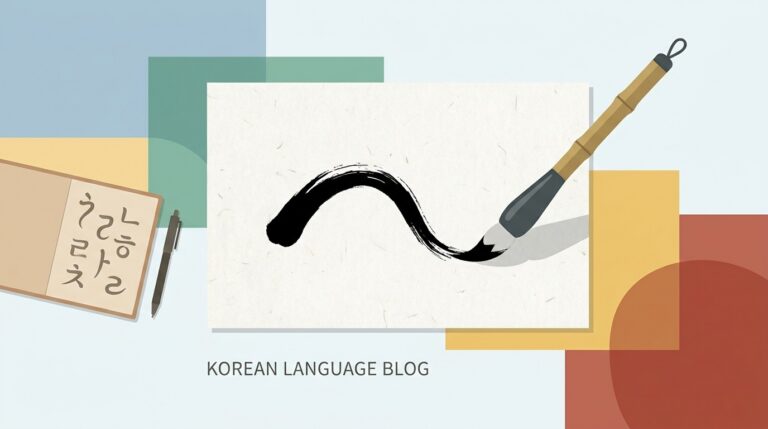
The Soul Behind the Stroke: East Asian Art Philosophy, Seoyeogi-in, and the Metaphysics of Calligraphy
Phase 1: 공감 (Story Immersion Opening)
안녕하세요! 매일한글 에디터입니다.
Have you ever walked into a serene, ink-scented art gallery nestled in the alleyways of Insa-dong or Samcheong-dong, stopped before a monumental hanging scroll, and felt an inexplicable shiver run down your spine? The canvas might hold nothing more than a single, sweeping vertical character executed on raw mulberry paper—yet it somehow feels alive, like a coiled dragon breathing in the gallery silence.
Many of our advanced learners share a common, slightly embarrassing memory. During an exhibition tour or a cultural tea gathering, they wanted to compliment an elder master or curator on a stunning piece of traditional Korean calligraphy (seoye, 서예). Wishing to sound encouraging, they smiled brightly and said: “선생님, 글씨를 정말 예쁘게 잘 쓰시네요!” (Teacher, your handwriting is so pretty and neat!).
Instantly, the atmosphere froze. The master smiled politely, but a faint, wistful sigh escaped his lips. Why? Because in East Asian aesthetic philosophy, calling fine calligraphy “pretty” (yeppeuda, 예쁘다) or “neat” is not high praise—it is an unwitting critique. To traditional masters, mechanical precision belongs to printing presses. A true stroke of the brush is neither an exercise in pretty curves nor mere technical flourish. It is governed by 서여기인 (書如其人): the profound conviction that the brushstroke is an unadorned, naked mirror of the creator’s moral character, mental discipline, and spiritual nobility.
When a stroke seems to rupture the paper with unyielding vitality—a phenomenon celebrated as 필력 (筆力) and 입목삼분 (入木三分)—it is not because the artist possessed strong biceps or clever hand gimmicks. It is because their inner integrity surged through the brush tip at that precise fraction of a second. Today, we step beyond intermediate textbook pleasantries into the realm of C2-level cultural fluency. Based on real feedback from seasoned Korean art critics, calligraphers, and master linguists, this guide will equip you to discuss aesthetics, appreciate empty space (yeobaek), and articulate deep artistic impressions with effortless cultural gravitas.
Phase 2: 핵심 표현 3선 심층 분석 (3 Core Expressions In-Depth)
1. 서여기인 (書如其人)
- Pronunciation: [Seo-yeo-gi-in] (Intuitive sound guide: imagine saying “Suh-yuh-gee-een” with a steady, reverent cadence.)
- Meaning:
- Literal: “Writing is like the person.”
- Actual Nuance: Calligraphy or prose is an undeniable mirror of the author’s moral stature, personal integrity, and lifelong self-cultivation. Skill can be faked, but the spiritual weight of the brush cannot.
- K-Culture Moment: In historical Korean period dramas (Sageuk), you will often see a discerning Joseon monarch or prime minister reject a high-ranking official’s petition without reading the words. They run their fingers over the brushwork and declare that the courtier harbors deceit, stating: “획이 비뚤어지고 기운이 탁하니, 서여기인이라 하지 않더냐.” (His strokes are crooked and his aura murky; is it not said that the writing is the person?)
- Editor’s Insight: You can use this phrase in elevated conversation when analyzing someone’s essay, speech, artistic signature, or even their leadership philosophy. It demonstrates that you perceive character over superficial polish.
- Situation Spectrum: Casual 🚫 | Semi-formal ⚠️ | Formal ✅
- 🤔 Think About It: In modern Western psychology, handwriting analysis (graphology) attempts to decipher personality traits. How does this compare with the East Asian belief that calligraphy directly reveals an individual’s ethical and moral cultivation?
2. 필력이 살아있다 (筆力이 살아있다) / 입목삼분 (入木三分)
- Pronunciation: [Pil-lyeo-gi sa-ra-it-da / Ipmoksambun] (Sounds like “Peel-ryuh-gee sa-ra-eet-da” / “Eep-mok-sam-boon”.)
- Meaning:
- Literal: “The brush-power is alive” / “Penetrating three-tenths of an inch into the wood.”
- Actual Nuance: A brushstroke executed with such razor-sharp momentum, inner concentration, and spiritual weight that it seems three-dimensional and possesses palpable life force.
- K-Culture Moment: When art critics evaluate the title calligraphy of blockbuster movies or album cover calligraphy—such as the fierce, unyielding brush titles in Korean films—they use this phrase to convey that the lettering conveys visceral, kinetic energy rather than static design.
- Editor’s Insight: 입목삼분 originates from the legendary calligrapher Wang Xizhi, whose ink seeped so intensely through the wood panel that the woodcarvers found the ink three-tenths of an inch deep. In Korean aesthetic discourse, saying someone’s 필력 is alive indicates that every stroke breathes.
- Situation Spectrum: Casual ⚠️ | Semi-formal ✅ | Formal ✅
- 🤔 Think About It: Why does the Korean language use biological metaphors of vitality (살아있다, “is alive”) to describe inanimate black soot ink on paper?
3. 기운생동 (氣韻生動)
- Pronunciation: [Gi-un-saeng-dong] (Phonetically close to “Gee-oon-seng-dong” with an open, flowing vowel.)
- Meaning:
- Literal: “Spiritual resonance creates life and movement.”
- Actual Nuance: The supreme aesthetic pinnacle in East Asian philosophy—the cosmic life force (qi) vibrating naturally across the medium, uniting ink, empty space, and the observer’s mind.
- K-Culture Moment: High-concept K-Pop stage design and contemporary dance performances (such as BTS’s iconic Black Swan and traditional stage adaptations) often project flowing ink strokes that swirl to life on LED screens, manifesting modern 기운생동.
- Editor’s Insight: It is the ultimate compliment for any masterwork. When you use this term in an art gallery, you instantly distinguish yourself as someone who grasps the metaphysical soul of Korean aesthetics.
- Situation Spectrum: Casual 🚫 | Semi-formal ⚠️ | Formal ✅
- 🤔 Think About It: Can an artwork have “technical perfection” without possessing 기운생동? What makes a work feel animated from within?
Phase 3: 교과서 한국어 vs 진짜 한국어 (Textbook vs Real-World Korean)
Situation 1: Praising profound art at an exhibition
- 📖 교과서 한국어 (Textbook Korean):
이 서예 작품은 정말 예쁘고 기술적으로 완벽합니다.
(I seoye jakpumeun jeongmal yeppeugo gisuljeogeuro wanbyeokhapnida. / “This calligraphy artwork is really pretty and technically perfect.”) - 🗣️ 진짜 한국어 (Native C2 Korean):
획마다 서슬 퍼런 필력과 작가의 고결한 기품이 고스란히 묻어나네요.
(Hwoengmada seoseul peoreon pillyeokgwa jakgaui gogyeolhan gipumi goseuranhi mudeonaneyo. / “In every stroke, the razor-sharp brush-power and the artist’s noble dignity seep through unmistakably.”) - 💡 왜 다를까? (Why the difference?):
Describing fine art as 예쁘다 (pretty) trivializes philosophical artwork. Native critics use evocative sensory idioms like 서슬 퍼런 (razor-sharp, unyielding) and 고스란히 묻어나다 (to seep through wholly) to honor the moral endurance embedded in the medium.
Situation 2: Admiring an uncompromising, bold piece of writing or speech
- 📖 교과서 한국어 (Textbook Korean):
그 사람의 강한 성격이 글씨에서 잘 느껴집니다.
(Geu saramui ganghan seonggyeogi geulssieseo jal neukkyeojipnida. / “That person’s strong personality is felt well in the handwriting.”) - 🗣️ 진짜 한국어 (Native C2 Korean):
과연 서여기인이라더니, 군더더기 없는 일필휘지에서 대가의 꼿꼿한 절개가 엿보입니다.
(Gwayeon seoyeogiin-iradeoni, gundedeogi eomneun ilpilhwijieseo daegaui kkotkkothan jeolgaega yeotboimnida. / “Indeed, as they say ‘the writing is the person,’ the master’s unbending integrity reveals itself in this decisive, clutter-free single sweep.”) - 💡 왜 다를까? (Why the difference?):
C2 fluency synthesizes classical Sino-Korean idioms (서여기인, 일필휘지) with core Confucian values like 절개 (unbending moral integrity), reflecting holistic cultural comprehension.
Phase 4: K-Culture 딥다이브 & 비언어적 매너 (Deep Dive & Etiquette)
4-1. 눈치 (Nunchi) & Somatic Etiquette in Calligraphy Spaces
When viewing an original Korean hanging scroll (chokja, 족자) or watching a calligraphy master work live, non-verbal respect is paramount:
* The Stance of Receptivity (공수, Gongsu): Never cross your arms or point directly at the calligraphy with an extended finger. Rest your right hand gently over your left hand at waist level. Lean forward subtly with controlled, quiet breath (jogi, 調氣).
* The Sacredness of Unmounted Hanji: Raw, unmounted traditional paper (hanji) is extremely delicate and susceptible to natural skin oils. Never touch the white margins with bare fingers. Let your gaze wander slowly from the initial seal to the dry brush termination (galpil, 渴筆).
* The Timed Silence: When a master finishes a bold stroke in one breath (ilpilhwiji), never applaud immediately like you are at a sports match. Hold your breath for a couple of seconds until the brush leaves the paper and returns to the brush rest. A measured, quiet nod communicates profound resonance.
4-2. Cultural Code Analysis: The Scholar’s Spirit (선비 정신)
In classic Korean historical dramas like Painter of the Wind (바람의 화원) or literary sagas, calligraphy is portrayed not as a career craft (gisul, 기술), but as an act of ascetic spiritual training (susin, 修身). Joseon scholars held that one’s inner greed or deceit immediately manifested as hesitation in the stroke. This is why calligraphic duels in Korean culture were battles of spiritual purity, where an unyielding soul easily triumphed over superficial flourishes.
Phase 5: 실전 롤플레이 시나리오 (Real-World Roleplay Scenario)
Setting: Master Calligrapher Song-am’s quiet, wood-scented hanok studio in Bukchon. Julian, an advanced art curator, examines a freshly brushed scroll hanging against the paper screen.
Song-am (송암 선생):
“자네, 이 한 획에서 무엇이 먼저 보이는가?”
(Jane, i han hwoegeseo mueosi meonjeo boineunga?)
“Tell me, what do you see first in this single stroke?”
Julian (줄리안):
🎭 [두 손을 가지런히 모으고 시선을 획의 끝에 두며]
“단순한 묵흔이 아니라, 종이를 뚫고 나올 듯한 서슬 퍼런 필력이 먼저 와닿습니다.”
(Dansunhan mukheuni anira, jong-ireul ttulko naol deuthan seoseul peoreon pillyeogi meonjeo wadansseumnida.)
“🎭 [Clasping hands respectfully, focusing gaze on the stroke’s tip] Rather than mere ink marks, the razor-sharp brush-power that seems to pierce through the paper strikes me first.”
Song-am (송암 선생):
🎭 [눈을 가늘게 뜨며 옅은 미소를 띤다]
“필력이라… 기교에 눈이 멀면 획이 번잡해지는 법인데, 자네는 획의 뼈대를 볼 줄 아는구먼.”
(Pillyeogira… Gigyoe nuni meolymyeon hwoegi beonjaphaejineun beobinde, janeneun hwoegui ppyodaereul bol jul aneungumeon.)
“🎭 [Narrowing his eyes with a faint smile] Brush-power, you say… When blinded by mere technique, the strokes become cluttered. Yet you know how to look at the very skeleton of the stroke.”
Julian (줄리안):
🎭 [고개를 정중히 숙이며]
“옛말에 서여기인이라 하였으니, 필경 선생님의 꼿꼿한 인품이 붓끝에 실려 입목삼분의 경지를 이룬 덕분입니다.”
(Yenmale seoyeogiin-ira hayeosseuni, pilgyeong seonsaengnimui kkotkkothan inpumi bukkeute sillyeo ipmoksambunui gyeongjireul irun deokbunimnida.)
“🎭 [Bowing with deep deference] As the ancients said, ‘writing is the person’; it is surely because your upright moral character carried through the brush tip, attaining that profound depth which penetrates the wood.”
Song-am (송암 선생):
“허허, 과찬이네. 허나 먹이 닿지 않은 저 여백은 자네에게 어찌 느껴지는가?”
(Heoheo, gwachanine. Heona meogi dachi aneun jeo yeobaegeun jane-ege eojji neukkyeojineunga?)
“Haha, you flatter me. But tell me, how does that empty space untouched by ink feel to you?”
Julian (줄리안):
“비어 있으되 결코 텅 빈 것이 아니라, 먹의 기운생동을 온전히 품어내는 무한한 숨결로 느껴집니다.”
(Bieo itsuidae gyeolko teong bin geosi anira, meogui giunsaengdongeul onjeonhi pumeonaeneun muhanhan sumgyeollo neukkyeojimnida.)
“Though empty, it is by no means vacant; I feel it as an infinite breath that fully embraces the spiritual resonance of the ink.”
Song-am (송암 선생):
🎭 [만족스러운 듯 수염을 쓰다듬으며 붓을 건넨다]
“훌륭하이. 기운이 살아서 움직이는 이치를 아는 자만이 붓을 제대로 쥘 자격이 있지.”
(Hullyunghai. Giuni saraseo umjigineun ichireul aneun jamani buseul jedaero jwil jagyeogi itji.)
“🎭 [Nodding with profound satisfaction, offering the brush] Splendid. Only one who comprehends the cosmic principle of living energy in motion has earned the right to hold the brush.”
Julian (줄리안):
“말씀을 깊이 새겨, 얕은 기교가 아닌 인격을 닦아 붓을 들도록 정진하겠습니다.”
(Malsseumeul gipi saegyeo, yateun gigyoga anin ingyeogeul dakka buseul deuldorok jeongjinhagessumnida.)
“I will engrave your words in my heart, striving to cultivate my character rather than shallow techniques whenever I lift the brush.”
🔀 인터랙티브 분기점 (Interactive Decision Point)
Song-am asks Julian how he should approach completing the bottom inscription (balmun, 발문). How should Julian respond?
- Option A: “선생님의 손기술이 워낙 화려하시니, 기계처럼 빠르고 정교하게 채워 넣으시면 완벽하겠습니다!”
Feedback (Bad): Comparing a traditional master to a machine (기계처럼) and praising “flashy hand skills” (손기술) is considered vulgar in East Asian art philosophy. - Option B: “한 치의 망설임 없는 일필휘지 속에 기운생동의 여운을 남겨주시면 족하겠습니다.”
Feedback (Best): Sublime! This recognizes decisive spontaneity (일필휘지) and spiritual lingering resonance (여운), showing true C2 cultural sophistication. - Option C: “여백이 너무 넓어서 미완성처럼 보이니, 먹물을 빈틈없이 채우시는 게 안전할 것 같습니다.”
Feedback (Risk): Risky! Suggesting that empty space looks unfinished proves that one fundamentally misunderstands the beauty of empty space (여백의 미).
Phase 6: 10초 감정 섀도잉 드릴 (10-Second Emotional Shadowing Drill)
Read aloud with pauses at the / marks, channeling the designated emotional state:
- [🧐 경건하고 깊이 있는 어조로 / Reverential and contemplative]
“서여기인이라 / 하였으니, / 붓끝 하나에도 / 사람의 됨됨이가 / 고스란히 드러나는 법입니다.”
(Seoyeogiin-ira / hayeosseuni, / bukkeut hana-edo / saramui doemdoemiga / goseuranhi deureonaneun beobimnida.)
“As it is said that the writing is the person, even in a single brush tip, one’s true human character is bound to reveal itself entirely.” -
[✨ 감탄과 경외를 담아서 / Filled with awe and admiration]
“종이를 뚫을 듯한 / 저 서슬 퍼런 필력은 / 단순한 기교가 아닌 / 오랜 인격 수양의 / 결실이군요.”
(Jong-ireul ttulheul deuthan / jeo seoseul peoreon pillyeogeun / dansunhan gigyoga anin / oraen ingyeok suyang-ui / gyeolsiligunyo.)
“That razor-sharp brush-power that seems to pierce the paper is not mere technique, but the fruit of long character cultivation.” -
[😌 차분하고 깊은 여운을 주며 / Calm and echoing with lingering depth]
“비어 있는 여백마저 / 기운생동의 호흡으로 / 가득 차 있어 / 깊은 울림을 줍니다.”
(Bieo inneun yeobaengmajeo / giunsaengdong-ui hoheubeuro / gadeuk cha isseo / gipeun ullimeul jumnida.)
“Even the untouched empty space is filled with the breath of spiritual resonance, leaving a profound, reverberating echo.”
Phase 7: K-Culture 미니 사전 (Mini Dictionary)
-
일필휘지 (一筆揮之, Ilpilhwiji)
Translation: Wielding the brush in a single, uninterrupted stroke.
Usage: Describes executing a complex, artistic, or written task with decisive, effortless mastery without stopping to second-guess. -
여백의 미 (餘白의 美, Yeobaegui mi)
Translation: The beauty of empty space / negative space.
Usage: Applied not only to ink paintings, but also to interior architecture, minimalist fashion, and even knowing when to stay silent in conversation. -
문기 (文氣, Mungi)
Translation: The literary, scholarly aura.
Usage: Refers to a dignified aura of deep reading, ethics, and contemplation emanating from an individual’s speech, prose, or presence. -
지기지우 (知己之友, Jigijiu)
Translation: A soulmate friend who truly recognizes one’s inner character.
Usage: In traditional art, it describes someone who can look at your brushstrokes or poetry and understand your hidden sorrows and pure intentions instantly.
Phase 8: 여행자를 위한 생존 키트 (Traveler’s Survival Kit)
Survival Expressions TOP 3 for Traditional Galleries & Studios
- “선생님의 낙관(落款)을 직접 찍어주실 수 있나요?”
(Seonsaengnimui nakgwaneul jikjeop jjigeojusil su innayo?)
Pro Tip: A nakgwan is the master’s personalized red seal stamp. Asking for this respectfully honors the completion of the artwork. - “먹향이 참 그윽하고 깊습니다.”
(Meokhyang-i cham geueukhago gipseumnida.)
Pro Tip: The scent of traditional pine-soot ink (meok) ground on an inkstone is calming. Complimenting its fragrance shows sophisticated sensibility. - “이 획의 농담(濃淡) 조절이 매우 경이롭습니다.”
(I hwoegui nongdam jojeori maeu gyeong-iropseumnida.)
Pro Tip: Nongdam refers to the graduation between pitch black and diluted grey ink. Using this term marks you as a true connoisseur.
Editor’s Travel Note
When exploring the calligraphy alleys behind Insa-dong or Tongin Market near Gyeongbokgung, do not rely on standard Google Maps, which often lacks detailed pedestrian routes in historic alleys. Instead, download the 네이버 지도 앱 다운로드 to uncover century-old brush workshops (pilbang, 필방). Many legacy paper masters will happily grind fresh ink for you if you show genuine reverence for traditional materials.
Phase 9: “한 발 더 깊이” (Deep Reflection Essay)
In Western Renaissance aesthetics, art often prioritized realism—capturing human anatomy, perspective, and optical fidelity through rigorous mathematical precision. In contrast, Joseon-era Korean aesthetics viewed mechanical likeness (hyeongsa, 형사) as merely the lowest tier of creation. The ultimate aspiration was seongeum (전신, 傳神)—transmitting the unseeable spirit. When an artist lifted a brush, they were not drawing an object; they were releasing their life force onto the paper. Because an ink stroke cannot be erased, edited, or painted over, every millimeter of the stroke records the artist’s heartbeat, hesitation, and moral rectitude.
서여기인 (書如其人) reminds us that our output—whether an ink scroll, an email, or a spoken greeting—is a direct, uncurated extension of our inner cultivation.
💬 Your Turn: Have you ever encountered a piece of art, handwriting, or design where you could instinctively sense the creator’s moral integrity or spiritual presence? Share your experience in the comments below!
Phase 10: FAQ & 흔한 실수 (FAQ & Avoiding Mistakes)
Q: Can I say “글씨가 귀여워요” or “글씨를 잘 쓰시네요” to an elderly calligraphy artist?
A: You should avoid this! Calling fine calligraphy 귀엽다 (cute) or using elementary phrases like 잘 쓰다 (to write well) diminishes decades of spiritual cultivation to kindergarten handwriting. Instead, say: “필력이 매우 힘차고 기품이 넘치십니다.” (Your brush-power is immensely vigorous and overflowing with noble dignity.)
Q: What is the historical origin of the phrase 입목삼분 (入木三分)?
A: It stems from ancient historical chronicles of calligrapher Wang Xizhi. When his writing was carved into wood for sacrificial inscriptions, the woodcarvers discovered that the black ink had deeply penetrated three-tenths of an inch (sam-bun) into the raw timber. Today, it describes an indomitable, piercing aesthetic vigor.
Q: Is empty space (여백) considered an unfinished area in traditional Korean art?
A: Absolutely not. In Eastern metaphysics rooted in Daoism and Buddhism, form is emptiness and emptiness is form (saekjeuksigung gongjeukgisaek). Empty space is not a vacuum; it is dynamic, breathing potential that gives ink strokes their life.
🚨 흔한 실수 (Common Mistakes) 경고판
- Mistake: Using 필력 (brush-power) to describe your physical arm strength or fast computer typing speed.
Correct Action: Reserve 필력 for literary depth, expressive conviction, and calligraphic dynamism. - Mistake: Pointing your index finger directly at an ink stroke on open hanji.
Correct Action: Gesture gently with an open palm facing upward, keeping your hands at a respectful distance. - Mistake: Assuming 일필휘지 means “rushing quickly to finish.”
Correct Action: 일필휘지 denotes an unclouded mind where intention and movement become seamlessly one.
Phase 11: 액션 미션 & 참여 유도 (Action Mission)
- 🥉 Bronze Mission (Solo Mastery): Practice reciting the Phase 6 Shadowing Drill three times out loud, ensuring your pauses (/) emulate the breathing cadence of a brush master.
- 🥈 Silver Mission (Social Share): Find a photo of Korean calligraphy or typography, post it on your social media with the hashtag #DailyHangul, and critique its 필력 in one bilingual sentence.
- 🥇 Gold Mission (Real-World Application): Visit an art museum or a Korean cultural center exhibition. Approach a curator or docent and offer the compliment: “획에 깃든 기운생동이 참 인상적입니다.” (The living spiritual resonance embedded in these strokes is truly impressive.)
- 🎮 K-Culture Mission: Watch the classic Korean film Chihwaseon (취화선) or modern historical dramas, and observe how painters grind ink stones (meok) to calm their minds before making a single stroke.
Phase 12: 인터랙티브 퀴즈 챌린지 (Interactive Quiz Challenge)
1. Situational Judgment: You are attending a solo exhibition of an octogenarian master calligrapher. What is the most culturally profound and respectful compliment you can give?
* A) “선생님, 폰트 디자인으로 출시해도 될 만큼 글씨가 깔끔하네요!”
* B) “기운생동의 필력 속에서 선생님의 고결한 인품과 서여기인의 정신이 깊이 느껴집니다.”
* C) “종이 여백이 너무 아까우니 다음에는 글씨를 더 크게 꽉 채워주세요.”
2. Fill-in-the-Blank:
붓을 한 번 휘둘러 거침없이 단숨에 글씨를 써 내려가는 경지를 사자성어로 ( )라 한다.
3. True or False:
In traditional Korean aesthetics, leaving white space (여백) on a scroll indicates that the artist ran out of ink or left the painting incomplete. (True / False)
👉 정답 및 해설 확인하기 (Click to reveal answers)
1. 정답: B
해설: Option B captures the heart of traditional aesthetics (기운생동, 서여기인). Option A compares masterwork to mere digital fonts, and Option C completely misses the metaphysics of empty space.
2. 정답: 일필휘지 (一筆揮之)
해설: ‘일필휘지’ refers to wielding the brush in a single breath without doubt, hesitation, or correction.
3. 정답: False
해설: Empty space (여백의 미) is an active, vital element of the composition that breathes life into the black ink strokes.







