

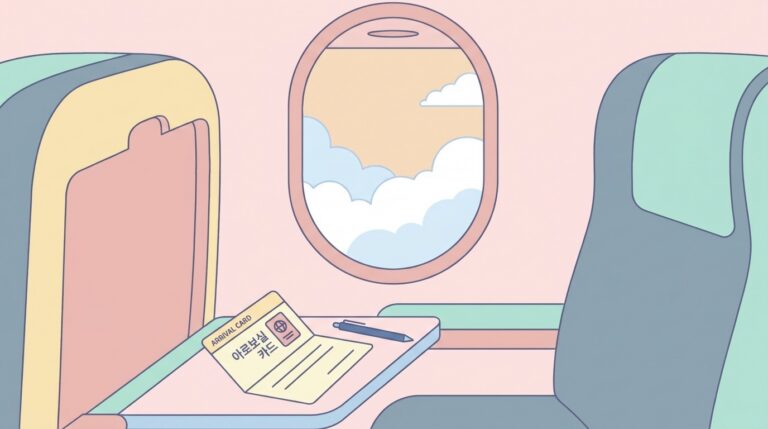
In-Flight Korean: How to Borrow a Pen and Ask for Arrival Cards Like a Pro
Phase 1: Empathy (Story-Driven Opening)
안녕하세요! 매일한글 에디터입니다. (Hello! This is your Daily Hangul editor.)
Picture this: You are seated on a flight descending toward Incheon International Airport. The flight attendants make the final announcement, the cabin lights brighten softly, and they begin handing out the arrival declaration forms. You look at the little paper slip, pat down your pockets, check your carry-on, and realize your only pen is buried deep inside the overhead bin beneath three heavy winter jackets.
You hear the flight attendant’s trolley rolling closer. You want to ask for a pen, but your mind races: If I say ‘Give me a pen,’ will I sound rude? What is the polite way to ask in Korean without sounding like a textbook robot?
You are not alone! Over 80% of our beginner learners tell us that their very first real-world spoken Korean test happens right in that airplane seat, 30,000 feet in the air. Getting this moment right sets the emotional tone for your entire Korean trip. Today, we will transform that nervous hesitation into smooth, natural Korean confidence so you can handle in-flight requests effortlessly.
Phase 2: Top 3 Core Expressions Deep Dive
1. 볼펜 좀 빌릴 수 있을까요? (Bolpen jom billil su isseulkkayo?)
- Pronunciation: Bol-pen jom beel-leel soo ees-seul-kka-yo? (Think of ‘jom’ like a soft ‘chom’ with a gentle sigh).
- Meaning: “Could I please borrow a pen?”
- K-Culture Moment: You will hear this exact tone in K-dramas whenever a character politely asks a colleague or stranger for a small favor at a municipal office or library.
- Editor’s Insight: The magic word here is 좀 (jom). While it literally translates to “a little,” it functions like an emotional shock-absorber. Without 좀 (jom), the request feels sterile; with it, it sounds considerate and sweet.
- Situation Spectrum: Casual (⚠️ with friends: 펜 좀 빌려줘) | Semi-formal (✅) | Formal (✅)
- 🤔 Think About It: Why does adding a word meaning “a little” make Koreans feel that you are respecting their personal space and time?
2. 입국신고서 한 장 더 주시겠어요? (Ipguk-singoseo han jang deo jusigesseoyo?)
- Pronunciation: Eep-gook-seen-go-suh han jahng duh joo-shee-gess-uh-yo?
- Meaning: “Could you please give me one more arrival card?”
- K-Culture Moment: That classic moment when you accidentally write your hotel address in the passport number box and need a fresh sheet without any embarrassing scribble marks.
- Editor’s Insight: 한 장 (han jang) uses the paper counter 장 (jang). Pairing it with 더 (deo – more) and the polite closing 주시겠어요? (jusigesseoyo?) shows high situational fluency.
- Situation Spectrum: Casual (🚫) | Semi-formal (✅) | Formal (✅)
- 🤔 Think About It: In your language, do you count paper with specific counter words, or do you just say “one paper”?
3. 다 썼어요, 감사합니다. (Da sseosseoyo, gamsahamnida.)
- Pronunciation: Dah ssuss-uh-yo, gahm-sah-hahm-nee-dah.
- Meaning: “I finished writing, thank you.”
- K-Culture Moment: Returning the borrowed pen with both hands to the smiling cabin crew before buckling up for landing.
- Editor’s Insight: Returning items promptly is a huge part of Korean etiquette. Saying 다 썼어요 (da sseosseoyo) lets the attendant know they can have their tool back immediately.
- Situation Spectrum: Casual (⚠️ 다 썼어) | Semi-formal (✅) | Formal (✅)
- 🤔 Think About It: How does verbally confirming the completion of a borrowed task build trust between strangers?
Phase 3: Textbook Korean vs. Real Korean
Situation 1: Asking to borrow a pen
* 📖 Textbook Korean: 볼펜을 빌려 주십시오. (Bolpeneul billyeo jusipsio.)
* 🗣️ Real Korean: 저기요, 볼펜 좀 빌릴 수 있을까요? (Jeogiyo, bolpen jom billil su isseulkkayo?)
* 💡 Why is it different? The “-십시오 (-sipsio)” imperative form sounds like an authoritative military drill or an automated subway announcement. Real Koreans soften requests using questions rather than direct commands.
Situation 2: Asking for an extra card
* 📖 Textbook Korean: 입국신고서를 주십시오. (Ipguk-singoseoreul jusipsio.)
* 🗣️ Real Korean: 저, 이거 한 장만 더 주세요. (Jeo, igeo han jang-man deo juseyo.)
* 💡 Why is it different? In real life, pointing at the form and saying 이거 한 장만 더 주세요 (igeo han jang-man deo juseyo – Just one more of this, please) is much more natural and eliminates tongue-twisting formal vocabulary under pressure.
Phase 4: K-Culture Deep Dive & Non-Verbal Manners
4-1. 눈치 (Nunchi) & Flight Etiquette Gestures
Korean flight attendants provide world-renowned, attentive service, but they are also exceptionally busy during the descent phase.
* The Soft Hand Raise: Never snap your fingers or yell across the cabin. Simply raise your hand midway (around chest or shoulder height) and make soft eye contact as they walk by.
* Two-Hand Rule (두 손): When receiving the pen or handing it back, hold it with both hands, or support your right wrist lightly with your left hand. Accompany this with a slight nod of the head (목례, mongnye). This non-verbal cue instantly signals deep cultural respect.
4-2. Cultural Code: The Anticipation of Arrival
In Korean travel culture, filling out the 입국신고서 (ipguk-singoseo) marks the ceremonial transition into Korea. It is the moment where travelers carefully review their Korean accommodation name and Korean phone number. Being ready with these phrases avoids the bottleneck at immigration gates!
Phase 5: Real-Life Roleplay Scenario
Setting: Aboard flight KE082 descending into Incheon. Cabin lights are bright. Flight attendant Min-ji is walking down the aisle checking seatbelts.
- You: 저기요, 실례합니다. (Jeogiyo, sillyehamnida.)
🎭 [Raises hand softly, making polite eye contact]
“Excuse me, pardon me.” - Min-ji (승무원): 네, 손님! 무엇을 도와드릴까요? (Ne, sonnim! Mueoseul dowadeurilkkayo?)
🎭 [Pauses with a warm professional smile]
“Yes, passenger! How can I help you?” - You: 입국신고서 작성해야 하는데, 혹시 볼펜 좀 빌릴 수 있을까요? (Ipguk-singoseo jakseonghaeya haneunde, hoksi bolpen jom billil su isseulkkayo?)
🎭 [Shows the blank card with a slightly sheepish, friendly smile]
“I need to fill out the arrival card, could I perhaps borrow a pen?” - Min-ji (승무원): 아, 그럼요! 여기 있습니다. (A, geureomyo! Yeogi itsseumnida.)
🎭 [Takes a pen from her apron pocket and hands it over with both hands]
“Ah, of course! Here you go.” - You: 감사합니다! 금방 쓰고 돌려드릴게요. (Gamsahamnida! Geumbang sseugo dollyeodeurilgeyo.)
🎭 [Receives the pen with both hands and bows head lightly]
“Thank you! I will use it quickly and return it to you.” - Min-ji (승무원): 천천히 쓰시고 편하실 때 주세요. (Cheoncheonhi sseusigo pyeonhasil ttae juseyo.)
🎭 [Nods gently before stepping forward]
“Take your time and give it back whenever it is convenient.” - You: 다 썼습니다. 정말 감사합니다! (Da sseotsseumnida. Jeongmal gamsahamnida!)
🎭 [Hands the pen back neatly with both hands]
“I am finished writing. Thank you so much!” - Min-ji (승무원): 감사합니다. 즐거운 여행 되세요! (Gamsahamnida. Jeulgeoun yeohaeng doeseyo!)
🎭 [Smiles warmly and returns pen to pocket]
“Thank you. Have a wonderful trip!”
🔀 Interactive Decision Point
What would you say if you made a mistake on your card and need a new one?
* Choice A: 야! 종이 다시 줘! (Ya! Jong-i dasi jwo!)
* Choice B: 입국신고서 작성 실패. 새것 요망. (Ipguk-singoseo jakseong silpae. Saegeot yomang.)
* Choice C: 죄송한데, 한 장만 더 주실 수 있을까요? (Joesonghande, han jang-man deo jusil su isseulkkayo?)
Feedback:
* Choice A (Risk – Extreme): This is rude slang you would only use when arguing with a childhood friend! Never use this with crew.
* Choice B (Bad): Sounds like a robotic computer error code.
* Choice C (Best!): Perfect! Starting with 죄송한데 (joesonghande – I am sorry to bother you, but…) softens the request flawlessly.
Phase 6: 10-Second Emotion Shadowing Drill
Repeat after the slash marks, matching the emotional tone indicators:
[🥺 Polite and gentle]
저기요, / 혹시 / 볼펜 좀 / 빌릴 수 있을까요?
(Jeogiyo, / hoksi / bolpen jom / billil su isseulkkayo?)-
[😊 Bright and assuring]
금방 쓰고 / 바로 / 돌려드릴게요!
(Geumbang sseugo / baro / dollyeodeurilgeyo!) -
[✨ Warm and genuinely thankful]
빌려주셔서 / 정말 / 감사합니다!
(Billyeojusyeoseo / jeongmal / gamsahamnida!)
Phase 7: K-Culture Mini Dictionary
- 입국신고서 (Ipguk-singoseo) | Arrival Declaration Card
Usage: The paper form distributed before international flights enter South Korea. - 볼펜 (Bolpen) | Ballpoint Pen
Usage: A Konglish staple! Koreans almost always say 볼펜 (bolpen) or simply 펜 (pen). - 승무원 (Seungmuwon) | Flight Attendant / Cabin Crew
Usage: The polite title for flight attendants. When calling them, use 저기요 (jeogiyo) rather than calling their title directly. - 여권 (Yeogwon) | Passport
Usage: Essential when writing your arrival card, as you will need your passport number (여권번호, yeogwon-beonho).
Phase 8: Survival Kit for Travelers
Top 3 In-Flight Survival Expressions
- 담요 하나만 더 주실 수 있나요? (Damyo hanaman deo jusil su innayo?)
Could I get one more blanket?
Pro Tip: Airplane air conditioning gets chilly over the Pacific; this phrase will save your sleep. - 따뜻한 물 좀 부탁드려요. (Ttatteut-han mul jom butakdeuryeoyo.)
Warm water, please.
Pro Tip: Great for soothing your throat after a long, dry flight. - 입국신고서 영어 버전 있나요? (Ipguk-singoseo yeongeo beojeon innayo?)
Do you have an English version of the arrival card?
Pro Tip: Korean carriers usually carry multilingual forms!
Editor’s Travel Note
Before your plane touches down at Incheon, get your phone ready! Be sure to prepare by following the 인천공항 가이드 앱 다운로드 guide to track terminal baggage carousels in real time. Also, remember to install the 네이버 지도 앱 다운로드 guide before landing, because international mapping apps have limited walking navigation features in South Korea due to national security map data laws.
Phase 9: One Step Deeper (Cultural Reflection)
In Korean culture, asking a stranger for a personal tool like a pen involves stepping into their personal utility space. This is why expressions like 혹시 (hoksi – by any chance) and 좀 (jom – a little) are so ubiquitous. They are not empty words; they serve as linguistic cushions that show you are mindful of not inconveniencing the other person. Politeness in Korean is less about stiff grammatical formality and more about active empathy for the listener’s comfort.
💬 Your Turn: Have you ever needed something urgently on a flight to another country? How did you ask for it using non-verbal signs? Share your funny in-flight memories in the comments below!
Phase 10: FAQ & Avoiding Misunderstandings
Q: Can I call the flight attendant by saying “아줌마 (Ajumma)” or “아가씨 (Agassi)”?
A: Never! These terms are outdated and can be perceived as disrespectful in service settings. Simply raise your hand slightly and say 저기요 (Jeogiyo – Excuse me) or 실례합니다 (Sillyehamnida – Pardon me).
Q: What if the flight attendant doesn’t speak English and I panic?
A: Keep it to two words: 볼펜 (Bolpen) and 주세요 (Juseyo) while holding up your arrival card. They will understand immediately and assist you with a smile!
Q: Do I need to return the pen right away?
A: Yes! Cabin crew often share a limited stash of pens among hundreds of passengers. Handing it back as soon as you finish shows great manners.
🚨 Common Mistakes Warning Board
- ❌ Mistake 1: Saying “펜 줘! (Pen jwo!)” -> Correct Action: Say “볼펜 좀 빌릴 수 있을까요? (Bolpen jom billil su isseulkkayo?)”.
- ❌ Mistake 2: Handing the pen back with one hand while looking away -> Correct Action: Use both hands with a light nod.
- ❌ Mistake 3: Shouting “여기요! (Yeogiyo!)” loudly across the cabin aisle -> Correct Action: Wait until the crew member walks nearby and say “저기요 (Jeogiyo)” softly.
Phase 11: Action Missions
- 🥉 Bronze Mission (Solo): Look into your mirror, hold up an imaginary card, and practice saying “볼펜 좀 빌릴 수 있을까요?” three times with a gentle smile.
- 🥈 Silver Mission (Social): Open your voice notes app, record your best delivery of “다 썼어요, 감사합니다!”, and listen to check if your tone sounds soft and warm.
- 🥇 Gold Mission (Real World): On your next flight to Korea or at a Korean cultural center, use “한 장만 더 주세요 (One more, please)” completely in Korean without switching to English!
- 🎮 K-Culture Mission: Watch any airport scene in a modern Korean drama (like Crash Landing on You or King the Land) and spot how passengers hold items when interacting with airline crew.
Phase 12: Interactive Quiz Challenge
1. Situation Judgment: You ruined your arrival card by spilling coffee on it. What is the most polite, natural way to request another one from the flight attendant?
* A) 종이 버렸어요, 새것 내놔요. (Jong-i beoryeosseoyo, saegeot naenwayo.)
* B) 입국신고서 한 장만 더 주시겠어요? (Ipguk-singoseo han jang-man deo jusigesseoyo?)
* C) 볼펜 어디 있어요? (Bolpen eodi itsseoyo?)
👉 Click to view answer and explanation
Correct Answer: B
Explanation: “입국신고서 한 장만 더 주시겠어요?” politely requests one more arrival card using the counter 한 장 (han jang) and the honorific ending 주시겠어요?. Choice A is rude, and Choice C asks where the pen is instead of the card!
2. Fill in the Blank: Complete the polite cushion phrase:
“혹시 볼펜 _____ 빌릴 수 있을까요?” (Could I borrow a pen a little?)
👉 Click to view answer and explanation
Correct Answer: 좀 (jom)
Explanation: 좀 (jom) is the essential magic word used to soften requests and make them sound considerate.
3. True or False Cultural Quiz:
True or False: In Korea, when receiving a borrowed pen from flight crew, it is considered polite to accept it with only one hand so you don’t slow them down.
👉 Click to view answer and explanation
Correct Answer: False
Explanation: In Korean culture, receiving and giving items with two hands (or supporting the wrist) is the hallmark of politeness and respect.






