

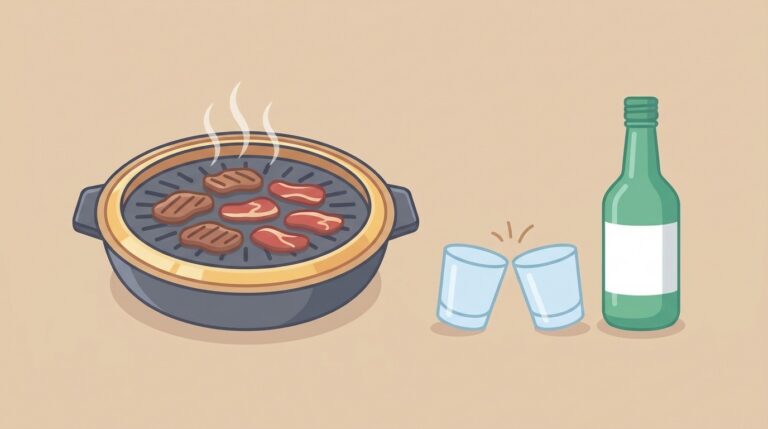
Never Freeze at a Korean BBQ: The Foolproof Beginner Guide to Cheers and Toasts
Phase 1: Empathy (Story-driven Opening)
안녕하세요! I am your Daily Hangul editor and your personal Korean culture navigator!
Picture this: You are sitting at a bustling, smoky Korean BBQ restaurant in the heart of Hongdae. Thick cuts of samgyeopsal are sizzling loudly on the grill, garlic cloves are turning golden brown, and condensation drips down chilled green bottles of soju. Suddenly, your Korean companion raises a small shot glass, looking directly at you with an expectant smile. Everyone lifts their glasses. The air hangs in suspense.
You freeze. Do you say “Cheers”? Do you yell “Kanpai”? What was that word you heard in your favorite K-Drama? And why is everyone holding their glasses with two hands?
Do not worry at all! Clinking glasses at a Korean table is not a high-stress test—it is an invitation to warmth, friendship, and shared memories. Based on real feedback from hundreds of beginner students at Daily Hangul who once felt that exact BBQ table panic, this guide breaks down the essential toast phrases and simple body language hacks you need to feel like an insider in no time.
Phase 2: Core Phrases Deep Dive
1. 건배! (Geonbae!)
- Pronunciation: [Geon-bae] (Sounds like the English word “gun” followed by “bae” as in sweetie: gun-bae!)
- Meaning: Literal: “Dry the cup” (empty glass) | Real Nuance: The classic, standard toast across generations, meaning “Cheers!”
- K-Culture Moment: You hear this in business K-Dramas like Itaewon Class or Misaeng during celebratory team dinners after closing a major deal.
- Editor’s Insight: While “Geonbae” literally shares roots with the Chinese “Ganbei” and Japanese “Kanpai”, modern Koreans do not expect you to chug your drink dry. It is simply a polite and universal toast.
- Situation Spectrum: Casual: ✅ | Semi-formal: ✅ | Formal: ✅
- 🤔 Think About It: In English, we say “Cheers” to wish good cheer. In Korean, “Geonbae” points to completing a drink together. Why do you think finishing a drink together holds such symbolic bonding power?
2. 짠! (Jjan!)
- Pronunciation: [Jjan] (Sounds like the sharp “j” in “jam” mixed with an energetic “ch”, ending with an “an”: jjan!)
- Meaning: Literal: An onomatopoeia mimicking the ringing sound of clinking glasses | Real Nuance: “Clink!” or “Cheers!” among close friends.
- K-Culture Moment: Seen in youthful romance dramas like Weightlifting Fairy Kim Bok-joo or casual variety shows when friends tap glasses over late-night fried chicken.
- Editor’s Insight: This is the word you will hear 90% of the time among people in their 20s and 30s. It feels joyful, lighthearted, and ultra-natural.
- Situation Spectrum: Casual: ✅ | Semi-formal: ⚠️ (only with friendly colleagues) | Formal: 🚫
- 🤔 Think About It: English speakers say “Clink!” playfully, but it is rarely the main toast. Why has the sound of glass tapping become the dominant social toast for Korean youth?
3. 위하여! (Wihayeo!)
- Pronunciation: [Wi-ha-yeo] (Sounds like wee-ha-yuh)
- Meaning: Literal: “For the sake of [something]!” | Real Nuance: “Here’s to us!” or “To our success!”
- K-Culture Moment: The booming cry heard in corporate team dinners (hoesik) when the team leader shouts: “우리 팀을…” (For our team…) and everyone roars: “위하여!” (Wihayeo!).
- Editor’s Insight: It carries theatrical, collective energy. When shouting this, make sure to hold out your glass with determination and smile broadly.
- Situation Spectrum: Casual: ⚠️ (feels slightly dramatic/funny) | Semi-formal: ✅ | Formal: ✅
- 🤔 Think About It: Why does Korean corporate culture favor dedicating toasts to collective goals (our team, our health) rather than individual celebration?
Phase 3: Textbook Korean vs. Real Korean
Situation 1: Clinking glasses casually with buddies at a pocha (tent bar)
- 📖 교과서 한국어 (Textbook): 우리 건배합시다. (Uri geonbaehapsida.) — “Let us toast.”
- 🗣️ 진짜 한국어 (Real-life): 자, 짠 하자! (Ja, jjan haja!) — “Alright, let’s clink!”
- 💡 왜 다를까? (Why the difference?): Nobody uses stiff verb endings like “-hapsida” with friends over casual drinks. “Jjan haja!” directly invites action with warm informality.
Situation 2: Making a toast to celebrate someone’s new job or good news
- 📖 교과서 한국어 (Textbook): 축배를 듭시다. (Chukbaereul deupsida.) — “Let us raise a celebratory cup.”
- 🗣️ 진짜 한국어 (Real-life): 대박을 위하여! (Daebageul wihayeo!) — “Here’s to your massive success!”
- 💡 왜 다를까? (Why the difference?): “Chukbaereul deupsida” sounds like dialogue from an old historical novel. Combining a modern buzzword like “대박 (Daebak)” with “위하여 (Wihayeo)” creates immediate camaraderie.
Phase 4: K-Culture Deep Dive & Non-Verbal Manners
4-1. 눈치 (Nunchi) & Table Gestures
At a Korean table, your hands speak just as loudly as your words. Keep these three physical cues in mind:
1. The Two-Hand Touch: When clinking glasses with someone older or senior in rank, support your pouring/clinking forearm or wrist lightly with your opposite hand, or hold your cup with both hands. It instantly signals respect.
2. The Humble Rim: Aim to tap the rim of your glass slightly lower than the senior’s glass. This tiny adjustment demonstrates humility and great nunchi (social awareness).
3. The Courteous Turn: When taking a sip in front of elders, subtly turn your head and torso to the side, shielding your drink with your hand.
4-2. Culture Code: The Bonding Alchemy of “Somaek” & Jeong
In dramas like Work Later, Drink Now, you will notice that drinking in Korea is rarely an isolated solo hobby; it is a community-building ritual known as sharing Jeong (deep affection and mutual connection). Mixing beer and soju (somaek) using chopsticks to create foamy bubbles is a playful social ritual meant to break down social awkwardness, transforming nervous strangers into tight-knit comrades within one evening.
Phase 5: Real-Life Roleplay Scenario
Setting: A vibrant samgyeopsal restaurant in Gangnam. Neon lights reflect off round stainless steel tables, sizzling pork fills the air, and K-Pop plays softly in the background.
Characters:
* 민지 (Minji): Your warm, energetic Korean coworker.
* You: A curious beginner ready for your first authentic toast.
- 민지: 고기 다 익었어요! 먼저 드세요. (Gogi da igeosseoyo! Meonjeo deuseyo.)
“The meat is all cooked! Please eat first.”
🎭 Picks up a crisp lettuce leaf and places a grilled slice on your plate with tongs. -
You: 와, 맛있겠다! 잘 먹겠습니다! (Wa, masitgetda! Jal meokgetseumnida!)
“Wow, looks delicious! Thank you for the meal!”
🎭 Takes a bite with an appreciative grin. -
민지: 자, 고기 먹을 때 시원하게 한잔해야죠? (Ja, gogi meogeul ttae siwonhage hanjanhaeyajyo?)
“Alright, when eating pork, we have to share a refreshing drink, right?”
🎭 Picks up the soju bottle with both hands, ready to pour into your glass. -
You: 좋아요! 감사합니다. (Joayo! Gamsahamnida.)
“Sounds great! Thank you.”
🎭 Holds the shot glass using both hands, tilting it slightly toward Minji. -
민지: 오늘 프로젝트 끝난 기념으로, 우리 팀을 위하여! (Oneul peurojekteu kkeutnan ginyeomeuro, uri timeul wihayeo!)
“In honor of finishing today’s project, here’s to our team!”
🎭 Raises her glass high with a beaming smile. -
You: 우리 팀을 위하여! 건배! (Uri timeul wihayeo! Geonbae!)
“Here’s to our team! Cheers!”
🎭 Clinks your glass, gently aiming the rim slightly lower than Minji's. -
민지: 짠! 오늘 수고 진짜 많았어요! (Jjan! Oneul sugo jinjja manasseoyo!)
“Clink! You really worked so hard today!”
🎭 Clinks cheerily and takes a satisfying sip. -
You: 짠! 민지 씨도 수고 많으셨어요. (Jjan! Minji ssido sugo maneusyeosseoyo.)
“Clink! You worked hard too, Minji.”
🎭 Turns head slightly to the side to take a sip, smiling back.
🔀 Interactive Decision Point
Minji notices your glass is half-empty and reaches for the bottle again. How do you respond?
- Option A: Pour yourself a full drink immediately using one hand before she can reach it.
- Option B: Drink whatever remains in your glass first, then hold your empty glass with both hands so she can pour for you.
- Option C: Put your hands up and shout loudly across the restaurant: “그만! (Geuman! / Stop!)”
Feedback:
* Option A [Bad]: In Korea, pouring your own drink (jajak) while drinking with others is considered antisocial and implies you don’t want company.
* Option B [Best]: Perfect etiquette! Koreans generally refill glasses once they are emptied, and receiving with both hands demonstrates heartfelt respect.
* Option C [Risk]: Abruptly shouting “Geuman!” sounds aggressive and cuts off the warm social mood. If you want to stop, softly touch the rim with your palm and say “괜찮아요, 천천히 마실게요 (Gwaenchanayo, cheoncheonhi masilgeyo – I’m good, I’ll drink slowly).”
Phase 6: 10-Second Emotional Shadowing Drill
Practice these lines with rhythm, feeling the pauses marked by /.
[😊 Cheerful & friendly]
자! / 오늘 만나서 / 반가워요, / 짠!
(Ja! / Oneul mannaseo / bangawoyo, / jjan!)
“Alright! / So glad / to meet today, / clink!”-
[🍻 Bold & passionate]
우리의 / 멋진 미래를 / 위하여!
(Urieui / meotjin miraereul / wihayeo!)
“To our / wonderful future / cheers!” -
[🥺 Warm & appreciative]
오늘 다들 / 고생 많았어요, / 건배!
(Oneul dadeul / gosaeng manasseoyo, / geonbae!)
“Everyone / worked so hard today, / cheers!”
Phase 7: K-Culture Mini Dictionary
- 짠 (Jjan): The ultimate casual toast. Used at pochas, chicken-and-beer joints, and whenever glasses touch.
- 원샷 (Wonsyat): Derived from “One Shot,” meaning draining the shot glass in one gulp. Only do this if you are comfortable; it is never mandatory!
- 회식 (Hoesik): Company dinner. A vital social institution where office hierarchies soften over barbecue and collective toasts.
- 소맥 (Somaek): A beloved blend of soju (소주) and beer (맥주). Celebrated for its smooth, crisp taste that cuts through rich grilled pork.
Phase 8: Survival Kit for Travelers
Survival Phrases TOP 3
- 한 잔 더 주세요! (Han jan deo juseyo!)
Pronunciation: [Han jan deo joo-se-yo]
Pro Tip: Use this to ask for “one more glass” or “one more drink” from the server. - 물 좀 주세요! (Mul jom juseyo!)
Pronunciation: [Mool jom joo-se-yo]
Pro Tip: Essential for pacing yourself! Korean BBQ spots provide chilled water carafes upon request for free. - 건배해요! (Geonbaehaeyo!)
Pronunciation: [Geon-bae-hae-yo]
Pro Tip: A polite, friendly way to initiate a toast with new Korean acquaintances.
Editor’s Travel Note
When venturing out into Seoul nightlife, never rely on Google Maps alone because local walking routes and small eateries are not fully mapped. Instead, make sure to complete your Naver Map app download for Korean travel before your evening out. If the party stretches past midnight and the subways shut down, hail a licensed cab safely using the Kakao T taxi booking app. Regarding payments: paying collectively is standard, but splitting the bill (더치페이 / deochipei) has become widespread among younger crowds.
Phase 9: Step Deeper (Reflective Thought)
In many Western cultures, a toast highlights personal achievements, birthdays, or individual speeches. In Korea, however, shouting “위하여! (Wihayeo!)” or tapping glasses with a shared “짠! (Jjan!)” is less about the individual and more about melting boundaries. Drinking together converts independent people into “우리 (Uri)”—meaning “We / Our group.” When glasses touch, social distances collapse, and everyone at the table enters a shared circle of trust.
💬 Your Turn: What is the traditional toast in your home country, and what values does it highlight? Share your story in the comments below!
Phase 10: FAQ & Avoiding Misunderstandings
Q: What if I do not drink alcohol? Will it be considered rude to refuse?
A: Not at all! Korean social culture has modernized significantly. Simply ask for cider (사이다 / sprite-like soda) or water, pour it into your shot glass, and participate in the clinking action. What matters is your presence and energy, not the ethanol!
Q: Can I use “짠 (Jjan)” with my boss or professor?
A: Be careful! “Jjan” is informal slang. Unless your boss explicitly tells you to relax and speak casually, stick to “건배 (Geonbae)” or “위하여 (Wihayeo)” in professional and academic settings.
Q: Is it true that I should never pour my own drink?
A: Yes! Pouring your own alcohol (jajak) can inadvertently make your companions feel neglectful. Keep an eye on your neighbor’s glass; if it’s empty, offer to pour for them, and they will happily return the favor.
🚨 Common Mistakes Alert
- ❌ Clinking higher than someone older: Tapping above an elder’s rim shows a lack of manners.
➡️ Correct Action: Keep your glass rim slightly lower than theirs. - ❌ Pouring with only one hand: It can appear careless or disrespectful.
➡️ Correct Action: Hold the bottle with your right hand while supporting your forearm with your left. - ❌ Ignoring eye contact during the clink: Looking away right as you touch glasses feels distant.
➡️ Correct Action: Make brief, friendly eye contact right before the glasses touch, then subtly turn your head away to drink.
Phase 11: Action Mission & Engagement
- 🥉 Bronze Level: Stand in front of your mirror with a glass of water. Practice saying “짠! (Jjan!)” with a confident, bright smile 3 times.
- 🥈 Silver Level: Next time you watch a K-Drama or YouTube mukbang, listen for the toast. Post an Instagram story or tweet tagging @DailyHangul with the phrase you caught!
- 🥇 Gold Level: Visit your local Korean restaurant or gather friends. Propose a toast using “우리 팀을 위하여! (Uri timeul wihayeo!)” while holding your glass with both hands!
🎮 K-Culture Mission: Watch an episode of a Korean variety show or drama (like Hospital Playlist). Spot the exact moment the characters touch glasses. Did they say “Jjan” or “Geonbae”? Tell us in the comments!
Phase 12: Interactive Quiz Challenge
Question 1: Scenario Judgment
You are having dinner with your Korean partner’s parents for the first time. The father raises his glass to toast. Which phrase is the most appropriate for you to use?
* A) 짠! (Jjan!)
* B) 건배! (Geonbae!)
* C) 원샷! (Wonsyat!)
Question 2: Fill in the Blank
Complete the company toast: “우리 회사를 ________!” (For our company!)
* A) 위하여 (Wihayeo)
* B) 맛있어요 (Masisseoyo)
* C) 주세요 (Juseyo)
Question 3: True or False (Culture Check)
In Korean drinking etiquette, it is considered polite to pour your own drink first before pouring for anyone else.
* A) True
* B) False
👉 Click to Check Answers & Explanations
- Question 1 Answer: B) 건배! (Geonbae!)
Explanation: “Jjan” is too casual for in-laws/elders, and “Wonsyat” (chug) is impolite at a formal family greeting. “Geonbae” is polite, clean, and respectful. - Question 2 Answer: A) 위하여 (Wihayeo)
Explanation: “위하여 (Wihayeo)” means “for the sake of / here’s to,” making it the proper partner to complete toasts dedicated to a group or cause. - Question 3 Answer: B) False
Explanation: You should always pour for others first. Pouring your own drink (jajak) goes against the Korean spirit of mutual care and attention.







