

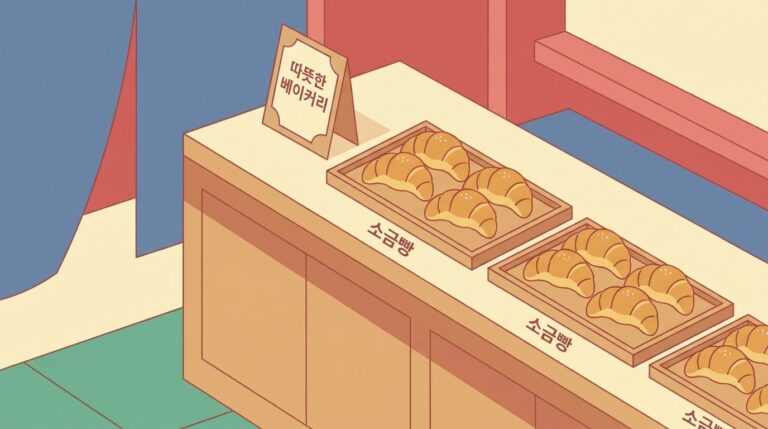
When is the Next Salt Bread Coming Out? The K-Bakery Guide
Phase 1: Empathy (Catching the Fresh Batch!)
안녕하세요! 매일한글 에디터입니다! (Annyeonghaseyo! It is your Daily Hangul editor here!)
Picture this: You are strolling through the trendy alleys of Seongsu-dong or Yeonnam-dong on a crisp afternoon. A divine, buttery aroma pulls you by the nose into a charming local boutique bakery. You spot a golden basket tagged 소금빵 (Sogeum-ppang / Salt Bread)—Korea’s reigning pastry darling. But as you grab your tray and tongs with excitement, your heart sinks: the shelf is completely bare! A small wooden card reads “준비 중” (In preparation).
Do you give up and settle for a cold pastry? Absolutely not! In Korean bakery culture, the magic happens when pastries come straight out of the hot deck oven. Freshly baked salt bread has a crispy bottom, an airy and buttery core, and flaky sea salt that melts on your tongue.
Many of our A2 learners tell us, “Editor, I saw the empty shelf and just walked out because I didn’t know how to ask when more would be baked!” Don’t let hesitation cost you the crunch of your life. Today, we are learning the exact natural Korean phrases locals use to catch warm, freshly baked bread right on time.
Phase 2: Core Expressions Deep Dive
Here are 3 essential expressions every bread lover in Korea needs:
1. 갓 구운 소금빵 나오는 시간이 언제예요?
- Pronunciation: [Gat gu-un so-geum-ppang na-o-neun si-gan-i eon-je-ye-yo?]
(Sound tip: “Gat” sounds like “gut” with a crisp, clipped ending; “ppang” is a pop-sound like “p” + “bang”!) - Meaning: Literal: “When is the time freshly baked salt bread comes out?” | Nuance: “What time does the next hot batch of salt bread come out?”
- K-Culture Moment: You will hear this everywhere in K-Vlogs whenever a foodie visits a famous “open-run” bakery in Seoul.
- Editor’s Insight: The tiny prefix 갓 (gat) means “just now / freshly.” Pair it with 구운 (gu-un / baked) to immediately sound like a connoisseur.
- Situation Spectrum:
- Casual (Friends): 갓 구운 빵 언제 나와? (⚠️ Close friends only)
- Semi-formal (Polite cafe talk): 갓 구운 소금빵 나오는 시간이 언제예요? (✅ Perfect for bakery staff)
- Formal (Official setting): 갓 구운 빵 출하 시간을 문의드립니다. (🚫 Too stiff for a bakery)
- 🤔 Think About It: In English, we often ask “When will it be ready?” but Koreans say “When does it come out?” (나와요). Notice how Korean treats the bread as an active protagonist emerging from the kitchen!
2. 방금 나온 빵 있어요?
- Pronunciation: [Bang-geum na-on ppang isseoyo?]
(Sound tip: “Bang-geum” rhymes with “gum” said twice quickly: bahng-geum!) - Meaning: Literal: “Is there bread that just came out?” | Nuance: “Do you have any pastries that just came fresh out of the oven?”
- K-Culture Moment: Seen in cozy K-dramas where the lead enters a bakery on a rainy day looking for comfort food.
- Editor’s Insight: If you aren’t picky about salt bread specifically and just want whatever is warm and cozy right now, this is your golden ticket.
- Situation Spectrum:
- Casual: 방금 나온 거 있어? (⚠️ Intimate only)
- Semi-formal: 방금 나온 빵 있어요? (✅ Natural and standard)
- Formal: 방금 나온 제품이 있습니까? (🚫 Sounds like an auditor)
- 🤔 Think About It: Why ask for “bread that just came out” instead of “hot bread” (뜨거운 빵)? In Korean culinary nuance, freshness (방금) is far more prized than merely temperature (뜨거움).
3. 몇 분 정도 걸려요?
- Pronunciation: [Myeot bun jeong-do geol-lyeo-yo?]
(Sound tip: “Myeot” sounds like “myut” without dragging out the t sound!) - Meaning: Literal: “About how many minutes does it take?” | Nuance: “How many minutes roughly until it is ready?”
- K-Culture Moment: In food travel reality shows when celebrities queue up at popular bakeries and check if they have time before their train leaves.
- Editor’s Insight: 정도 (jeongdo) adds a softening cushion meaning “around” or “roughly.” It makes your question sound much friendlier and less demanding.
- Situation Spectrum:
- Casual: 몇 분 걸려? (⚠️ Casual)
- Semi-formal: 몇 분 정도 걸려요? (✅ Daily sweet spot)
- Formal: 몇 분 소요되십니까? (🚫 Overly corporate)
- 🤔 Think About It: Adding “정도” turns a direct time query into a polite request that gives the baker breathing room.
Phase 3: Textbook Korean vs. Real Korean
Situation 1: Asking about the baking schedule
- 📖 Textbook Korean: 소금빵 제조 완료 시간은 언제입니까? (So-geum-ppang je-jo wan-ryo si-gan-eun eon-je-im-ni-kka?)
- 🗣️ Real Korean: 소금빵 언제 나와요? (So-geum-ppang eon-je na-wa-yo?)
- 💡 Why the difference? Textbook phrases sound like factory production logs! In daily life, Koreans keep questions light with “언제 나와요?” (When is it coming out?).
Situation 2: Checking if items are out of stock
- 📖 Textbook Korean: 소금빵 재고가 모두 소진되었습니까? (So-geum-ppang jae-go-ga mo-du so-jin-doe-eoss-seum-ni-kka?)
- 🗣️ Real Korean: 소금빵 다 나갔어요? (So-geum-ppang da na-gat-seo-yo?)
- 💡 Why the difference? Koreans colloquially say items “went out” (다 나갔어요) to mean “sold out” instead of using stiff business vocabulary.
Phase 4: K-Culture Deep Dive & Non-Verbal Manners
4-1. Nunchi & Bakery Etiquette
- Tray & Tong Etiquette: When you enter, pick up a tray (쟁반) and sheet of wax paper (유산지) before picking up your tongs (집게). Never tap your tongs together loudly like castanets! Korean bakery owners gently consider that bad table manners.
- The Blackboard Scan: Before asking the baker, quickly scan near the kitchen window. Many famous bakeries post a 빵 나오는 시간표 (Baking Schedule Blackboard). If you spot it, read the time first! It shows instant bakery nunchi (situational awareness).
- Eye Contact & Soft Bow: If the staff is busy rolling dough, make gentle eye contact, give a tiny 15-degree head nod, and start with “저기요, 혹시…” (Excuse me, by any chance…).
4-2. The “Bbangji Sunrye” Craze
In Korea, bakery touring is an official hobby called 빵지순례 (Bbangji Sunrye)—a playful blend of Bbang (bread) and Seongji Sunrye (pilgrimage). Food lovers travel from city to city with checklist maps. Salt bread (소금빵), originally introduced from Japan, underwent a massive renaissance in Korea with garlic-butter, truffle, and whipped-cream variations. Catching them warm is a badge of honor on Korean Instagram!
Phase 5: Real-Life Roleplay Scenario
Setting: Butter & Crust (버터앤크러스트), a boutique bakery in Yeonnam-dong. Sunbeams hit warm wooden displays.
Characters: Alex (An excited traveler) and Mina (A friendly young baker adjusting trays).
- Mina: 어서 오세요! 버터앤크러스트입니다. (Eoseo oseyo! Beoteo-aen-keureoseuteu-imnida. / Welcome! This is Butter & Crust.)
🎭 Greets with a warm smile from behind the showcase - Alex: 안녕하세요! 저… 혹시 소금빵 다 나갔나요? (Annyeonghaseyo! Jeo… hoksi sogeum-ppang da nagatnayo? / Hello! Excuse me… is the salt bread all sold out?)
🎭 Glances slightly worried at the empty wooden crate - Mina: 아, 앞 타임 수량은 방금 다 팔렸어요! (A, ap taim suryangeun bang-geum da pallyeosseoyo! / Ah, the previous batch just sold out completely!)
🎭 Tilts head apologetically with an understanding smile - Alex: 아쉽네요! 갓 구운 소금빵 나오는 시간이 언제예요? (Aswimneyo! Gat gu-un sogeum-ppang naoneun sigani eonjeyeyo? / What a pity! What time do the freshly baked salt breads come out?)
🎭 Asks politely with hands folded loosely in front - Mina: 다음 빵은 15분 뒤인 3시에 나와요! (Daeum ppang-eun sibo-bun dwi-in se-si-e nawayo! / The next batch comes out in 15 minutes, at 3:00 PM!)
🎭 Points gently toward the digital kitchen oven timer - Alex: 15분이면 금방이네요. 몇 개 남았는지 예약할 수 있어요? (Sibo-bun-imyeon geumbang-ineyyo. Myeot gae nam-eunneunji yeyak-hal su isseoyo? / 15 minutes is quick. Can I reserve two before they run out?)
🎭 Leans forward with hopeful eyes - Mina: 네! 결제 먼저 해 주시면 갓 나온 걸로 따로 빼놓을게요. (Ne! Gyeolje meonje hae jusimyeon gat na-on geollo ttaro ppaenoeulgeyo. / Yes! If you pay first, I will set aside hot ones straight from the oven for you.)
🎭 Tears off a pickup receipt with a bright nod - Alex: 정말 감사합니다! 따뜻할 때 꼭 먹고 싶었어요. (Jeongmal gamsahamnida! Ttatteut-hal ttae kkok meokgo sipeosseoyo. / Thank you so much! I really wanted to eat it fresh and warm.)
🎭 Bows politely and hands over a card
🔀 Interactive Decision Point
Suppose Mina told you: “다음 빵은 40분 뒤에 나와요.” (The next bread comes out in 40 minutes.) How do you respond?
- Choice A: 아, 그럼 40분 뒤에 다시 올게요! 감사합니다. (Ah, then I will come back in 40 minutes! Thank you.)
👉 Feedback [BEST]: Polite, natural, leaves a great impression, and lets you explore nearby shops. - Choice B: 왜 이렇게 오래 걸려요? 빨리 주세요. (Why does it take so long? Give it to me quickly.)
👉 Feedback [BAD]: Extremely rude! Baking takes fixed chemical and physical time; you will mortify the baker. - Choice C: 야, 너무 늦다! 다른 거 줘. (Hey, that is way too late! Give me something else.)
👉 Feedback [RISK]: Untenable rudeness! Uses banmal (informal language) with a complete stranger.
Phase 6: 10-Second Emotion Shadowing Drill
Practice matching your voice with genuine feelings using pause slashes (/):
[🥺 Slight disappointment, cute curiosity]
혹시… / 소금빵 / 다 나갔어요?
(Hoksi… / sogeum-ppang / da nagat-seo-yo?)-
[✨ Hopeful and bright]
갓 구운 빵은 / 언제 나와요?
(Gat gu-un ppang-eun / eonje nawayo?) -
[😊 Relieved and thankful]
10분이면 / 여기서 / 기다릴게요!
(Sip-bun-imyeon / yeogiseo / gidarilgeyo!)
Phase 7: K-Culture Mini Dictionary
- 소금빵 (Sogeum-ppang): Salt bread. A crescent-shaped roll rich with melted butter in the center and sea salt crystals sprinkled on top.
- 갓 구운 (Gat gu-un): Freshly baked. Combining “갓” (just now) and “구운” (baked). Can also be applied to rice: 갓 지은 밥 (freshly cooked rice).
- 빵지순례 (Bbangji-sunrye): Bread pilgrimage. Going bakery-hopping across neighborhoods like Mangwon, Seongsu, and Hannam.
- 품절 (Pumjeol): Sold out. Often displayed as 품절되었습니다 (Sold Out) or colloquially called 완판 (Clean sweep sold out).
Phase 8: Traveler’s Survival Kit
Top 3 Bread Survival Phrases:
- 포장해 주세요. (Po-jang-hae ju-se-yo.) — “Please pack it to go.” (Pro Tip: Bakeries often ask “드시고 가세요?” [Are you eating here?]. Answer with this phrase!)
- 따뜻하게 데워 주실 수 있나요? (Tta-tteut-ha-ge de-wo ju-sil su in-na-yo?) — “Could you warm this up for me?” (Pro Tip: If you miss the fresh batch, staff will gladly toast it for 30 seconds).
- 인기 메뉴가 뭐예요? (In-gi me-nyu-ga mwo-ye-yo?) — “What is your most popular item?” (Pro Tip: Great when the display has 30 overwhelming choices).
Editor’s Travel Note:
When hunting bakeries in Korea, do not use Google Maps because many small artisan shops update exclusively on Korean platforms. Use the Naver Map App for Bakery Search and search “소금빵 맛집” (Salt Bread Hotspots). Look for customer reviews with photos of the kitchen timetable!
Phase 9: One Step Deeper
In Korean food philosophy, timing is an emotional bond. Notice how the word 갓 (gat) appears in our fondest moments: 갓 구운 빵 (freshly baked bread), 갓 튀긴 치킨 (freshly fried chicken), 갓 지은 밥 (freshly made rice). Sharing food at its thermal, sensory peak is considered an act of deep hospitality and affection (정 / Jeong). When you wait patiently for the baker’s bell to ring, you aren’t just buying food; you are participating in a shared cultural ritual of savoring life’s simple warmth.
💬 Your Turn: Have you ever waited in line for food in Korea? Or what pastry would you love to eat straight out of an oven? Tell us in the comments below!
Phase 10: FAQ & Avoiding Misunderstandings
Q: Can I touch the bread with my bare hands if tongs run out?
A: Absolutely not! In Korea, touching display pastries with hands is a major hygiene taboo. If there are no tongs, politely ask: “집게 하나 더 주실 수 있나요?” (Could you give me one more tong?).
Q: What does “1인당 구매 제한” written on the sign mean?
A: It means “Purchase limit per person.” Famous salt bread shops often write 1인당 4개 제한 (Max 4 per customer) to prevent scalping and ensure everyone in line gets a share!
Q: Can I sit at the cafe table with just bread without buying a drink?
A: Most Korean bakery-cafes have a “1인 1음료” (1 beverage per person) policy if you use their dine-in seating. If you only want pastries, ask for 포장 (takeout).
🚨 Common Mistakes Alert:
- Mistake 1: Calling every baked item “케이크” (Cake).
Correct Action: Use 빵 (Ppang) as the master category for buns, rolls, and loaves. - Mistake 2: Asking “빵 언제 끝나요?” (When does bread finish?).
Correct Action: That sounds like you are asking when the bread will expire or close! Always ask: “빵 언제 나와요?” (When does the bread come out?). - Mistake 3: Putting bread directly onto the plastic tray without wax paper.
Correct Action: Always lay down a sheet of 유산지 (wax paper) first.
Phase 11: Action Mission & Engagement
- 🥉 Bronze Level: Stand in front of your mirror and practice saying “갓 구운 소금빵 나오는 시간이 언제예요?” 3 times smoothly in under 10 seconds.
- 🥈 Silver Level: Take a picture of your favorite pastry on Instagram or Threads and caption it in Korean: “갓 구운 빵이 최고예요! 🥐” (Freshly baked bread is the best!).
- 🥇 Gold Level: Enter a local Korean bakery in your city or during your Korea trip, locate the staff, and ask: “방금 나온 빵 있어요?” and buy whatever they recommend!
🎮 K-Culture Quest: Next time you watch a modern K-drama cafe scene, see if you can spot the words 포장 (takeout) or 소금빵 (salt bread) on the counter chalkboard.
Phase 12: Interactive Quiz Challenge
Test your real-world instincts!
1. Situational Judgment:
You enter a bakery at 1:50 PM. The salt bread basket is empty, but you smell baking butter. What is the most natural thing to say to the clerk?
(A) 빵 빨리 구워 주세요.
(B) 소금빵 나오는 시간이 언제예요?
(C) 빵이 왜 하나도 없습니까?
2. Fill in the Blank:
“Do you have any bread that just came out?”
→ “______ 나온 빵 있어요?”
3. True or False:
In Korea, it is polite to test how soft bread is by squeezing it gently with your tongs before putting it on your tray. (True / False)
👉 Click to view answers and explanations!
-
Answer: (B)
Explanation: (B) is polite, friendly, and practical. (A) is demanding, and (C) sounds accusatory. -
Answer: 방금 (Bang-geum)
Explanation: 방금 나온 빵 literally means “bread that just came out.” -
Answer: False!
Explanation: Never squeeze or damage pastries with tongs on the shelf! If you touch an item with tongs, you are expected to place it on your tray and purchase it.







