

안녕하세요! 매일한글 에디터입니다.
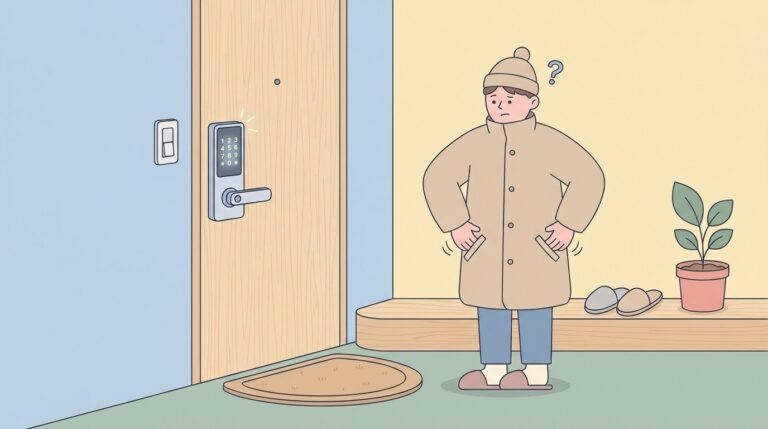
Have you ever stood in front of your front door after a long, exhausting day in Seoul, ready to collapse onto your cozy bed, only to freeze mid-step? You reach into your coat pocket expecting the reassuring click-clack of your apartment keycard. Nothing. You check your jeans pocket. Empty. You check your tote bag for the third time. Still nothing!
In movies, characters might yell dramatically. But in everyday Korean life, what truly slips out is a soft, puzzled sound: “Eora?” (어라?).
If you have only learned textbook Korean, you might be tempted to say: “Jeoneun yeolsoe-reul ireobeoryeotseumnida” (저는 열쇠를 잃어버렸습니다 – I have lost my key). While grammatically flawless, it sounds like an automated airport announcement! When something unexpected vanishes into thin air, native speakers instantly turn to natural exclamations and conversational fillers (추임새 – chuimsae). Master these little spontaneous sparks, and you instantly bridge the gap between sounding like a language robot and chatting naturally like a local friend.
Phase 2: Core Expressions Deep Dive
1. 어라? (Eora?)
- Pronunciation: [Eo-ra?] (Sounds like saying “Uh-rah?” with an eyebrow raised, like discovering your coffee cup is suddenly empty)
- Meaning: “Huh?” / “Wait, what?” (Literal: An instinctive exclamation of surprise at an unexpected result)
- K-Culture Moment: You will hear this in almost every Korean sitcom or romantic comedy when a character checks their fridge expecting late-night fried chicken leftovers, only to realize their roommate ate it.
- Editor’s Insight: “Eora?” is completely involuntary. It signals that your reality does not match your expectation. It is softer than “Wait!” and carries a gentle, puzzled curiosity rather than deep anger.
- Situation Spectrum: Casual ✅ | Semi-formal ⚠️ (Only as self-muttering) | Formal 🚫
- 🤔 Think About It: In English, we often blurt out “Wait…” or “What the…”. Korean uses soft vowel sounds like eo (어) to cushion surprise. How does your native language vocalize momentary confusion without sounding aggressive?
2. 분명히… (Bunmyeonghi…)
- Pronunciation: [Boon-myeong-hi] (Sounds like “Boon-myung-hee”, spoken with firm, deliberate emphasis)
- Meaning: “Clearly…” / “I definitely…” (Literal: Clearly / Evidently)
- K-Culture Moment: Classic K-Drama detective scene: “Bunmyeonghi yeogi isseonneunde…” (분명히 여기 있었는데… – “It was definitely right here just a moment ago…”).
- Editor’s Insight: At the A2 level, you know kkok (꼭 – surely) or jeongmal (정말 – really). But bunmyeonghi expresses your internal certainty about a past action. When paired with past tense, it means: “My memory is 100% sure I did this!”
- Situation Spectrum: Casual ✅ | Semi-formal ✅ | Formal ✅
- 🤔 Think About It: Why do humans across all cultures emphasize certainty right before realizing they made a silly mistake? Bunmyeonghi serves as your psychological defense before admitting defeat to misplaced keys!
3. 어디 갔지? (Eodi gatji?)
- Pronunciation: [Eo-di gat-ji?] (Think of “Uh-dee” + “got-jee?” with a contemplative downward-then-upward inflection)
- Meaning: “Where did it go?” (Literal: “Where did it go?” rather than “Where is it?”)
- K-Culture Moment: Running late for a morning subway at Gangnam Station, frantically looking around the living room entryway: “Kadeu eodi gatji?” (카드 어디 갔지? – “Where did my transit card go?”).
- Editor’s Insight: Notice that Korean personifies the missing object! Instead of asking “Eodi isseoyo?” (Where is it?), native speakers use the past tense of “to go” (gada -> gatji), as if the object grew legs and walked away on its own!
- Situation Spectrum: Casual ✅ | Semi-formal ⚠️ (As private self-talk) | Formal 🚫
- 🤔 Think About It: Saying “Where did it walk off to?” shifts the blame away from your own forgetfulness. Isn’t language wonderfully forgiving?
Phase 3: Textbook Korean vs. Real Korean
Scenario 1: Realizing something unexpected is missing
- 📖 교과서 한국어 (Textbook): 이상합니다. 물건이 없습니다. (Isanghamnida. Mulgeoni eopseumnida. / “This is strange. The object is not here.”)
- 🗣️ 진짜 한국어 (Real-life): 어라? 이게 왜 없지? (Eora? Ige wae eopji? / “Huh? Why isn’t this here?”)
- 💡 왜 다를까? (Why the difference?): Real Koreans rarely describe the state of an event as “strange” (isanghamnida) when searching for their belongings; they voice their immediate bewilderment with Eora? followed by a quick rhetorical question to themselves.
Scenario 2: Wondering where you left your keys
- 📖 교과서 한국어 (Textbook): 제 열쇠가 어디에 있습니까? (Je yeolsoega eodie itsseumnikka? / “Where is my key located?”)
- 🗣️ 진짜 한국어 (Real-life): 내 열쇠 어디 갔지? 분명히 주머니에 넣었는데… (Nae yeolsoe eodi gatji? Bunmyeonghi jumeonie neoeonneunde… / “Where did my key go? I definitely put it in my pocket…”)
- 💡 왜 다를까? (Why the difference?): When looking for personal items, Koreans treat the situation as an internal monologue (honjatmal). Asking “itsseumnikka?” sounds like you are interrogating someone else!
Phase 4: K-Culture Deep Dive & Non-verbal Manners
4-1. 눈치 (Nunchi) & Body Gestures
When muttering “어라?” (Eora?), body language does half the talking:
* The Head Tilt & Pocket Tap: You tilt your head 15 degrees to the side, lightly patting both outer coat pockets with flat palms. This visual cue signals to bystanders: “I’m not doing anything suspicious; I’m just looking for my personal belongings.”
* The Soft Monologue: In Korean public spaces, blurting out loud exclamations can disturb communal harmony. Instead, “어라?” is delivered at half-breath volume—audible enough for companions to realize you need a moment, but quiet enough to maintain public etiquette.
4-2. Cultural Code: The Land of Digital Locks (도어락)
If you visit or live in modern South Korea, traditional physical metal keys are nearly extinct. Almost every villa, apartment, and officetel uses a high-tech keypad digital door lock (번호키 / 도어락 – beonhoki / doeorak).
So why would someone say “열쇠 어디 갔지?” (Where did my key go?) today?
1. RFID Keyfobs & Cards: Many apartment systems provide small plastic RFID tags or cards for tapping the sensor rather than typing the code.
2. Metaphorical Use: Even when people mean their keycard, locker key at a jjimjilbang (Korean sauna), or bike lock key, yeolsoe remains the instinctive blanket term!
Phase 5: Real-World Roleplay Scenario
Setting: It is 10:30 PM outside an officetel hallway in Mapo-gu, Seoul. You and your Korean classmate, Minho, just grabbed late-night street tteokbokki and arrived at your door.
- Turn 1 (Minho):
🎭 Tiredly leaning against the wall with a boba tea in hand
오늘 진짜 많이 걸었다. 얼른 들어가서 쉬자!
(Oneul jinjja mani georeotta. Eolleun deureogaseo swija!)
“We really walked a lot today. Let’s hurry inside and rest!” -
Turn 2 (You):
🎭 Reaching into your padded jacket pocket confidently
응! 내가 문 열어 줄게. 잠깐만.
(Eung! Naega mun yeoreo julge. Jamkkanman.)
“Yeah! I’ll unlock the door for you. Just a second.” -
Turn 3 (You):
🎭 Fingers grasping only empty fabric, eyes blinking in surprise
어라? 분명히 주머니에 넣었는데…
(Eora? Bunmyeonghi jumeonie neoeonneunde…)
“Huh? I definitely put it in my pocket…” -
Turn 4 (Minho):
🎭 Perking up, noticing your sudden stillness
응? 왜 그래? 카드 키 안 보여?
(Eung? Wae geurae? Kadeu ki an boyeo?)
“Huh? What’s wrong? Can’t find your card key?” -
Turn 5 (You):
🎭 Frantically patting down your tote bag and jeans pockets
이상하다… 열쇠가 어디 갔지?
(Isanghada… Yeolsoega eodi gatji?)
“That’s weird… Where did the key go?” -
Turn 6 (Minho):
🎭 Putting his tea down to help you check
아까 분식집 테이블 위에 두고 온 거 아니야?
(Akka bunsikjip teibeul wie dugo on geo aniya?)
“Didn’t you leave it on the snack restaurant table earlier?” -
Turn 7 (You):
🎭 Gasping as memory strikes
아, 맞다! 계산할 때 꺼냈었어!
(A, matda! Gyesanhal ttae kkeonaesseosseo!)
“Oh, right! I took it out when paying!” -
Turn 8 (Minho):
🎭 Chuckling warmly and checking the restaurant receipt phone number
다행이다, 기억나서! 얼른 전화해 보자.
(Dahaeng-ida, gieongnaseo! Eolleun jeonhwahae boja.)
“Thank goodness you remembered! Let’s call them right away.”
🔀 Interactive Decision Point
Suppose you check your pockets and cannot find the key. How do you respond to Minho in Korean?
- Option A: “열쇠가 사라졌습니다. 경찰서에 갑시다.” (Yeolsoega sarajyeotseumnida. Gyeongchalseoe gapsida. – “The key has disappeared. Let us proceed to the police station.”)
- Option B: “어라? 분명히 아까 있었는데… 어디 갔지?” (Eora? Bunmyeonghi akka isseonneunde… eodi gatji? – “Huh? It was definitely here earlier… where did it go?”)
- Option C: “몰라요. 그냥 문 부수세요.” (Mollayo. Geunyang mun bususeyo. – “I don’t know. Just smash the door down.”)
Feedback:
- Option A (Risk): Far too dramatic and robotic! Losing an access card does not require a police dispatch team.
- Option B (Best!): ⭐ Perfectly natural A2 conversational Korean! It uses an exclamation (Eora?), emphasizes your memory (Bunmyeonghi), and invites your friend into problem-solving.
- Option C (Bad): You will shock your friend and end up with an enormous repair bill for the landlord!
Phase 6: 10-Second Emotion Shadowing Drill
Practice reading these lines aloud with the indicated emotion and pause markers (/):
[🤔 갸우뚱하며 의아하게 / Puzzled & Head-tilting]
어라? / 분명히 / 주머니에 넣었는데…
(Eora? / Bunmyeonghi / jumeonie neoeonneunde…)-
[😨 살짝 당황하며 혼잣말로 / Slightly flustered whisper]
내 카드 키 / 어디 갔지? / 가방에 있나?
(Nae kadeu ki / eodi gatji? / Gabange inna?) -
[💡 무릎을 탁 치며 번뜩 깨달았을 때 / Sudden realization click]
아, 맞다! / 테이블 위에 뒀지!
(A, matda! / Teibeul wie dwotji!)
Phase 7: K-Culture Mini Dictionary
- 도어락 (Doe-eo-rak) | Digital Door Lock
- Modern digital keypad/RFID locks installed on 95%+ of Korean residential front doors. Unlocking them with a keycard or a 4-to-6-digit PIN code is an essential daily ritual in Korea.
- 주머니 (Ju-meo-ni) | Pocket
- Common noun used in daily life. You will frequently hear idioms like “jumeoni sajeong” (pocket circumstances = financial budget).
- 깜빡하다 (Kkam-ppak-ha-da) | To slip one’s mind / To blank out
- An onomatopoeic verb describing a memory blinking out like a flickering lightbulb. “Kkamppakhaesseoyo!” (I totally spaced on that!).
- 추임새 (Chu-im-sae) | Conversational filler / Interjection
- Originally the vocal encouragement given by drummers in traditional Pansori music, now referring to natural everyday vocal reactions (e.g., geureochyo, eora, daebak) that keep a conversation breathing.
Phase 8: Traveler’s Survival Kit
Top 3 Lost-and-Found Survival Phrases
- 혹시 카드 키 보셨어요? (Hoksi kadeu ki bosyeosseoyo?)
- Meaning: “By any chance, did you see a card key?”
- Pro Tip: Always start polite requests with “Hoksi” (By any chance) to sound instantly considerate and gentle.
- 분실물 들어온 거 있나요? (Bunsilmul deureoon geo innayo?)
- Meaning: “Has any lost property been turned in?”
- Pro Tip: Use this at subway station info booths or hotel front desks.
- 잠깐만요, 주머니 좀 확인할게요. (Jamkkanmanyo, jumeoni jom hwaginhalkeyo.)
- Meaning: “One moment, let me check my pockets.”
- Pro Tip: Great to say when a clerk is waiting for your payment card or passport.
Editor’s Travel Note
If you accidentally leave your belonging on a Seoul metro train or bus, do not panic! South Korea has an exceptionally organized lost-and-found network. First, make sure you download Naver Map app to pinpoint the exact station name and car door number you used. Next, check the official police lost property portal LOST112. Koreans habitually hand over found phones, wallets, and keys to station masters within hours!
Phase 9: “One Step Deeper”
In Western cultures, talking out loud to yourself in public can occasionally draw curious looks. In Korean society, however, brief honjatmal (혼잣말 – self-directed speech) like “어라?” or “어디 갔지?” is a deeply ingrained social lubricant. By vocalizing your internal search state in front of others, you subtly telegraph: “I am currently searching for something, please bear with me for a moment.” It softens sudden pauses in interaction without forcing direct confrontation. Language in Korea is not just a tool for sending data; it is an ambient mood regulator.
💬 Your Turn: Have you ever lost your keys or transport card while traveling? What was the first word that slipped out of your mouth? Share your story in the comments below!
Phase 10: FAQ & Avoiding Misunderstandings
Q: Can I say “어라?” (Eora?) to my university professor or company boss?
A: No! “어라?” is an informal exclamation. Using it directly while looking at your boss will sound cheeky or impolite. However, if you are looking down into your own bag and murmur it under your breath, it is tolerated as self-talk. In formal business dialogue, substitute it with: “Eo, jamsi mannyo…” (어, 잠시만요… – “Oh, excuse me for just one moment…”).
Q: What is the subtle difference between “어?” (Eo?) and “어라?” (Eora?)?
A: “어?” (Eo?) is a single-syllable reflex of pure surprise (like “Huh?”). “어라?” (Eora?) carries an added layer of narrative intrigue: you expected situation X, but discovered situation Y. It invites exploration.
Q: What does the suffix “-지?” (-ji?) mean in “어디 갔지?” (Eodi gatji?)?
A: The ending -ji indicates you are asking a question to yourself or seeking gentle confirmation from your own memory. It turns “Where did it go?” into a soft, musing self-inquiry rather than a demand for an answer from someone else.
🚨 Common Mistakes Warning Board
- Mistake: Shouting “Eora!” at a waiter when your order is late.
- Correction: Never use Eora to address service staff. Say: “Jeogi-yo, jumun hwagin jom butakdeuryeoyo” (저기요, 주문 확인 좀 부탁드려요 – Excuse me, could you please check our order?).
- Mistake: Saying “Nae yeolsoe eodi gaseoyo?” trying to make eodi gatji polite with honorifics.
- Correction: Objects do not get the honorific -syeo-. If asking someone politely, say: “Hoksi yeolsoe eodi inneunji aseyo?” (혹시 열쇠 어디 있는지 아세요? – Do you happen to know where the key is?).
- Mistake: Pronouncing Bunmyeonghi as “Boon-myung-hee” with a hard, flat English “H”.
- Correction: The h sound between vowels in Korean is very soft and breathy, almost silent. Blend it smoothly: [Bun-myeong-i].
Phase 11: Action Mission & Engagement
Put this lesson to work immediately with your 3-Step Action Mission:
* 🥉 Bronze Mission (Solo Practice): Hide your room key or earphones under a pillow. Walk up to it, look around, tilt your head, and practice saying: “어라? 분명히 여기 뒀는데 어디 갔지?” three times with authentic facial expressions!
* 🥈 Silver Mission (Social Share): Post a short clip or text on your Instagram story / Threads tagging @DailyHangul with the caption: “Eora? Where did my weekend go? 어라? 주말 어디 갔지?”
* 🥇 Gold Mission (Real-world local action): The next time you open your backpack or search your pockets in Korea, skip the English “Wait, where is it?” and whisper to yourself: “어라? 어디 갔지?”
🎮 K-Culture Mission: Watch any episode of a Korean variety show (like Running Man or Going Seventeen). Count how many times the members say “Eora?” or “Eodi gatji?” during mission games. You will easily hear it at least three times!
Phase 12: Interactive Quiz Challenge
Test what you have absorbed today!
1. Situational Judgment
You are standing at the convenience store checkout counter. You swore you had your wallet in your right pocket, but your hand comes up empty. What is the most natural, authentic Korean phrase to mutter as you check your bag?
* (A) 실례합니다. 지갑이 파괴되었습니다.
* (B) 어라? 분명히 주머니에 넣었는데…
* (C) 당신은 내 지갑을 보았습니까?
2. Fill-in-the-Blank
Complete the sentence to mean: “I definitely put it here… where did it go?”
[ ________ ] 여기 뒀는데... 어디 [ ________ ]?
3. True / False Cultural Check
- Statement: Saying “어라?” directly to your company director during a formal meeting is considered completely standard and polite Korean business honorific speech. (True / False)
👉 Click to reveal answers & explanations!
- Answer: (B)
- Explanation: (B) accurately uses Eora? and Bunmyeonghi to express momentary surprise and memory certainty. (A) unnaturally says your wallet was destroyed, and (C) sounds like an aggressive foreign interrogation!
- Answer: 분명히 (Bunmyeonghi) / 갔지 (gatji)
- Complete Sentence: 분명히 여기 뒀는데… 어디 갔지? (Bunmyeonghi yeogi dwonneunde… eodi gatji?)
- Answer: False
- Explanation: “어라?” is an informal conversational particle (banmal family). Using it directly toward a boss or elder violates Korean honorific speech levels (jondaetmal).
- Explanation: “어라?” is an informal conversational particle (banmal family). Using it directly toward a boss or elder violates Korean honorific speech levels (jondaetmal).







