

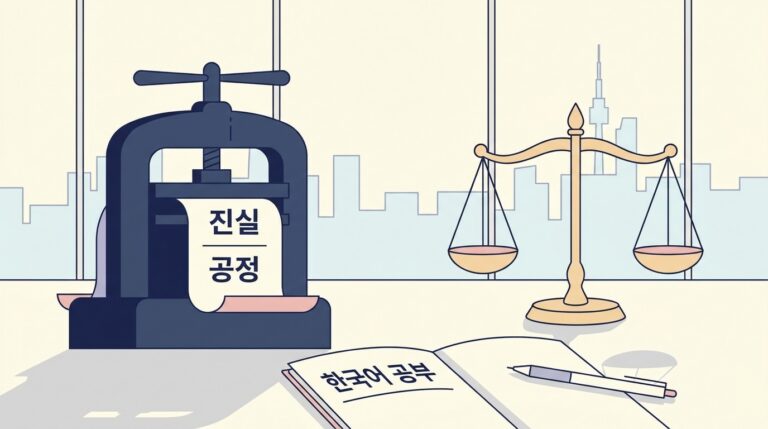
안녕하세요! 매일한글 에디터입니다.
Have you ever watched an intense scene in a Korean investigative drama—like Argon or Pinocchio—where an editor-in-chief slams their hand on the desk and shouts, “Can you prove in court that this serves the public interest?” If you have, you’ve witnessed one of the most intellectually charged battlegrounds in modern South Korea: the collision between investigative journalism’s gatekeeping duty and the constitutional protection of personal reputation. In South Korea, unlike in many Western common-law jurisdictions, speaking the absolute truth can still technically subject someone to criminal defamation under Article 307(1) of the Criminal Act (사실적시 명예훼손). Yes, you read that right: even if your report is 100% factually accurate, you can face criminal liability unless your reporting satisfies a very strict legal threshold.
Our advanced C2 learners often encounter this specific dilemma when parsing Korean editorial columns, Supreme Court precedents, or high-stakes corporate dramas. The burning question is: how do Korean journalists, whistleblowers, and broadcasters publish earth-shattering exposés without landing in prison? The answer lies in Article 310 of the Criminal Code—a doctrine known as the preclusion of illegality. Korean courts grant complete defamation immunity exclusively when two stringent conditions coexist: the reporting is unmistakably for the public interest (공공의 이익), and the reporter had reasonable grounds (상당한 이유)—backed by exhaustive, demonstrable verification—to believe the claim was true. Today, we step beyond elementary vocabulary to analyze the exact rhetorical tools, legal nuances, and journalistic gatekeeping phrasing used at the pinnacle of Korean intellectual discourse.
Phase 2: Core Expressions Deep Dive (핵심 표현 3선)
1. 공공의 이익 (Gonggong-ui i-ik)
- Pronunciation: [Gong-gong-ui i-ik] (Think of the resonant gong at a Buddhist temple ‘gong-gong’, combined with the crisp English word ‘eek’ softened into ‘i-ik’.)
- Meaning: Literal: “Public’s profit/benefit.” Nuance: The legal and civic doctrine of the public interest or common good, functioning as the decisive shield against civil and criminal defamation.
- K-Culture Moment: In the critically acclaimed legal thriller Stranger (비밀의 숲), prosecutors and journalists frequently weigh whether publishing an unverified memo serves “개인의 보복” (personal retaliation) or “공공의 이익” (the public good) before leaking it to the press.
- Editor’s Insight: To invoke this defense under Korean case law (대법원 판례), the subject matter cannot merely cater to voyeuristic curiosity (흥미 위주 보도). It must directly relate to state affairs, social justice, consumer safety, or the integrity of public figures.
- Situation Spectrum:
- Casual: 🚫 (Way too heavy for chatting over tteokbokki)
- Semi-formal: ⚠️ (Appropriate only when debating serious societal issues)
- Formal / Legal: ✅ (Essential for courtrooms, boardrooms, and editorial meetings)
- 🤔 Think About It: Does your native legal system criminalize true statements if they harm personal honor? How does Korea’s emphasis on communal harmony reshape what qualifies as “public interest”?
2. 상당한 이유 (Sangdanghan iyu)
- Pronunciation: [Sang-dang-han i-yu] (Sounds like ‘song’ with a flat ‘a’—’sang’, followed by ‘dong’, ending with the soft questioning sound ‘ee-yoo’.)
- Meaning: Literal: “Substantial / appropriate reason.” Nuance: The legal requirement of demonstrable, diligent verification; having objective grounds solid enough that any rational journalist would believe the findings are true.
- K-Culture Moment: Seen in newsroom dramas when a senior fact-checker rejects an exclusive scoop: “취재원 한 명의 진술만으로는 ‘상당한 이유’가 성립하지 않습니다!” (A single anonymous source doesn’t establish demonstrable verification!)
- Editor’s Insight: It is not enough to say “I genuinely believed it was true!” Korean Supreme Court precedent requires proof of cross-examination: Did you verify public records? Did you provide the opposing party a fair opportunity to refute the claims? Without tangible fact-checking records, this defense instantly collapses.
- Situation Spectrum:
- Casual: 🚫
- Semi-formal: ⚠️
- Formal: ✅
- 🤔 Think About It: Notice the difference between personal sincerity (주관적 신념) and justifiable verification (객관적 상당성). In Korean professional ethics, good intentions never pardon procedural negligence.
3. 위법성 조각 (Wibeopseong jogak)
- Pronunciation: [Wi-beop-seong jo-gak] (Break it down: ‘wee’ + crisp ‘bup’ + ‘sung’, then ‘cho’ + ‘gahk’ like chopping a block of wood.)
- Meaning: Literal: “Chipping away/carving out illegality.” Nuance: Justification; legal immunity or preclusion of wrongfulness (the act fits the statutory definition of an offense, but exceptional legal justifications eliminate criminal liability).
- K-Culture Moment: Broadcast journalists frequently consult in-house counsel right before airing investigative reports on programs like 그것이 알고 싶다 (Unanswered Questions), asking: “형법 제310조에 따라 위법성 조각 사유가 충분히 소명됩니까?” (Do we have sufficient evidence to substantiate preclusion of illegality under Article 310?)
- Editor’s Insight: ‘조각 (阻却/彫刻)’ here comes from legal Hanja meaning to block or negate (阻却). You will sound exceptionally fluent if you use “위법성을 조각하다” (to preclude illegality) rather than colloquial phrases like “무죄가 되다” (to become innocent).
- Situation Spectrum:
- Casual: 🚫
- Semi-formal: 🚫
- Formal: ✅ (Used in juridical, broadcast, and executive corporate contexts)
- 🤔 Think About It: Why does Korean law characterize the defense as “negating illegality” rather than defining truthful reporting as fundamentally non-criminal from the outset?
Phase 3: 교과서 한국어 vs 진짜 한국어 (Textbook vs. Real Native C2)
Scenario 1: Briefing your editor on the readiness of an investigative scoop
- 📖 교과서 한국어 (Textbook):
- 우리는 진실을 확인했기 때문에 고소를 당하지 않을 것입니다.
- (Urineun jinsireul hwaginhaetgi ttaemune gosoreul danghaji aneul geosimnida.)
- “Because we verified the truth, we will not be sued.”
- 🗣️ 진짜 한국어 (Native C2 Gatekeeping):
- 반론권 보장과 교차 검증을 충실히 거친 만큼, 위법성 조각 사유로서 상당한 이유를 충분히 입증할 수 있습니다.
- (Ballon-gwon bojang-gwa gyocha geomjeung-eul chungsilhi geochin mankeum, wibeopseong jogak sayuroseo sangdanghan iyureul chungbunhi ipjeunghal su itseumnida.)
- “Insofar as we thoroughly upheld their right to refute and completed rigorous cross-verification, we can fully substantiate reasonable grounds for legal justification.”
- 💡 왜 다를까? (Why the difference?): In high-stakes journalism, simply “checking the truth” is amateurish. Elite Korean professionals explicitly highlight procedural defense markers like 반론권 보장 (guarantee of right of reply) and 교차 검증 (cross-verification).
Scenario 2: Responding to corporate threats of defamation injunctions
- 📖 교과서 한국어 (Textbook):
- 이 기사는 모두를 위한 것이라서 법적으로 아무런 문제가 없습니다.
- (I gisaneun modureul wihan geosiraseo beopjeogeuro amureon munjega eopseumnida.)
- “This article is for everyone, so there is no legal problem at all.”
- 🗣️ 진짜 한국어 (Native C2 Gatekeeping):
- 본 보도는 오로지 공공의 알 권리와 사회적 감시라는 공익적 목적에 천착하고 있어, 위법성이 조각됨이 명백합니다.
- (Bon bPerformance dodo-neun oroji gonggong-ui al gwolliwa sahoejeok gamsiraneun gong-ikjeok mokjeoge cheonchakhago isseo, wibeopseongi jogakdoemi myeongbaekhamnida.)
- “This report adheres strictly to the public interest—namely, society’s right to know and democratic oversight—rendering preclusion of illegality incontrovertible.”
- 💡 왜 다를까? (Why the difference?): Using specialized, authoritative terms such as 천착하다 (to delve deeply/anchor strictly) and 사회적 감시 (social oversight) communicates unwavering legal readiness and institutional authority.
Phase 4: K-Culture Deep Dive & Non-Verbal Manners (K-문화 딥다이브)
4-1. 눈치 (Nunchi) & Gestural Dynamics in Gatekeeping
In Korean media and corporate boardrooms, gatekeeping is rarely an aggressive, screaming shouting match like in Hollywood films. Instead, it is conducted through weighted, chillingly precise non-verbal micro-manners:
* The Head Tilt and Silent Review: When an Editor-in-Chief (부장 / 편집국장) silently reviews your draft while gently turning pages without looking up, direct interruptions are strictly taboo. Wait for the pen to be placed horizontally across the desk—this non-verbal cue signals that the legal gatekeeping evaluation is complete.
* Eye-level Confrontation with Politeness: When addressing allegations of corporate malfeasance, maintaining direct eye contact without blinking while pairing it with ultra-deferential honorifics (극존칭) signals unwavering confidence. Saying “말씀하신 취지는 이해하나, 당사는 취재 윤리에 입각한 증빙 자료를 이미 확보했습니다” (I comprehend your perspective; however, we have already secured documentary evidence grounded in journalistic ethics) with an upright, disciplined posture conveys an unyielding journalistic stance.
4-2. Cultural Code Analysis: The Legend of ‘그것이 알고 싶다’ (Unanswered Questions)
For over three decades, SBS’s flagship investigative show 그것이 알고 싶다 has defined the gold standard of public-interest verification in South Korea. The host’s iconic signature catchphrase—“그런데 말입니다…” (Geureonde marimnida… / But you see… / However…)—has entered the national lexicon as a symbol of critical inquiry.
What makes the show culturally remarkable is its acute awareness of the “알 권리 vs. 인격권” (Right to Know vs. Personality Rights) balance. Notice how broadcast editors blur faces, modulate voices, and present side-by-side verification reports. They do not just reveal scandals; they visually demonstrate to the viewing public (and prospective appellate judges) that they painstakingly fulfilled the legal requirement of 상당한 이유 before hitting the broadcast switch.
Phase 5: Real-World Roleplay Scenario (실전 롤플레이 시나리오)
Setting: Late evening inside the investigative desk meeting room of a major Seoul daily. Rain streaks against the floor-to-ceiling windows overlooking Gwanghwamun. Desk Chief Han (한 부장), a veteran journalist of 25 years with battle scars from Supreme Court trials, faces junior reporter Park (박 기자), who holds an unverified insider ledger detailing slush funds of a major conglomerate.
- 박 기자 (Reporter Park):
- 부장님, 이 장부만 단독 보도하면 정경유착의 민낯을 그대로 폭로할 수 있습니다. 지금 송고해야 합니다!
- (Bujangnim, i jangbuman dandok bodohamyeon jeong-gyeong-yuchag-ui minnacheul geudaero pongnohal su itseumnida. Jigeum songgohaeya hamnida!)
- “Desk Chief, if we run an exclusive on this ledger alone, we can expose the raw reality of political-business collusion. We need to file the copy now!”
🎭 (Eyes burning with excitement, leaning forward and tapping the paper folder impatiently)
- 한 부장 (Desk Chief Han):
- 침착해, 박 기자. 특종 욕심에 눈이 멀면 법정에서 언론의 명예가 한순간에 난도질당해.
- (Chimchakhae, Bak gija. Teukjong yoksime nuni meolmyeon beopjeong-eseo eonron-ui myeong-yega hansungane nandodildanghae.)
- “Calm down, Reporter Park. If you’re blinded by greed for a scoop, our journalistic honor will be slaughtered in court in an instant.”
🎭 (Slowly taking off reading glasses, rubbing the bridge of his nose with a calm, grave expression)
- 박 기자 (Reporter Park):
- 하지만 대기업 총수의 횡령 혐의는 명백한 공공의 이익에 부합하지 않습니까?
- (Hajiman daegieop chongsu-ui hoengnyeong hyeom-uineun myeongbaekhan gonggong-ui i-ige buhap-haji anseumnikka?)
- “However, doesn’t corporate embezzlement by a conglomerate chairman unequivocally serve the public interest?”
🎭 (Looking baffled, spreading hands outward in protest)
- 한 부장 (Desk Chief Han):
- 공공의 이익은 절반의 요건일 뿐이야. 법원은 보도 내용이 진실이라고 믿을 만한 ‘상당한 이유’를 증명하라고 요구해.
- (Gonggong-ui i-igeun jeolban-ui yogeonil ppuniya. Beobwoneun bodo naeyong-i jinsirirago mideul manhan ‘sangdanghan iyu’reul jeungmyeongharago yoguhae.)
- “Public interest is only half the statutory requirement. The court demands we prove ‘reasonable grounds’ to believe the reporting was true.”
🎭 (Tapping his fountain pen firmly against the desk twice)
- 박 기자 (Reporter Park):
- 제보자의 진술이 일관되고, 장부의 회사 직인도 확인했습니다. 이 정도면 충분하지 않습니까?
- (Jebojaui jinsuri ilgwandoego, jangbu-ui hoesa jigindo hwaginhaetseumnida. I jeongdomyeon chungbunhaji anseumnikka?)
- “The whistleblower’s testimony is consistent, and I verified the corporate seal on the ledger. Isn’t this sufficient?”
🎭 (Furrowing eyebrows, speaking in an earnest, defensive tone)
- 한 부장 (Desk Chief Han):
- 해당 기업에 대한 공식 반론권 행사는 거쳤나? 당사자의 해명 서면 없이는 교차 검증의 흠결로 위법성 조각이 깨져.
- (Haedang gieobe daehan gongsik ballon-gwon haengsaneun geochyeonna? Dangsajaui haemyeong seomyeon eopsineun gyocha geomjeung-ui heumgyeollo wibeopseong jogagi kkaejyeo.)
- “Did you give the company an official opportunity to exercise their right of reply? Without their written response, verification defects will shatter our immunity defense.”
🎭 (Leaning back into the leather chair, folding his arms resolutely)
- 박 기자 (Reporter Park):
- …아직 반론 요청서를 발송하지 못했습니다. 보도가 유출되어 엠바고가 깨질까 두려웠습니다.
- (…Ajik ballon yocheongseoreul balsonghaji mothaetseumnida. Bodoga yuchuldoeeo embagoga kkaejilkka duryeowotseumnida.)
- “…I haven’t dispatched the official request for rebuttal yet. I was afraid the story would leak and break our exclusive embargo.”
🎭 (Dropping his head slightly, realizing the procedural vulnerability)
- 한 부장 (Desk Chief Han):
- 팩트의 치밀함이 기자의 생명줄이야. 내일 정오까지 서면 질의서를 보내고 답변 기한을 줘. 그게 우리를 지키는 유일한 방패다.
- (Paekteu-ui chimilhami gijaui saengmyeongjuriya. Naeil jeong-ogkaji seomyeon jir-uiseoreul bonaego dapbyeon gihaneul jwo. Geuge urireul jikineun yu-ilhan bangpaeda.)
- “Meticulous fact-checking is a reporter’s lifeline. Send the formal written inquiry by tomorrow noon and grant a deadline for rebuttal. That is the only shield that protects us.”
🎭 (Looking straight into Park’s eyes with quiet, paternal authority)
🔀 Interactive Decision Point
Imagine you are Reporter Park right after this conversation. What do you say to Desk Chief Han?
- Option A: “부장님 말씀이 맞습니다. 즉시 반론 요청서를 작성하여 법적 리스크를 차단하고, 교차 검증 내역을 파일링하겠습니다.” (You are right, Desk Chief. I will draft the inquiry immediately to eliminate legal liability and file all cross-verification documents.)
- Option B: “경쟁 언론사에서 눈치채기 전에 일단 온라인에 익명으로 짧은 단독 기사부터 올리겠습니다!” (Let’s at least upload a short anonymous exclusive online before rival newsrooms catch wind of it!)
- Option C: “기업 홍보팀에 전화해서 장부를 보여줄 테니 합의금을 준비하라고 압박하겠습니다.” (I will call the corporate PR team, show them the ledger, and pressure them into a settlement.)
Detailed Feedback:
* Choice A (Best Choice): 🏆 Flawless C2 professional judgment! You recognize that under Korean law, offering a verifiable right of reply (반론권 보장) is the cornerstone of establishing “상당한 이유.” You save the newsroom from criminal defamation and reputational suicide.
* Choice B (Bad Choice): ⚠️ Fatal error. Hasty publication without verifying counter-arguments removes the defense of Article 310. The court will deem the reporter negligent, exposing you to personal civil damages and criminal penalties.
* Choice C (Extreme Risk): 🚫 Disastrous. This crosses from reckless reporting directly into extortion (공갈죄) under the Korean Penal Code. You will lose your press credentials and face immediate imprisonment.
Phase 6: 10초 감정 섀도잉 드릴 (10-Second Emotional Shadowing Drill)
Practice these lines aloud, honoring rhythm markers (/) and emotional cues:
[⚖️ 결연하고 단호하게 - Resolute & Uncompromising]- 진실성 입증을 넘어 / 공공의 이익을 위한 보도였음을 / 법정에서 당당히 증명하겠습니다.
- (Jinsilseong ipjeung-eul neomeo / gonggong-ui i-igeul wihan bodoyeosseumeul / beopjeong-eseo dangdanghi jeungmyeonghagetseumnida.)
- “Beyond establishing the truth / that this was reported for the public benefit / we shall proudly substantiate before the court.”
[🔍 신중하고 엄격하게 - Rigorous & Analytical]- 단순한 풍문이나 추측은 배제하고, / 객관적인 교차 검증을 통해 / 상당한 이유를 확보해야 합니다.
- (Dansunhan pungmun-ina chucheug-eun baejehago, / gaekgwanjeogin gyocha geomjeung-eul tonghae / sangdanghan iyureul hwakbohaeya hamnida.)
- “Excluding simple rumors or speculations, / through objective cross-verification / we must secure reasonable grounds.”
[🛡️ 권위 있고 확신에 차서 - Authoritative & Steadfast]- 언론의 게이트키핑은 / 알 권리와 인격권의 균형점을 찾는 / 가장 준엄한 법적 책무입니다.
- (Eonron-ui geiteukiping-eun / al gwolliwa ingyeokgwon-ui gyunhyeongjeom-eul chajneun / gajang juneomhan beopjeok chaegmu-imnida.)
- “Journalistic gatekeeping is / finding the equilibrium between the right to know and personality rights / the most solemn legal obligation.”
Phase 7: K-Culture Mini Dictionary (핵심 키워드 4선)
- 알 권리 (Al gwolli)
- Translation: The Right to Know.
- Usage: Derived from constitutional guarantees of freedom of expression, this phrase is the ultimate justification used by Korean journalists to unearth governmental and corporate corruption.
- 인격권 (In-gyeok-gwon)
- Translation: Personality Rights (Right to Personal Honor and Privacy).
- Usage: Under Korean civil law, a person’s dignity, social reputation, and likeness rights are vigorously protected. It functions as the direct counter-weight to freedom of the press.
- 게이트키핑 (Ge-i-teu-ki-ping)
- Translation: Gatekeeping.
- Usage: Widely used in Korean journalism academia and elite media houses to denote the rigorous editorial process of fact-checking, legal vetting, and ethical evaluation prior to transmission.
- 엠바고 (Em-ba-go)
- Translation: Press Embargo.
- Usage: In the Korean press corps system (출입기자단), journalists and state/corporate organs mutually agree to hold back information until a stipulated time for accurate verification. Breaking an embargo can lead to an expulsion from press briefings.
Phase 8: Professional & Traveler’s Survival Kit (미디어/법조 참관 가이드)
If you are attending a public trial at the Seoul Central District Court or observing Korean press operations, keep these in your analytical arsenal:
- Top 3 High-Register Survival Expressions:
- “취재 윤리와 반론권 보장 절차를 명확히 준수했습니다.”
(We scrupulously observed journalistic ethics and right of reply procedures.)
→ Pro Tip: Use this when defending corporate statements or academic investigations against ethical complaints. - “공공의 알 권리에 비추어 보도의 정당성이 인정됩니다.”
(In light of the public’s right to know, the legitimacy of the reporting is recognized.)
→ Pro Tip: Found ubiquitously in editorial columns (사설) justifying aggressive exposés. - “사안의 중대성을 감안할 때 엄격한 교차 검증이 요구됩니다.”
(Considering the gravity of the matter, strict cross-verification is demanded.)
→ Pro Tip: Essential phrasing for high-level editorial, executive, or audit conferences.
- “취재 윤리와 반론권 보장 절차를 명확히 준수했습니다.”
- Editor’s Note: Navigating Legal and Media Resources in Korea:
- To review actual Supreme Court judgments on media defamation, install the 국가법령정보센터 앱 다운로드 to search Article 310 (형법 제310조) precedent.
- If you plan to attend a public appellate trial in Seocho-dong, Seoul, carry your official passport or Alien Registration Card (ARC), wear business attire, and turn off all recording electronics before entering the gallery.
Phase 9: “한 발 더 깊이” (Philosophical Essay & Reflection)
In Western common law, “truth” is often heralded as an absolute, unconditional defense against defamation. If it is true, the case typically ends there. In contrast, South Korea’s legal ethos—deeply rooted in communitarian sensitivity and the preservation of personal social standing (체면, Chaemyeon)—operates under the conviction that the weaponization of naked truth can cause irreparable societal death. Thus, the legal framework intentionally places a high hurdle: you may speak the truth about someone’s private or corporate affairs, but you must prove that your speech is elevated above malicious spite into the realm of the common good (공익성). This dual mandate—demanding both social purpose and demonstrable diligence—compels Korean journalism to constantly look inward, transforming gatekeeping into an existential moral test.
💬 Your Turn: Do you believe that exposing someone’s true past mistakes should be criminally punishable if it lacks “public interest”? Or should truth always be completely uninhibited? Share your perspective in the comments below! (여러분의 생각을 댓글로 남겨주세요!)
Phase 10: FAQ & Common Pitfalls (FAQ 및 주의사항)
Q: Can someone really be convicted of defamation in South Korea even if what they said was 100% true?
A: Yes. Under Korean Criminal Code Article 307(1), defaming another person by publicly stating true facts can result in up to two years of imprisonment or a fine of up to 5 million KRW. The only statutory exception is Article 310, which requires you to prove that the statement was exclusively for the public benefit (공공의 이익).
Q: What exact evidence proves “상당한 이유” (reasonable grounds) in Korean court?
A: Korean courts evaluate the thoroughness of the investigation: Did the reporter seek multiple independent corroborating sources? Did they inspect original documents? Did they give the accused party reasonable time to provide a counter-statement (반론권)? A single unverified anonymous tip will almost never satisfy 상당한 이유.
Q: Does criticizing a politician or public figure automatically qualify as “공익성” (public interest)?
A: Not automatically. While the Korean Supreme Court applies a far wider standard of tolerance regarding public figures and their official duties, purely personal, salacious aspects of a politician’s private life that do not affect their public competence remain fully protected under their personality rights (인격권).
🚨 Common Mistakes (흔한 실수 TOP 3)
- Mistake: Assuming that an apology from the subject means you can report without verification.
- Correct Action: An apology does not establish factual truth. Secure hard primary documents before running the story.
- Mistake: Using “무죄 (Mu-joe)” interchangeably with “위법성 조각 (Wibeopseong jogak)”.
- Correct Action: At C2 level, recognize that 위법성 조각 specifically means the act technically matches an offense definition, but its criminality is systematically nullified due to justified public purpose.
- Mistake: Relying solely on “알 권리” (The Right to Know) while completely ignoring “인격권” (Personality Rights).
- Correct Action: Korean courts balance the two like a scale (이익형량). Always demonstrate that your rhetoric carefully weighed the harm to the subject’s honor against societal benefit.
Phase 11: Action Missions & K-Culture Engagement (액션 미션)
- 🥉 Bronze Mission (Solo Shadowing): Read the Phase 6 Shadowing Drill aloud three times. Focus on delivering the legal terminology smoothly without pausing awkwardly between compound Hanja words.
- 🥈 Silver Mission (Critical Analysis): Pick a recent Korean news article exposing a corporate controversy. Identify whether the journalist explicitly cited a counter-argument (해명/반론) from the company.
- 🥇 Gold Mission (Community Debate): Write a 4-sentence Korean paragraph in the comment section evaluating a fictional investigative scoop using the words: 공공의 이익, 상당한 이유, and 위법성 조각.
- 🎮 K-Culture Mission: Watch an episode of a Korean legal drama (such as Hyena, Argon, or Law School). Spot the exact moment when counsel or an editor debates whether evidence can be released under the shield of public interest.
Phase 12: Interactive Quiz Challenge (인터랙티브 퀴즈 챌린지)
Quiz 1: Situation Judgment
A reporter discovers undeniable bank receipts proving an incumbent cabinet minister accepted bribes. However, without reaching out to the minister’s office for comment, the reporter airs the story immediately because “the evidence is clear and the public has an urgent right to know.” Under Korean Supreme Court precedent, what is the primary legal vulnerability?
🔍 Click to reveal the answer and legal analysis
Answer: The lack of demonstrable verification effort and denial of the right of reply (반론권 보장의 흠결), which jeopardizes the establishment of 상당한 이유 (reasonable grounds).
Analysis: While the topic unquestionably falls under 공공의 이익 (public interest), Korean jurisprudence firmly mandates that a diligent reporter must exhaust objective verification procedures—including offering the opposing party a fair chance to explain or contextualize the records—before immunity under Article 310 can be safely claimed.
Quiz 2: Fill in the Blank
Complete this advanced legal assertion:
“언론 보도가 진실성 여부를 떠나 오로지 사회 일반의 ( )을/를 도모하기 위한 것일 때, 형법 제310조에 따라 ( ) 사유가 인정될 여지가 커집니다.”
🔍 Click to reveal the answer
Answer: 공공의 이익 (Public Interest) / 위법성 조각 (Preclusion of Illegality / Justification)
Full Sentence: “언론 보도가 진실성 여부를 떠나 오로지 사회 일반의 공공의 이익을 도모하기 위한 것일 때, 형법 제310조에 따라 위법성 조각 사유가 인정될 여지가 커집니다.”
(When reporting aims solely to promote the public interest of general society, the likelihood of recognizing justification/preclusion of illegality under Article 310 expands significantly.)
Quiz 3: True or False Cultural/Legal Check
Statement: In South Korea, if an exposé about a private citizen is proven 100% true, the journalist is automatically exempt from criminal defamation charges without needing to prove public interest.
🔍 Click to reveal the answer
Answer: FALSE (거짓)
Explanation: South Korea maintains criminal defamation for truthful statements under Criminal Code Article 307(1). Without proving that the report served 공공의 이익 (public interest) under Article 310, absolute factual truth alone does not grant automatic immunity.







