

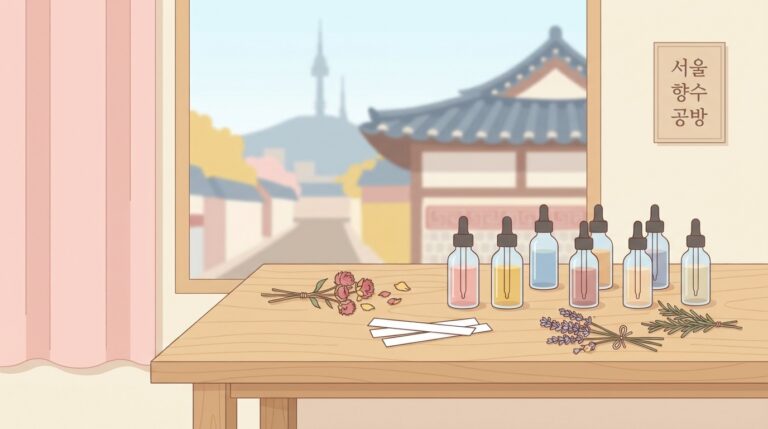
Craft Your Signature Scent: The Ultimate Korean Guide to Niche Perfume Workshops
Phase 1: 공감 (Story Immersion Opening)
안녕하세요! 매일한글 에디터입니다.
Imagine walking down an atmospheric brick alleyway in Seongsu-dong or Yeonnam-dong on a crisp Seoul afternoon. You step through an unassuming frosted glass door into a sunlit atelier lined with amber bottles, delicate pipettes, and strips of textured paper. You’ve booked a bespoke perfume “one-day class” (원데이 클래스) to blend a signature scent that nobody else on earth possesses. But as the friendly perfumer hands you a test strip and gently asks, “어떤 분위기의 향을 원하세요?” (Eotteon bunwigieui hyangeul wonhaseyo? / What kind of mood are you envisioning?), your mind goes completely blank. You know what you want to smell like in English—soft, grounding, subtly sweet, like fresh rain on pine needles—yet the only Korean words coming to mind are “좋아요” (joh-ayo / good) and “꽃 냄새” (kkot naemsae / flower smell).
If you have ever felt trapped behind basic vocabulary while trying to express complex, artistic sensory impressions, take a deep breath. At the B2 level, moving past textbook descriptors into tactile, emotive Korean is where your conversational fluency truly blooms. This guide is crafted directly from field experience in Seoul’s top artisanal perfumeries to equip you with nuanced sensory vocabulary, professional atelier etiquette, and natural phrases that will make Korean perfumers nod in instant appreciation.
Phase 2: 핵심 표현 3선 심층 분석 (3 Core Expressions Deep Dive)
1. 잔향이 은은하게 남았으면 좋겠어요 (Janhyangi euneunhage namasseumyeon jokesseoyo)
- Pronunciation: [Jan-hyang-i eun-eun-ha-ge na-mas-seu-myeon jo-kes-seo-yo] (Sounds like: Zhan-hyahng-ee oon-oon-hah-geh nah-mahs-soo-myun zho-kess-uh-yo)
- Meaning: Literal: “It would be nice if the lingering scent remained delicately.” / Actual Nuance: “I’d love for the dry-down (base note) to fade into a soft, subtle skin scent.”
- K-Culture Moment: Frequently heard in lifestyle vlogs where creators describe bespoke fragrances that leave a delicate trace on knitted scarves in autumn.
- Editor’s Insight: 잔향 (janhyang) specifically refers to the trailing dry-down or base note, while 은은하게 (euneunhage) depicts something soft, shimmering, and non-intrusive. It’s the ultimate praise for understated elegance in Korea.
- Situation Spectrum:
- Casual: ⚠️ (Use “잔향이 은은하게 남으면 좋겠어”)
- Semi-formal: ✅ (Perfect for one-day classes and boutique consultations)
- Formal: ✅ (“잔향이 은은하게 남기를 희망합니다”)
- 🤔 Think About It: Notice how Korean culture cherishes 은은함 (subtle diffusion) over loud, overpowering projection. Why do you think modern Koreans gravitate toward quiet luxury in personal scent?
2. 묵직한 우디 향에 상큼한 시트러스를 더하고 싶어요 (Mukjikan udi hyange sangkeumhan siteureoseureul deohago sipeoyo)
- Pronunciation: [Muk-jji-kan u-di hyang-e sang-keum-han si-teu-reo-seu-reul deo-ha-go si-peo-yo] (Sounds like: Mook-zjee-kahn oo-dee hyahng-eh sahng-koom-hahn she-too-ruh-soo-rool duh-hah-go she-puh-yo)
- Meaning: Literal: “I want to add fresh citrus to a heavy woody scent.” / Actual Nuance: “I’d like to brighten up a rich, deep woody base with a crisp, zesty top note.”
- K-Culture Moment: Seen in trend-focused YouTube reviews of artisanal Korean fragrance labels like Nonfiction, Tamburins, or Granhand.
- Editor’s Insight: 묵직하다 (mukjikada) comes from physical weight, describing rich bases like cedarwood, vetiver, or amber. Pairing it with 상큼하다 (sangkeumhada / bright, tart freshness) illustrates an intentional fragrance contrast.
- Situation Spectrum:
- Casual: ⚠️
- Semi-formal: ✅ (Standard polite form for workshops)
- Formal: ✅
- 🤔 Think About It: In English, we often say a scent is “heavy” or “dark.” Korean uses weight (묵직하다) alongside tactile textures. How does sensory metaphor change across your language and Korean?
3. 첫 향은 강렬한데 갈수록 포근해져요 (Cheot hyangeun gangnyeolhande galsurok pogeunhaejyeoyo)
- Pronunciation: [Cheot hyang-eun gang-nyeol-han-de gal-su-rok po-geun-hae-jyeo-yo] (Sounds like: Chuht hyahng-oon gahng-nyul-hahn-deh gahl-soo-rohk poh-goon-heh-zyuh-yo)
- Meaning: Literal: “The first scent is intense, but as time goes on, it becomes cozy.” / Actual Nuance: “The opening has a punchy impact, but the dry-down turns incredibly cozy and comforting.”
- K-Culture Moment: Used by beauty influencers describing how a spicy top note evolves into a warm musk or cashmeran blend.
- Editor’s Insight: 첫 향 (cheot hyang) is the everyday Korean phrase for the top note. The connector 갈수록 (galsurok / gradually as time passes) demonstrates smooth temporal transition, showcasing intermediate grammatical mastery.
- Situation Spectrum:
- Casual: ⚠️
- Semi-formal: ✅
- Formal: ✅
- 🤔 Think About It: 포근하다 (pogeunhada) evokes wrapping yourself in freshly laundered blankets on a cold morning. Korean distinguishes between 따뜻하다 (temperature warmth) and 포근하다 (emotional, tactile coziness).
Phase 3: 교과서 한국어 vs 진짜 한국어 (Textbook vs. Real Korean)
Situation 1: Describing the base note longevity
- 📖 교과서 한국어: 이 향수는 지속력이 매우 우수합니다. (I hyangsuneun jisongnyeogi maeu usuhamnida. / This perfume’s persistence is highly excellent.)
- 🗣️ 진짜 한국어: 잔향이 오래가서 살냄새처럼 자연스러워요. (Janhyangi oraegaseo salnaemsaecheoreom jayeonseureowoyo. / The dry-down lasts long and settles naturally like your own skin scent.)
- 💡 왜 다를까? Textbook phrases sound like clinical product specifications. Real native speakers evaluate perfumes around the viral concept of 살냄새 (salnaemsae / natural bare-skin scent), highlighting intimate, natural wearability over mechanical “longevity.”
Situation 2: Asking to modify the opening note
- 📖 교과서 한국어: 가벼운 탑 노트를 첨가해 주십시오. (Gabyeoun tap noteureul cheomgahae jusipsio. / Please add a light top note.)
- 🗣️ 진짜 한국어: 첫 향은 좀 더 산뜻하게 빼고 싶어요. (Cheot hyangeun jom deo santteuthage ppaego sipeoyo. / I’d prefer the opening note to feel a bit crisper and fresher.)
- 💡 왜 다를까? In actual creative workshops, Koreans use verbs like 빼다 (to draw out/shape a vibe) and evocative descriptors like 산뜻하다 (refreshingly crisp) instead of stiff directives like 첨가하다 (to add/supplement).
Phase 4: K-Culture 딥다이브 & 비언어적 매너 (K-Culture Deep Dive)
4-1. 눈치(Nunchi) & Atelier Manners
- The Smelling Strip (시향지) Ritual: When given a paper blotter (시향지, sihyangji), never wave it aggressively right under the perfumer’s nose or shake it frantically in the air. Instead, gently waft it 5 to 10 cm below your nostrils, keeping your shoulders relaxed. Take two soft breaths, pause, and step back.
- Olfactory Fatigue Etiquette: If your nose feels saturated, do not sniff your shirt or sigh loudly. Discreetly pick up the glass jar of roasted coffee beans (원두, wondu) placed on the table, take a slow breath through your nose, or gently breathe warm air into the crook of your own elbow. The perfumer will respect this conscious professional gesture.
4-2. The Bespoke & “Salnaemsae” Phenomenon in Korea
In contemporary South Korea, mass-market designer perfumes have taken a backseat among Millennials and Gen Z. Walking into subway stations smelling identical to everyone else is viewed as the antithesis of personal identity. Instead, “Niche Perfumery” (니치 퍼퓸) and bespoke ateliers represent personal branding. Koreans obsess over 살냄새—a fragrance that doesn’t smell like synthetic cologne, but rather gives the illusion that your body naturally radiates warm musk, clean cotton, or damp cedar. When booking an atelier in Bukchon or Seongsu, you aren’t just making a scent; you are formulating your own intimate signature.
Phase 5: 실전 롤플레이 시나리오 (Real-World Roleplay Scenario)
- Setting: A boutique niche atelier in Yeonnam-dong. Warm jazz plays softly, and sunlight filters over amber bottles.
- Characters:
- 조향사 지우 (Perfumer Jiwoo): A chic, attentive artisan with a sharp eye for scent harmony.
- 알렉스 (Alex): An intermediate Korean learner looking to craft a unique autumnal fragrance.
Turn 1
* 조향사 지우: 🎭 (새로운 시향지를 건네며 은은한 미소를 짓는다) 이번 베이스 노트는 샌달우드와 머스크를 조합해 봤는데, 느낌이 어떠세요?
(Ibeon be-i-seu no-teu-neun saen-dal-u-deu-wa meo-seu-keu-reul jo-hap-hae bwan-neun-de, neu-kkim-i eo-tteo-se-yo?)
“I blended sandalwood and musk for this base note trial. How does it feel to you?”
Turn 2
* 알렉스: 🎭 (시향지를 살짝 흔들어 알코올을 날린 뒤, 조심스럽게 향을 맡는다) 와, 첫 향은 묵직한데 갈수록 진짜 포근해지네요.
(Wa, cheot hyang-eun muk-ji-kan-de gal-su-rok jin-jja po-geun-hae-ji-ne-yo.)
“Wow, the initial scent is rich, but it gets genuinely cozy as time passes.”
Turn 3
* 조향사 지우: 🎭 (고개를 끄덕이며 차트에 기록한다) 맞아요. 미들 노트에 플로럴 계열을 살짝 얹으면 조금 더 부드러워질 것 같은데, 어떠세요?
(Ma-ja-yo. Mi-deul no-teu-e peul-lo-reol gye-yeo-reul sal-jjak eon-jeu-myeon jo-geum deo bu-deu-reo-wo-jil geot ga-teun-de, eo-tteo-se-yo?)
“Exactly. I think adding a soft floral touch to the middle note would soften it up even more. What do you think?”
Turn 4
* 알렉스: 🎭 (잠시 생각하다가 눈을 반짝이며) 너무 달달한 꽃향기보다는, 비 온 뒤 숲속 같은 촉촉한 느낌을 더하고 싶어요.
(Neo-mu dal-dal-han kkot-hyang-gi-bo-da-neun, bi on dwi sup-sok ga-teun chok-cho-kan neu-kki-meul deo-ha-go si-peo-yo.)
“Rather than an overly sweet floral scent, I’d love to add a moist feeling, like a forest after the rain.”
Turn 5
* 조향사 지우: 🎭 (감탄한 듯 미소를 띠며) 아, ‘페트리코(흙내음)’ 감성이군요! 그럼 시더우드와 이끼 향을 한두 방울 추가해 볼까요?
(A, ‘pe-teu-ri-ko(heuk-nae-eum)’ gam-seong-i-gun-yo! Geu-reom si-deo-u-deu-wa ik-ki hyang-eul han-du bang-ul chu-ga-hae bol-kka-yo?)
“Ah, a petrichor vibe! Shall we add a drop or two of cedarwood and oakmoss then?”
Turn 6
* 알렉스: 🎭 (기대 가득 찬 표정으로) 네, 좋아요! 잔향이 은은하게 남았으면 좋겠어요.
(Ne, jo-a-yo! Jan-hyang-i eun-eun-ha-ge na-mas-seu-myeon jo-kes-seo-yo.)
“Yes, sounds great! I really want the dry-down to linger delicately.”
Turn 7
* 조향사 지우: 🎭 (스포이트로 원액을 정밀하게 계량하며) 알렉스 님만의 분위기가 담긴 멋진 시그니처 향이 나올 것 같아요.
(Al-lek-seu nim-man-ui bun-wi-gi-ga dam-gin meot-jin si-geu-ni-cheo hyang-i na-ol geot ga-ta-yo.)
“I think we’re going to create a stunning signature scent that truly captures your persona, Alex.”
Turn 8
* 알렉스: 🎭 (원두 통을 집어 잠시 코를 정돈하며) 전문가의 손길이 닿으니 배합이 훨씬 정교해지네요!
(Jeon-mun-ga-ui son-gil-i da-eu-ni bae-hap-i hwol-ssin jeong-gyo-hae-ji-ne-yo!)
“With an expert’s guidance, the formulation becomes so much more sophisticated!”
🔀 인터랙티브 분기점 (Interactive Decision Point)
At Turn 4, the perfumer asks if you’d like to add a floral note. What do you say?
- Option A: 달달한 건 별로예요. 그냥 나무 냄새만 팍팍 넣어주세요. (Daldalhan geon byeolloyeyo. Geunyang namu naemsaeman pakpak neoeojuseyo.)
- Feedback: [Bad] “별로예요” can sound abrupt, and “팍팍” (dump heavily) disrupts the delicate nuance of perfume formulation.
- Option B: 플로럴도 좋지만, 첫 향은 좀 더 시원하고 산뜻하게 빼고 싶어요. (Peulloreoldo jochiman, cheot hyangeun jom deo siwonhago santteuthage ppaego sipeoyo.)
- Feedback: [Best] Exceptionally polite and clear. You acknowledge the suggestion while specifying a crisp, refreshing direction for the top note.
- Option C: 아무거나 어울리는 걸로 알아서 해주세요. (Amugeona eoullineun geollo araseo haejuseyo.)
- Feedback: [Risk] Bespoke classes exist to translate your individuality. Leaving it entirely to the perfumer robs you of the customized experience.
Phase 6: 10초 감정 섀도잉 드릴 (10-Second Emotion Shadowing Drill)
Read these aloud, hitting the pause markers (/) and channeling the emotional cues!
[😊 차분하고 기대감 넘치게]
잔향이 / 은은하게 남아서 / 하루 종일 기분이 좋을 것 같아요.
(Janhyangi / euneunhage namaseo / haru jongil gibuni joeul geot gat-ayo.)
“Because the dry-down lingers softly, / I feel like I’ll be in a good mood / all day long.”-
[🧐 섬세하고 탐색하듯이]
탑 노트는 상큼한데, / 베이스는 묵직해서 / 반전 매력이 있네요.
(Tap noteuneun sangkeumhande, / be-i-seuneun mukjikan-de / banjeon maeryeogi inne-yo.)
“The top note is zesty, / but because the base is heavy, / it has an unexpected contrasting charm.” -
[🥰 포근하고 감탄하며]
인위적이지 않고 / 제 원래 살냄새처럼 / 싹 스며들어요.
(Inwijeogiji anko / je wonrae salnaemsaecheoreom / ssak seumyeodeureoyo.)
“It’s not synthetic at all; / just like my own natural skin scent, / it absorbs seamlessly.”
Phase 7: K-Culture 미니 사전 (Core Vocabulary)
-
시향지 (Sihyangji / Scent Blotter Strip)
Meaning: Paper test strips used to evaluate perfume.
Usage: In an atelier, you’ll hear: “시향지에 살짝 묻혀서 잔향을 확인해 보세요.” (Test the dry-down after dipping the strip.) -
살냄새 (Salnaemsae / Natural Skin Scent)
Meaning: The intimate, natural scent of clean skin, often replicated by white musk, ambergris, or iris notes.
Usage: Crucial in Korean beauty marketing. “살냄새와 어우러지는 향” (A scent that harmonizes with your natural skin warmth). -
조향사 (Johyangsa / Perfumer)
Meaning: A fragrance designer or artisan who formulates scents.
Usage: Address the instructor politely as 조향사님 (Johyangsa-nim) instead of simply 선생님. -
원데이 클래스 (Wondei Keullaeseu / One-Day Workshop)
Meaning: A single-session lifestyle class popular among couples and friends for weekends.
Usage: Commonly booked on lifestyle platforms: “주말에 성수동으로 향수 원데이 클래스 다녀왔어요.”
Phase 8: 여행자를 위한 생존 키트 (Traveler’s Survival Kit)
Top 3 Survival Expressions in Ateliers
- 코가 조금 피로해서 원두 향 좀 맡을게요.
(Koga jogeum pirohaeseo wondu hyang jom mateulgeyo.)
Pro Tip: Use this when your olfactory senses get overwhelmed. It sounds respectful and sophisticated. - 지속력이 몇 시간 정도 유지되나요?
(Jisongnyeogi myeot sigan jeongdo yujidoenayo?)
Pro Tip: Essential when deciding between Eau de Toilette (오 드 뚜왈렛) and Eau de Parfum (오 드 퍼퓸) concentrations. - 이 향은 숙성(숙성 기간)을 얼마나 거쳐야 하나요?
(I hyangeun sukseongeul eolmana geochyeoya hanayo?)
Pro Tip: Freshly blended perfumes need 1–2 weeks of maceration (숙성 / sukseong) before peak performance.
Editor’s Travel Note
- Booking: Ateliers in trendy districts like Seongsu-dong (성수), Hannam-dong (한남), and Bukchon (북촌) strictly operate via advance reservation. Download the Naver Map Application to search for “조향 공방” (perfume workshops) and book time slots directly via Naver Booking (네이버 예약).
- Maceration Tip: After hand-blending, the perfumer will advise you to store the bottle in a cool, dark place for 14 days so the alcoholic base harmonizes with the essential oils.
Phase 9: “한 발 더 깊이” (Deep Thinking Essay)
In traditional Korean collectivism, drawing excessive personal attention was often discouraged; scent was historically associated with cleanliness (향긋함) rather than pungent individual assertion. However, modern South Korea’s explosion of niche perfumery marks a profound cultural transformation. In an ultra-dense, fast-paced society where visual style can quickly be copied on Instagram, your scent (나만의 향기) remains an invisible sanctuary of individuality. Creating a bespoke perfume is not merely a hobby; it is a quiet, poetic declaration that you exist as an individual with distinct memories, tastes, and presence.
💬 Your Turn: What would your signature Korean scent embody? Would you lean toward wet stone and pine (비 온 뒤 숲속), or soft morning laundry (포근한 비누 향)? Share your vision in the comments below!
Phase 10: FAQ & 흔한 실수 (FAQ & Common Mistakes)
Q: What is the difference between ‘냄새’ and ‘향 / 향기’?
A: 냄새 (naemsae) is a neutral word meaning “odor” or “smell,” which can include foul smells (e.g., 발냄새 – foot odor, 쓰레기 냄새 – trash smell). 향 (hyang) or 향기 (hyanggi) strictly refers to pleasant, aromatic fragrances, incense, or perfumes. Always ask for 좋은 향 rather than 좋은 냄새 in ateliers.
Q: Can I use English fragrance terms like ‘Top Note’ or ‘Woody’?
A: Absolutely! Korean perfumers frequently use loanwords such as 탑 노트 (tap noteu), 미들 노트 (mideul noteu), 베이스 노트 (be-iseu noteu), 우디 (woody), 시트러스 (citrus), and 머스크 (musk). However, adding Korean sensory predicates (e.g., 묵직한 우디, 산뜻한 시트러스) instantly elevates your fluency to B2 level.
Q: How do I tell the instructor that a scent is giving me a headache?
A: Politely say: “향이 제게는 조금 강해서 머리가 띵해요. 조금 더 은은한 계열로 바꿀 수 있을까요?” (The scent is a bit strong for me so I feel dizzy. Could we shift to a more delicate family?)
🚨 Common Mistakes Warning Board
- ❌ Mistake 1: Calling perfume “향기로운 약” (fragrant medicine) or using literal translations.
✔️ Fix: Simply use 향수 (hyangsu / perfume) or 시그니처 향 (signature hyang). - ❌ Mistake 2: Saying “냄새가 달아요” when describing sweet vanilla/floral notes.
✔️ Fix: Say 달콤한 향이 나요 (It smells sweet) or 달달해요 (colloquially sweet). - ❌ Mistake 3: Sniffing the dropper bottle directly from the rim.
✔️ Fix: Always transfer a drop to a 시향지 (test strip) and wait 5 seconds before smelling to let the alcohol evaporate.
Phase 11: 액션 미션 & 참여 유도 (Action Missions)
- 🥉 Bronze Level: Stand in front of your mirror and practice the phrase: “잔향이 은은하게 남았으면 좋겠어요” 5 times smoothly without reading the Romanization.
- 🥈 Silver Level: Check your favorite perfume at home. Write a one-sentence Korean description in the comments below describing its top and base notes (e.g., “첫 향은 시트러스라 상큼한데, 잔향은 우디해서 포근해요”).
- 🥇 Gold Level: During your next trip to Korea, book an atelier workshop or visit a niche store (like Tamburins or Granhand) and converse with the staff entirely in Korean without switching to English!
- 🎮 K-Culture Mission: Watch an episode of a modern K-drama (like 사내맞선 or 눈물의 여왕) or an idol vlog and spot whether they describe someone’s aura using scent metaphors (좋은 향이 난다).
Phase 12: 인터랙티브 퀴즈 챌린지 (Interactive Quiz Challenge)
1. 상황 판단 퀴즈 (Context Judgment)
You want the base notes of your bespoke perfume to settle like clean, natural skin warmth rather than synthetic sweetness. Which expression should you say to the perfumer?
* ① 인위적인 꽃 냄새를 팍팍 넣어 주세요.
* ② 첫 향이 너무 묵직해서 머리가 아파요.
* ③ 잔향이 은은한 살냄새처럼 남았으면 좋겠어요.
2. 빈칸 채우기 (Fill in the Blank)
- “첫 향은 상큼한 오렌지 향인데, 갈수록 나무 향이 느껴져서 참 [ ] 매력이 있네요.”
(힌트: A charm coming from an unexpected contrast or plot-twist)
3. True / False 문화 퀴즈
- In a Korean perfume atelier, it is standard polite etiquette to shake a scent test strip vigorously back and forth directly in front of the perfumer’s face to dry it quickly. (T / F)
🔍 정답 및 해설 확인하기 (Click to Reveal Answers)
-
정답: ③
해설: ③ directly communicates your desire for a soft, natural dry-down (은은한 살냄새). ① is rude and requests synthetic floral scents, while ② is merely a complaint. -
정답: 반전 (Banjeon – Reversal / Twist)
해설: 반전 매력 (banjeon maeryeok) is an indispensable Korean phrase meaning “an unexpected charm that surprises you,” perfectly describing a perfume whose dry-down differs delightfully from its opening! -
정답: False
해설: Shaking blotters aggressively is considered bad atelier manners. Waft it gently near your own nose, keeping space and avoiding intrusive movements.







