

Speak Like a K-Drama Lead: How to Say Let’s Start Over in Natural Korean
Phase 1: Empathy & Story Intro
안녕하세요! (Annyeonghaseyo!) I’m your Daily Hangul editor.
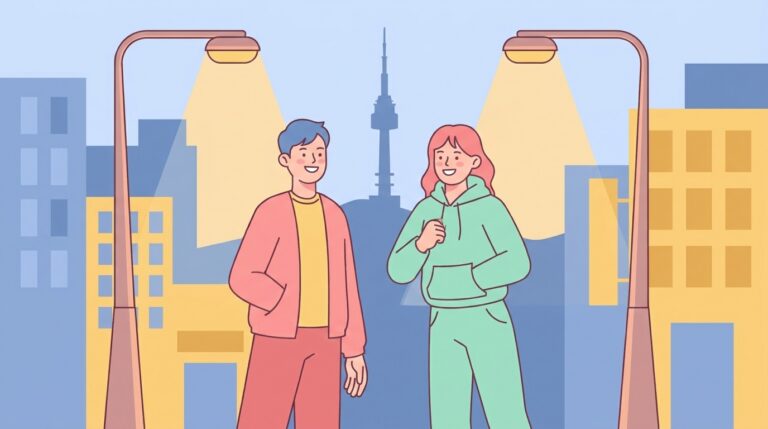
Picture this: Soft golden rain falls across a quiet street in Seoul. Inside a warm pojangmacha (street tent), two characters sit across from each other holding steaming paper cups of fish-cake broth. After ten episodes of painful misunderstandings, pride, and missed phone calls, the female lead looks up, eyes glistening, and whispers that magical line: “우리 다시 시작해요” (Uri dasi sijak-haeyo — “Let’s start over again”). The OST swells, viewers worldwide wipe away tears, and you think: I wish I could say that with that exact emotion!
If you have ever tried translating emotional K-drama lines using automated translation apps, you know the frustration. Apps often churn out robotic phrases like “Please reset the relationship,” which sounds more like rebooting a Wi-Fi router than opening your heart! Many of our beginner learners tell us they feel stuck between stiff textbook grammar and dramatic TV dialogue. This guide was built directly from real student feedback to bridge that gap. By learning how to say “let’s start over” naturally, you will not only understand your favorite drama scenes on a deeper level, but you will also gain the real-world ability to smooth over awkward moments, mend minor misunderstandings, and connect warmly with Korean speakers.
Phase 2: Core Expressions Breakdown
Here are the top three expressions you will hear repeatedly across romance, slice-of-life, and friendship K-dramas, broken down for absolute beginners.
1. 우리 다시 시작해요 (Uri dasi sijak-haeyo)
- Pronunciation: Uri dasi sijak-haeyo (Sounds like: Oo-ree dah-shee she-jack-hey-yo)
- Meaning: Literal: “We again start.” / Actual Nuance: “Let’s wipe the slate clean and try again from the beginning.”
- K-Culture Moment: The iconic reconciliation scene in romance dramas where both leads agree to forget the painful past.
- Editor’s Insight: The magic word here is 우리 (uri, meaning “we/our”). In Korean, placing uri at the start softens the mood instantly because it invites the other person into a shared experience rather than placing blame on anyone.
- Situation Spectrum:
- Casual (Friends/Intimate): ⚠️ 우리 다시 시작해 (Uri dasi sijak-hae – drop the -yo)
- Semi-formal (Polite everyday): ✅ 우리 다시 시작해요 (Uri dasi sijak-haeyo)
- Formal (Business/Speeches): 🚫 (Too personal and intimate for formal office settings)
- 🤔 Think About It: In English, we often say “Can I apologize?” or “Will you give me a second chance?” Why do you think Korean instinctively frames a restart around 우리 (“we”) instead of 나 (“me”)?
2. 처음부터 다시 해요 (Cheoeumbuteo dasi haeyo)
- Pronunciation: Cheoeumbuteo dasi haeyo (Sounds like: Chuh-eum-boo-tuh dah-shee hey-yo)
- Meaning: Literal: “From the start, do again.” / Actual Nuance: “Let’s take it from square one / Let’s pretend that didn’t happen and redo it.”
- K-Culture Moment: The hilarious moment when a first meeting goes completely wrong—like accidentally spilling iced Americano on someone’s white shirt—and the character offers a playful reset handshake.
- Editor’s Insight: 처음 (cheoeum) means “the very first time” and -부터 (-buteo) means “from.” You can use this playfully when you make a funny pronunciation mistake during your Korean practice!
- Situation Spectrum:
- Casual: ⚠️ 처음부터 다시 해 (Cheoeumbuteo dasi hae)
- Semi-formal: ✅ 처음부터 다시 해요 (Cheoeumbuteo dasi haeyo)
- Formal: ✅ 처음부터 다시 하시죠 (Cheoeumbuteo dasi hasijyo)
- 🤔 Think About It: Does asking for a “redo” feel less embarrassing when you acknowledge the awkwardness with a smile?
3. 우리 화해해요 (Uri hwahae-haeyo)
- Pronunciation: Uri hwahae-haeyo (Sounds like: Oo-ree hwa-heh-hey-yo)
- Meaning: Literal: “We reconcile.” / Actual Nuance: “Let’s make up / Stop being mad at each other.”
- K-Culture Moment: Two close friends or cute couples linking pinkies after a silly argument over who gets the last piece of Korean fried chicken.
- Editor’s Insight: 화해 (hwahae) means reconciliation. Adding -해요 (-haeyo) turns it into a warm proposal. It carries an affectionate, disarming tone that diffuses lingering anger.
- Situation Spectrum:
- Casual: ⚠️ 우리 화해하자 (Uri hwahae-haja)
- Semi-formal: ✅ 우리 화해해요 (Uri hwahae-haeyo)
- Formal: 🚫 (Sounds overly cute or emotional for business disputes)
- 🤔 Think About It: How does directly proposing peace demonstrate emotional honesty compared to waiting in cold silence?
Phase 3: Textbook Korean vs. Real Korean
Many phrasebooks teach stiff, written formulas that native speakers rarely say out loud in daily life. Here is how to upgrade your Korean from textbook robot to natural speaker:
Situation 1: Resetting an awkward conversation
- 📖 교과서 한국어 (Textbook): 관계를 재정립합시다. (Gwangyereul jaejeongniphapsida. – “Let us re-establish our bilateral relationship.”)
- 🗣️ 진짜 한국어 (Real-Life): 우리 다시 시작해요. (Uri dasi sijak-haeyo. – “Let’s start over again.”)
- 💡 왜 다를까? (Why the difference?): The textbook version sounds like two diplomats signing an international treaty! Real Korean prioritizes simple verbs like 시작하다 (sijakhada, to start) wrapped in polite -해요 endings.
Situation 2: Asking a friend to stop sulking after an argument
- 📖 교과서 한국어 (Textbook): 갈등을 원만히 해결합시다. (Galdeungeul wonmanhi haegyeolhapsida. – “Let us amicably resolve our conflict.”)
- 🗣️ 진짜 한국어 (Real-Life): 이제 우리 화해해요! (Ije uri hwahae-haeyo! – “Let’s make up now!”)
- 💡 왜 다를까? (Why the difference?): Conflict resolution between friends in Korea is emotional and relational, not legalistic. Short, gentle words melt cold atmospheres much faster.
Phase 4: K-Culture Deep Dive & Non-Verbal Manners
4-1. 눈치 (Nunchi) & Gestures
When saying “우리 다시 시작해요,” your body language speaks louder than your vocabulary:
* Eye Contact: Avoid intense, unbroken eye contact, which can feel aggressive or defensive in Korean culture. Soften your gaze, look down briefly when admitting your mistake, and look back up with a slight smile.
* The Head Tilt & Hand Position: Clasp your hands lightly near your chest or open your palms facing upward. A gentle 15-degree head tilt signals humility and sincerity.
* The Pinky Promise (약속 – Yaksok): If you are joking with a close friend, curl your pinky finger out toward them while saying 화해해요 (hwahae-haeyo). Touching thumbs (도장 – stamp) and sweeping palms (복사 – photocopy) guarantees a laugh.
4-2. Cultural Code: The Drama Trope of “Resetting”
In Korean storytelling, “starting over” is rarely about erasing consequences; it is about honoring 정 (Jeong—deep emotional bonding). When drama characters offer a reset, they are extending an olive branch that values the relationship over individual pride. Demonstrating this willingness to restart is seen as a sign of warmth and emotional maturity in Korean society.
Phase 5: Real-World Roleplay Scenario
Setting: You arranged to meet your Korean language exchange partner, Minjun, at a café in Hongdae. You took the subway in the wrong direction and arrived 30 minutes late. Minjun is sitting alone by the window sipping water.
- You: 민준 씨, 늦어서 정말 미안해요! (Minjun-ssi, neujeoseo jeongmal mianhaeyo! – Minjun, I am truly sorry I am late!)
🎭 Bows slightly at 30 degrees with a flustered expression - Minjun: 어, 왔어요? 괜찮아요! 길 찾기 많이 어려웠죠? (Eo, wasseoyo? Gwaenchanhayo! Gil chatgi mani eoryeowotjyo? – Oh, you made it? It’s okay! Was it very hard to find the way?)
🎭 Smiles warmly and gestures to the empty seat - You: 네, 지하철을 반대로 탔어요. 바보 같아요. (Ne, jihacheoreul bandaero tasseoyo. Babo gat-ayo. – Yes, I took the subway in the opposite direction. I feel so silly.)
🎭 Sits down, scratching head with an embarrassed grin - Minjun: 서울 지하철은 한국인도 헷갈려요. 시원한 커피 마셔요. (Seoul jihacheoreun hanguk-indo hetgallyeoyo. Siwonhan keopi masyeoyo. – Even Koreans get confused by the Seoul subway. Drink some cool coffee.)
🎭 Slides a fresh iced Americano toward you - You: 고마워요. 우리 처음부터 다시 시작해요! (Gomawoyo. Uri cheoeumbuteo dasi sijak-haeyo! – Thank you. Let’s start over from the very beginning!)
🎭 Smiles brightly and extends hand for a formal first-time handshake - Minjun: 하하, 좋아요! 안녕하세요, 저는 김민준입니다! (Haha, joayo! Annyeonghaseyo, jeoneun Kim Minjun-imnida! – Haha, great! Hello, I am Kim Minjun!)
🎭 Shakes your hand vigorously with a playful laugh - You: 만나서 반갑습니다! 오늘 재미있게 이야기해요. (Mannaseo bangapseumnida! Oneul jaemi-itge iyagihaeyo. – Nice to meet you! Let’s have a fun conversation today.)
🎭 Laughs with relief, tension completely gone - Minjun: 네! 맛있는 디저트부터 시켜요. (Ne! Masinneun dijeoteubuteo sikyeoyo. – Yes! Let’s order some delicious dessert first.)
🎭 Hands you the dessert menu
🔀 Interactive Decision Point
What if Minjun looked slightly stressed when you arrived? What should you say?
* Option A: “우리 다시 시작해요!” (Uri dasi sijak-haeyo!)
* Feedback (Best!): Perfect choice. It lightens the heavy mood, admits the awkwardness with self-awareness, and moves the day forward positively.
* Option B: “왜 화났어요?” (Wae hwanasseoyo? – Why are you angry?)
* Feedback (Bad): Dangerous! It puts the other person on the spot and assumes negative emotion, creating instant discomfort.
* Option C: (Saying nothing and checking your phone silently)
* Feedback (Risk): Cold and aloof. In Korea, letting silence hang after being late makes you appear indifferent.
Phase 6: 10-Second Emotion Shadowing Drill
Practice these three short lines aloud. Pay special attention to the pause slashes (/) and emotional tone cues!
[🥺 아쉽고 진심을 담아 / Sincere & Apologetic]- “미안해요… / 우리 다시 / 시작해요.”
- (Mianhaeyo… / uri dasi / sijak-haeyo.)
- Cadence: Drop your pitch on 미안해요, pause, then speak 시작해요 with a soft upward tilt.
[😊 밝고 활기차게 / Playful & Energetic]- “처음부터 / 다시 / 해요!”
- (Cheoeumbuteo / dasi / haeyo!)
- Cadence: Crisp bounce on 처음부터, quick pause, and a bright pop on 해요!
[🤝 다정하고 따뜻하게 / Gentle & Reassuring]- “이제 우리 / 화해해요, / 네?”
- (Ije uri / hwahae-haeyo, / ne?)
- Cadence: Soft melody throughout, finishing with a sweet, questioning 네? (ne?).
Phase 7: K-Culture Mini Dictionary
- 다시 (Dasi) | Adverb: Again / Anew
- Daily Usage: Used everywhere from ordering another drink (다시 주문할게요 – I will order again) to replaying your favorite K-pop song.
- 시작 (Sijak) | Noun: Beginning / Start
- Daily Usage: You hear this in every Korean competition show right before the buzzer: 시작! (Start!).
- 화해 (Hwahae) | Noun: Reconciliation / Peace
- Daily Usage: Essential drama vocabulary when two rivals finally shake hands and settle differences.
- 약속 (Yaksok) | Noun: Promise / Social Appointment
- Daily Usage: In Korean, saying “I have plans tonight” is simply 약속 있어요 (Yaksok isseoyo—literally, “I have a promise”).
Phase 8: Survival Kit for Travelers
If you find yourself in an awkward mix-up while traveling in Korea, keep these three lifesavers ready:
- 1. 한 번 더 해주세요 (Han beon deo hae-juseyo)
- Meaning: “Please do it one more time.”
- Pro Tip: If a train station clerk or barista speaks too quickly, say this politely while pointing to your ear.
- 2. 천천히 말해주세요 (Cheoncheonhi malhae-juseyo)
- Meaning: “Please speak slowly.”
- Pro Tip: Instantly signals to locals that you are a beginner learner without needing complex grammar.
- 3. 제가 실수했어요 (Jega silsuhaesseoyo)
- Meaning: “I made a mistake.”
- Pro Tip: A humble, highly respected phrase that immediately softens any misstep at hotels, restaurants, or transit gates.
Editor’s Travel Note
Getting lost on Seoul’s vast transit network happens to everyone! Always download the Naver Map app guide before landing, as international map services often lack updated walking routes in Korea. Pair it with the Kakao Metro navigation tool for real-time transfer alarms so you never miss your stop and arrive late to your Korean friend’s meetups!
Phase 9: One Step Deeper (Cultural Reflection)
In Western languages, the concept of starting over often emphasizes individual autonomy: “I want to try again” or “Give me another chance.” In Korean society, however, life is lived in the web of the collective. When you say 우리 다시 시작해요, you are not simply talking about yourself; you are wrapping both people in the protective blanket of 우리 (uri – we). This reveals how Korean communication seeks mutual harmony rather than unilateral victory. It reminds us that forgiveness and fresh starts are collaborative acts.
💬 Your Turn: Have you ever watched a K-drama scene where a character asked for a fresh start? What drama was it, and how did the other person react? Share your favorite scene in the comments below!
Phase 10: FAQ & Common Mistakes
Q: Can I use “우리 다시 시작해요” with my boss or teacher?
A: It is better not to! While the phrase ends in the polite -요 (-yo), the word 우리 combined with 다시 시작해요 carries romantic or close interpersonal undertones. For a boss or professor, use formal professional phrases like 다시 검토하겠습니다 (Dasi geomto-hagesseumnida – “I will review it again”) or 처음부터 다시 준비하겠습니다 (Cheoeumbuteo dasi junbi-hagesseumnida – “I will prepare it again from scratch”).
Q: What is the difference between “다시” (dasi) and “또” (tto)?
A: Both can translate to “again” in English, but they have distinct feelings! 다시 (dasi) means starting anew, redoing something from scratch, or returning to a previous state. 또 (tto) means an additional occurrence or repetition (often with a slight nuance of “again?!” when something repeats frequently).
Q: How do I respond if someone says “우리 다시 시작해요” to me?
A: If you agree happily, smile and say: “좋아요, 다시 시작해요!” (Joayo, dasi sijak-haeyo! — “Sounds great, let’s start over!”). If you need a moment, say: “생각해 볼게요” (Saenggak-hae bolgeyo — “I will think about it”).
🚨 Common Mistakes Warning Board
- Dropping the “-요” too early: Saying just 우리 다시 시작해 (Uri dasi sijak-hae) to someone older or not intimately close sounds rude and overly blunt. Always keep the -요 (-yo) attached!
- Confusing “시작” (Start) with “출발” (Departure): 시작 is for starting activities, processes, or relationships. 출발 (chulbal) is strictly for trains, flights, or physical journeys departing.
- Overusing automated translation for apologies: Saying 관계 리셋 (Gwangye riset – “relationship reset”) sounds comedic and robotic. Stick to genuine, everyday expressions like 처음부터 다시 해요.
Phase 11: Action Missions
Take your learning off the screen and into real life with these three progressive levels:
- 🥉 Bronze Mission (Solo Practice): Stand in front of your mirror, smile, extend your right hand, and practice saying “우리 처음부터 다시 해요!” three times with bright intonation.
- 🥈 Silver Mission (Social Media): Post a screenshot of your favorite K-drama reconciliation scene on Instagram or X (Twitter) and caption it in Korean: 우리 다시 시작해요! Tag
@DailyHangulso we can cheer you on! - 🥇 Gold Mission (Live Action): The next time you mispronounce a word during a language exchange or Korean class, laugh, wave your hands playfully, and say: “선생님, 처음부터 다시 해요!” (Teacher, let’s do it again from the start!).
🎮 K-Culture Bonus Mission: Put on an episode of your favorite romance K-drama this weekend. Keep a tally of how many times you hear the words 다시 (dasi) or 시작 (sijak). You will be amazed at how often they appear once your ears are tuned to them!
Phase 12: Interactive Quiz Challenge
Test your understanding of today’s lesson! Can you score 3 out of 3?
Question 1 (Situational Judgement)
You arrived 20 minutes late to lunch with a Korean friend because of heavy rain. You apologized, and now you want to playfully reset the atmosphere and start the day over. What is the most natural sentence to say?
* A) 우리 다시 출발합시다. (Uri dasi chulbal-hapsida.)
* B) 우리 처음부터 다시 해요! (Uri cheoeumbuteo dasi haeyo!)
* C) 갈등을 끝내세요. (Galdeungeul kkeunnaeseyo.)
👉 Click to reveal Answer & Explanation
Correct Answer: B
Explanation: Option B is bright, friendly, and invites a lighthearted restart. Option A uses 출발 (physical vehicle departure), and Option C is an awkward demand meaning “End the conflict!”
Question 2 (Fill-in-the-Blank)
Complete this classic K-drama reconciliation line:
* “미안해요. 우리 [ ] 시작해요.” (Hint: The word for “again / anew”)
👉 Click to reveal Answer & Explanation
Correct Answer: 다시 (dasi)
Explanation: The complete phrase is 우리 다시 시작해요 (Uri dasi sijak-haeyo — Let’s start over again).
Question 3 (True or False Cultural Quiz)
Statement: In Korean, using the word 우리 (uri – we/our) before making a polite request or proposal makes the speaker sound aggressive because it forces an assumption onto the listener.
* True or False?
👉 Click to reveal Answer & Explanation
Correct Answer: False!
Explanation: In Korean culture, 우리 is an affectionate, unifying word that diffuses tension and creates a feeling of togetherness (Jeong). It makes requests sound softer and much more collaborative.







