

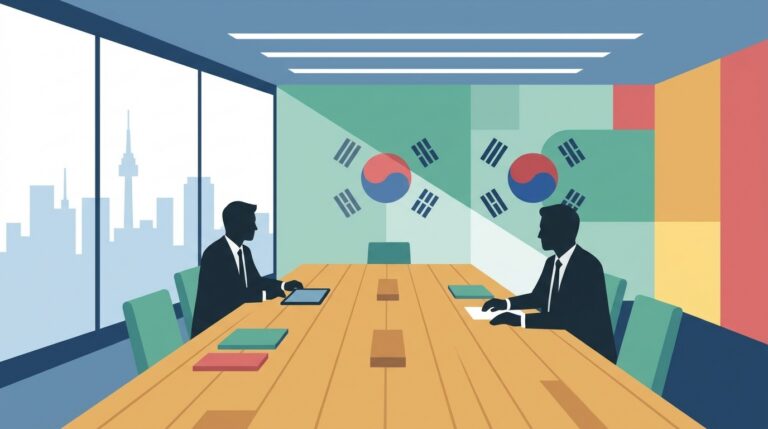
Diplomatic Rhetoric: Decoding Strategic Ambiguity and Constructive Parallel Phrasing in Korean
Phase 1: 공감 (Empathetic Narrative Opening)
안녕하세요! 매일한글 에디터입니다. Have you ever watched a gripping political K-drama like Designated Survivor: 60 Days or The Whirlwind, where two high-stakes delegations spend fourteen exhausting hours locked in a summit room, arguing fiercely over historical narratives or territorial jurisdiction—only to emerge in front of flashing press cameras, bow cordially, and release a joint statement that leaves international correspondents scratching their heads?
You might look at the official release and wonder: Wait, did they agree or did they disagree? The document seems to say both! In high-stakes diplomacy—especially across East Asia where sovereign integrity, contested history, and national dignity collide—direct confrontation is often seen as a failure of tact. Instead, seasoned negotiators master the delicate high-wire act of 전략적 모호성 (strategic ambiguity) and 병기 (parallel phrasing).
Navigating C2-level Korean requires reading far beyond literal dictionary entries; it demands decoding the pregnant silences, the meticulously balanced clauses, and the intentional double-meanings hidden between the lines (행간을 읽다). Many advanced learners tell me, “Editor, I know all the words in the treaty draft, but I cannot tell whether Seoul conceded or stood firm!” Don’t worry. Today, drawing on authentic diplomatic communiqués and executive training cases, we will unpack how elite Korean diplomats turn deadlocks into diplomatic breakthroughs. By the end of this guide, you will wield the linguistic precision needed to analyze, draft, and navigate even the most sensitive bilateral flashpoints with unmatched confidence.
Phase 2: 핵심 표현 3선 심층 분석 (Deep Dive: Top 3 Core Expressions)
1. 각자의 입장을 병기하다 (Gak-ja-ui ip-jang-eul byeong-gi-ha-da)
- Pronunciation: [Gak-ja-eui eep-jang-eul byeong-gee-ha-da] (Think of ‘byeong-gi’ like ‘parallel writing’, rhyming with ‘plenty’)
- Meaning: Literally “to write each party’s position side by side”; practically, using parallel phrasing in an official text so both sides can claim adherence to their domestic mandate without triggering an overt collapse of talks.
- K-Culture Moment: Seen in high-profile political thrillers and inter-Korean summit press rooms when drafting joint communiqués on armistice management or border demarcations.
- Editor’s Insight: This is the ultimate “agree to disagree” device in Korean diplomatic drafting. By using
병기하다, neither party absorbs the other’s legal vocabulary; they coexist peacefully on the same page. - Situation Spectrum: Casual 🚫 | Semi-formal ⚠️ | Formal ✅
- 🤔 Think About It: Does your native legal culture favor a singular, binding interpretation, or do you also allow dual-language parallel clauses to prevent geopolitical stalemate?
2. 상호 유의미한 합의점을 모색하다 (Sang-ho yu-ui-mi-han hab-ui-jeom-eul mo-saek-ha-da)
- Pronunciation: [Sang-ho yoo-ee-mee-hahn hahb-ee-jeom-eul mo-saek-hah-dah] (Sounds like ‘Sang-ho you-mean-me-hahn’)
- Meaning: Literally “to seek a mutually meaningful point of agreement”; contextually, an elegant euphemism acknowledging that no agreement exists yet, but both sides agree not to walk away from the negotiating table.
- K-Culture Moment: Spoken by presidential spokespersons at the Cheong Wa Dae or Yongsan Presidential Office briefing podium when fielding hostile press questions following an inconclusive bilateral dialogue.
- Editor’s Insight:
모색하다(to seek / to explore in the dark) signals ongoing process rather than finality. Pairing it with상호 유의미한elevates the dialogue from an outright impasse to a sophisticated work-in-progress. - Situation Spectrum: Casual 🚫 | Semi-formal ⚠️ | Formal ✅
- 🤔 Think About It: How does qualifying an outcome as “meaningful” protect face (체면) for both delegations in high-context societies?
3. 구동존이의 지혜를 발휘하다 (Gu-dong-jon-i-ui ji-hye-reul bal-hwi-ha-da)
- Pronunciation: [Goo-dong-john-ee-eui jee-hyeh-reul bahl-hwee-hah-dah] (Based on the Sino-Korean idiom 求同存異)
- Meaning: Literally “to exert the wisdom of seeking common ground while setting aside differences”; practically, pursuing actionable pragmatic cooperation while freezing contested sovereignty or historical debates.
- K-Culture Moment: A signature phrase deployed in Korea-China-Japan trilateral summits to advance supply-chain or climate agreements amidst unresolved territorial or wartime history controversies.
- Editor’s Insight: This expression reflects centuries of East Asian statecraft. It honors deep-seated ideological divergence without letting that divergence paralyze economic or humanitarian coordination.
- Situation Spectrum: Casual 🚫 | Semi-formal ⚠️ | Formal ✅
- 🤔 Think About It: Is compartmentalizing conflicts viewed as pragmatic diplomacy or moral compromise in your home country?
Phase 3: 교과서 한국어 vs 진짜 한국어 (Textbook vs. Real Diplomatic Korean)
Situation 1: Reporting an impasse over sovereign territory or historical terminology
- 📖 교과서 한국어 (Textbook Korean):
양측은 영토 문제에 대해 합의하지 못하고 회담을 끝냈습니다.
(Yang-cheuk-eun yeong-to mun-je-e dae-hae hap-ui-ha-ji mot-ha-go hoe-dam-eul kkeut-naet-seum-ni-da.)
“Both sides failed to agree on territorial matters and ended the meeting.” - 🗣️ 진짜 한국어 (Real Diplomatic Korean):
양측은 관련 사안에 대해 각자의 기본 입장을 재확인하고, 솔직하고 심도 있는 의견 교환을 나누었습니다.
(Yang-cheuk-eun gwan-ryeon sa-an-e dae-hae gak-ja-ui gi-bon ip-jang-eul jae-hwak-in-ha-go, sol-jik-ha-go sim-do it-neun ui-gyeon gyo-hwan-eul na-nu-eot-seum-ni-da.)
“Both sides reaffirmed their respective fundamental stances on the matters concerned and engaged in a frank, in-depth exchange of views.” - 💡 왜 다를까? (Cultural & Strategic Rationale): In diplomacy, saying “we failed to agree” signals diplomatic crisis or severed relations. In contrast, stating that parties reaffirmed fundamental positions through a frank exchange (
솔직한 의견 교환) signals a constructive deadlock where lines were drawn clearly without burning bridges.
Situation 2: Crafting intentional ambiguity in a joint communiqué clause
- 📖 교과서 한국어 (Textbook Korean):
양국은 나중에 이 단어의 의미를 다시 해석하기로 했습니다.
(Yang-guk-eun na-jung-e i dan-eo-ui ui-mi-reul da-si hae-seok-ha-gi-ro haet-seum-ni-da.)
“Both countries decided to reinterpret the meaning of this word later.” - 🗣️ 진짜 한국어 (Real Diplomatic Korean):
양측은 문맥적 해석의 여지를 열어둠으로써 전략적 유연성을 확보하기로 뜻을 모았습니다.
(Yang-cheuk-eun mun-maek-jeok hae-seok-ui yeo-ji-reul yeol-eo-dum-eu-ro-sseo jeon-ryak-jeok yu-yeon-seong-eul hwak-bo-ha-gi-ro tteut-eul mo-at-seum-ni-da.)
“Both parties concurred on securing strategic flexibility by leaving room for contextual interpretation.” - 💡 왜 다를까? (Cultural & Strategic Rationale): Elite diplomats never confess to postponing work; they frame ambiguities as proactive assets (
전략적 유연성, strategic flexibility) that preserve future room for policy maneuvering.
Phase 4: K-Culture 딥다이브 & 비언어적 매너 (Non-Verbal Protocol & Cultural Codes)
4-1. 눈치 (Nunchi), Micro-Signals, and Room Dynamics
In Korean diplomatic negotiations, non-verbal cues carry as much legal weight as the ink on parchment:
* The Measured Nod (묵언의 경청): When listening to a foreign delegation state an unacceptable historical claim, a Korean diplomat will maintain an upright posture, resting their eyes on the bridge of the speaker’s nose, offering a slow, single nod. This does not mean agreement; it merely signals 경청 (respectful hearing). Do not misinterpret this as concession.
* The Two-Hand Document Presentation: Even when exchanging a disputed draft (문안), always hold the folder with both hands, thumbs parallel along the top rim. Throwing or sliding a folder across the conference table, even in theatrical frustration, breaks Confucian propriety (의전) and will permanently chill personal rapport.
* The Controlled Inhale (미세한 들숨): When an unworkable phrase is proposed, a subtle inward hiss through lightly closed teeth, accompanied by a tilted head, is the diplomatic equivalent of a red light. It alerts you to propose parallel phrasing immediately before formal objections are entered into the record.
4-2. Cultural Code Analysis: The Balance of 명분 (Moral Justification) and 실리 (Pragmatism)
Diplomatic drafting in South Korea reflects an ancient philosophical tension between 명분 (Myeongbun – moral legitimacy / principle) and 실리 (Silli – pragmatic national interest). During the Joseon Dynasty, scholars and diplomats engaged in historic debates over how to preserve national sovereignty against vast regional empires without compromising sovereign integrity. Today, when negotiating touchy sovereignty or maritime boundary disputes, the government cannot sacrifice 명분 without provoking public outrage, yet it cannot abandon 실리 without triggering severe economic or security fallout. Constructive ambiguity (전략적 모호성) and parallel phrasing (병기) are the exact rhetorical bridges that satisfy domestic 명분 while protecting bilateral 실리.
Phase 5: 실전 롤플레이 시나리오 (High-Stakes Bilateral Negotiation)
Setting: A secluded conference room inside the Ministry of Foreign Affairs (MOFA) in Gwanghwamun, Seoul. Midnight drafting session of a joint maritime security declaration.
Characters:
* 한세원 국장 (Director Han Se-won): Veteran Korean Director-General of Regional Affairs. Impeccable dark suit, sharp gaze, serene demeanor.
* 학습자 (You): Chief Negotiator of the visiting foreign delegation.
한세원 국장: (천천히 찻잔을 내려놓으며 차분한 목소리로) 이번 조약 문안 제3조에서 명시된 관할 수역 명칭은 저희 국내법적 원칙과 국민적 정서상 단독 표기가 불가피합니다.
(I-beon jo-yak mun-an je-sam-jo-e-seo myeong-si-doen gwan-hal su-yeok myeong-ching-eun jeo-hui guk-nae-beop-jeok won-chik-gwa guk-min-jeok jeong-seo-sang dan-dok pyo-gi-ga bul-ga-pi-ham-ni-da.)
“Regarding the nomenclature of the jurisdictional waters in Article 3, an exclusive designation is strictly inevitable given our domestic legal principles and public sentiment.”
학습자 (You): (서류를 응시하며 신중하게 고개를 끄덕인다) 국장님의 입장은 충분히 이해합니다만, 저희 본국 정부 역시 역사적 연고권을 포기하는 문안에는 결코 서명할 수 없습니다.
(Guk-jang-nim-ui ip-jang-eun chung-bun-hi i-hae-ham-ni-da-man, jeo-hui bon-guk jeong-bu yeok-si yeok-sa-jeok yeon-go-gwon-eul po-gi-ha-neun mun-an-e-neun gyeol-ko seo-myeong-hal su eop-seum-ni-da.)
“I fully understand your stance, Director-General, but my home government can likewise never sign off on text relinquishing historic claims.”
한세원 국장: (눈을 가늘게 뜨고 만년필을 만지작거리며) 그렇다면 이번 공동성명 채택 자체가 무산될 위기인데, 양측 모두에게 외교적 부담이 너무 큽니다.
(Geu-reot-da-myeon i-beon gong-dong-seong-myeong chae-taek ja-che-ga mu-san-doel wi-gi-in-de, yang-cheuk mo-du-e-ge oe-gyo-jeok bu-dam-i neo-mu keum-ni-da.)
“Then the adoption of this joint declaration is on the verge of collapse, which poses far too severe a diplomatic burden on both sides.”
학습자 (You): (단호하면서도 유화적인 어조로) 바로 그렇기 때문에, 양국의 명분과 실리를 절충할 창의적 해법이 필요한 시점입니다.
(Ba-ro geu-reot-gi ttae-mun-e, yang-guk-ui myeong-bun-gwa sil-li-reul jeol-chung-hal chang-ui-jeok hae-beop-i pil-yo-han si-jeom-im-ni-da.)
“Precisely for that reason, now is the moment we require a creative solution reconciling the principles and pragmatism of both nations.”
한세원 국장: (흥미를 보이며 상체를 약간 앞으로 기울인다) 창의적 해법이라… 구체적으로 어떤 구상을 염두에 두고 계십니까?
(Chang-ui-jeok hae-beop-i-ra… Gu-che-jeok-eu-ro eo-tteon gu-sang-eul yeom-du-e du-go gye-sim-ni-kka?)
“A creative solution… What specific formulation do you have in mind?”
학습자 (You): (문서 초안을 조심스럽게 가리키며) 쟁점이 되는 명칭을 단일화하는 대신, 본문 각주에 양측의 고유 명칭을 병기하는 방안은 어떻겠습니까?
(Jaeng-jeom-i doe-neun myeong-ching-eul dan-il-hwa-ha-neun dae-sin, bon-mun gak-ju-e yang-cheuk-ui go-yu myeong-ching-eul byeong-gi-ha-neun bang-an-eun eo-tteot-get-seum-ni-kka?)
“Instead of unifying the contested name, how about parallel phrasing where each party’s distinctive designation is recorded side-by-side in the footnotes?”
한세원 국장: (깊은 생각에 잠겨 고개를 천천히 끄덕이며) 병기 방식이라… 각자의 기본 입장을 훼손하지 않으면서도 합의를 도출할 수 있는 절묘한 타협안이 될 수 있겠군요.
(Byeong-gi bang-sik-i-ra… Gak-ja-ui gi-bon ip-jang-eul hwe-son-ha-ji an-heu-myeon-seo-do hab-ui-reul do-chul-hal su it-neun jeol-myo-han ta-hyeop-an-i doel su it-get-gun-yo.)
“Parallel phrasing… That could indeed be an exquisite compromise enabling us to extract consensus without impairing either party’s baseline stance.”
학습자 (You): (엷은 미소를 띠며 안도한다) 구동존이의 정신을 바탕으로 실무진에게 문안 조율을 지시하도록 하겠습니다.
(Gu-dong-jon-i-ui jeong-sin-eul ba-tang-eu-ro sil-mu-jin-e-ge mun-an jo-yul-eul ji-si-ha-do-rok ha-get-seum-ni-da.)
“Based on the spirit of seeking common ground while reserving differences, I shall instruct our working group to fine-tune the drafting.”
🔀 인터랙티브 분기점 (Interactive Decision Point)
Director Han looks at you, waiting for your concluding clause proposal to finalize the footnote. How will you phrase it?
- Choice A (Constructive & Parallel): “양측은 당해 수역에 대해 각자의 법률적 호칭을 병기하며, 이는 주권 주장에 대한 상호 침해가 아님을 명시합니다.”
- Choice B (Confrontational & Rigid): “우리 측 명칭이 우선하며, 귀국의 입장은 단순 참고 사항일 뿐임을 확인합니다.”
- Choice C (Excessively Vague): “이 수역의 이름은 중요하지 않으니, 향후 적당한 시점에 민간 전문가들이 결정하게 합시다.”
Director Han’s Feedback:
* Choice A (Best Outcome ✅): Director Han’s face brightens with sincere respect. “탁월한 혜안이십니다! (Brilliant insight!)” Both governments protect their sovereignty mandates, and the treaty is signed on schedule tomorrow morning.
* Choice B (Bad Outcome ❌): Director Han visibly freezes, shuts his folder with an audible snap, and stands up. “더 이상의 대화는 무의미합니다. (Further discussion is meaningless.)” You have sparked an international diplomatic scandal.
* Choice C (High Risk ⚠️): Director Han furrows his brows with disappointment. Leaving it to private experts without legal framing creates an unmanageable domestic political liability. The summit declaration stalls indefinitely.
Phase 6: 10초 감정 섀도잉 드릴 (Emotional Shadowing Drill)
Practice these sentences aloud. Emphasize the cadence pauses (/) and embody the diplomatic persona indicated by the emotional milestone tags!
[🧐 극도로 정중하면서도 확고하게 - Ultra-Polite yet Unyielding]
본 사안에 대한 / 저희 측의 원칙적 입장은 / 결코 불변함을 / 양해하여 주시기 바랍니다.
(Bon sa-an-e dae-han / jeo-hui cheuk-ui won-chik-jeok ip-jang-eun / gyeol-ko bul-byeon-ham-eul / yang-hae-ha-yeo ju-si-gi ba-ram-ni-da.)
“Please understand / that regarding this matter / our principled stance / remains strictly immutable.”-
[🤝 유연하고 포용력 넘치게 - Flexible, Magnanimous & Conciliatory]
이견이 존재하는 부분은 / 잠시 유보하고, / 상호 공동의 이익을 도출할 수 있는 / 협력 방안부터 / 우선 모색해 나갑시다.
(I-gyeon-i jon-jae-ha-neun bu-bun-eun / jam-si yu-bo-ha-go, / sang-ho gong-dong-ui i-ik-eul do-chul-hal su it-neun / hyeop-ryeok bang-an-bu-teo / u-seon mo-saek-hae na-gap-si-da.)
“Let us temporarily shelve / areas where discrepancies exist, / and first explore / collaborative avenues / that yield mutual common benefit.” -
[⚖️ 전략적이고 치밀하게 - Strategically Meticulous & Analytical]
다의적 표현을 통해 / 문맥적 해석의 여지를 남겨두는 것이 / 양국 정상의 정치적 부담을 / 최소화하는 길입니다.
(Da-ui-jeok pyo-hyeon-eul tong-hae / mun-maek-jeok hae-seok-ui yeo-ji-reul nam-gyeo-du-neun geot-i / yang-guk jeong-sang-ui jeong-chi-jeok bu-dam-eul / choe-so-hwa-ha-neun gil-im-ni-da.)
“Leaving room for contextual interpretation / through ambiguous phraseology / is the definitive path / to minimizing political strain on both leaders.”
Phase 7: K-Culture 미니 사전 (Core Diplomatic Lexicon)
| 단어 (Word) | 국립국어원 표기 (RR) | 영어 번역 (Translation) | 일상/비즈니스 실전 쓰임새 (Usage Context) |
|---|---|---|---|
| 병기 (竝記) | Byeong-gi | Parallel recording / Side-by-side listing | Crucial when contrasting two disputed trademarks, project codenames, or disputed boundary names in enterprise contracts and treaties. |
| 구동존이 (求同存異) | Gu-dong-jon-i | Seeking common ground while setting differences aside | Used frequently by C-suite executives and senior officials when merging contrasting corporate cultures or concluding complex joint ventures. |
| 행간 (行間) | Haeng-gan | Between the lines (subtext) | Used in phrases like 행간을 읽다 (to read between the lines). Indispensable for interpreting executive emails or official government statements. |
| 문안 조율 (文案 調律) | Mun-an jo-yul | Drafting and text harmonization | The painstaking legal and editorial process of fine-tuning commas, clauses, and modal verbs before an international deal is signed. |
Phase 8: 여행자 & 비즈니스를 위한 생존 키트 (Travel & Protocol Survival Kit)
Whether you are arriving at Incheon International Airport for high-stakes business summits, or dealing with administrative procedures at immigration offices, these polished phrases prevent unnecessary friction:
- Top 1: 원활한 소통을 위해 양측의 입장을 함께 기록해 주실 수 있습니까?
(Won-hwal-han so-tong-eul wi-hae yang-cheuk-ui ip-jang-eul ham-kke gi-rok-hae ju-sil su it-seum-ni-kka?)
Pro Tip: Use this when negotiating administrative disagreements with civil servants or corporate partners to keep options open without sounding confrontational. - Top 2: 잠시 실무적인 조율 시간을 가진 뒤 다시 논의하시지요.
(Jam-si sil-mu-jeok-in jo-yul si-gan-eul ga-jin dwi da-si non-ui-ha-si-ji-yo.)
Pro Tip: The premier phrase to request a tactical recess whenever a meeting becomes heated or stalls. - Top 3: 상호 신뢰를 바탕으로 합리적인 절충점을 찾기를 희망합니다.
(Sang-ho sin-roe-reul ba-tang-eu-ro hap-ri-jeok-in jeol-chung-jeom-eul chat-gi-reul hui-mang-ham-ni-da.)
Pro Tip: A gracious closing remark that projects goodwill while subtly insisting that unilateral concessions are off the table.
Editor’s Travel & Protocol Note
If you are traveling in Seoul for high-level meetings in Gwanghwamun, Yeouido, or Gangnam, skip foreign navigation tools that lack local transport micro-routing. Make sure to download the Naver Map travel navigation application for real-time subway routing right down to the optimal platform transfer car door. For instant document transcription during fast-moving meetings, use the Papago translation application, keeping in mind that high-context diplomatic idioms require human validation!
Phase 9: “한 발 더 깊이” (Deep Cultural Reflection)
In Western debate traditions, clarity is frequently equated with honesty: an issue is either resolved or unresolved, true or false, black or white. However, in high-context Korean society shaped by centuries of communal interdependence (공동체 의식) and strategic regional survival, unvarnished directness is often viewed not as bravery, but as a destructive lack of consideration (배려의 부재). When Korean diplomats employ constructive ambiguity, they are not concealing deceit; they are demonstrating reverence for relational harmony (화합), allowing both counterparts to walk away with their dignity intact while keeping the doors of dialogue unlocked for future generations.
💬 Your Turn: In your home culture, is diplomatic ambiguity celebrated as an art form of peace-building, or criticized as political indecisiveness? Share your thoughts in the comments below!
Phase 10: FAQ & 흔한 실수 방지 (FAQ Schema & Mistake Prevention)
Q: Does using “병기” (parallel phrasing) mean both parties secretly agree on the matter?
A: No. Parallel phrasing (병기) explicitly documents that both parties hold irreconcilable positions, yet mutually agree to co-publish them within the same instrument to prevent talks from breaking down completely.
Q: When is “전략적 모호성” (strategic ambiguity) considered a mistake rather than a tactic?
A: Strategic ambiguity backfires when domestic stakeholders or international allies misinterpret your intended reserve as weakness, or when the terminology is so broad that it invites arbitrary unilateral enforcement by the stronger counterparty.
Q: Can I use “구동존이” (Gu-dong-jon-i) in casual everyday conversations with Korean friends?
A: Using 구동존이 over street food or beer with friends will sound hilariously theatrical and overly pedantic! Reserve this term for high-level business disputes, academic debates, editorial writing, or formal negotiations.
🚨 흔한 실수 (Common Mistakes) 경고판
- Mistake: Translating “We need to talk honestly” directly into diplomatic Korean as “우리 정직하게 말합시다” (Sounds accusatory, implying the other side has been lying!).
Correct Action: Say “솔직하고 격의 없는 대화를 기대합니다” (I look forward to a frank and unreserved dialogue). - Mistake: Assuming “검토하겠습니다” (We will review it) means an approval is on its way.
Correct Action: Recognize it as classic Korean polite ambiguity meaning “We are aware of your position, but substantial internal hurdles remain.” - Mistake: Demanding an immediate “Yes or No” (예, 아니오로 답하십시오) in multilateral talks.
Correct Action: Provide face-saving phrasing by inviting them to explore “constructive options” (건설적인 대안을 함께 모색하시지요).
Phase 11: 액션 미션 & 참여 유도 (Action Missions)
- 🥉 Bronze Mission (Solo Practice): Read the Phase 6 Shadowing Drill sentences aloud 3 times each, recording your voice on your smartphone and adjusting your cadence pauses (
/). - 🥈 Silver Mission (Social Media Engagement): Take a screenshot of the Mini Dictionary in Phase 7 and share your favorite diplomatic term on Instagram or X with the hashtag
#DailyHangulDiplomacy. - 🥇 Gold Mission (Real-World Application): The next time you find yourself in an impasse at work or during an academic group project, propose a solution using the concept of 구동존이 (setting differences aside for a mutual objective) and witness how it shifts the negotiation tone.
- 🎮 K-Culture Mission: Watch an episode of a political K-drama (like The Whirlwind on Netflix) and listen specifically for how government spokespersons announce summit results or contested ministerial appointments.
Phase 12: 인터랙티브 퀴즈 챌린지 (Interactive Quiz Challenge)
Quiz 1: 상황 판단 (Situational Judgment)
Both your company and a Korean partner firm claim proprietary ownership of a joint algorithmic formula. To announce your joint venture without triggering a lawsuit, what is the most diplomatic approach to drafting the press release?
* A) Insist that only your company logo appears on the release.
* B) Propose 병기 (parallel phrasing) in the technical appendix acknowledging each side’s respective operational contributions.
* C) Demand an instant verdict from a third-party arbitrator before signing anything.
👉 Click to Reveal Answer & Explanation
Correct Answer: B
Explanation: Proposing parallel phrasing (병기) acknowledges each party’s baseline stance while allowing the commercial partnership to advance without immediate legal deadlock.
Quiz 2: 빈칸 채우기 (Fill in the Blank)
서로 다른 점을 인정하면서도 공통의 이익을 추구하는 지혜를 사자성어로 (____)라고 합니다.
(The four-character idiom meaning the wisdom of seeking common ground while reserving differences is called ____.)
👉 Click to Reveal Answer & Explanation
Correct Answer: 구동존이 (求同存異 / Gu-dong-jon-i)
Explanation: This historic idiom captures the essence of pragmatic diplomacy where ideological or jurisdictional differences are acknowledged, yet pragmatic cooperation proceeds.
Quiz 3: True / False 문화 퀴즈
In Korean formal diplomacy, an inward breath hiss accompanied by a slight tilt of the head indicates immediate and enthusiastic agreement. (True / False?)
👉 Click to Reveal Answer & Explanation
Correct Answer: False
Explanation: A controlled inhale through the teeth combined with a tilted head is a high-context non-verbal signal of discomfort, warning, or polite reluctance.






