

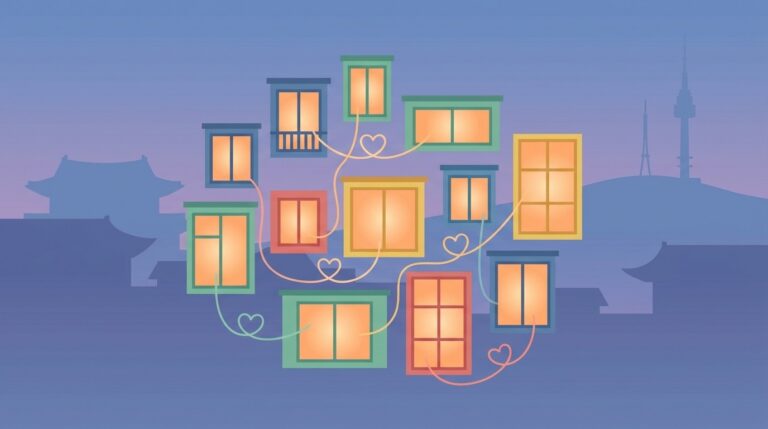
Solo Living in Korea Without Being Alone: How to Build Caring Communities
Phase 1: Empathy (Story-Driven Opening)
안녕하세요! 매일한글 에디터입니다. (Hello! It’s your Daily Hangul editor.)
Picture this: You are living in a cozy one-room (원룸) in Seoul. You relish the pristine autonomy—eating delivery fried chicken at midnight, bingeing your favorite K-dramas without anyone commenting on your posture, and decorating your sanctuary exactly how you want. Single-person households (1인 가구 – il-in gagu) now account for over 35% of all homes in South Korea. But then, one winter evening, you catch a sudden, immobilizing flu. As you lie in bed staring at the ceiling, waiting for an electrolyte drink to arrive, a chilling thought strikes: If something genuinely catastrophic happened to me right now, who would know? How long would it take for anyone to notice?
This quiet dread isn’t just an expat worry; it is one of the most pressing socio-cultural conversations in contemporary Korea. Media works like Netflix’s Move to Heaven (무브 투 헤븐) have brought the tragic reality of godoksa (고독사 – solitary deaths) into the national spotlight, highlighting not only vulnerable seniors but also an increasing number of youth in their 20s and 30s. Today, Korean society is grappling with a profound paradox: How do we celebrate privacy and individual autonomy while ensuring that no one slips through the cracks into total isolation?
As a B2 (intermediate) learner, mastering the vocabulary surrounding this topic allows you to participate in mature social dialogues, read nuanced editorial essays, and connect with Korean peers on issues that transcend superficial small talk. Based on field feedback from long-term international residents and community social workers in Seoul, this guide equips you with the exact language and cultural mindset needed to discuss modern community-building with genuine empathy.
Phase 2: Core Expressions Deep Dive
1. 사생활을 침해하지 않으면서 챙겨주다 (Sasanghwareul chimhaehaji aneumyeonseo chaenggyeojuda)
- Pronunciation: [Sah-sang-hwal-eul chim-hae-hah-ji ahn-eum-yeon-seo chaeng-gyuh-joo-dah] (Sounds like sah-sang-hwal + chim-hae [soft ch] + chaeng-gyuh).
- Meaning: Literal: “To look after someone without violating their private life.” / Nuance: Showing thoughtful care and discreet check-ins while strictly respecting someone’s personal boundaries.
- K-Culture Moment: You will hear this frequently in documentaries covering civic youth projects in Mapo-gu, where neighborhood teams leave meal kits on door handles for isolated individuals without knocking aggressively or demanding face-to-face interaction.
- Editor’s Insight: The verb 챙기다 (chaenggida) is deeply ingrained in Korean culture, representing practical affection—ensuring someone eats, stays warm, and stays well. Paired with 사생활을 침해하지 않다 (not invading privacy), it represents the modern golden standard of neighborliness.
- Situation Spectrum: Casual: ⚠️ | Semi-formal: ✅ | Formal: ✅
- 🤔 Think About It: Does your native language have a single verb like chaenggida that bundles care, logistical support, and affection without necessarily implying romance or familial obligation?
2. 촘촘한 사회적 안전망이 절실해요 (Chomchomhan sahoejeok anjeonmangi jeolsilhaeyo)
- Pronunciation: [Chom-chom-hahn sah-hwe-jeok ahn-jeon-mahng-ee juhl-sheel-hae-yo] (Imagine the rhythmic beat of chom-chom, mimicking a tightly woven fishing net).
- Meaning: Literal: “A dense/closely woven social safety net is desperate/urgent.” / Nuance: Emphasizes that institutional and grassroots systems must be finely calibrated so that vulnerable solo dwellers do not slip through bureaucratic cracks.
- K-Culture Moment: Commonly spoken on current affairs panel shows (시사 프로그램) when sociologists discuss rising living costs and preventive social welfare for single-person households.
- Editor’s Insight: Chomchomhada (촘촘하다) literally describes something closely spaced or finely meshed, like high-thread-count fabric. Using it as a metaphor for social welfare shows advanced command of Korean discourse.
- Situation Spectrum: Casual: 🚫 | Semi-formal: ✅ | Formal: ✅
- 🤔 Think About It: How does phrasing welfare as a “tight mesh” change the social expectation from passive charity to proactive infrastructure?
3. 고립되지 않도록 연결 고리를 만들다 (Goripdoeji antorok yeongyeol gorireul mandeulda)
- Pronunciation: [Go-rip-dweh-ji ahn-toh-rok yeon-gyeol go-ree-reul mahn-deul-dah] (Notice the crisp linkage in yeon-gyeol [connection] and gori [loop/ring]).
- Meaning: Literal: “To make a connecting ring so that one does not become isolated.” / Nuance: Proactively establishing low-pressure community links so individuals retain a lifeline to society.
- K-Culture Moment: Found in local district council initiatives promoting shared kitchens (공유 주방) and community gardens where people can interact without social expectations.
- Editor’s Insight: The term 연결 고리 (yeongyeol gori – connecting link/chain) emphasizes that community ties in modern society don’t happen by accident; they require deliberate, structural construction.
- Situation Spectrum: Casual: ✅ | Semi-formal: ✅ | Formal: ✅
- 🤔 Think About It: Is loneliness treated as an individual flaw or a community challenge in your home country?
Phase 3: Textbook Korean vs. Real Korean
Situation 1: Checking on a neighbor living alone
- 📖 교과서 한국어 (Textbook):
이웃에게 문제가 없는지 정기적으로 방문하여 확인하십시오.
(Iutege munjega eomneunji jeonggijeogeuro bangmunhayeo hwaginhashipsio.
/ “Please visit regularly to confirm whether there are problems with your neighbor.”) - 🗣️ 진짜 한국어 (Real-World):
옆집에 별일 없는지 문밖에서 슬쩍 기척만 살폈어요.
(Yeopjibe byeoril eomneunji munbakkeseo seuljjeok gicheongman salpyeosseoyo.
/ “I just quietly listened for signs of life outside their door to make sure everything was fine next door.”) - 💡 왜 다를까? (Why the difference?):
Unannounced door knocking can provoke anxiety (nunchi violation) in high-density Korean apartment buildings. Real-life care often involves subtle observation (기척을 살피다 – checking for signs of presence) to balance vigilance with privacy.
Situation 2: Advocating for community spaces for solo dwellers
- 📖 교과서 한국어 (Textbook):
정부는 1인 가구를 위한 복지 정책을 수립해야 합니다.
(Jeongbuneun il-in gagu bokji jeongchaegeul suriphaeya hamnida.
/ “The government must formulate welfare policies for single households.”) - 🗣️ 진짜 한국어 (Real-World):
혼자 살아도 막막하지 않게, 동네 사랑방 같은 완충 지대가 꼭 필요해요.
(Honja sarado mangmakhaji anke, dongne sarangbang gateun wanchung jidaega kkok piryohaeyo.
/ “To prevent solo dwellers from feeling helpless, we desperately need buffer zones like neighborhood communal rooms.”) - 💡 왜 다를까? (Why the difference?):
Native speakers use emotive imagery: 사랑방 (sarangbang – traditional guest reception room turned community hangout) and 완충 지대 (wanchung jidae – buffer zone) humanize abstract policy language.
Phase 4: K-Culture Deep Dive & Non-Verbal Manners
4-1. 눈치 (Nunchi) & Distance Management
When expressing care for neighbors in Korea, the golden rule of Nunchi (social intuition) is non-intrusive awareness.
* The Hallway Gaze: If you meet a solo neighbor in a narrow studio hallway or elevator, do not ask inquisitive personal questions like “Do you live alone?” (혼자 사세요?) or “Why are you home so late?”. Instead, keep your gaze slightly lowered, offer a soft nod (목례 – mongnye), and use generalized pleasantries like 식사하셨어요? (Siksahayeosseoyo? – Have you eaten?) or 날씨가 많이 춥죠? (Nalssiga mani chupjyo? – It’s quite cold, isn’t it?).
* Doorstep Etiquette: Never linger right directly in front of the door’s digital peephole. If you are delivering food or checking in as a volunteer, step back at least one meter so the resident feels safe opening the door.
4-2. Cultural Phenomenon: Smart Plugs & The Evolution of “Hon-jok”
Korea’s “Hon-jok” (혼족 – solo tribe) culture originated as an empowering celebration of self-reliance—honbap (eating alone) and honsul (drinking alone). However, municipalities have recognized the shadow side: prolonged social disconnection.
In response, districts across Seoul have implemented the Smart Plug Project (스마트 플러그 사업). IoT devices installed on television sets or microwaves monitor power consumption. If an isolated resident uses zero electricity for 24 to 50 hours, an alert is sent to the local community center (주민센터), prompting a gentle inquiry without using invasive cameras. It represents high-tech Korean compassion: safeguarding life while honoring personal boundaries.
Phase 5: Real-Life Roleplay Scenario
Setting: A community service center (주민복지센터) in Gwanak-gu, Seoul. You are volunteering alongside Min-seo, a veteran community organizer.
- 민서 (Min-seo): 요즘 우리 동네 원룸촌에 청년 1인 가구가 부쩍 늘었더라고요. (Yojeum uri dongne wonrumchone cheongnyeon il-in gaguga bujjeok neureotdeoragoyo. / “Lately, the number of young solo households in our neighborhood’s studio flat area has surged.”)
- 나 (You): 🎭 [진지한 표정으로 고개를 끄덕이며 / Nodding with a serious expression] 맞아요. 자율적인 삶은 좋지만, 혼자 고립되는 건 경계해야 할 것 같아요. (Majayo. Jayuljeogin salmeun jochiman, honja goripdoeneun geon gyeonggyehaeya hal geot gatayo. / “That’s right. Autonomy is great, but we should be vigilant against people becoming isolated.”)
- 민서 (Min-seo): 그렇죠. 그래서 이번에 문고리에 안부 편지랑 식료품 키트를 걸어두는 프로젝트를 기획 중이에요. (Geureochyo. Geuraeseo ibeone mungorie anbu pyeonjirang singryopum kiteureul georeoduneun peurojekteureul gihoek jung-ieyo. / “Exactly. That’s why we’re planning a project to hang well-wishing letters and grocery kits on doorknobs.”)
- 나 (You): 🎭 [생각에 잠긴 듯 턱을 매만지며 / Stroking your chin thoughtfully] 좋은 생각이네요! 혹시 문을 직접 두드리는 건 부담스러워하지 않을까요? (Joeun saenggagineyo! Hoksi muneul jikjeop dudeurineun geon budamseureowohaji aneulkkayo? / “Great idea! But wouldn’t directly knocking on their doors feel burdensome to them?”)
- 민서 (Min-seo): 맞아요! 그게 핵심이에요. 사생활을 침해하지 않으면서 챙겨주는 방식이어야 하거든요. (Majayo! Geuge haeksimieyo. Sasanghwareul chimhaehaji aneumyeonseo chaenggyeojuneun bangsik-ieoya hageodeunyo. / “Precisely! That’s the core. It must be a way of caring without invading their privacy.”)
- 나 (You): 🎭 [공감하며 미소를 띠고 / Smiling with empathy] 촘촘한 돌봄망을 만들되, 적당한 거리감을 유지하는 거군요. (Chomchomhan dolbommangeul mandeuldoe, jeokdanghan georigameul yujihaneun geogunyo. / “So it’s about building a tightly woven care network while maintaining comfortable distance.”)
- 민서 (Min-seo): 역시 잘 아시네요! 그럼 이번 주말에 키트 포장부터 같이 시작해 볼까요? (Yeoksi jal asineyo! Geureom ibeon jumare kiteu pojangbuteo gachi sijakhae bolkkayo? / “I knew you’d understand! Shall we start packing the kits together this weekend?”)
- 나 (You): 🎭 [자신감 넘치게 주먹을 쥐며 / Pumping your fist with confidence] 네, 작은 연결 고리를 만드는 일에 기꺼이 동참할게요! (Ne, jageun yeongyeol gorireul mandeuneun ire gikkeoi dongchamhalgeyo! / “Yes, I will gladly join in creating those small connecting links!”)
🔀 Interactive Decision Point
How do you suggest promoting the kit to skeptical solo dwellers?
* Choice A: “전화번호를 남기게 해서 매일 확인 전화를 돌립시다.” (Let’s make them leave their phone numbers and call them every day.)
* Choice B: “익명 오픈채팅방 QR코드를 동봉해서 부담 없이 소통하게 해요.” (Let’s include an anonymous KakaoTalk open chat QR code so they can communicate without pressure.)
* Choice C: “무조건 주말마다 동네 모임에 필수로 나오라고 공지해요.” (Let’s mandate that everyone must attend weekly neighborhood gatherings.)
Feedback:
- Choice A (Risk): High friction! Demanding direct phone numbers can trigger defense mechanisms against invasion of privacy.
- Choice B (Best!): Perfect cultural nuance! An anonymous open chat allows residents to access resources and solidarity (neuseunhan yeondae) on their own terms.
- Choice C (Bad): Disastrous. Mandatory participation directly destroys the autonomy cherished by single households.
Phase 6: 10-Second Emotion Shadowing Drill
Practice matching the emotional melody of the Korean speaker. The slashes (/) indicate natural pause points.
- [🥺 따뜻하고 조심스럽게 – Warmly & delicately]
사생활을 침해하지 않으면서 / 조용히 챙겨주는 게 / 가장 중요해요.
(Sasanghwareul chimhaehaji aneumyeonseo / joyonghi chaenggyeojuneun ge / gajang jungyohaeyo.)
“What’s most important / is quietly looking out for them / without invading their private life.” -
[🤔 진지하고 단호하게 – Seriously & resolutely]
누구도 벼랑 끝에 / 홀로 남겨지지 않도록 / 촘촘한 안전망이 / 절실합니다.
(Nugudo byeorang kkeute / hollo namgyeojiji antorok / chomchomhan anjeonmangi / jeolsilhamnida.)
“So that no one / is left stranded on the edge of a cliff / a tightly woven safety net / is desperately needed.” -
[💪 다정하면서 결의에 차서 – Affectionately yet determinedly]
작은 안부 한마디가 / 소중한 연결 고리가 / 될 수 있어요.
(Jageun anbu hanmadiga / sojunghan yeongyeol goriga / doel su isseoyo.)
“A single short check-in / can become / an invaluable connecting link.”
Phase 7: K-Culture Mini Dictionary
- 고독사 (Godoksa) [Noun]
- Translation: Solitary death / Lonely death.
- Real-World Usage: Refers to individuals living isolated from family and society who pass away alone and whose bodies are discovered after a period of time. Discussed prominently in policy and welfare reporting.
- 1인 가구 (Il-in gagu) [Noun]
- Translation: Single-person household.
- Real-World Usage: Essential demographic term used across business (e.g., mini rice cookers, half-size watermelons) and social politics in Korea.
- 느슨한 연대 (Neuseunhan yeondae) [Noun phrase]
- Translation: Loose solidarity / Weak ties.
- Real-World Usage: Describes the preferred community structure of modern Koreans—connecting based on shared interests without invasive personal expectations.
- 안부 묻기 (Anbu mutgi) [Action phrase]
- Translation: Inquiring after someone’s safety and well-being.
- Real-World Usage: Sending a quick message asking if someone is doing well, often centered around whether they have eaten or recovered from illness.
Phase 8: Expat & Traveler Survival Kit
Top 3 Survival Phrases
- 혹시 무슨 일 생기면 바로 연락주세요. (Hoksi museun il saenggimyeon baro yeollakjuseyo.)
- Translation: “If anything happens by any chance, please contact me immediately.”
- Pro Tip: Use this with neighbors or language exchange partners to establish mutual emergency support without being intrusive.
- 혼자 계실 때 아프면 주저 말고 말씀하세요. (Honja gyesil ttae apeumyeon jujeo malgo malsseumhaseyo.)
- Translation: “If you get sick while being alone, please don’t hesitate to tell me.”
- Pro Tip: Ideal phrase to comfort an independent friend living away from family.
- 문 앞에 작은 마음을 두고 갈게요. (Mun ape jageun maeumeul dugo galgeyo.)
- Translation: “I’ll leave a small token of my thoughts in front of your door.”
- Pro Tip: Text this when hanging snacks or medicine on a sick friend’s door handle.
Editor’s Note: Essential Support Systems
- Check your local district via the Dasan Call Center 120 Guide for foreign language community services.
- Download the Danggeun Neighborhood Life App to participate in local hobby clubs (somoyim) and volunteer drives where solo dwellers form low-stress friendships.
Phase 9: “One Step Deeper” (Reflective Essay)
Traditional Korean culture was built upon Jeong (정) and deep-rooted collectivism, where villages functioned as extended families who knew every detail of each other’s lives. In modern hyper-urbanized cities like Seoul, this dynamic has transformed. The younger generation fiercely protects their personal space from unsolicited evaluations and family pressure.
However, humans are inherently relational. The modern dilemma is not whether we need community, but what shape that community should take. Today, Koreans are redefining Jeong—moving away from intrusive closeness toward discreet vigilance (neuseunhan yeondae). Caring for someone today means respecting their closed door while making sure they know there is a hand ready to reach out the moment they open it.
💬 Your Turn: In your home country, how do you show care for neighbors without overstepping their personal privacy? Share your thoughts below!
Phase 10: FAQ & Common Mistakes
Q: Isn’t asking someone if they live alone a good way to offer help?
A: In Korea, asking a casual acquaintance or neighbor “혼자 사세요?” (Do you live alone?) can cause immediate safety anxiety, particularly for women living in studio apartments. Instead, use neutral conversation openers like “이 동네 오래 사셨어요?” (Have you lived in this neighborhood long?).
Q: What is the linguistic difference between ‘고립’ (isolation) and ‘독립’ (independence)?
A: 독립 (Dongnip) is active, self-chosen autonomy and healthy independence. In contrast, 고립 (Gorip) denotes involuntary severing of connections, where an individual feels stranded with no viable exits.
Q: Is Godoksa (solitary death) only an issue for the elderly?
A: No. In recent years, 청년 고독사 (solitary death among youth) has emerged as a serious concern, linked to severe youth unemployment, prolonged social withdrawal (hikikomori or 은둔형 외톨이), and the breakdown of traditional support networks.
🚨 흔한 실수 (Common Mistakes) Notice Board
- Mistake: Saying “혼자 살면 외롭지 않아요?” (Don’t you feel lonely living alone?)
- Problem: Sounds patronizing and questions their autonomy.
- Correct Action: Say “혼자 지내시니까 편한 점도 많으시겠어요.” (Living solo must have many convenient aspects.)
- Mistake: Knocking abruptly on a Korean neighbor’s door to introduce yourself with food.
- Problem: In studio apartments, sudden knocking can startle residents and raise safety concerns.
- Correct Action: Leave a neat gift bag with a polite handwritten note on the outer door handle.
- Mistake: Confusing 고독 (godok – solitude/loneliness) with 고립 (gorip – physical/social isolation).
- Correct Action: Use godok for emotional inner states and gorip when discussing societal barriers and structural lack of contact.
Phase 11: Action Missions
- 🥉 Bronze Mission (Solo Practice): Read the Phase 6 Shadowing Drill aloud three times. Focus on softening your final verb endings (-hamnida / -haeyo) to sound empathetic rather than bureaucratic.
- 🥈 Silver Mission (Social Reflection): Write a 2-sentence journal entry in Korean describing your ideal neighborhood community, using the vocabulary phrase 느슨한 연대 (loose solidarity).
- 🥇 Gold Mission (Real-World Application): When you see a delivery box or parcel sitting outside a neighbor’s door for several days in a row, politely mention it to your building manager (Gwalliin – 관리인) using: “옆집 문앞에 택배가 며칠째 쌓여 있어서 혹시나 해서 말씀드려요.” (Packages have been piling up outside next door for days, so I’m letting you know just in case.)
- 🎮 K-Culture Media Mission: Watch Episode 1 of Move to Heaven on Netflix. Note down how the trauma cleaners treat the belongings of the deceased with dignity, and observe how community workers interact with the neighborhood.
Phase 12: Interactive Quiz Challenge
1. Situation Judgment
Your Korean friend has recently started living alone in an officetel and seems overwhelmed with work and stress. Which message demonstrates the best balance of care and respect for their autonomy?
* A) “내가 지금 너희 집으로 갈 테니까 문 열어!” (I’m coming to your house right now, open the door!)
* B) “혼자 사는 건 위험하니까 당장 본가로 들어가.” (Living alone is dangerous, move back to your parents’ home immediately.)
* C) “많이 바쁘지? 문앞에 비타민 음료 걸어두고 갈 테니까 푹 쉬어!” (You must be busy! I’ll hang some vitamin drinks on your door handle, get some good rest!)
2. Fill-in-the-Blank
“우리는 개인의 자율성을 존중하면서도, 위기 상황에서 아무도 방치되지 않도록 ( ) 사회적 안전망을 만들어야 합니다.”
* Hints: An adjective meaning “densely woven” or “closely spaced.”
3. True / False Cultural Fact
“In Korean culture, dropping by an acquaintance’s studio apartment unannounced is viewed as an affectionate display of Jeong (정).”
👉 Click here to reveal answers and explanations!
- Answer: C
- Explanation: Hanging a gift with a warm note provides tangible care without demanding social energy or violating their private living sanctuary.
- Answer: 촘촘한 (Chomchomhan)
- Explanation: 촘촘한 사회적 안전망 (closely-knit social safety net) is the definitive terminology for nuanced, gap-free community welfare.
- Answer: False
- Explanation: In modern Korea, especially among 1-person households, unexpected visits are considered a major violation of personal boundaries and Nunchi.
- Explanation: In modern Korea, especially among 1-person households, unexpected visits are considered a major violation of personal boundaries and Nunchi.







