

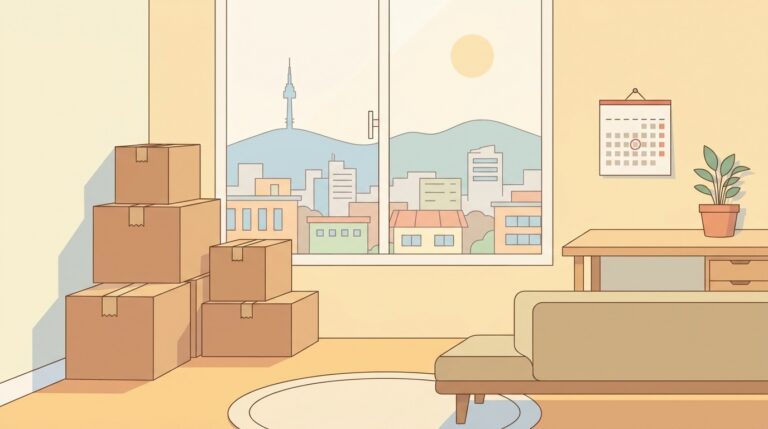
Don’t Get Trapped by Auto-Renewal: How to Give Move-Out Notice in Korea
Phase 1: 공감 (Story Opening)
안녕하세요! 매일한글 에디터입니다. (Hello! This is your Daily Hangul editor.)
Picture this: You have lived in a cozy studio officetel near Hongdae for almost two years. You’ve found a sunlit new apartment in Seongsu, packed your boxes, and called your landlord just three weeks before your lease end date to say goodbye. But suddenly, your landlord sighs over the phone and drops a bombshell: “Wait, Alex-ssi, you didn’t say anything earlier. Under Korean law, your contract has already been automatically renewed for another two years!”
A cold chill runs down your spine. This nightmare scenario is what Koreans call 묵시적 갱신 (Muksijeok gaengsin)—implicit or automatic lease renewal. In South Korea, tenant laws require you to express your intent to leave at least two months prior to lease expiration. Miss that deadline, and your contract rolls over automatically, making it difficult to reclaim your hefty deposit (보증금 – bojeunggeum) on time.
Today, we are equipping you with real-life, culturally savvy Korean expressions that protect your rights, keep relationships amicable, and ensure you get every won of your security deposit back with zero drama!
Phase 2: 핵심 표현 3선 심층 분석 (Core Expressions)
1. 계약 연장 안 하고 만기 퇴실할게요 (Gyeyak yeonjang an hago mangi toesilhalgeyo)
- Pronunciation: [Gye-yak yeon-jang an ha-go man-gi toe-sil-hal-ge-yo] (Sounds like: Geh-yahk yawn-jahng ahn hah-goh mahn-gee toh-ee-sheel-hahl-geh-yoh)
- Meaning: Direct: “I will not extend the contract and will move out upon expiration.” | Nuance: A firm, polite, and unmistakable declaration of your plan to leave, leaving no ambiguity.
- K-Culture Moment: Think of classic K-drama scenes where an independent lead politely informs their landlord (집주인 – jipjuin) that they are moving on to the next chapter of life.
- Editor’s Insight: Using the Sino-Korean term 만기 (mangi – expiration) alongside 퇴실 (toesil – vacating the room) conveys that you respect the contractual timeline and understand your rights.
- Situation Spectrum: Casual 🚫 | Semi-formal ✅ | Formal ✅
- 🤔 Think About It: In many Western leases, contracts roll over month-to-month. In Korea, an implicit renewal binds both sides to the original lease term (often 1 or 2 years). How does language shape our sense of urgency?
2. 묵시적 갱신 안 되게 미리 연락드려요 (Muksijeok gaengsin an doege miri yeollakdeuryeoyo)
- Pronunciation: [Muk-si-jeok gaeng-sin an doe-ge mi-ri yeol-lak-deu-ryeo-yo] (Sounds like: Mook-shee-juhk gang-sheen ahn dweh-geh mee-ree yawn-lahk-deu-ryuh-yoh)
- Meaning: Direct: “I am contacting you in advance so implicit renewal does not occur.” | Nuance: A smart, proactive phrase showing you are legally literate without sounding aggressive.
- K-Culture Moment: Highly educated characters in office dramas like Misaeng who handle paperwork with sharp legal precision.
- Editor’s Insight: Dropping the legal term 묵시적 갱신 (muksijeok gaengsin) instantly alerts landlords that you understand the Korean Housing Lease Protection Act.
- Situation Spectrum: Casual 🚫 | Semi-formal ✅ | Formal ✅
- 🤔 Think About It: Does bringing up legal terms in your native culture feel confrontational? In Korea, stating legal terms courteously prevents future misunderstandings (오해 – ohae).
3. 보증금 반환 일정 확인 부탁드립니다 (Bojeunggeum banhwan iljeong hwagin butakdeurimnida)
- Pronunciation: [Bo-jeung-geum ban-hwan il-jeong hwa-gin bu-tak-deu-rim-ni-da] (Sounds like: Boh-jeung-geum bahn-hwahn eel-jung hwah-geen boo-tahk-deu-reem-nee-dah)
- Meaning: Direct: “Please confirm the schedule for the deposit refund.” | Nuance: An honorific yet unyielding request to lock in the exact hour your security deposit will be wired back.
- K-Culture Moment: The tense morning of moving day in Korea, where three moving trucks synchronize bank transfers within minutes.
- Editor’s Insight: Security deposits in Korea are massive (often 10,000,000 KRW to 100,000,000 KRW+). Asking for the 반환 일정 (return schedule) ahead of time prevents the landlord from stalling.
- Situation Spectrum: Casual 🚫 | Semi-formal ⚠️ | Formal ✅
- 🤔 Think About It: Why does money talk always require the highest honorific ending (~십니다/드립니다)? It removes personal emotion and keeps matters strictly business.
Phase 3: 교과서 한국어 vs 진짜 한국어 (Textbook vs. Real-Life)
Situation A: Informing your landlord you plan to vacate
- 📖 교과서 한국어: 저는 이번 계약이 끝나면 이사를 가겠습니다. (Jeoneun ibeon gyeyagi kkeutnamyeon isareul gagessseumnida.) — “When this contract ends, I shall move.”
- 🗣️ 진짜 한국어: 집주인님, 만기 날짜 맞춰서 퇴실하려고 미리 연락드렸어요! (Jipjuinnim, mangi naljja matchwoseo toesilharyeogo miri yeollakdeuryeosseoyo!) — “Landlord, I’m reaching out in advance to vacate right on the expiration date!”
- 💡 왜 다를까? Textbook Korean sounds like an official proclamation from a Joseon Dynasty scroll! Real Koreans address the landlord warmly (집주인님/사장님) and specify that they are reaching out proactively (미리).
Situation B: Scheduling the move-out inspection
- 📖 교과서 한국어: 방의 상태를 언제 검사하시겠습니까? (Bang-ui sangtaereul eonje geomsa-hasigessseumnikka?) — “When will you inspect the condition of the room?”
- 🗣️ 진짜 한국어: 퇴실 당일 방 상태 확인 몇 시쯤 하실까요? (Toesil dangil bang sangtae hwagin myeot sijjeum hasilkkayo?) — “Around what time will you check the room condition on move-out day?”
- 💡 왜 다를까? The word 검사 (geomsa) sounds like a police search or tax audit. Real tenants use 상태 확인 (condition check) with the softer question ending ~하실까요?.
Phase 4: K-Culture 딥다이브 & 비언어적 매너 (Culture & Etiquette)
4-1. 눈치 (Nunchi) & Non-Verbal Manners: The “Written Trail” Rule
In Korea, phone calls alone are legally risky. While a verbal call is considered polite and warm, savvy tenants always follow up with a polite KakaoTalk or SMS text message: “방금 통화드린 내용 정리해서 문자 남겨놓습니다” (As discussed over the phone, I am leaving a written summary). When communicating via text, use soft polite markers like ^^ or ! rather than dry periods (.), which can make your landlord defensive.
4-2. Culture Code: The Moving Day Chain Reaction
Why is the two-month notice strictly regulated in Korea? Because of the Jeonse / Wolse deposit chain. Korean landlords rarely keep tens of thousands of dollars sitting liquid in a checking account. They rely on the incoming tenant’s deposit to refund your deposit on the exact same morning! Giving notice at least two months in advance allows your landlord to post the unit on real estate networks so that you can both get paid seamlessly.
Phase 5: 실전 롤플레이 시나리오 (Interactive Roleplay)
- Scenario: Alex (an expat tenant living in a Mapo officetel) texts Mrs. Park (the landlord) exactly 70 days before contract expiration.
- Alex: 안녕하세요, 사장님! 302호 알렉스입니다. (Annyeonghaseyo, sajangnim! Sambak-i-ho Alleksu-imnida.) [🎭 Polishing a polite text message on KakaoTalk] — Hello, Landlord! This is Alex from Unit 302.
- Landlord: 네, 알렉스 씨. 별일 없죠? (Ne, Alleksu ssi. Byeoril eopjyo?) [🎭 Replying warmly while reviewing property ledger] — Yes, Alex. Everything going well?
- Alex: 네! 다름이 아니라 3월 31일 계약 만기 맞춰 퇴실하려 연락드렸습니다. (Ne! Dareumi anira samwol samsibiril gyeyak mangi matchwo toesilharyeo yeollakdeuryeosseumnida.) [🎭 Checking calendar to verify the two-month window] — Yes! I’m reaching out because I plan to move out upon my contract expiration on March 31st.
- Landlord: 아이고, 벌써 그렇게 됐나? 연장 안 하고 나가는 거예요? (Aigo, beolsseo geureoke dwaenna? Yeonjang an hago naganeun geoyeyo?) [🎭 Slightly surprised tone] — Oh dear, has it been that long already? You are moving out without renewing?
- Alex: 네, 회사 근처로 이사하게 되었어요. 묵시적 갱신 안 되게 미리 말씀드립니다. (Ne, hoesa geuncheoro isahage doeeosseoyo. Muksijeok gaengsin an doege miri malsseumdeurimnida.) [🎭 Sending a polite bow emoji] — Yes, I am moving closer to my company. I am letting you know in advance so implicit renewal doesn’t occur.
- Landlord: 알겠어요. 그럼 이번 주부터 부동산에 방 내놓을게요. (Algesseoyo. Geureom ibeon jubeuteo budongsane bang naenoheulgeyo.) [🎭 Making a note in her rental diary] — Understood. Then I will list the room with real estate agencies starting this week.
- Alex: 네, 집 보여줄 때 미리 문자 부탁드려요. 퇴실 당일 보증금 반환도 차질 없이 부탁드립니다! (Ne, jip boyeojul ttae miri munja butakdeuryeyo. Toesil dangil bojeunggeum banhwando chajil eopsi butakdeurimnida!) [🎭 Typing respectfully yet asserting clear expectations] — Yes, please text me before showing the house. Please also ensure deposit return goes smoothly on move-out day!
- Landlord: 그래요. 당일 시설 확인하고 바로 송금해 줄게요. (Geuraeyo. Dangil siseol hwaginhago baro songgeumhae julgeyo.) [🎭 Sending a reassuring confirmation] — Sure thing. I will inspect the fixtures on that day and wire the transfer right away.
🔀 인터랙티브 분기점 (Choose Your Move!)
If the landlord asks: “Can prospective tenants visit the room with realtors anytime during the week?”, how should you respond?
- Option A: “네, 제가 출근 중일 때 비밀번호 누르고 그냥 들어오세요.” (Sure, just enter the passcode and come in while I am at work.)
- ⚠️ Risk: Giving out your door passcode without notice compromises your privacy and personal safety!
- Option B: “방문하시기 최소 2시간 전에 미리 문자 주시면 감사하겠습니다!” (I would appreciate it if you could text me at least 2 hours before visiting!)
- 🌟 Best: Polite, sets healthy boundaries, and preserves safety while cooperating with the search.
- Option C: “절대 안 됩니다. 제가 이사 나가는 날까지 아무도 들어올 수 없습니다.” (Absolutely not. No one can enter until the day I move out.)
- 🚫 Bad: Hostile. Refusing visits makes it harder for the landlord to find a replacement, which could delay your deposit refund!
Phase 6: 10초 감정 섀도잉 드릴 (Shadowing Drill)
Practice these lines with rhythm, pauses (/), and genuine emotion:
[😊 정중하고 상냥하게 - Polite & warm]- 집주인님, / 만기 두 달 전이라 / 미리 퇴실 연락드립니다. (Jipjuinnim, / mangi du dal jeon-ira / miri toesil yeollakdeurimnida.)
[🧐 단호하고 명확하게 - Firm & clear]- 계약 연장은 안 하고요, / 날짜 맞춰서 퇴실할게요. (Gyeyak yeonjangeun an hagoyo, / naljja matchwoseo toesilhalgeyo.)
[🤝 정중하지만 빈틈없이 - Respectful yet sharp]- 당일 오전에 방 확인하시고 / 보증금 반환 부탁드립니다. (Dangil ojeone bang hwaginhasigo / bojeunggeum banhwan butakdeurimnida.)
Phase 7: K-Culture 미니 사전 (Mini Dictionary)
- 묵시적 갱신 (Muksijeok Gaengsin) | Implicit Lease Renewal
- Automatic renewal that takes effect under Korean law if neither party states an intent to change or terminate the contract 2 to 6 months before expiration.
- 원상복구 (Wonsangbokgu) | Restoration to Original State
- The tenant’s contractual duty to return the studio to its initial state upon move-out. Normal wear and tear is excluded, but wallpaper damage from pets or unapproved wall anchors must be restored.
- 장기수선충당금 (Janggi Suseon Chungdanggeum) | Long-term Repair Reserve Fund
- A maintenance fee charged to your monthly building bill that is legally the landlord’s burden. When you move out, ask building management for a statement and get reimbursed by your landlord!
- 확정일자 (Hwakjeong-ilja) | Fixed Date stamp
- The official stamp obtained at a local community center (주민센터) that gives your security deposit priority lien status under Korean tenancy law.
Phase 8: 세입자를 위한 생존 키트 (Survival Kit)
TOP 3 Survival Phrases
- 벽지 오염은 생활 마모로 알고 있습니다. (Byeokji oyeomeun saenghwal mamoro algo isseumnida.)
- Romanization: [Byeok-ji o-yeo-meun saeng-hwal ma-mo-ro al-go is-seum-ni-da.]
- Pro Tip: Use this if a landlord tries to charge you for mild sunlight discoloration on the wallpaper. Normal wear (생활 마모) is not the tenant’s liability!
- 관리비 정산 내역서 보내주세요. (Gwanribi jeongsan naeyeokseo bonaejuseyo.)
- Romanization: [Gwan-ri-bi jeong-san nae-yeok-seo bo-nae-ju-se-yo.]
- Pro Tip: Essential for getting exact utility bills settled up to the hour you move.
- 장기수선충당금 환급금 확인했습니다. (Janggi suseon chungdanggeum hwangeupgeum hwaginhaesseumnida.)
- Romanization: [Jang-gi su-seon chung-dang-geum hwan-geup-geum hwa-gin-haes-seum-ni-da.]
- Pro Tip: Claim back your accumulated long-term maintenance fees—often worth hundreds of dollars after a 2-year lease!
Editor’s Survival Note
Before signing or exiting a rental contract, cross-reference market rates and legal notices using the Naver Real Estate property information portal. When hunting for your next officetel, use the Zigbang official apartment and studio discovery platform to compare real listings and standard contract clauses.
Phase 9: 한 발 더 깊이 (Cultural Reflection)
In South Korea, interpersonal relationships are traditionally governed by 정 (Jeong – warm human bonding). However, real estate transactions are where Jeong clashes head-on with modern contract law. Many foreigners feel guilty texting legal terms to their smiling, elderly landlord. But remember: Korean landlords actually appreciate tenants who state their contractual dates precisely in writing, because it shields everyone from costly legal misunderstandings.
💬 Your Turn: Have you ever experienced moving out in another country? How early did you have to notify your landlord? Share your story in the comments below!
Phase 10: FAQ & 흔한 실수 방지 (FAQ & Common Mistakes)
Q: What if I notify my landlord 1 month and 28 days before expiration?
A: Under the revised Korean Housing Lease Protection Act, notice must arrive at least 2 full months before the expiration date. If you notify even one day late, the lease automatically renews as an implicit renewal (묵시적 갱신). If that happens, you can still terminate the lease, but it legally takes 3 months from the day the landlord receives your notice for the termination to take effect!
Q: Does a text message count as legal notification in Korea?
A: Yes! Text messages and KakaoTalk count as valid legal proof, provided the landlord responds with an acknowledgment (e.g., “네, 확인했습니다” – Yes, confirmed). Always keep screenshots backed up.
Q: Who pays the real estate commission if I leave right at expiration?
A: The landlord pays the commission for finding the next tenant if you complete your full contract term. You only pay if you break the lease early prior to the agreed expiration date.
🚨 Common Mistakes Warning Board
- Calling without a written record: A verbal promise can be forgotten or denied. Always send a follow-up text summarizing the date and deposit return.
- Forgetting the Long-Term Repair Fund: Forgetting to request your 장기수선충당금 refund from the landlord on move-out day can cost you $200–$500 in lost money.
- Waiting until moving day to talk deposit timing: Ask for the deposit return time in advance so your moving truck and new apartment landlord are not left waiting outside in the cold.
Phase 11: 액션 미션 & 참여 유도 (Action Missions)
- 🥉 Bronze Mission: Write down today’s core sentence:
계약 연장 안 하고 만기 퇴실할게요three times on a notepad. - 🥈 Silver Mission: Open your calendar and calculate the exact date that is 2 months before your current lease expires. Set an alert titled: 묵시적 갱신 방지 (Prevent Implicit Renewal)!
- 🥇 Gold Mission: Roleplay sending a KakaoTalk move-out notification with your Korean language partner or tutor.
- 🎮 K-Culture Mission: Watch an episode of a Korean real estate show like Where is My Home (구해줘! 홈즈) and spot how realtors and tenants discuss room conditions (원상복구)!
Phase 12: 인터랙티브 퀴즈 챌린지 (Quiz Challenge)
1. Situational Judgment:
Your lease ends on December 31st. When is the latest day your move-out notice must be acknowledged by the landlord to prevent implicit renewal?
* A) December 1st
* B) October 31st
* C) November 30th
2. Fill in the Blank:
“묵시적 갱신 안 되게 (________) 연락드렸습니다.” (I am contacting you in advance so that implicit renewal does not occur.)
* A) 어제 (Yesterday)
* B) 미리 (In advance)
* C) 갑자기 (Suddenly)
3. True or False:
If your lease implicitly auto-renews, the landlord can kick you out at any time with 1 week’s notice.
* True / False
👉 Click to reveal answers & explanations!
- Answer: B) October 31st
- Explanation: Korean law requires notification at least 2 full months before the contract end date. Notice must reach the landlord by October 31st for a December 31st expiration!
- Answer: B) 미리 (In advance)
- Explanation: 미리 (miri) means “in advance/ahead of time”, creating the polite and proactive phrase 미리 연락드렸습니다.
- Answer: False
- Explanation: In an implicit renewal, the tenant is protected for an additional 2-year term. The landlord cannot arbitrarily terminate the contract early, whereas the tenant can terminate with 3 months’ notice.
- Explanation: In an implicit renewal, the tenant is protected for an additional 2-year term. The landlord cannot arbitrarily terminate the contract early, whereas the tenant can terminate with 3 months’ notice.







