

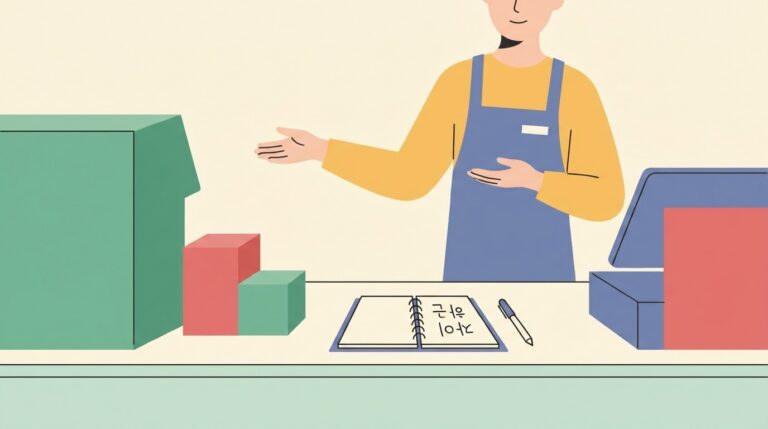
Handling Cafe Customer Claims Calmly Like a Pro Barista
Phase 1: Empathy (Story-Driven Opening)
안녕하세요! 매일한글 에디터입니다. (Hello! It’s your Daily Hangul editor here!)
Imagine this: You finally landed your dream part-time job (알바, alba) at a trendy glass-front cafe in Seongsu-dong or Hongdae. The jazz playlist is smooth, the espresso aroma is heavenly, and you feel like the main character in an indie K-Drama. Suddenly, the door chime rings. A customer strides in, slams a half-eaten spicy street snack on the counter, and demands an iced latte in a single-use plastic cup—announcing they intend to sit right by the window.
Your stomach drops. In South Korea, local laws strictly fine cafes up to 3 million won if customers drink from disposable cups indoors, and bringing outside food violates most cafe hygiene policies. You want to enforce the rule, but your heart is pounding. What if you sound aggressive? What if you offend them and end up in a heated argument? Many of our intermediate learners share this exact fear: knowing the grammar rules in a textbook is one thing, but standing your ground gracefully in Korean while remaining professional is a whole different beast.
Mastering these tactful de-escalation scripts will not only protect your cafe from hefty city fines, but it will also transform your confidence. Today’s guide is crafted from real training manuals used across major Seoul franchise cafes and real feedback from foreign retail workers who turned stressful confrontations into five-star customer service moments. Let’s make sure you never freeze at the counter again!
Phase 2: Top 3 Core Expressions Deep Dive
Here are the three golden shields you need when dealing with customer requests that breach shop rules.
1. 매장 내에서는 일회용 컵 사용이 법적으로 금지되어 있어서요
- Pronunciation: [Mae-jang nae-e-seo-neun il-hoe-yong keop sa-yong-i beop-jeog-eu-ro geum-ji-doe-eo it-seo-yeo] (Sounds like: “Mae-jang nay-eh-suh-noon eel-hweh-yong kup sah-yong-ee bup-juh-goo-roh goom-jee-dweh-uh eet-suh-yo”)
- Meaning: Direct translation: “Inside the store, disposable cup usage is legally prohibited, so…” | Real Nuance: “I’m really sorry to trouble you, but by law we cannot serve drinks in plastic cups for dine-in.”
- K-Culture Moment: Think of the workplace drama Misaeng or retail scenes in Clean with Passion for Now, where an employee has to explain regulations without pointing fingers at the customer.
- Editor’s Insight: Ending your sentence with
-어서요 (-eoseoyo)leaves the tail open and soft. By citing the law (법적으로, beopjeogeuro), you position yourself not as the person restricting them, but as a fellow civilian bound by strict city policies. - Situation Spectrum:
- Casual: 🚫
- Semi-formal: ⚠️
- Formal: ✅
- 🤔 Think About It: In your native culture, do workers usually say “Company policy forbids this” or do they quote government environmental laws? Notice how Korean retail uses external regulations to preserve both parties’ social face (체면, chemyeon).
2. 죄송하지만 외부 음식은 매장 내 취식이 불가합니다
- Pronunciation: [Joe-song-ha-ji-man oe-bu eum-sig-eun mae-jang nae chwi-sig-i bul-ga-ham-ni-da] (Sounds like: “Jweh-song-hah-jee-mahn weh-boo oom-sheeg-oon may-jahng nay chwee-sheeg-ee bool-gah-hahm-nee-dah”)
- Meaning: Direct translation: “I am sorry, but external food ingestion inside the store is not possible.” | Real Nuance: “We kindly ask you not to consume outside food inside our store.”
- K-Culture Moment: Commonly heard in modern K-Dramas whenever friends pop into a cozy specialty cafe holding greasy baguettes or street tteokbokki.
- Editor’s Insight: Using Sino-Korean vocabulary such as 외부 음식 (outside food) and 취식 불가 (consumption not permitted) creates professional emotional distance, taking away personal blame from the customer.
- Situation Spectrum:
- Casual: 🚫
- Semi-formal: ⚠️
- Formal: ✅
- 🤔 Think About It: Why does Korean customer service prefer impersonal Sino-Korean terms when delivering bad news? How does elevated vocabulary cushion social awkwardness?
3. 너른 양해 부탁드립니다
- Pronunciation: [Neo-reun yang-hae bu-tak-deu-rim-ni-da] (Sounds like: “Nuh-roon yahng-hay boo-tahk-doo-reem-nee-dah”)
- Meaning: Direct translation: “I request your generous understanding.” | Real Nuance: “Thank you so much for your kind patience and understanding on this matter.”
- K-Culture Moment: The quintessential closing phrase heard at subway delays, airport gates, and upscale Korean retail counters when minor inconveniences arise.
- Editor’s Insight: 너른 (broad/spacious) paints a picture of a generous heart. When asking for 양해 (understanding), you are complimenting the customer’s maturity, which psychologically makes them far less likely to shout.
- Situation Spectrum:
- Casual: 🚫
- Semi-formal: ✅
- Formal: ✅
- 🤔 Think About It: Unlike the standard English “Sorry for the inconvenience,” Korean shifts the agency to the listener, requesting their benevolent grace.
Phase 3: Textbook Korean vs. Real-World Korean
Let’s see how standard classroom Korean compares with what natural native staff say on the floor.
Situation 1: Informing someone they cannot use a plastic cup inside
- 📖 교과서 한국어 (Textbook Korean): 매장 안에서 일회용 컵을 쓰면 안 됩니다. (Maejang an-eseo ilhoeyong keobeul sseumyeon an doemnida.) — You must not use disposable cups inside the store.
- 🗣️ 진짜 한국어 (Real-World Korean): 손님, 매장 이용하시면 다회용 잔으로 준비해 드려도 괜찮을까요? (Sonnim, maejang iyonghasimyeon dahoeyong janeuro junbihae deuryeodo gwaenchaneulkkayo?) — Guest, if you are dining in, may I prepare this in a reusable mug for you?
- 💡 왜 다를까? (Why is it different?): Telling an adult customer “안 됩니다” (you must not) triggers defensiveness. Native baristas reframe the rule into a positive, polite choice offering a mug (다회용 잔).
Situation 2: Asking a guest to put away outside snacks
- 📖 교과서 한국어 (Textbook Korean): 밖에서 사 온 빵을 여기서 드시지 마세요. (Bakk-eseo sa on ppang-eul yeogiseo deusiji maseyo.) — Do not eat bread bought outside here.
- 🗣️ 진짜 한국어 (Real-World Korean): 죄송하지만 다른 음식은 잠시 가방에 보관해 주실 수 있을까요? (Joesonghajiman dareun eumsigeun jamsi gabange bogwanhae jusil su isseulkkayo?) — We apologize, but could you perhaps keep the other food inside your bag for a moment?
- 💡 왜 다를까? (Why is it different?): Instead of commanding them to stop eating, real baristas gently offer a concrete solution: keeping it zipped inside their bag.
Phase 4: K-Culture Deep Dive & Non-Verbal Manners
4-1. 눈치 (Nunchi) & Body Language
When delivering rules to an upset customer, your body communicates faster than your grammar:
1. The Two-Hand Posture (두 손 모으기): Keep both hands clasped softly in front of your navel (공수자세, gongsu-jase). Never cross your arms or point a single finger at the banned item. Point using an open palm facing upward.
2. The 15-Degree Head Nod (목례): When starting with 죄송하지만…, tilt your head down about 15 degrees. It lowers your defensive posture and demonstrates instant humility.
3. Eye Contact: Maintain gentle eye contact while speaking, but soften your gaze toward their collarbone when they express frustration. Staring directly into an agitated elder’s eyes can be perceived as challenging their authority.
4-2. Cultural Context: The Zero-Waste Cafe Law
In South Korea, regulations enacted under the Act on the Promotion of Saving and Recycling of Resources (자원재활용법) make it illegal for cafes to provide single-use plastic cups for in-store seating. Local district officers (구청 단속반) conduct random spot checks. If an inspector spots someone sitting down with a clear plastic cup, the store—not the customer—gets fined up to several thousand dollars! Furthermore, Korean cafes build the cost of aesthetic table space, Wi-Fi, and electricity into their coffee prices; bringing outside snacks is seen as a breach of social courtesy (상도덕, commercial etiquette).
Phase 5: Real-Life Roleplay Scenario
Setting: A bustling cafe in Gangnam at 1:30 PM. A hurried office worker, Manager Park, carries a large plastic iced cup from another franchise and a bakery sandwich box, taking a seat at a central table.
- Turn 1 (Employee – Alex): 🎭 Approaches table with hands clasped, speaking softly
손님, 주문 도와드릴까요? 편하게 보시고 말씀해 주세요.
(Sonnim, jumun dowadeurilkkayo? Pyeonhage bosigo malsseumhae juseyo.)
“Sir, may I help you with an order? Please take your time and let me know.” -
Turn 2 (Customer – Manager Park): 🎭 Without looking up from phone
아, 저 일행 기다리는 중이라 일단 앉아 있을게요.
(A, jeo ilhaeng gidarineun jung-ira ildan anja isseulgeyo.)
“Ah, I’m waiting for a colleague, so I’ll just sit here for now.” -
Turn 3 (Employee – Alex): 🎭 Bows slightly, points with an open palm toward the bakery box
그러셨군요! 손님, 정말 죄송하지만 저희 매장 규정상 외부 음식 취식은 어려우셔서요.
(Geureosyeotgunyo! Sonnim, jeongmal joesonghajiman jeohui maejang gyujeongsang oebu eumsik chwisigeun eoryeousyeoseoyo.)
“I see! Sir, I am terribly sorry, but by our store policy, consuming outside food isn’t permitted here.” -
Turn 4 (Customer – Manager Park): 🎭 Frowns, raising voice slightly
아직 뜯지도 않았는데 왜 그래요? 커피도 곧 시킬 건데 너무 팍팍하시네.
(Ajik tteutjido anatneunde wae geuraeyo? Keopido got sikil geonde neomu pakpakhasi-ne.)
“I haven’t even opened it yet, why are you being so strict? I’m going to order coffee soon anyway.” -
Turn 5 (Employee – Alex): 🎭 Nods empathetically, lowering voice pitch
기분 상하셨다면 죄송합니다. 날씨가 더워 잠깐 쉬고 싶으셨을 텐데요.
(Gibun sanghasyeotdamyeon joesonghamnida. Nalssiga deowo jamkkan swigo sipeusyeosseul tendeyo.)
“I sincerely apologize if that upset you. It’s so hot outside, you must have wanted to rest for a moment.” -
Turn 6 (Employee – Alex): 🎭 Offers smooth alternative
혹시 일행분 오실 때까지 빵은 가방에 잠시 넣어 주실 수 있을까요? 음료 주문하시면 시원한 다회용 잔에 바로 준비해 드리겠습니다.
(Hoksi ilhaengbun osil ttaekkaji ppang-eun gabang-e jamsi neoeo jusil su isseulkkayo? Eumryo jumunhasimyeon siwonhan dahoeyong jane baro junbihae deurigetsseumnida.)
“Could you perhaps tuck the bread into your bag until your party arrives? Once you order your drink, I’ll prepare it right away in a chilled reusable glass.” -
Turn 7 (Customer – Manager Park): 🎭 Sighs, realizing the worker is being reasonable
아… 규정이 그렇다면 어쩔 수 없죠. 알겠어요, 가방에 넣을게요.
(A… gyujeong-i geureotdamyeon eojjeol su eopjyo. Algesseoyo, gabang-e neoheulgeyo.)
“Ah… well, if that’s the rule, nothing I can do. Fine, I’ll put it in my bag.” -
Turn 8 (Employee – Alex): 🎭 Bows warmly
너른 양해 감사드립니다! 편안한 시간 되시길 바랍니다.
(Neoreun yanghae gamsadeurimnida! Pyeon-an-han sigan doesigil baramnida.)
“Thank you so much for your gracious understanding! I hope you have a relaxing time.”
🔀 Interactive Choice Point
What would you say if the customer retorted: “I will just drink from my disposable plastic cup and leave in 5 minutes!”?
- Option A: 손님, 5분이어도 법적 단속 대상이라 벌금이 나와서 절대 안 됩니다. (Sonnim, 5bun-ieodo beopjeok dansok daesang-ira beolgeum-i nawaseo jeoldae an doemnida.)
- Option B: 네, 그러시면 5분 뒤에 나가셔야 합니다. (Ne, geureosimyeon 5bun dwie nagasyeoya hamnida.)
- Option C: 손님, 마음은 이해하지만 잠깐이어도 구청 단속 시 과태료가 부과될 수 있어서요. 테이크아웃 잔을 유리잔으로 바로 옮겨 담아 드릴까요? (Sonnim, ma-eum-eun ihaehajiman jamkkan-ieodo gucheong dansok si gwataeryoga bugwadoel su isseoseoyo. Teikeu-aut janeul yurijaneuro baro olmgyeo dama deurilkkayo?)
Feedback Breakdown:
* Option A [Risk]: Although factually true, saying “절대 안 됩니다” (absolutely forbidden) sounds adversarial and challenges the customer.
* Option B [Bad]: Yielding violates local laws and sets you up for a catastrophic fine if district inspectors walk in.
* Option C [Best]: Validates their feeling (마음은 이해하지만), explains the municipal inspection risk neutrally, and instantly solves the problem by offering to transfer the drink into a glass mug.
Phase 6: 10-Second Emotional Shadowing Drill
Practice these with exact pause breaks / and the indicated emotional nuance.
[🥺 죄송하고 차분하게 - Apologetic and calm]
손님, 죄송하지만 / 매장 내에서는 / 다회용 컵을 / 이용해 주셔야 합니다.
(Sonnim, joesonghajiman / maejang nae-eseoneun / dahoeyong keobeul / iyonghae jusyeoya hamnida.)-
[🛡️ 부드럽지만 단호하게 - Soft yet firm]
구청 단속 규정이라 / 테이크아웃 컵은 / 매장 이용이 / 어려운 점 양해 부탁드립니다.
(Gucheong dansok gyujeong-ira / teikeu-aut keobeun / maejang iyong-i / eoryeoun jeom yanghae butakdeurimnida.) -
[😊 따뜻하고 감사한 어조 - Warm and appreciative]
배려해 주셔서 / 진심으로 감사드립니다, 손님!
(Baeryeohae jusyeoseo / jinsimeuro gamsadeurimnida, sonnim!)
Phase 7: K-Culture Mini Dictionary
| Term | Romanization | Translation | Real-Life / Business Application |
|---|---|---|---|
| 진상 손님 | Jinsang sonnim | Demanding / Rude Customer | Slang used in staff break rooms to describe entitled customers who break rules or scream at workers. |
| 알바생 | Alba-saeng | Part-time Worker | Derived from the German Arbeit. Refers affectionately to college or youthful part-time cafe, convenience store, and retail staff. |
| 양해 | Yanghae | Gracious understanding | Formal noun combined with 구하다 (to seek) or 부탁드리다 (to request) when store operations inconvenience someone. |
| 과태료 | Gwataeryo | Administrative Fine | The municipal fine imposed on shops when guests are caught using single-use items indoors. |
Phase 8: Traveler & Part-Timer Survival Kit
Top 3 Survival Phrases
- 매장 취식이 불가능합니다.
- Maejang chwisigi bulganeunghamnida. (Dining-in with this item is not allowed.)
- Pro Tip: Use this when someone brings smelly street food or fast food into a cafe.
- 머그잔으로 바꿔 드릴까요?
- Meogeujaneuro bakkwo deurilkkayo? (Shall I switch this into a mug for you?)
- Pro Tip: The ultimate peaceful solution when someone decides to sit down after ordering a takeout drink.
- 규정상 어렵습니다.
- Gyujeongsang eoryeopseumnida. (Due to our regulations, that is difficult.)
- Pro Tip: Use 어렵습니다 (it is difficult) rather than 안 됩니다 (no/impossible) to maintain peak politeness.
Editor’s Travel Note
If you are traveling in Korea or looking for cafe gigs, always keep the Naver Map navigation app handy. Not only will it pinpoint nearby cafes, but its reviews will often note whether a cafe strictly inspects outside food or features pet-friendly areas. Also, keep in mind that most contemporary Korean spots prefer mobile card payments (카드 결제), so handling complaints rarely involves cash recalculations.
Phase 9: One Step Deeper (Thinking Question)
In traditional Korea, hospitality meant offering limitless generosity to guests under the adage “손님은 왕이다” (“The customer is king”). However, contemporary South Korea has undergone a major cultural and legal shift. With the passage of the Emotional Laborers Protection Act (감정노동자 보호법), retail brands now openly prioritize workers’ mental well-being over abusive customer demands. Respecting the barista’s polite request regarding environmental guidelines reflects personal character (인성, inseong).
💬 Your Turn: Does your home culture expect cafe employees to strictly enforce environmental laws, or is that responsibility placed solely on individual customers? Share your experiences in the comments below!
Phase 10: FAQ & Avoiding Misunderstandings
Q: Can a customer use a paper cup instead of a plastic cup inside a Korean cafe?
A: Under the current environmental guidelines, most paper cups for hot drinks have been temporarily granted exceptions depending on regional district ordinances, but transparent plastic cold cups remain strictly prohibited for dine-in seating across all franchises. When in doubt, always offer a glass or ceramic mug (머그잔/유리잔).
Q: What should I say if a customer yells, “Call the manager!” in Korean?
A: Stay calm and say: “점장님께 바로 연결해 드리겠습니다. 잠시만 기다려 주시겠습니까?” (Jeomjangnimkke baro yeongyeolhae deurigetsseumnida. Jamsiman gidaryeo jusigetseumnikka? – “I will connect you with our store manager right away. Would you mind waiting just a moment?”).
Q: What if an elderly customer simply doesn’t understand the cup law?
A: Older customers may not follow recent eco-regulations. Speak slowly and warmly: “어르신, 나라 법으로 정해진 거라 저희가 벌금을 내게 됩니다. 예쁜 잔에 담아 드릴게요!” (Eoreusin, nara beobeuro jeonghaejin geora jeohuiga beolgeumeul naege doemnida. Yeoppeun jane dama deurilgeyo! – “Sir/Ma’am, because the government decided this law, our shop will be fined. Let me put it in a pretty glass for you!”).
🚨 Common Mistakes Alert
- ❌ Mistake 1: Saying “안 돼요! 나가세요!” (An dwaeyo! Nagaseyo! – No! Get out!).
- Correct Action: Even if provoked, never shout orders. Use: “손님, 죄송하지만 매장 이용 규칙을 지켜 주시기 바랍니다.” (Sonnim, joesonghajiman maejang iyong gyuchigeul jikyeo jusigi baramnida.)
- ❌ Mistake 2: Using intimate or casual language (반말, banmal) when flustered.
- Correct Action: Even when dealing with someone younger or rude, stick strictly to polite honorifics (존댓말, jondaetmal). It keeps you in the ethical right.
- ❌ Mistake 3: Touching the customer’s personal property to move outside food.
- Correct Action: Always ask permission before touching anything: “제가 잠시 치워 드려도 괜찮을까요?” (Jega jamsi chiwo deuryeodo gwaenchaneulkkayo?).
Phase 11: Action Mission & Engagement
Take action today to cement these practical skills:
- 🥉 Bronze Level (Solo Practice): Stand in front of your mirror and practice the 15-degree bow while reciting: “죄송하지만 매장 내에서는 일회용 잔 이용이 어렵습니다.” three times smoothly.
- 🥈 Silver Level (Social Share): Share your favorite de-escalation Korean phrase in our comment section, translating how you would handle an angry customer in your own town.
- 🥇 Gold Level (Real-World Challenge): Next time you visit a Korean cafe, pay close attention to the signage near the pickup zone or listen to how the barista asks: “매장에서 드시고 가시나요?” (Are you drinking inside?). Answer using “네, 머그잔에 부탁드려요!” (Yes, in a mug please!).
🎮 K-Culture Mission: Watch an episode of a workplace K-Drama (like Itaewon Class or Would You Like a Cup of Coffee?) and spot how employees handle customers who disrupt other guests!
Phase 12: Interactive Quiz Challenge
Test your situational judgement and Korean retail vocabulary!
1. Situational Judgment
A customer walks in with a hot pizza box and sits down without ordering drinks. Which response is the most appropriate for a B1-level retail worker?
* A) 피자 냄새나니까 당장 나가세요.
* B) 손님, 죄송하지만 외부 음식 반입은 어려우시며, 매장 이용 시 음료 주문 부탁드립니다.
* C) 피자 여기서 드시면 벌금 300만 원 내야 합니다.
👉 Click to Reveal the Answer & Explanation
Correct Answer: B
* Explanation: Option A is aggressive and rude. Option C gives false legal information (fines apply to disposable cups, not eating pizza directly). Option B remains exceptionally polite, explains store policy, and prompts them to order.
2. Fill in the Blank
Complete this natural barista statement:
“구청 단속 규정 때문에 테이크아웃 컵은 매장 이용이 불가능한 점 너른 ( ________ ) 부탁드립니다.”
* A) 할인 (Discount)
* B) 양해 (Understanding)
* C) 환불 (Refund)
👉 Click to Reveal the Answer & Explanation
Correct Answer: B (양해)
* Explanation: 너른 양해 부탁드립니다 is the gold-standard phrase meaning “We ask for your kind and generous understanding.”
3. Cultural True or False
Statement: If a customer insists on using a plastic disposable cup indoors and gets caught by city inspectors, only the customer pays a personal fine.
* True
* False
👉 Click to Reveal the Answer & Explanation
Correct Answer: False
* Explanation: Under South Korea’s eco-regulations, the cafe owner/business is fined heavily (up to 3 million won depending on violation history), which is why baristas must enforce this rule diligently.







