

Phase 1: 공감 (Story-driven Warm Opening)
안녕하세요! 매일한글 에디터입니다.
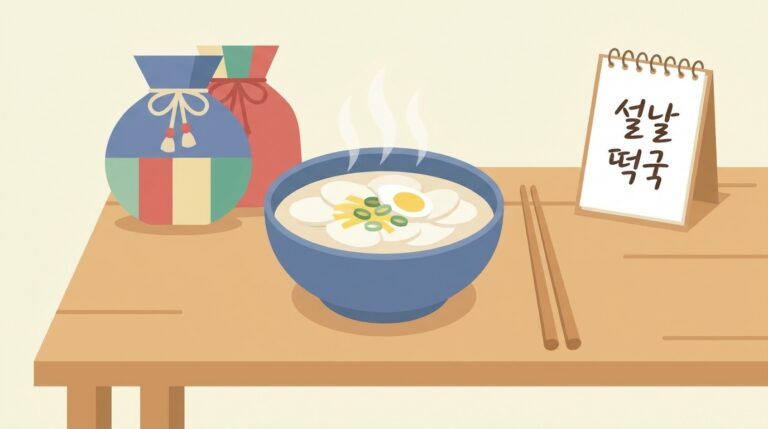
Picture this: It is a crisp, freezing morning in Seoul during Seollal (설날, Korean Lunar New Year). You are sitting criss-cross on the warm floor (ondol) at a Korean friend’s house. The kitchen smells heavenly—rich beef broth simmering for hours. The grandmother smiles warmly and slides a steaming, fragrant bowl of sliced white rice cake soup in front of you.
Before you take your first bite, she chuckles warmly: “떡국 한 그릇 다 먹어야 나이 한 살 더 먹는다!” (You have to finish this bowl of tteokguk to turn a year older!).
Your spoon freezes in mid-air. Wait, what? Eating soup makes me older? What if I eat two bowls… do I age two years today? Can I skip the bowl if I want to stay young forever?!
If you have ever felt confused by this unique Korean holiday tradition, you are definitely not alone! Every foreign resident and K-drama fan has paused at this very scene. But don’t worry: understanding this soup-eating age ritual is actually your golden ticket to winning the hearts of any Korean family. In this friendly guide based on real beginner feedback from our Daily Hangul learners, you will discover the foundational greetings for Seollal and Chuseok, master natural dining phrases, and learn how to handle New Year pleasantries like an absolute native.
Phase 2: 핵심 표현 3선 심층 분석 (Top 3 Essential Expressions)
1. 새해 복 많이 받으세요 (Saehae bok mani badeuseyo)
- Pronunciation: [Sae-hae bok mah-nee bah-deu-seh-yo] (Think: Say-hey! + Bok choy + Manicure + Ba-deu-say-yo)
- Meaning: Literal: “Please receive a lot of good fortune in the New Year.” / Nuance: “Happy New Year! Wishing you endless health and wealth.”
- K-Culture Moment: The signature line delivered right after performing the deep ceremonial bow (sebae, 세배) to family elders during holiday specials of variety shows like Running Man or historical K-dramas.
- Editor’s Insight: In English, we simply state “Happy New Year,” but in Korean, you are actively wishing that tangible blessings (bok, 복) flow abundantly into the listener’s life. It is respectful, humble, and universally loved.
- Situation Spectrum:
- Casual (to close friends): ⚠️ (Use “새해 복 많이 받아!” Saehae bok mani bada! instead)
- Semi-formal (colleagues/acquaintances): ✅
- Formal (elders/bosses/in-laws): ✅
- 🤔 Think About It: In Western cultures, we celebrate the turning of the calendar page. In Korean culture, why do you think greetings focus on actively “receiving blessings” (bok) as a community?
2. 떡국 드셨어요? (Tteokguk deusyeosseoyo?)
- Pronunciation: [Ddeok-guk deu-syeo-sseo-yo] (Sound analogy: Ddeok like a punchy ‘Duck’ + Guk like ‘Cook’ + Deu-syeo-sseo-yo)
- Meaning: Literal: “Did you honorably eat rice cake soup?” / Nuance: “Did you celebrate New Year’s day well?”
- K-Culture Moment: When idols pop onto Weverse or Instagram Live on Seollal morning, the very first question they ask their fans is almost always, “여러분, 떡국 드셨어요?” (Everyone, did you eat tteokguk?).
- Editor’s Insight:
드셨어요?is the honorific past tense of “to eat” (먹다 -> 드시다). Using this instead of the plain 먹었어요? shows instant cultural polish and warmth toward seniors and acquaintances. - Situation Spectrum:
- Casual: 🚫 (Too formal for same-age friends; say 떡국 먹었어?)
- Semi-formal: ✅
- Formal: ✅
- 🤔 Think About It: Why do you think asking whether someone ate a specific holiday food replaces a generic “How are you doing?” in Korea?
3. 한 살 더 먹었어요 (Han sal deo meogeosseoyo)
- Pronunciation: [Hahn sahl duh muh-guh-ssuh-yo] (Sound analogy: Hahn solo + Salad + Duh + Muh-guh-so-yo)
- Meaning: Literal: “I ate one more year.” / Nuance: “I’ve gained another year / I grew one year older.”
- K-Culture Moment: When a character in a slice-of-life drama playfully sighs on New Year’s Day, looking in the mirror and pinching their cheeks, saying, “아이고, 또 한 살 더 먹었네…” (Oh gosh, I ate another year again…).
- Editor’s Insight: Notice that Korean uses the verb 먹다 (meokda, to eat) for aging! It connects directly to the tradition of consuming tteokguk. Once you finish your bowl, you symbolically “ingest” maturity and another year of life experience.
- Situation Spectrum:
- Casual: ⚠️ (Say 한 살 더 먹었어 to close pals)
- Semi-formal: ✅
- Formal: ✅
- 🤔 Think About It: In your native language, do you “gain,” “turn,” or “grow” into an age? How does “eating” an age change how you perceive growing older?
Phase 3: 교과서 한국어 vs 진짜 한국어 (Textbook vs. Real-Life Korean)
Situation 1: Wishing Someone a Happy New Year
- 📖 교과서 한국어 (Textbook): 새해를 축하합니다. (Saehaereul chukahamnida. – “Congratulations on the New Year.”)
- 🗣️ 진짜 한국어 (Real Life): 새해 복 많이 받으세요! (Saehae bok mani badeuseyo! – “Please receive lots of New Year fortune!”)
- 💡 왜 다를까? (Why is it different?): Saying “Congratulations on the new year” sounds like reading from a corporate teleprompter. Real Koreans almost exclusively gift “blessings” (bok) through the spoken word!
Situation 2: Asking if a Friend Ate Rice Cake Soup
- 📖 교과서 한국어 (Textbook): 당신은 떡국을 먹었습니까? (Dangsineun tteokgugeul meogeotseumnikka? – “Did you [formal subject] eat tteokguk?”)
- 🗣️ 진짜 한국어 (Real Life): 떡국 먹었어? (Tteokguk meogeosseo? – [Casual]) / 떡국 드셨어요? (Tteokguk deusyeosseoyo? – [Polite])
- 💡 왜 다를까? (Why is it different?): Native speakers completely drop the unnatural pronoun 당신 (dangsin, you) in conversation. Mentioning the dish directly with warm tone pitch is the natural, friendly way.
Phase 4: K-Culture 딥다이브 & 비언어적 매너 (Deep Dive & Body Language)
4-1. 눈치 (Nunchi) & Gestures: Table Etiquette & The Seollal Bow
- Two Hands Rule: When someone passes you your bowl of hot tteokguk, never take it with just one hand. Hold the base or rim gently with both hands, bow your head slightly, and say: “감사합니다, 잘 먹겠습니다!” (Gamsahamnida, jal meokgetseumnida! – Thank you, I will eat well!).
- The Waiting Game (Nunchi): Do not pick up your spoon first! Wait until the eldest person at the table lifts their spoon and takes their first sip of broth. Only then should you begin.
- The Sebae Bow: If visiting elders, you will perform a deep floor bow (sebae). Men place their left hand over the right hand; women place their right hand over the left hand. Bend deeply with your head touching down, then stand back up smoothly before saying “새해 복 많이 받으세요.”
4-2. Cultural Code Analysis: Why White Sliced Rice Cakes?
Ever wondered why tteokguk rice cakes are sliced into white, diagonal oval discs?
1. Purity and Reset: The long, white cylinder rice cake (garaetteok, 가래떡) represents cleanliness, a fresh start, and a long life free from illness.
2. Coin Wealth: When sliced into small discs, they resemble old brass coins (yeopjeon, 엽전). Eating a bowl of round rice cakes is a wish to fill your life with wealth and financial prosperity in the coming year!
Phase 5: 실전 롤플레이 시나리오 (Real-Life Roleplay Dialogue)
Setting: Lunar New Year morning at Auntie Minji’s warm apartment in Mapo-gu, Seoul. The table is laden with jeon (savory pancakes), kimchi, and two steaming porcelain bowls of tteokguk.
Characters:
* Minji (Imo/Auntie): Warm, energetic Korean host.
* Alex (You): An eager beginner Korean learner visiting a local family.
- Minji: 알렉스, 새해 복 많이 받아요! (Alex, saehae bok mani badayo!)
- 🎭 Smiling wide, placing a hot bowl of soup in front of you.
- (“Alex, Happy New Year!”)
- Alex: 새해 복 많이 받으세요, 이모! (Saehae bok mani badeuseyo, imo!)
- 🎭 Bowing head slightly with both hands resting politely on the table.
- (“Happy New Year, Auntie!”)
- Minji: 자, 뜨거울 때 떡국 얼른 먹어요. (Ja, tteugeoul ttae tteokguk eolleun meogeoyo.)
- 🎭 Gesturing toward the soup with a proud smile.
- (“Now, hurry and eat your tteokguk while it is hot.”)
- Alex: 와, 정말 맛있겠어요! 잘 먹겠습니다. (Wa, jeongmal masitgesseoyo! Jal meokgetseumnida.)
- 🎭 Clasping spoon with both hands and sniffing the aroma happily.
- (“Wow, it looks delicious! I will eat well.”)
- Minji: 떡국 한 그릇 다 먹으면 나이 한 살 더 먹는 거예요! (Tteokguk han geureut da meogeumyeon nai han sal deo meongneun geoyeyo!)
- 🎭 Playfully teasing while serving a slice of kimchi.
- (“If you eat up a whole bowl, you turn one year older!”)
- Alex: 어? 그럼 저 두 그릇 먹으면 두 살 먹어요? (Eo? Geureom jeo du geureut meogeumyeon du sal meogeoyo?)
- 🎭 Eyes widening comically with chopsticks frozen in air.
- (“Huh? Then if I eat two bowls, do I age two years?”)
- Minji: 하하하! 아이고 귀여워라. 배부르면 한 살만 먹어요! (Hahaha! Aigo gwiyeowora. Baebureumyeon han salman meogeoyo!)
- 🎭 Bursting into laughter and patting your arm affectionately.
- (“Hahaha! Oh, how cute. If you’re full, just eat one year!”)
- Alex: 네! 맛있어서 다 먹을게요! (Ne! Masisseoseo da meogeulgeyo!)
- 🎭 Taking a big, joyful spoonful of savory broth and rice cake.
- (“Yes! It is so delicious I’ll eat it all!”)
🔀 인터랙티브 분기점 (Interactive Choice!)
After Auntie Minji teases you about gaining an age, how do you respond?
- Choice A: “맛있어서 열 그릇 먹고 할아버지 될래요!” (Masisseoseo yeol geureut meokgo harabeoji doellaeyo! – It’s so yummy I’ll eat ten bowls and become a grandpa!)
- Choice B: “싫어요, 나이 먹기 싫으니까 안 먹을래요.” (Sireoyo, nai meokgi sireunikka an meogeullaeyo. – I hate it, I don’t want to get old so I won’t eat.)
- Choice C: “저는 외국인이니까 떡국 먹어도 안 늙어요.” (Jeoneun oeguk-in-inikka tteokguk meogeodo an neulgeoyo. – I am a foreigner, so even if I eat tteokguk I don’t age.)
Feedback:
* Choice A (Best! 🏆): Hilarious, witty, and heartwarming! Auntie will probably give you extra beef slices and tell all her neighbors about how charming you are.
* Choice B (Bad! ❌): Even as a joke, refusing holiday food prepared with care can come across as blunt or ungrateful to elders.
* Choice C (Risk! ⚠️): Culturally accurate in reality (foreign age systems), but kills the cozy traditional storytelling vibe at the dinner table.
Phase 6: 10초 감정 섀도잉 드릴 (10-Second Emotion Shadowing Drill)
Practice these lines out loud! Follow the pause markers (/) and embody the emotion tags:
[🙇 정중하고 진심 어린 미소로](With a polite, heartfelt bow & smile)- 새해 복 / 많이 / 받으세요!
- (Sae-hae bok / mah-nee / bah-deu-seh-yo!)
[😋 따뜻한 국물을 보며 군침 돌게](Drooling slightly, looking at steaming broth)- 잘 먹겠습니다! / 떡국이 / 정말 맛있어 보여요.
- (Jal meok-get-seum-ni-da! / Tteok-gu-gi / jeong-mal mah-si-sseo bo-yeo-yo.)
[😆 깜짝 놀라며 장난스럽게](Cheeky, playful surprise)- 한 그릇 다 먹으면 / 한 살 / 더 먹는다고요?!
- (Han geu-reut da meo-geu-myeon / han sal / deo meong-neun-da-go-yo?!)
Phase 7: K-Culture 미니 사전 (Holiday Keyword Mini-Dictionary)
- 떡국 (Tteokguk) [Ddeok-guk]
- Definition: Sliced rice cake soup cooked in savory beef or anchovy broth, garnished with egg strips, seaweed, and minced meat.
- Everyday Use: Consumed on the morning of Seollal. If someone asks you in January or February, “떡국 먹었어?”, they are asking if you celebrated the New Year properly.
- 세배 (Sebae) [Se-bae]
- Definition: The formal ceremonial deep bow performed to grandparents and parents on Seollal.
- Everyday Use: Kids and young adults practice this diligently because doing it properly leads directly to step 3!
- 세뱃돈 (Sebaetdon) [Se-baet-don]
- Definition: New Year’s gift money given in crisp new envelopes by elders after receiving the sebae bow.
- Everyday Use: A huge topic of discussion every holiday season among Korean youth: “세뱃돈 얼마나 받았어?” (How much New Year’s money did you get?).
- 설날 (Seollal) [Seol-lal]
- Definition: Korean Lunar New Year, one of the two biggest national holidays along with Chuseok (Korean Thanksgiving).
- Everyday Use: Expresses family reunion, homecoming traffic jams (gwihyang-gil), and warm home-cooked feasts.
Phase 8: 여행자를 위한 생존 키트 (Traveler’s Survival Kit)
Survival Phrases TOP 3
- 새해 복 많이 받으세요! (Saehae bok mani badeuseyo!)
- Pro Tip: Say this to taxi drivers, hotel receptionists, and convenience store clerks on Seollal day. You will immediately be met with glowing smiles.
- 떡국 한 그릇 주세요. (Tteokguk han geureut juseyo.)
- Pro Tip: When visiting traditional Korean restaurants or food alleys in Insadong/Gwangjang Market around January/February, use this simple sentence to order the seasonal specialty.
- 추석 잘 보내세요! (Chuseok jal bonaeseyo!)
- Pro Tip: The autumn sister greeting! When Chuseok arrives in September or October, swap Seollal for this phrase: “Have a wonderful Chuseok!”
Editor’s Travel Note 💡
- Holiday Closures & Ghost Town Seoul: During Seollal day and Chuseok day, major independent shops, local clinics, and mom-and-pop restaurants in Seoul shut down for 2-3 days as families travel south. Always verify shop hours using the Naver Map application instead of international map apps, which often do not reflect real-time holiday schedules in Korea.
- Palace Free Entry: Here is a secret money-saver! Major royal palaces like Gyeongbokgung and Changdeokgung usually offer free admission to all visitors (including foreigners) during Seollal and Chuseok holidays. It’s the ultimate photo-op!
Phase 9: “한 발 더 깊이” (Reflective Humanities Essay)
In Western cultures, turning older is an individual milestone marked by your private birthday cake and candles. But historically in Korea, age was communal. Under the traditional Korean age counting system (Hanguk-nai), everyone gained a year together on the first day of the New Year, bound by the shared ritual of eating hot tteokguk together.
Even though South Korea officially standardized international age calculation on official documents in 2023, the cultural soul of “eating a bowl of tteokguk equals gaining a year” remains as vibrant as ever. It reminds us that growing older in Korea is never a lonely journey. You age together with your family, your neighbors, and your community over warm broth.
💬 Your Turn: Does your culture celebrate birthdays individually, or do you have a holiday dish associated with wisdom, fortune, or age? Tell us in the comments below!
Phase 10: FAQ & 오해 방지 (FAQ Schema & Pitfalls)
Q: If South Korea legally changed to the international age system, do Koreans still say tteokguk makes you older?
A: Yes, absolutely! Legally, your legal age now tracks your actual birthday like the rest of the world. However, culturally and colloquially, 100% of Koreans still joke and celebrate the adage “떡국 먹고 한 살 더 먹었다!” (I ate tteokguk and turned a year older!). It is an affectionate cultural habit that legislation will likely never erase.
Q: Can I eat tteokguk on regular days, or is it strictly forbidden outside of Seollal?
A: You can eat tteokguk any day of the year! In fact, tteok-manduguk (rice cake soup with dumplings) is a super common lunchtime comfort food at everyday Korean diners (bunsikjeom). However, eating it specifically on the morning of Lunar New Year is what carries the special symbolic meaning of renewal and fortune.
Q: What is the main difference between Seollal and Chuseok greetings?
A: For Seollal (New Year), the standard greeting is 새해 복 많이 받으세요 (Receive lots of New Year blessings). For Chuseok (autumn harvest festival), you say 즐거운 추석 보내세요 (Have an enjoyable Chuseok) or 풍성한 한가위 되세요 (Have an abundant Hangawi harvest).
🚨 흔한 실수 (Common Mistakes) Warning Board
- ❌ Mistake 1: Saying “생일 축하해요” (Happy Birthday) to elders on New Year’s Day because “everyone turns a year older.”
- ✅ Correct Action: Only use 새해 복 많이 받으세요. “생일” refers exclusively to biological birthdays!
- ❌ Mistake 2: Bowing with the casual hand wave or a standing hand-shake when elders perform sebae.
- ✅ Correct Action: Keep your feet still, stand politely with hands clasped in front (gongsu, 공수), or join in on the floor bow if invited.
- ❌ Mistake 3: Slurping tteokguk noisily like ramen.
- ✅ Correct Action: Korean table manners traditionally favor quiet spooning. Lift the oval rice cakes gently with your spoon, blow on them lightly, and chew comfortably.
Phase 11: 액션 미션 & 참여 유도 (Action Missions)
- 🥉 Bronze Mission (Solo Practice): Stand before a mirror. Practice the greeting “새해 복 많이 받으세요!” 3 times with a gentle 30-degree bow and a warm, inviting smile.
- 🥈 Silver Mission (Social Media): Find your favorite K-pop idol or actor’s Seollal post from this past year. Reply with: “새해 복 많이 받으세요! 떡국 드셨어요?”.
- 🥇 Gold Mission (Real Life): Visit a local Korean grocery mart or restaurant this week. Order tteokguk or simply greet the cashier with “새해 복 많이 받으세요!” when January rolls around. Watch their face light up!
- 🎮 K-Culture Mission: Watch Episode 1 or the holiday special of any classic K-drama (like Reply 1988 or Weightlifting Fairy Kim Bok-joo). Spot the scene where the family sits together around a bowl of tteokguk!
Phase 12: 인터랙티브 퀴즈 챌린지 (Interactive Quiz)
Test your holiday mastery before heading out into the real world!
- Situational Judgment: You arrive at your Korean friend’s house on Seollal morning. Their grandmother opens the door. What is the most natural greeting?
- A) 축하합니다! (Chukahamnida!)
- B) 새해 복 많이 받으세요! (Saehae bok mani badeuseyo!)
- C) 생일 축하해요! (Saeng-il chukahaeyo!)
- Fill-in-the-Blank: Complete the traditional teasing idiom:
- “떡국 한 그릇 먹으면 나이 한 살 더 (_____)!”
- (Eating a bowl of tteokguk means gaining one year!)
- A) 마셔요 (masyeoyo – drink)
- B) 먹어요 (meogeoyo – eat)
- C) 버려요 (beoryeoyo – throw away)
- True or False Cultural Trivia:
- White oval rice cakes in tteokguk historically symbolize old brass coins and wishing for wealth.
- (True / False)
👉 Click here to reveal answers & explanations!
Answers:
1. B) 새해 복 많이 받으세요! (Choice A is too stiff/generic; Choice C is only for individual biological birthdays!)
2. B) 먹어요 (meogeoyo). (In Korean, you “eat” (먹다) an age along with the rice cake soup!)
3. True! (The oval slices resemble ancient yeopjeon coins, symbolizing prosperous fortune for the coming year.)







