

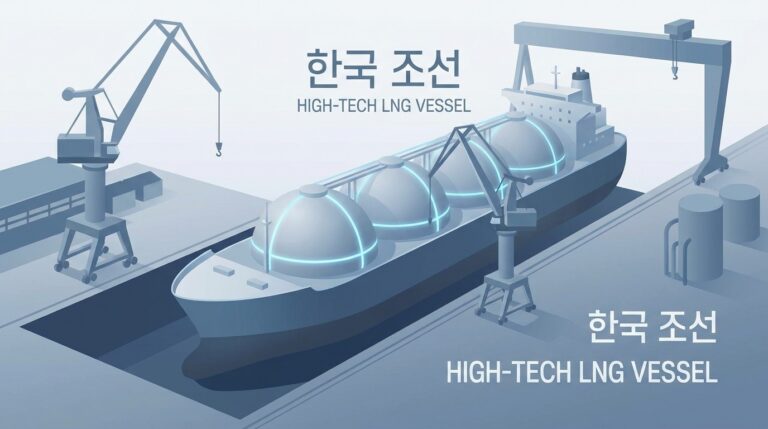
The Art of Cryogenic Mastery: Decoding Korea’s High-Value Shipbuilding at -163°C and Beyond
Phase 1: 공감 (Story Immersion Opening)
안녕하세요! 매일한글 에디터입니다.
Imagine standing on the catwalk inside a massive drydock in Geoje Island, South Korea. The wind blowing off Gohyeon Bay smells of brine, anti-corrosion primer, and the crisp bite of sliced steel. Below you yawns a cavernous space spanning 300 meters—a technological cathedral engineered to transport liquefied natural gas (LNG) at a blistering -163°C, or liquid hydrogen at -253°C, where ordinary steel shatters like peanut brittle. Many international engineers and C-suite maritime executives arrive in Korea thinking technical English alone will carry them through negotiations with shipbuilders like HD Hyundai, Hanwha Ocean, or Samsung Heavy Industries.
Yet, during high-stakes project milestone meetings or over an intense dinner of grilled pork belly (samgyeopsal) with shipyard directors, the conversation abruptly pivots to terms like 초격차 화물창 (super-gap cargo containment) and 용접 결함 제로화 (zero-defect welding). If your Korean is limited to polite textbook greetings, you will miss the unspoken subtext of industrial pride, geopolitical stakes, and maritime craft that define Korean shipbuilding dominance. Based on real consulting debriefs with foreign project directors in Ulsan and Geoje, this guide bridges that exact linguistic void so you can converse with technical precision, cultural authority, and C2-level nuance.
Phase 2: 핵심 표현 3선 심층 분석 (Core 3 Expressions In-Depth)
1. 극저온 화물창 (Geukjeo-on hwamulchang)
- Pronunciation: [Geuk-jeo-on hwa-mul-chang] (Think: “Gook-juh-on hwa-mool-chahng”)
- Meaning: Cryogenic Cargo Containment System (CCS). Literally: “Ultra-low temperature cargo warehouse/hold.”
- K-Culture Moment: Evoked in corporate boardroom dramas like Misaeng or investigative corporate documentaries, where mega-contracts hinge on mastering thermal contraction barriers.
- Editor’s Insight: In Korean maritime discourse, this is not merely a “tank” (탱크). Using 화물창 elevates your register immediately to expert naval architectural status. It signifies the secondary barrier, invar alloy membranes, and complex insulation lattices that prevent boiling gas from touching the ship’s hull.
- Situation Spectrum:
- Casual: ⚠️ (Too academic for ordering beer, but acceptable if debating tech news)
- Semi-formal: ✅
- Formal / Business: ✅
- 🤔 Think About It: Why does Korean distinguish between a simple storage container (보관함) and specialized maritime 화물창? Notice how Sino-Korean roots (창, 艙) immediately delineate vessel-specific industrial scale.
2. 용접 결함 제로화 (Yongjeop gyeolham jerohwa)
- Pronunciation: [Yong-jeop gyeol-ham je-ro-hwa] (Think: “Yong-jup gyul-hahm zeh-ro-hwa”)
- Meaning: Zero-defect welding / Flawless seam integrity. Literally: “Making welding flaws zero.”
- K-Culture Moment: Resembles the relentless quest for perfection showcased when master artisans (명장) are interviewed on national broadcast programs like Master of Living (생활의 달인).
- Editor’s Insight: Cryogenic membranes demand kilometers of manual and automated TIG welding on ultra-thin corrugated stainless steel without a single pinhole leak. When Korean engineers speak of 결함 제로화, they are not quoting a KPI; they are invoking a quasi-sacred occupational standard of shipyard honor.
- Situation Spectrum:
- Casual: 🚫
- Semi-formal: ⚠️
- Formal / Technical: ✅
- 🤔 Think About It: In English, we often say “zero tolerance for defects.” In Korean, the suffix -화 (化) turns “zero defects” into an active, continuous transformation process. How does that reshape managerial responsibility?
3. 초격차 기술력 (Chogyeokcha gisullyeok)
- Pronunciation: [Cho-gyeok-cha gi-sul-lyeok] (Think: “Cho-gyuck-cha ghee-sool-lyuck”)
- Meaning: Super-gap technological prowess (an insurmountable technological lead over competitors).
- K-Culture Moment: A ubiquitous buzzword in business reporting and corporate keynote addresses by top Korean chaebol conglomerates, reflecting Korea’s national strategic doctrine in semiconductors, secondary batteries, and LNG carriers.
- Editor’s Insight: 초격차 is not just “competitive advantage” (경쟁우위). Coined in the Korean high-tech sphere, it describes opening such a massive technological chasm that rivals cannot catch up even if they copy the current standard.
- Situation Spectrum:
- Casual: ⚠️
- Semi-formal: ✅
- Formal / Executive: ✅
- 🤔 Think About It: What does a nation’s obsession with 초격차 reveal about its geopolitical survival instinct between surrounding superpowers?
Phase 3: 교과서 한국어 vs 진짜 한국어 (Textbook vs. Real-world Korean)
Situation 1: Emphasizing technical superiority in contract discussions
- 📖 교과서 한국어 (Textbook Korean):
우리 회사는 우수한 기술력을 보유하고 있어서 다른 경쟁사보다 앞서 있습니다.
(Uri hoesaneun usuhan gisullyeogeul boyuhago isseoseo dareun gyeongjaengsaboda apseo isseumnida. / “Our company possesses superior technology and is ahead of other competitors.”) - 🗣️ 진짜 한국어 (Real C2 Industry Korean):
극저온 화물창 분야만큼은 우리가 확실한 초격차 기술력을 쥐고 있어 경쟁국이 쉽게 넘볼 수 없습니다.
(Geukjeo-on hwamulchang bunyamankeumeun uriga hwaksilhan chogyeokcha gisullyeogeul jwigo isseo gyeongjaenggugi swipge neombol su eopseumnida. / “When it comes to cryogenic containment systems, we hold an undeniable super-gap lead that rival nations cannot easily touch.”) - 💡 왜 다를까? (Cultural Insight): The textbook sentence sounds passive and timid. High-stakes Korean industrial leaders use assertive idiomatic verbs like 쥐다 (to grasp firmly) and 넘보다 (to covet or dare encroach) to project strategic dominance.
Situation 2: Demanding absolute precision on the assembly dock
- 📖 교과서 한국어 (Textbook Korean):
품질 관리를 철저히 해서 누수가 생기지 않도록 해주세요.
(Pumjil gwallireul cheoljeohi haeseo nusage saenggiji antorok haejuseyo. / “Please manage quality thoroughly so that leaks do not occur.”) - 🗣️ 진짜 한국어 (Real C2 Industry Korean):
영하 백육십삼 도를 견뎌야 합니다. 한 땀 한 땀 전수검사해서 용접 결함 제로화로 마감 쳐주십시오.
(Yeongha baegyuksipsam doreul gyeondyeoya hamnida. Han ttam han ttam jeonsugeomsahaeseo yongjeop gyeolham jerohwaro magam cheojusipsio. / “It must withstand -163°C. Inspect every single millimeter stitch-by-stitch and finish this with zero welding defects.”) - 💡 왜 다를까? (Cultural Insight): Korean master builders borrow the idiom 한 땀 한 땀 (stitch by stitch, originally used for bespoke haute couture tailoring) to convey the obsessive human artistry required for cryogenic membrane welding.
Phase 4: K-Culture 딥다이브 & 비언어적 매너 (Deep Dive & Non-Verbal Nuance)
4-1. 눈치 (Nunchi) & Dockside Non-Verbal Manners
When walking through a Korean fabrication shop or inspecting an insulated cargo membrane:
* The Two-Handed Blueprint Handover: Never hold technical blueprints, QA checklists, or structural schematics with one hand. Present documents with both hands, thumbs parallel, accompanied by a slight forward bow of the torso (15 degrees).
* Eye-Line Courtesy with Master Craftsmen (명장): In Korea, veteran welders often outrank mid-level white-collar managers in practical shipyard authority. When interacting with a senior 반장님 (site foreman) or 명장 (national master artisan), do not maintain cold, unbroken Western direct eye contact while questioning a weld seam. Listen with a downward tilt of the head, nodding periodically (끄덕임) to show deference to their decades of tactile experience.
* Safety Helmet Protocol: Touching or adjusting another executive’s hard hat (안전모) strap is seen as a sign of close paternal camaraderie, but among partners, remove your helmet immediately upon entering a dockside conference room to signify that you are shifting from operational scrutiny to bilateral consensus.
4-2. Cultural Code: The Mythos of Korean Heavy Industry
South Korea’s global lead in LNG carrier construction isn’t just an export statistic; it is a foundational pillar of modern Korean self-worth. In the 1970s, Hyundai founder Chung Ju-yung famously showed a British bank executive a 500-won banknote depicting the 16th-century turtle ship (거북선) to prove Koreans had the genetic capacity to build modern supertankers on empty sand beaches. Today’s high-value eco-vessels (methanol-ready, ammonia-fueled, and cryogenic hydrogen carriers) are viewed as the 21st-century evolution of that national survival drive. When you treat cryogenic engineering with historic reverence, Korean shipyard teams will stop treating you as an outside auditor and embrace you as a true strategic ally.
Phase 5: 실전 롤플레이 시나리오 (Real-World Roleplay Scenario)
Setting: The VIP Briefing Deck at HD Hyundai Heavy Industries, Ulsan. Cold wind howls outside the double-glazed observation window overlooking Hull No. 3342, an ultra-large LNG carrier undergoing containment pressure trials.
Characters:
* Dr. Elena Vance (Reader): Chief Technical Officer of an international Arctic shipping consortium.
* 박 수석 (Chief Engineer Park): Veteran Head of Naval Architecture and Cryogenic Containment.
박 수석: 엘레나 이사님, 이번 북극 항로용 쇄빙 LNG선의 화물창 단열재 두께를 최종 승인하셔야 합니다.
(Elena isanim, ibeon bukgeuk hangroyong swaebing LNGseonui hwamulchang danyeoljae dukkereul choejong seung-inhasiyeoya hamnida.)
(Elena, you must grant final sign-off on the cargo containment insulation barrier thickness for this Arctic-class icebreaking LNG carrier.)
Elena: 극저온 환경에서 BOG(Boil-Off Gas) 손실률을 잡으려면 멤브레인 접합부의 안정성이 최우선입니다.
(Geukjeo-on hwangyeong-eseo BOG sonsillyureul jabeuryeomyeon membure-in jeophapbuui anjeongseongi choe-useon-imnida.)
(To suppress the Boil-Off Gas loss rate in cryogenic extremes, the stability of the membrane joints is our absolute priority.)
박 수석: 🎭 손가락으로 3D 단면도를 짚으며 저희가 독자 개발한 화물창은 영하 백육십삼 도에서도 열 수축 응력을 완벽히 분산시킵니다.
(Jeohuiga dokja gaebalhan hwamulchangeun yeongha baegyuksipsam dodo-eseodo yeol suchuk eungnyeogeul wanbyeokhi bunsansikimnida.)
(🎭 Pointing with his index finger at the 3D cross-section schematic The cargo containment system we developed in-house perfectly disperses thermal contraction stress even at -163°C.)
Elena: 액화수소 화물창까지 염두에 둔다면 영하 이백오십삼 도를 견뎌야 할 텐데요. 그 초극저온에서도 용접선 균열 위험이 없습니까?
(Aekhwasuso hwamulchang-kkaji yeomdue dundamyeon yeongha ibaegosipsam doreul gyeondyeoya hal tendeyo. Geu chogeukjeo-on-eseodo yongjeopseon gyunyeol wiheomi eopseumnikka?)
(If we keep liquid hydrogen cargo holds in mind, it will need to withstand -253°C. Is there no risk of weld seam cracking even at that ultra-cryogenic point?)
박 수석: 🎭 굳은 확신에 찬 표정으로 고개를 끄덕이며 특수 오스테나이트계 스테인리스 강재에 자동 레이저 용접을 적용해 용접 결함 제로화를 달성했습니다.
(Teuksu oseutenaitogye seute-inriseu gangjaee jadong re-ijeo yongjeobeul jeok-yonghae yongjeop gyeolham jerohwareul dalseonghaesseumnida.)
(🎭 Nodding firmly with an expression of resolute confidence By applying automated laser welding to specialized austenitic stainless steel, we achieved zero welding defects.)
Elena: 중국 조선소들도 최근 국산화 멤브레인을 내세우며 견적을 대폭 낮추고 있습니다만.
(Jungguk joseonso-deuldo choegeun guksanhwa membure-ineul naese-umyeo gyeonjeogeul daepok natchugo itsseumnidaman.)
(Chinese shipbuilders have also been touting indigenous membranes lately and dramatically lowering their quotes.)
박 수석: 단열재 폼의 미세 균열 하나가 공해상에서 폭발적인 재앙을 부릅니다. 이건 가격 경쟁의 문제가 아니라 초격차 기술력의 신뢰도 문제입니다.
(Danyeoljae pom-ui mise gyunyeol hanaga gonghaesang-eseo pokbaljeogin jae-angeul bureumnida. Igeon gagyeok gyeongjaeng-ui munjejga anira chogyeokcha gisullyeogui sinroedo munje-imnida.)
(A single microscopic crack in the insulation foam invites catastrophic disaster on open waters. This is not a matter of price competition; it is a question of trust in super-gap engineering.)
Elena: 🎭 서류철을 정중히 덮으며 신뢰는 입증되었습니다. 박 수석님 팀을 믿고 원안대로 밀고 나가지요.
(Sinroeneun ipjeungdoeeotseumnida. Park suseongnim timeul mitgo won-andaero milgo nagajiyo.)
(🎭 Closing the dossier with dignified composure Trust has been proven. I trust your team, Chief Park; let us push forward with the original blueprint.)
🔀 인터랙티브 분기점 (Interactive Decision Point)
At turn 6, when Chief Park defends the shipyard’s pride against cheaper competitors, how should you respond?
- Option A: “그래도 선주 입장에서는 단가 절감이 최우선이니 타협점을 찾읍시다.” (Still, for shipowners, cost cutting is paramount, so let’s find a compromise.)
- Option B: “단열재 폼의 안전 마진 데이터를 확인한 후, 초격차 기술에 합당한 프리미엄을 집행하겠습니다.” (Once we verify the safety margin data of the insulation foam, we will authorize the premium justified by your super-gap technology.)
- Option C: “중국 야드에 가서 똑같이 용접할 수 있는지 확인해보고 오겠습니다.” (I’ll go check with Chinese yards to see if they can weld this the exact same way.)
Feedback:
* Option A [Risk]: Diminishes the Korean team’s technological pride. Chief Park may become guarded, restricting your consortium’s access to proprietary containment monitoring data.
* Option B [Best]: Masterful C2 execution. Balances financial prudence with profound respect for 초격차 기술, gaining executive loyalty and top-tier yard scheduling.
* Option C [Bad]: A catastrophic faux pas. Comparing Korean cryogenic welding to developing competitor yards directly offends the engineering team’s industrial integrity.
Phase 6: 10초 감정 섀도잉 드릴 (10-Second Emotional Shadowing Drill)
Practice these lines using the slash marks / for breath cadence and rhythmic pacing:
- [🧐 냉철하고 단호하게 – Cold, Analytical, and Decisive]
“영하 백육십삼 도의 극저온에서는 / 미세한 용접 결함 하나가 / 선체 전체의 안전을 / 좌우합니다.”
(Yeongha baegyuksipsam dowi geukjeo-on-eseoneun / misehan yongjeop gyeolham hanaga / seonche jeonche-ui anjeoneul / jwauhamnida.)
“At cryogenic temperatures of -163°C / a single microscopic welding flaw / dictates the safety / of the entire hull.” -
[🔥 결의에 차서 당당하게 – Filled with Fierce Resolution and Professional Pride]
“우리가 추구하는 것은 / 단순한 납기 준수가 아니라 / 그 누구도 넘볼 수 없는 / 초격차 품질입니다.”
(Uriga chuguhaneun geoseun / dansunhan napgi junsuga anira / geu nugudo neombol su eomneun / chogyeokcha pumjirimnida.)
“What we pursue / is not mere adherence to delivery deadlines / but super-gap quality / that no one can dare contest.”
Phase 7: K-Culture 미니 사전 (Mini Dictionary)
-
명장 (Myeongjang) [Myeong-jang]
- Definition: National Master Craftsman.
- Usage: A government-accredited title awarded to supreme masters of industrial trades (welding, mold design, precision tooling). In Korean heavy industry, calling a senior specialist 명장님 commands immense respect.
- 수주 랠리 (Suju raelli) [Su-ju rael-li]
- Definition: Order-winning rally / Serial contract streak.
- Usage: Frequently headline news in Korea whenever the “Big 3” shipbuilders sweep international procurement tenders for mega-LNG carriers and ammonia duel-fuel bulkers.
- 보냉재 (Bonaengjae) [Bo-naeng-jae]
- Definition: Cryogenic insulation barrier / cold-retention material.
- Usage: Polyurethane foam, glass wool, or aerogel panels sandwiched between the ship’s double hull and the liquid gas membrane to prevent heat transfer.
- 맨땅에 헤딩 (Maenttange heding) [Maen-ttang-e he-ding]
- Definition: Headbutting bare dirt (starting from scratch against all odds).
- Usage: An affectionate corporate idiom used to describe how Korean heavy industries built world-beating high-tech dominance with zero baseline capital or technology in the 1970s.
Phase 8: 여행자를 위한 생존 키트 (Traveler’s Survival Kit for Geoje & Ulsan)
Survival Expressions TOP 3
- “조선소 정문 VIP 의전실로 가려면 어디로 가야 합니까?”
(Joseonso jeongmun VIP uijeonsillo garyeomyeon eodiro gaya hamnikka?)
Pro Tip: Shipyards are self-contained cities spanning millions of square meters. Always specify the VIP Protocol Office (의전실) or you may be dropped at freight gates miles away. - “도크 내 진입 시 보안 서약서와 안전모 착용 규정을 확인해 주세요.”
(Dokeu nae jin-ip si bo-an seoyakseowa anjeonmo chagyong gyujeongeul hwaginhae juseyo.)
Pro Tip: Industrial espionage is strictly policed; smartphone camera lenses are taped over at the gate. - “오늘 진수식 일정에 맞춰 시운전 결과를 브리핑해 주십시오.”
(Oneul jinsusik iljeong-e matchwo si-unjeon gyeolgwaneul beuripinghae jusipsio.)
Pro Tip: Ship launchings (진수식) are grand spiritual and corporate celebrations. Use this phrase when coordinating sea trial data before the ceremonial ribbon cutting.
Editor’s Travel Note: Heading to Maritime Hubs
When traveling to Okpo (Geoje) or Bangeojin (Ulsan), do not rely on standard international taxi apps. Download the 네이버 지도 앱 다운로드 (Naver Map App) for precise shipyard gate-by-gate transit directions and intercity express bus reservations. If visiting Geoje, try the local 굴구이 (charcoal-grilled oysters) or 도다리쑥국 (flounder mugwort soup) with shipyard engineers after hours—it is the quickest route to building genuine professional trust.
Phase 9: “한 발 더 깊이” (Step Deeper – Cultural Reflection)
In Western corporate environments, precision engineering is framed as adherence to empirical checklists and ISO metrics. In South Korea, high-stakes manufacturing—such as the manual welding of thousands of cryogenic containment plates—is deeply rooted in 장인정신 (the craftsman’s soul) and 공동체적 책임감 (communal accountability). To let a single seam fracture under -163°C is not seen merely as a mechanical warranty failure; it is considered a breach of communal trust that tarnishes the shipyard’s flag and the nation’s industrial standing. When you acknowledge the moral gravity behind Korean precision, you transcend linguistic fluency and enter true cultural alignment.
💬 Your Turn: Does your native industrial culture view engineering through cold contractual metrics, or is there an element of national identity woven into high-tech manufacturing? Share your thoughts below!
Phase 10: FAQ & 오해 방지 (FAQ & Common Mistakes)
Q: Is it acceptable to use casual language with yard technicians if they are younger than me?
A: Absolutely not. In industrial heavy engineering environments, safety and hierarchy are deeply entwined. Always use 하십시오체 (formal high) or polite 해요체 ending in -시지요 with all shipyard personnel regardless of their age, referring to them by title (e.g., 기사님, 반장님, 책임연구원님).
Q: Can I use the term ‘탱크’ (tank) instead of ‘화물창’ (cargo hold)?
A: While people will understand you, ‘탱크’ refers to independent fuel tanks (e.g., Type C pressurized tanks). Membrane-type systems that utilize the ship’s hull structure for support are strictly designated as 화물창 (Containment System). Using the wrong term in front of naval architects signals amateur status.
Q: What does ‘국산화율’ mean in contract disputes?
A: 국산화율 (Guksanhwayul) refers to the domestic localization rate of components. Korea pays significant licensing fees to foreign patent holders (such as France’s GTT) for containment designs. When Koreans discuss 국산화 화물창, they are discussing the nation’s dream to deploy self-developed containment membranes free from foreign patent rents.
🚨 흔한 실수 (Common Mistakes) Warning Board
- Mistake: Translating “Zero Defects” as “결함 없음” (Gyeolham eopseum).
- Correct Action: Use the formal industry nominalization 결함 제로화 (Gyeolham jerohwa).
- Mistake: Calling a Master Craftsman “선생님” (Teacher).
- Correct Action: Use the official, revered industrial title 명장님 (Myeongjang-nim).
- Mistake: Pronouncing -163°C using pure Korean numbers (e.g., 백예순세 도).
- Correct Action: Always use Sino-Korean numbers for temperatures: 영하 백육십삼 도 (Yeongha baegyuksipsam do).
Phase 11: 액션 미션 & 참여 유도 (Action Missions)
- Bronze Mission (Solo Practice): Record yourself reading the Phase 6 Shadowing Drill 3 times, focusing on clear diction for 영하 백육십삼 도 and 초격차 기술력.
- Silver Mission (Social Engagement): Write a LinkedIn or social post commenting on a recent maritime news event (e.g., Arctic shipping routes or green ammonia vessels) using the keyword 초격차.
- Gold Mission (Real Application): In your next technical email or meeting with Korean counterparts, replace the bland phrase “품질이 좋습니다” with “화물창 설계의 안정성과 결함 제로화 역량이 대단히 인상적입니다.”
- 🎮 K-Culture Mission: Watch a scene from an industrial K-drama (such as Misaeng Episode 13 or corporate documentary features on Ulsan shipyards) and spot how junior traders address chief technical engineers.
Phase 12: 인터랙티브 퀴즈 챌린지 (Interactive Quiz Challenge)
1. Situational Judgment
Which expression is most appropriate when praising a Korean shipyard’s technological gap over regional competitors during a formal contract banquet?
* A) 우리 배를 싸게 만들어 줘서 고맙습니다.
* B) 타 야드가 넘볼 수 없는 초격차 화물창 기술력에 깊은 경의를 표합니다.
* C) 기술이 제법 괜찮으니 다음에도 계약해 드릴게요.
2. Fill-in-the-Blank
영하 백육십삼 도의 극저온을 견디기 위해서는 멤브레인 용접 부위의 (__________ )가 반드시 실현되어야 합니다.
(Hint: A 6-syllable term meaning ‘zero-defect welding’)
3. True / False Cultural Check
True or False: In a Korean shipyard dock inspection, pointing directly at a senior welder’s seam with your index finger while speaking casual Korean is considered a modern, proactive sign of hands-on leadership.
👉 정답 및 해설 확인하기 (Click to reveal Quiz Answers & Explanations)
- 정답: B
- 해설: Choice B utilizes the high-register idiom 넘볼 수 없는 초격차 (insurmountable super-gap) and polite honorific respect (경의를 표합니다), perfectly tailored for C-suite and naval architecture leadership.
- 정답: 용접 결함 제로화 (Yongjeop gyeolham jerohwa)
- 해설: This industry-standard term encapsulates the uncompromising engineering requirement for LNG/LH2 containment membranes.
- 정답: False
- 해설: Pointing fingers at someone’s craft and using informal register violates industrial decorum. Respect for experienced craftsmen (명장) requires open-handed gesturing, deferential posture, and high-formal language.
- 해설: Pointing fingers at someone’s craft and using informal register violates industrial decorum. Respect for experienced craftsmen (명장) requires open-handed gesturing, deferential posture, and high-formal language.







