

Phase 1: Empathy (Story Immersion Opening)
안녕하세요! It is your Daily Hangul editor and your personal Korean cultural navigator.
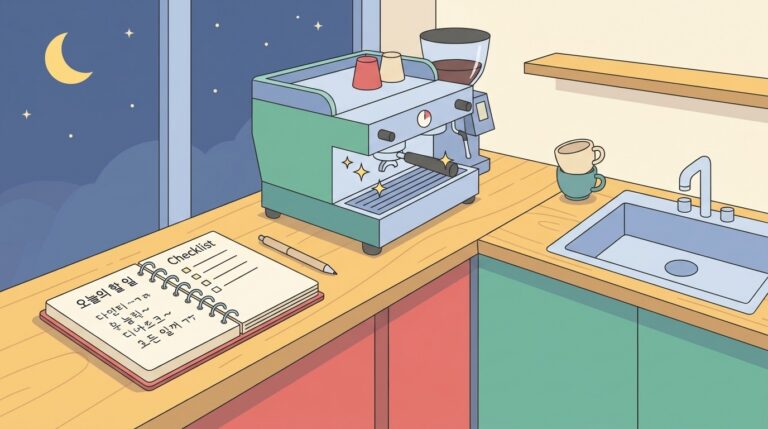
Picture this: It is 10:45 PM on a chilly Friday night in a trendy cafe in Yeonnam-dong. The last customer has just stepped out into the neon-lit alley, and suddenly the cafe falls dead silent. You stand behind the counter, staring at the intimidating, steaming espresso group heads, a sink piled with milk pitchers, and a dreaded green ledger book sitting next to the glowing POS terminal. Your shift mate whispers, “Can you do the chemical backflush on the portafilters while I balance the cash drawer?”
Panic sets in. You know how to make a vanilla latte, but what on earth is the Korean word for “backflushing detergent”? How do you write in the handover note that you emptied the slimy sink strainer so the morning manager does not leave an angry note in the team KakaoTalk chat? In K-dramas, working in a cafe looks like warm smiles, indie acoustic soundtracks, and cute apron scenes. In reality, cafe closing (magam alba) is an Olympic sport of sanitation, precision, and silent workplace etiquette (nunchi).
If you have ever felt nervous about reporting your work tasks in Korean or worried that your phrasing sounded either awkwardly robotic or unintentionally rude, take a deep breath. Today, based on feedback from hundreds of foreign part-timers who survived the Seoul cafe trenches, we are breaking down the exact phrasing, cultural codes, and handover formulas you need to sound like an ultra-reliable, seasoned pro.
Phase 2: Core 3 Expressions In-Depth
1. 커피 머신 포터필터 약품 세척 끝냈어요 (Keopi meosin poteopilteor yakpum secheok kkeunnaesseoyo)
- Pronunciation: [Keo-pi meo-sin po-teo-pil-teo yak-pum se-cheok kkeun-nae-sseo-yo] (Sounds like: cup-ee muh-sheen po-toe-peel-toe yahk-poom seh-chawk gkeun-nae-so-yo)
- Meaning: Literal: “I finished chemical washing of the coffee machine portafilter.” / Nuanced: “I thoroughly backflushed and soaked the portafilters with espresso detergent; the machine is prepped and sanitized.”
- K-Culture Moment: Seen in every realistic cafe workplace web drama when the senior part-timer checks off the checklist before flipping the “Closed” sign.
- Editor’s Insight: 약품 세척 (yakpum secheok) refers specifically to the daily blind-basket backflushing routine using dedicated espresso cleaning powder. Saying just 씻었어요 (ssiseosseoyo) sounds like you only rinsed it with water. Using 약품 세척 instantly proves you know professional barista hygiene!
- Situation Spectrum: Casual: ⚠️ (with close coworkers) / Semi-formal: ✅ (default workplace polite) / Formal: ✅ (약품 세척 완료했습니다)
- 🤔 Think About It: In English, we often say “I cleaned the machine.” In Korean workplace culture, naming the exact process (약품 세척) reassures your team that standard operating procedure was strictly honored.
2. 싱크대 배수구 거름망 비워뒀어요 (Singkeudae baesugu georeummang biwodu-eosseoyo)
- Pronunciation: [Sing-keu-dae bae-su-gu geo-reum-mang bi-wo-dwo-sseo-yo] (Sounds like: sing-kuh-deh beh-soo-goo guh-loom-mahng bee-wo-dwo-so-yo)
- Meaning: Literal: “I emptied the sink drain strainer and left it that way.” / Nuanced: “I dumped the coffee grinds and food debris out of the drain trap, cleaned it, and it is ready for the morning crew.”
- K-Culture Moment: The true test of cafe camaraderie in Korean part-time circles. If you forget this, the opening shift will post a photo on the shift group chat with a passive-aggressive sticker!
- Editor’s Insight: The helper verb grammar -아/어 두다 (-a/eo duda) denotes “doing something beforehand for future benefit.” By saying 비워뒀어요 (biwodu-eosseoyo) instead of just 비웠어요 (biwosseoyo), you subtly convey: “I did this task ahead of time to make your morning shift easier.”
- Situation Spectrum: Casual: ⚠️ / Semi-formal: ✅ / Formal: ✅ (거름망 비워두었습니다)
- 🤔 Think About It: Notice how the Korean grammar explicitly embeds thoughtfulness for the next person into the verb itself. What words in your native tongue carry this built-in sense of consideration?
3. 포스기 마감 정산 딱 맞춰놨어요 (Poseugi magam jeongsan ttak matchwonwasseoyo)
- Pronunciation: [Po-seu-gi ma-gam jeong-san ttak mat-chwo-nwa-sseo-yo] (Sounds like: poh-soo-gee mah-gahm jung-sahn dahk maht-chwo-nwah-so-yo)
- Meaning: Literal: “I matched the POS closing settlement right on the dot.” / Nuanced: “The cash drawer and the card receipts balance perfectly to the last won; there are zero discrepancies.”
- K-Culture Moment: The triumphant climax of an evening shift where the tired worker breathes a sigh of relief before locking up.
- Editor’s Insight: The adverb 딱 (ttak) gives a punchy, satisfying emphasis meaning “flawlessly on point.” Pairing it with 맞춰놨어요 (matchwonwasseoyo) demonstrates immense pride in your bookkeeping accuracy.
- Situation Spectrum: Casual: ✅ / Semi-formal: ✅ / Formal: ⚠️ (정산 오차 없이 완료했습니다)
- 🤔 Think About It: Why is financial exactness so praised in Korean team handovers? Because in Korean shops, missing cash often has to be deducted or tracked through tedious CCTV reviews.
Phase 3: Textbook Korean vs Real Korean
Situation 1: Reporting Coffee Machine Maintenance
- 📖 교과서 한국어 (Textbook): 커피 기계를 깨끗하게 닦았습니다. (Keopi gigyereul kkaekkeuthage dakk-atseumnida.) — “I wiped the coffee machine cleanly.”
- 🗣️ 진짜 한국어 (Real-life): 머신 마감 약품 세척 돌려놨어요! (Meosin magam yakpum secheok dollyeonwasseoyo!) — “I ran the chemical closing cleaning cycle on the machine!”
- 💡 Why the difference? Textbook phrasing is vague and passive. In Korean cafes, machines are colloquially called 머신 (meosin), and running automated backflushes or dishwasher cycles is expressed with the action verb 돌리다 (dollida) (“to spin/run”).
Situation 2: Concluding Handover Notes for the Opener
- 📖 교과서 한국어 (Textbook): 다음 근무자님, 확인해 주시기 바랍니다. (Daeum geunmujanim, hwaginhae jusigi baramnida.) — “Next worker, please examine this.”
- 🗣️ 진짜 한국어 (Real-life): 특이사항 메모 남겨뒀으니 확인 부탁드려요! 오늘도 파이팅입니다~ (Teug-isahang memo namgyeodwoesseuni hwagin butakdeuryeoyo! Oneuldo paiting-imnida~) — “I left a note on the unusual items, so please check it! Have a great day today!”
- 💡 Why the difference? Real Korean workplaces soften instructions using 부탁드려요 (butakdeuryeoyo) and add encouraging cheer-ups (파이팅!) to build team harmony, avoiding stiff bureaucratic orders.
Phase 4: K-Culture Deep Dive & Non-Verbal Manners
4-1. Nunchi & Gestures: The Silent Cafe Handover Protocol
In Korean cafe culture, 인수인계 (insu-in-gye) is 40% verbal communication and 60% visual proof.
* The Visual Check: After washing the portafilters, place them loosely in the group heads or line them neatly on a spotless microfiber drying mat with handles facing forward. Never slam them locked into hot group heads overnight, as this wears out rubber gaskets.
* The Drain Etiquette: When you empty the sink strainer (거름망), tap it thoroughly, rinse down stray grounds, and leave it slightly propped up to dry. A shiny sink drain without single coffee ground speaks louder than a five-minute speech.
* Handover Eye Contact: When handing the written handover note (인수인계장) or the POS printout to your shift successor or manager, hold the paper with both hands (두 손으로), bowing slightly (15 degrees) while saying your closing greeting.
4-2. Cultural Code: The Sacred “인수인계 (Insu-in-gye)” Ledger
Every Korean small business lives and dies by the 인수인계 노트 (handover notebook) or a dedicated group chat on KakaoTalk or Band. In Korea’s fast-paced cafe economy—where one location may turn over hundreds of specialty drinks an hour—the morning crew has zero minutes to guess if oat milk was restocked or if bean grinder hopper #2 was calibrated. Writing detailed, clear notes is viewed as the highest form of 배려 (baeryeo – considerate empathy) toward your team. Leaving a dirty workstation or a sloppy POS register is not just seen as laziness; it is perceived as breaking the unspoken social contract of collective duty.
Phase 5: Real-Life Roleplay Scenario
Setting: 10:55 PM, “Cafe Bomnal” near Hongik University Station. Senior part-timer Minji is counting the cash safe while Alex (B1 learner) finishes the sink area.
- 민지 (Minji): 알렉스 씨, 오늘 금요일이라 마감 진짜 빡셌죠? 거의 다 끝나가요? (Alex-ssi, oneul geum-yo-il-ira magam jinjja ppak-setjyo? Geoui da kkeunna-gayo?)
🎭 Leaning over the counter, rubbing her temples tiredly.
(Alex, Friday was super hectic, right? Are you almost finished?) -
알렉스 (Alex): 네, 민지 선배! 머신 포터필터 약품 세척 다 끝냈어요. (Ne, Minji seonbae! Meosin poteopilteor yakpum secheok da kkeunnaesseoyo.)
🎭 Pointing with two hands toward the sparkling dry bar.
(Yes, Minji! I’ve finished the chemical washing of the machine portafilters.) -
민지 (Minji): 와, 손 진짜 빠르시네요! 혹시 싱크대 배수구 거름망도 확인하셨어요? (Wa, son jinjja ppareusineyo! Hoksi singkeudae baesugu georeummangdo hwaginhasyeosseoyo?)
🎭 Peeking over the partition with curious eyes.
(Wow, you are so fast! Did you happen to check the sink drain strainer too?) -
알렉스 (Alex): 네, 거름망 커피 찌꺼기 싹 비우고 뜨거운 물로 소독해 뒀어요. (Ne, georeummang keopi jjiggeogi ssak bi-u-go tteugeo-un mullo sodokhae dwosseoyo.)
🎭 Nodding confidently with a pleasant smile.
(Yes, I emptied all the coffee grounds from the strainer and sanitized it with hot water.) -
민지 (Minji): 완벽해요! 이제 포스기 마감 정산서만 출력하면 끝나요. (Wanbyeokhaeyo! Ije poseugi magam jeongsanseoman chullyeokhamyeon kkeutnayo.)
🎭 Tapping on the POS touch panel, checking receipts.
(Perfect! Now we just need to print the POS closing settlement report and we’re done.) -
알렉스 (Alex): 현금 시재 세어봤는데, 마감 정산 딱 맞춰놨어요. 오차 0원이에요! (Hyeongeum sijae se-eobwassneunde, magam jeongsan ttak matchwonwasseoyo. Ocha yeong-won-ieyo!)
🎭 Presenting the counted bills neatly sorted by denomination.
(I counted the cash float, and I balanced the closing register perfectly. Zero discrepancy!) -
민지 (Minji): 대박… 오늘 오차 없는 거 기적이에요. 인수인계 노트에 메모 적어둘까요? (Daebak… oneul ocha eomneun geo gijeog-ieyo. Insu-in-gye noteu-e memo jeogeodulkkayo?)
🎭 Sighing in genuine admiration and stamping the closing book.
(Awesome… Zero difference today is a miracle. Shall we write the note in the handover log?) -
알렉스 (Alex): 네! 내일 오픈 조를 위해 우유 부족하다고 적어둘게요. 수고하셨습니다! (Ne! Naeil opeun joreul wihae uyu bujokhada-go jeogeodulgeyo. Sugohasyeossseumnida!)
🎭 Bowing respectfully with both hands clasped in front.
(Yes! I’ll note that milk is low for tomorrow’s opening shift. Thank you for your hard work!)
🔀 Interactive Choice Point
After completing the chores, Minji asks: “알렉스 씨, 내일 아침 점장님께 카톡 남겨주실래요?” (Alex, could you leave a KakaoTalk message for the store manager tomorrow morning?) What is your move?
- Option A: “점장님, 마감 완료. 포터필터 약품 세척함. 우유 없음.” (Jeomjangnim, magam wanryo. Poteopilteor yakpum secheok-ham. Uyu eopseum.)
- Option B: “점장님! 오늘 마감 정산 오차 없이 마쳤고, 포터필터 세척과 배수구 청소 끝냈습니다. 우유 재고 2팩 남아서 인수인계장에 적어두었습니다. 좋은 주말 보내세요!” (Jeomjangnim! Oneul magam jeongsan ocha eopsi machyeotgo, poteopilteor secheok-gwa baesugu cheongso kkeunnaessseumnida. Uyu jaego dupaek namaseo insuingyejange jeogeodu-eossseumnida. Joeun jumal bonaeseyo!)
- Option C: “점장님 저 다 했으니까 퇴근해요~ 낼 봐요!” (Jeomjangnim jeo da haesseunikka toe-geun-haeyo~ nael bwayo!)
Feedback:
- Option A [Risk]: Grammatically understood, but using short telegraphic endings (-함) with your boss sounds robotic and blunt. It lacks workplace politeness.
- Option B [Best!]: Outstanding! It covers precision, addresses tasks completed, reports low stock without alarm, and ends with warm social grace. You just became employee of the month!
- Option C [Bad]: Dangerously casual. Never use super-informal slang like 낼 봐요 (see ya tmrw) with a Korean business manager unless they explicitly asked you to treat them like an older sibling.
Phase 6: 10-Second Emotion Shadowing Drill
Practice reading these out loud at natural tempo, paying close attention to pauses (/) and emotional tone!
[🫡 깍듯하고 야무지게 - Polite, crisp, and capable]
포터필터 약품 세척 / 깨끗하게 끝내뒀습니다! (Poteopilteor yakpum secheok / kkaekkeuthage kkeunnaedwoesseumnida!)
(I have cleanly completed the chemical cleaning of the portafilters!)-
[😊 뿌듯하고 시원시원하게 - Proud, bright, and cheerful]
배수구 거름망 싹 비우고 / 마감 정산도 딱 맞췄어요! (Baesugu georeummang ssak bi-u-go / magam jeongsando ttak matchwosseoyo!)
(I emptied out the drain strainer clean / and balanced the register right on the mark!) -
[🤝 다정하고 든든하게 - Warm, considerate, and collegial]
특이사항은 / 인수인계 노트에 / 꼼꼼하게 적어둘게요! (Teug-isahang-eun / insu-in-gye noteu-e / kkomkkomhage jeogeodulgeyo!)
(As for special notes / I will write them down thoroughly / in the handover log!)
Phase 7: K-Culture Mini Dictionary
-
마감 (Magam)
- Meaning: Closing shift / Deadline
- Usage: Used everywhere from cafes (마감 알바 – closing shift part-timer) to offices and webtoon artists submitting weekly chapters (마감 시간 – deadline hour).
- 인수인계 (Insu-in-gye)
- Meaning: Work transition / Shift handover
- Usage: The formal handover of responsibilities and equipment between departing and incoming staff. Highly respected professional concept in Korea.
- 시재 점검 (Sijae jeomgeom)
- Meaning: Float / Cash drawer audit
- Usage: The crucial routine of manually counting physical banknotes and coins in the register to compare against POS records.
- 거름망 (Georeummang)
- Meaning: Mesh strainer / Drain basket trap
- Usage: Vital in food & beverage work. Often preceded by 배수구 (sink drain) or 음식물 (food waste). Keeping this clean prevents bad odors and fruit flies (초파리).
Phase 8: Traveler’s Survival Kit
Top 3 Part-Timer / Cafe Worker Survival Expressions
- 세척 약품 어디에 보관해요? (Secheok yakpum eodie bogwanhaeyo?)
- Pronunciation: [Se-cheok yak-pum eo-di-e bo-gwan-hae-yo?]
- Pro Tip: Ask this on your very first training shift. Cleaning chemicals are often tucked in cabinets below the sink.
- 영수증 재출력해서 정산서에 붙여둘게요. (Yeongsujeung jaechullyeokhaeseo jeongsanseo-e buchyeodulgeyo.)
- Pronunciation: [Yeong-su-jeung jae-chul-lyeok-hae-seo jeong-san-seo-e bu-chyeo-dul-ge-yo.]
- Pro Tip: If a card receipt went missing during the day, reprint it and staple it directly to the closing log.
- 마감 빨래 널어놓고 갈게요! (Magam ppallae neoreonohgo galgeyo!)
- Pronunciation: [Ma-gam ppal-lae neo-reo-noh-go gal-ge-yo!]
- Pro Tip: Wiping cloths (행주) must be bleached and hung up to dry overnight. This line proves you finished every small detail.
Editor’s Travel Note: Living and Working in Korea
If you are on a Working Holiday (H-1) or student visa (D-2) searching for cafe part-time work, do not rely on generic search engines. Install the dedicated Korean job application apps like the Albamon Official App Download and Alba Cheonguk Job Portal. In your bio, highlighting certifications like the Barista Level 2 certificate (바리스타 2급 자격증) and your readiness for 마감 (closing shifts) will jump you to the top of interview lists since closing staff are the hardest to hire!
Phase 9: “One Step Deeper” (Reflective Question)
In many Western workplaces, once your clock-out time arrives, whatever dishes remain in the sink become the next shift’s problem. In Korea, however, workplace culture is deeply communal and roots itself in the philosophy of 뒷정리 (dwitjeongri – finishing up cleanly after oneself). Leaving a workstation disordered is perceived as burdening your fellow human with unpaid labor. Taking an extra three minutes to empty the sink trap (거름망) or note that the vanilla syrup is running low is not merely cleaning; it is an act of civic hospitality and communal respect.
💬 Your Turn: In your home culture, how are shift handovers handled? Is it strictly transactional and fast, or do you have unwritten rules to help the morning crew? Tell us in the comments below!
Phase 10: FAQ & Avoiding Misunderstandings (FAQ Schema)
Q: What is the difference between “물 세척 (mul secheok)” and “약품 세척 (yakpum secheok)”?
A: 물 세척 (mul secheok) is merely rinsing parts with clean water throughout the day. 약품 세척 (yakpum secheok) involves specialized espresso cleaning powder (like Cafiza) backflushed into the group heads and soaking portafilter baskets to strip rancid coffee oils. Always confirm with the cafe owner if chemical cleaning is done daily or weekly!
Q: What should I write in the handover book if the register is short on cash?
A: Do not panic and never try to hide it. State the exact difference objectively: “현금 시재 1,000원 부족합니다. 영수증 내역 확인 부탁드립니다.” (Cash float is 1,000 won short. Please verify receipt records). Transparency builds instant trust.
Q: Should I use banmal (informal speech) in the handover note if my coworkers are the same age?
A: No. The handover ledger (인수인계장) is an official shop document that can be reviewed by managers, franchise owners, and tax accountants. Always use polite semi-formal (-어요/-아/어 두었습니다) or honorific endings.
🚨 Common Mistakes Alert
- Mistake: Forgetting to rinse thoroughly after 약품 세척.
- Correct Action: After running cleaning powder through the group heads, run several cycles of pure hot water to flush remaining residue, or the morning customer’s first espresso will taste like soap!
- Mistake: Throwing wet coffee grounds into the standard kitchen trash.
- Correct Action: In Korea, coffee grounds (커피박/커피 찌꺼기) are usually classified as regular waste (일반 쓰레기), but food scraps in the sink go to 음식물 쓰레기. Keep them strictly separate!
- Mistake: Writing notes with vague pronouns like “그거 다 했어요” (I did that thing).
- Correct Action: Specify item names (원두 호퍼 마감, 제빙기 얼음 채우기) so incoming workers do not need to call you while you are sleeping.
Phase 11: Action Missions
- 🥉 Bronze Level: Stand in front of your bathroom sink or kitchen counter tonight and practice aloud 3 times: “싱크대 배수구 거름망 비워뒀어요!”
- 🥈 Silver Level: Snap a photo of your clean kitchen counter, post it on your Instagram Story or Korean study account, and caption it: “오늘 주방 마감 완료! 포터필터 세척 끝! ☕✨”
- 🥇 Gold Level: Next time you visit a local Korean cafe near closing hours, observe the baristas. Notice where they place their portafilters and how they greet their closing teammates!
🎮 K-Culture Mission: Watch an episode of a workplace K-drama (like Misaeng or Coffee Prince). Listen for the words 인수인계 (handover) and 마감 (closing) and jot down the context in which they are used!
Phase 12: Interactive Quiz Challenge
Test your cafe mastery! Can you get all 3 correct?
- [Situation Judgment] You finished closing the cafe and are writing a note for the morning crew about the machine and the sink. Which sentence is the most professional and considerate?
- (1) 거름망 치웠다. 머신도 닦음.
- (2) 머신 약품 세척 끝냈고 배수구 거름망 비워뒀어요. 내일도 화이팅하세요!
- (3) 포스기 정산 모르겠으니까 내일 아침에 직접 보세요.
- [Fill-in-the-Blank] Choose the appropriate word combination:
“현금 시재를 다 세어봤는데, 마감 정산이 _____ 맞았어요.”- (1) 꽝 (Kkwang)
- (2) 딱 (Ttak)
- (3) 뚝 (Ttuk)
- [True or False Cultural Quiz] In Korean cafe handover notes, writing playful, friendly messages with informal banmal (반말) is standard because all cafe part-timers consider each other friends. (T / F)
👉 Click to reveal answers & explanations!
- Answer: (2)
- Explanation: Option (2) uses the thoughtful -어 두다 grammar (비워뒀어요), details specific tasks, and ends with a polite workplace cheer. Option (1) is impolitely blunt, and (3) is irresponsible.
- Answer: (2) 딱 (Ttak)
- Explanation: 딱 is the idiomatic adverb meaning “perfectly on target” or “exactly right.” 딱 맞다 means to match spot-on.
- Answer: False (F)
- Explanation: Handover notes are formal business logs frequently inspected by store owners and store managers. Using polite Korean (존댓말) is mandatory.
- Explanation: Handover notes are formal business logs frequently inspected by store owners and store managers. Using polite Korean (존댓말) is mandatory.







