

Phase 1: Empathy & Story-Driven Opening
안녕하세요! 매일한글 에디터입니다. (Annyeonghaseyo! It’s your Daily Hangul editor here!)
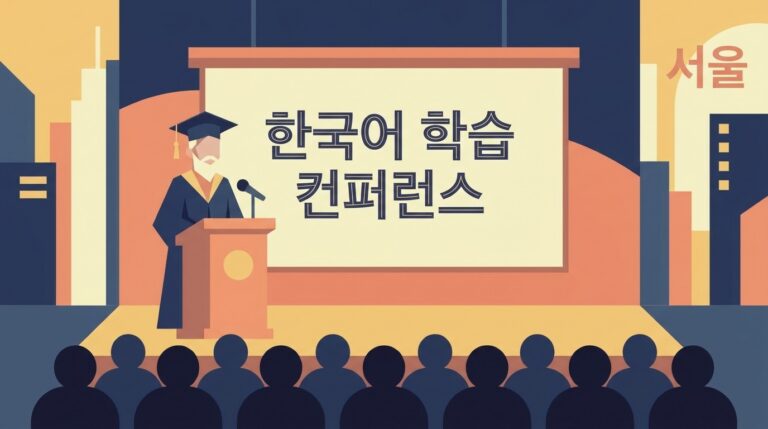
Picture this: You are standing at the lectern inside the grand auditorium of COEX in Seoul. The house lights dim, the spotlight hits, and you look out at a crowd of three hundred scholars gathered for an international symposium. But there is a catch—this is not just a room full of peers from your exact sub-discipline. Seated together are AI engineers, cognitive scientists, medical ethicists, and graduate students. Ten minutes into your presentation, you notice the dreaded “screen glow”: listeners are glancing down at their smartphones, overwhelmed by the hyper-specialized Greek symbols and wall-to-wall differential equations projected onto the massive screen behind you.
Every researcher who has ever stepped onto a global stage has felt that cold sweat. How do you shift gears in Korean academic settings from merely reading off dense technical minutiae to holding the entire auditorium spellbound?
In Korean intellectual culture, an exceptional keynote speaker or panel moderator (좌장, jwajang) is not measured by how complicated they can make things look. True mastery is demonstrated through 통섭 (tongseop, consilience) and the art of lifting the audience above the weeds to gaze at the horizon. Today, we are unlocking the C1-level academic and rhetorical repertoire that allows you to say: “세부 수식 나열보다 다양한 전공의 청중 모두가 공감할 거시적 질문과 통찰을 제시했어요” (Rather than dense equations, I offered overarching questions that resonated across fields). Based on coaching dozens of foreign scholars and visiting fellows presenting at Korea’s top universities, this guide will transform your next academic appearance from an alienating technical drill into an unforgettable keynote.
Phase 2: Core Expressions Deep Dive
1. 세부적인 수식 나열을 지양하다 (Sebujeogin susik nayeoreul jiyanghada)
- Pronunciation: Sebujeogin susik nayeoreul jiyanghada (Think: seh-boo-jeo-geen soo-seek nah-yeol-eul jee-yahng-hah-dah; the “jiyang” sounds like “jee” + “yahng”, meaning to consciously refrain from or avoid).
- Meaning: Literally “To refrain from listing detailed mathematical formulas.” Nuance: Deliberately prioritizing conceptual elegance over tedious technical granularity.
- K-Culture Moment: Seen frequently on intellectual talk shows like JTBC’s 차이나는 클라스 (Talking Class) or tvN’s 어쩌다 어른 (How Did I Become an Adult?), where professors pivot away from textbook jargon to engage the public directly.
- Editor’s Insight: Notice the word 지양하다 (jiyanghada). It means to avoid doing something unhelpful. Do not confuse it with 지향하다 (jihyanghada, with an h), which means to aim toward or aspire to a goal! Mixing these two up at an academic lectern is an infamous slip-up.
- Situation Spectrum: Casual 🚫 | Semi-formal ⚠️ | Formal ✅
- 🤔 Think About It: Why does Korean academic rhetoric value explicit statements about what you choose not to do? It signals intellectual consideration for the listeners’ mental bandwidth.
2. 학제 간 경계를 허무는 화두를 던지다 (Hakje gan gyeonggyereul heomuneun hwadureul deonjida)
- Pronunciation: Hakje gan gyeonggyereul heomuneun hwadureul deonjida (hahk-jeh gahn gyeong-gyeh-reul heh-moo-neun hwah-doo-reul deon-jee-dah).
- Meaning: Literally “To throw a central topic that tears down boundaries between academic disciplines.” Nuance: Pitching a provocative, unifying question that bridges siloed faculties.
- K-Culture Moment: When leading tech visionaries and cultural critics appear on educational panels like EBS 위대한 수업 (Great Minds) to discuss AI ethics, they always “던지다” (throw) a profound question into the audience to spark cross-talk.
- Editor’s Insight: The noun 화두 (hwadu) originates from Seon (Zen) Buddhist koans—a focal question meant to prompt deep breakthrough thinking. Using “화두를 던지다” frames you not merely as an information deliverer, but as an intellectual catalyst.
- Situation Spectrum: Casual 🚫 | Semi-formal ⚠️ | Formal ✅
- 🤔 Think About It: How does your native language describe introducing a major question? Is it framed as “raising an issue” or “casting a koan”?
3. 거시적인 통찰과 공감대를 이끌어내다 (Geosijeogin tongchalgwa gonggamdaereul ikkeulleonaeda)
- Pronunciation: Geosijeogin tongchalgwa gonggamdaereul ikkeulleonaeda (guh-see-jeo-geen tong-chahl-gwah gong-gahm-dae-reul eek-keul-law-nae-dah).
- Meaning: Literally “To draw out macroscopic insight and a shared zone of empathy/consensus.” Nuance: Elevating the discussion to a high altitude where everyone sees their own role in the big picture.
- K-Culture Moment: In academic conference debriefs in K-dramas like 스타트업 (Start-Up), characters praise pitch presentations not for raw code, but for establishing a universal 공감대 (emotional and intellectual consensus).
- Editor’s Insight: 공감대 (gonggamdae) literally means an “empathy zone.” In Korean scholarly environments, intellectual consensus is rarely detached from emotional resonance. A successful moderator aligns both logic and shared feeling.
- Situation Spectrum: Casual 🚫 | Semi-formal ✅ | Formal ✅
- 🤔 Think About It: Does true leadership in your culture require an intellectual “common ground,” or is disagreement more prized?
Phase 3: Textbook Korean vs. Real Academic Korean
Situation 1: Explaining your moderation strategy to a peer after the keynote
- 📖 교과서 한국어 (Textbook Korean): “어려운 수식을 많이 안 보여주고 큰 질문을 해서 사람들이 좋아했습니다.” (Eoryeoun susigeul mani an boyeojugo keun jilmuneul haeseo saramdeuri joahaetseumnida. / “I did not show many difficult formulas and asked big questions, so people liked it.”)
- 🗣️ 진짜 한국어 (Real C1 Korean): “지엽적인 수식 나열은 과감히 덜어내고, 학계를 아우르는 거시적 담론에 집중했더니 반응이 훨씬 뜨겁더라고요.” (Jiyeopjeogin susik nayeoreun gwagamhi deoreonaego, hakgyereul aureuneun geosijeok damrone jipjunghaetdeoni baneungi hwolssin tteugeopdeoragoyo. / “I boldly trimmed out the granular formulas and focused on an overarching discourse that embraces the entire field, and the reception was significantly warmer.”)
- 💡 Why the Difference? C1 professionals replace childish negative phrasing (“어려운 것을 안 하고”) with authoritative rhetoric like “과감히 덜어내다” (boldly pared back) and “학계를 아우르다” (encompassing academia).
Situation 2: Opening a panel discussion across diverse fields as a moderator
- 📖 교과서 한국어 (Textbook Korean): “패널분들의 전공이 다르지만 모두에게 중요한 문제를 이야기해 봅시다.” (Paeneolbundeurui jeongongi dareujiman moduege jungyohan munjereul iyagihae bopsida. / “The panelists have different majors, but let us talk about an important issue for everyone.”)
- 🗣️ 진짜 한국어 (Real C1 Korean): “각 패널분의 세부 전공은 상이하지만, 우리 모두가 직면한 본질적인 화두를 중심으로 학제 간 융합의 접점을 모색해 보고자 합니다.” (Gak paeneolbunui sebu jeongongeun sang-ihajiman, uri moduga jikmyeonhan bonjiljeogin hwadureul jungsimeuro hakje gan yunghapui jeopjeomeul mosaekhae bogoja hamnida. / “While our distinguished panelists represent disparate specializations, we seek to discover interdisciplinary intersections centered around the fundamental core questions facing us all.”)
- 💡 Why the Difference? Verbs like “모색하다” (to explore/seek strategically) and Sino-Korean nouns like “상이하다” (different/divergent) establish the intellectual prestige appropriate for high-stakes symposia.
Phase 4: K-Culture Deep Dive & Non-Verbal Manners
4-1. Nunchi (눈치) & Podium Body Language
When delivering a keynote or moderating in Korea, non-verbal etiquette (비언어적 태도) is just as crucial as the syntax of your slides:
* The Two-Handed Pointer: Never single-finger point at slides or speakers. Use a gentle open palm facing upward when referencing a panelist or gesturing to the screen (양손 혹은 펼친 손바닥으로 제스처 취하기).
* Eye Sweeping (시선 배분): Acknowledge the senior chairpersons seated in the VIP front row first with a brief 15-degree nod before sweeping your gaze across the back balcony.
* Modulating Cadence (완급 조절): Korean academic listening rewards rhythmic pauses. When delivering an overarching takeaway (핵심 통찰), lower your pitch slightly, pause for 1.5 seconds, and look directly at the audience without looking at the prompter.
4-2. The Cultural Value of Tongseop (통섭)
Korea’s intellectual landscape in the 21st century has been deeply influenced by the philosophy of 통섭 (Consilience / Cross-disciplinary integration), popularized by evolutionary biologist Dr. Choe Jae-chun. Rather than remaining isolated in hyper-specialized silos, modern Korean audiences revere scholars who demonstrate humility by distilling abstract knowledge into shared cultural meaning. Balancing intellectual modesty with broad synthesis commands immense respect.
Phase 5: Real-World Roleplay Scenario
- Setting: The backstage green room at the International Smart Society Forum, Songdo Convensia, Incheon.
- Character: 박민석 교수 (Professor Park Min-seok), Senior Chair of the Academic Steering Committee, known for his high expectations and sharp critical eye.
[Turn 1]
* 🎭 박 교수가 따뜻한 눈빛으로 커피 잔을 건네며 다가온다. (Park gyosuga ttatteuthan nunbicheuro keopi janeul geonnemyeo dagaonda. / Prof. Park approaches with a warm gaze, handing over a cup of coffee.)
* 박 교수: “에디터 박사님, 오늘 기조강연 정말 인상 깊었습니다. 다양한 분야의 청중들이 끝까지 한눈팔지 않고 몰입하더군요.” (Editeo baksanim, oneul gijogang-yeon jeongmal insang gipeotseumnida. Dayanghan bunyaui cheongjungdeuri kkeutkkaji hannunpalji anko moriphadeogunyo. / “Dr. Editor, your keynote today was truly impressive. Audience members from so many different fields stayed completely locked in until the very end.”)
[Turn 2]
* 🎭 두 손으로 찻잔을 받으며 겸손한 미소를 짓는다. (Du soneuro chatjaneul badeumyeo gyeomsonhan misoreul jinneunda. / Receiving the teacup with both hands and offering a humble smile.)
* 나 (Me): “과찬이십니다, 교수님. 청중의 스펙트럼이 넓다는 점을 염두에 두고 발표 전략을 짰습니다.” (Gwachanisimnida, gyosunim. Cheongjungui seupekteureomi neolpdaneun jeomeul yeomdue dugo balpyo jeonryageul jjasseumnida. / “You flatter me, Professor. I developed our presentation strategy bearing in mind that our audience spanned a broad spectrum.”)
[Turn 3]
* 🎭 박 교수가 안경을 고쳐 쓰며 흥미로운 듯 고개를 끄덕인다. (Park gyosuga angyeongeul gocheo sseumyeo heungmiroun deut gogaereul kkeodeoginda. / Prof. Park adjusts his glasses, nodding with genuine intrigue.)
* 박 교수: “보통 기술 분야 연사들은 복잡한 수식과 알고리즘 아키텍처를 빼곡하게 채워오기 마련인데, 오늘은 전혀 달랐어요.” (Botong gisul bunya yeonsadeureun bokjaphan susikgwa algorijeum akitekcheoreul ppaegokhage chaewooni maryeoninde, oneureun jeonhyeo dallasseoyo. / “Usually, technical speakers tend to pack slides full of complex equations and algorithmic architectures, but today was completely different.”)
[Turn 4]
* 🎭 확신에 찬 눈빛으로 차분하게 설명한다. (Hwaksine chan nunbicheuro chabunhage seolmyeonghanda. / Explaining calmly with conviction in one’s eyes.)
* 나 (Me): “네, 세부 수식 나열보다는 모든 분들이 공감할 만한 거시적 질문과 통섭적 통찰을 제시하는 데 무게를 두었습니다.” (Ne, sebu susik nayeolbodaneun modeun bundeuri gonggamhal manhan geosijeok jilmungwa tongseopjeok tongchareul jesihaneun de mugereul dueotseumnida. / “Yes, rather than listing detailed equations, I placed emphasis on presenting overarching questions and consilient insights that everyone could relate to.”)
[Turn 5]
* 🎭 박 교수가 손뼉을 가볍게 치며 탄복한다. (Park gyosuga sonppyeogeul gabyeopge chimyeo tanbokhanda. / Prof. Park claps his hands lightly in admiration.)
* 박 교수: “바로 그겁니다! 그 덕분에 인문학자와 컴퓨터공학자가 다 같이 활발하게 질의응답에 참여할 수 있었던 거군요.” (Baro geugeomnida! Geu deokbune inmunhakjawa keompyuteogonghakjaga da gachi hwalbalhage jiri-eungdabe cham-yeohal su isseotdeon geogunyo. / “That’s precisely it! Thanks to that approach, humanists and computer scientists alike could participate vigorously in the Q&A.”)
[Turn 6]
* 🎭 공을 동료들과 좌장에게 돌리며 고개를 가볍게 숙인다. (Gongeul dongnyodeulgwa jwajang-ege dollimyeo gogaereul gabyeopge suginda. / Deferring credit to colleagues and the session chair with a polite bow.)
* 나 (Me): “좌장님께서 토론 세션에서 학제 간 경계를 허무는 화두를 절묘하게 던져주신 덕분입니다.” (Jwajangnimkkeseo toron sesyeoneseo hakje gan gyeonggyereul heomuneun hwadureul jeolmyohage deonjyeojusin deokbunimnida. / “It was largely because you, as moderator, so exquisitely threw out a core issue that broke down interdisciplinary boundaries during the discussion.”)
[Turn 7]
* 🎭 박 교수가 만족스러운 듯 껄껄 웃으며 명함을 건넨다. (Park gyosuga manjokseureoun deut kkeolkkeol useumyeo myeonghameul geonnenda. / Prof. Park chuckles heartily with satisfaction and hands over his business card.)
* 박 교수: “하하, 협력의 장을 마련한 보람이 있네요. 다음 가을 학술대회에서도 메인 패널 좌장을 맡아주시겠습니까?” (Haha, hyeopnyeogui jangeul maryeonhan borami inneyeo. Daeum gaeul haksuldaehoeesodo mein paeneol jwajangeul matajusigetseumnikka? / “Haha, it makes providing this collaborative forum so worthwhile. Would you be willing to chair our main panel discussion at next autumn’s conference as well?”)
[Turn 8]
* 🎭 두 손으로 명함을 정중히 받으며 화답한다. (Du soneuro myeonghameul jeongjunghi badeumyeo hwadaphanda. / Receiving the business card formally with both hands and answering.)
* 나 (Me): “영광입니다, 교수님. 의미 있는 지적 공론장을 만드는 데 기꺼이 일조하겠습니다.” (Yeonggwang-imnida, gyosunim. Uimi inneun jijeok gongnonjangeul mandeuneun de gikkeoi iljohagetseumnida. / “It would be an honor, Professor. I will gladly contribute to building a meaningful public forum for intellectual discourse.”)
🔀 Interactive Decision Point
Suppose Professor Park then asks you: “패널 토론 중에 두 발표자가 서로 전공 용어를 쓰며 첨예하게 대립할 땐 좌장으로서 어떻게 정리하십니까?” (When two panelists clash sharply using specialized jargon, how do you handle it as chair?)
- Option A: “시간이 없으니 싸우지 마시고 제 결론에 동의하자고 정리합니다.” (Since time is short, I tell them not to fight and to agree with my conclusion.)
- Feedback: Bad. Extremely blunt and authoritarian. It shuts down intellectual dialogue and violates Korean scholarly decorum.
- Option B: “세부 방법론의 대립에서 한 걸음 물러나, 두 연구가 궁극적으로 추구하는 본질적인 목표의 공통분모를 짚어냅니다.” (I step back from the clash over granular methodologies to pinpoint the lowest common denominator in the ultimate goals both studies pursue.)
- Feedback: Best! Demonstrates textbook C1 mediation skills. Shows you can synthesize high-level perspectives without picking favorites.
- Option C: “그냥 둘 중 더 유명한 연구자의 의견에 손을 들어줍니다.” (I simply side with the more renowned scholar among the two.)
- Feedback: Risk. Flattering hierarchy at the expense of objectivity ruins your scholarly credibility as an impartial moderator (좌장).
Phase 6: 10-Second Emotion Shadowing Drill
Master the oratorical cadence of a keynote speaker. Practice these rhythmic pauses marked by /:
[🏛️ 중후하고 확신에 찬 어조로 / Gravitas & Firm Conviction]- “오늘 강연에서는 / 세부 수식의 나열은 지양하고, / 학제 간 경계를 아우르는 / 거시적인 화두를 던지고자 합니다.”
- (Oneul gang-yeoneseoneun / sebu susigui nayeoreun jiyanghago, / hakje gan gyeonggyereul aureuneun / geosijeogin hwadureul deonjigoja hamnida.)
- “In today’s talk / refraining from granular equations, / I intend to cast overarching themes / that embrace our interdisciplinary boundaries.”
[🤝 청중 전체를 부드럽게 감싸안으며 / Warm & Inclusive Synthesis]- “서로 다른 방법론 속에서도, / 우리가 도출할 수 있는 / 통섭적 통찰과 공감대는 / 분명히 존재합니다.”
- (Seoro dareun bangbeobnon sogeseodo, / uriga dochulhal su inneun / tongseopjeok tongchalgwa gonggamdaeneun / bunmyeonghi jonjaehamnida.)
- “Even amidst disparate methodologies, / the consilient insights and common ground / that we can extract / undoubtedly exist.”
[✨ 미래를 조망하는 차분한 결의 / Visionary & Composed Outlook]- “미시적인 데이터에 매몰되기보다, / 함께 더 큰 담론을 형성해 나갈 때 / 진정한 혁신이 시작됩니다.”
- (Misijeogin de-iteo-e maemoldoegiboda, / hamkke deo keun damroneul hyeongseonghae nagal ttae / jinjeonghan hyeoksini sijakdoemnida.)
- “Rather than becoming buried in microscopic data, / it is when we shape a broader discourse together / that true innovation begins.”
Phase 7: K-Culture Mini Dictionary
- 화두 (Hwadu / Central Theme or Koan)
- Definition: A pivotal, deeply provocative question that reorients how people think about an issue.
- Real-world use: In boardrooms and academic symposiums, people say: “오늘 회의의 핵심 화두는 지속 가능성입니다” (The core thematic question of today’s meeting is sustainability).
- 통섭 (Tongseop / Consilience)
- Definition: The synthesis and integration of sciences and humanities into a single holistic perspective.
- Real-world use: Widely cited in Korean academia when developing interdisciplinary convergence curricula (융복합 학과).
- 지양하다 (Jiyang-hada / To refrain from or eschew)
- Definition: To consciously avoid an undesirable habit or lower-level practice in pursuit of a higher standard.
- Real-world use: Academic papers frequently state: “단순한 이분법적 사고를 지양해야 한다” (We must eschew simplistic dichotomous thinking).
- 담론 (Damnon / Discourse)
- Definition: A sustained, structured exchange of ideas around a major societal or intellectual domain.
- Real-world use: Used when elevating a chat to a high-level conversation: “새로운 인공지능 윤리 담론을 형성합시다” (Let us establish a new discourse on AI ethics).
Phase 8: Academic Expat Survival Kit
Top 3 Conference Survival Expressions
- “발표 자료의 상세 수식은 부록에 수록해 두었습니다.” (Balpyo jaryoui sangse susigeun buroge surokhae dueotseumnida.)
- Pro Tip: Use this on stage so technical auditors know you did the math, while keeping your main presentation slides visually clean.
- “패널 토론의 원활한 진행을 위해 발언 시간을 3분 내외로 조율해 주시길 부탁드립니다.” (Paeneol toronui wonhwalhan jinhaengeul wihae bareon siganeul sambun naewoiro joyulhae jusigil butakdeurimnida.)
- Pro Tip: The polite, standard formula for a moderator reclaiming control over a panelist who is monopolizing the microphone.
- “오늘 기조강연의 총평을 한 문장으로 갈음하고자 합니다.” (Oneul gijogang-yeonui chongpyeongeul han munjangeuro gareumhagoja hamnida.)
- Pro Tip: An elegant C1 way to say “I will conclude my closing assessment with this final sentence.”
Editor’s Conference Logistics Note
- Navigating Large Venues: When attending conferences at COEX in Gangnam or BEXCO in Busan, downloading the Naver Map Application is essential for finding indoor escalators and quiet breakout rooms.
- The After-Conference Dinner (뒷풀이, Dwitpuri): In Korean scholarly circles, the real collaborative alliances happen at the post-symposium dinner over grilled hanwoo beef or galbi. Remember to check out our detailed guide to Korean business dining etiquette for how to turn your keynote success into lasting academic partnerships.
Phase 9: A Step Deeper (한 발 더 깊이)
In classical Confucian philosophy, true scholarship is encapsulated in the ideal of 화이부동 (Hwa-i-bu-dong: 和而不同)—achieving true harmony without demanding absolute uniformity. When moderating or delivering keynotes in Korea, this ancient concept remains vibrantly alive. Presenting dense equations can build a wall around your specific micro-field, isolating those outside it. But framing overarching, consilient questions welcomes every mind into the tent while honoring diverse viewpoints.
💬 Your Turn: Have you ever attended an academic keynote where the speaker lost the room in the details? How would you translate your own field’s core research question into a universal “화두” (hwadu) for non-specialists? Share your thoughts below in the comments!
Phase 10: FAQ & Avoiding Misunderstandings
Q: Can I use “지양하다” (jiyanghada) in everyday casual conversations with friends?
A: You can, but it sounds somewhat bookish and pedantic in casual settings! With friends at a café, say “줄이다” (jurida, to reduce) or “안 하다” (an hada, to not do). Reserve “지양하다” for formal meetings, presentations, and written essays.
Q: How do I address the audience as a keynote speaker?
A: Open with: “존경하는 학회원 여러분, 그리고 내외 귀빈 여러분” (Distinguished members of the academic society, and honorable domestic and international guests). This establishes the requisite respect right away.
Q: What is the difference between a “사회자” (sahoeja) and a “좌장” (jwajang)?
A: A 사회자 (sahoeja) is a master of ceremonies (MC) who oversees event logistics and speaker introductions. A 좌장 (jwajang) is specifically an academic panel chair who directs the intellectual flow, steers the Q&A, and synthesizes differing scholarly papers.
🚨 Common Mistakes (흔한 실수)
- Confusing 지양 (Jiyang) vs. 지향 (Jihyang):
- Wrong: “우리는 평화를 지양해야 합니다.” (We must avoid peace. 😱)
- Correct: “우리는 평화를 지향하고, 불필요한 갈등을 지양해야 합니다.” (We should strive for peace and eschew unnecessary conflict.)
- Using “틀렸다” (Wrong) when comparing academic approaches:
- Avoid: “김 교수님의 의견은 틀렸습니다.” (Prof. Kim’s opinion is wrong.)
- Correct: “김 교수님의 관각과 본 연구의 접근법은 결을 달리합니다.” (Prof. Kim’s perspective and our study’s approach follow different grains.)
- Overusing English acronyms without context:
- Correction: While international symposiums use global acronyms, define your overarching paradigm in clear Korean once before running through acronym-heavy slides.
Phase 11: Action Missions
- 🥉 Bronze Mission (Solo Drill): Stand in front of your mirror and practice shadowing Drill #1 from Phase 6 three times with clear, resonant projection.
- 🥈 Silver Mission (Social Post): Write a 2-sentence summary of your current professional goal or thesis on LinkedIn or Threads, using the phrase: “세부적인 수식 나열보다는 거시적인 화두를 던지는…”
- 🥇 Gold Mission (Real Field Execution): At your next research group meeting or symposium, introduce a slide by stating: “지엽적인 분석에 앞서, 우리 모두가 직면한 거시적 과제부터 짚어보고자 합니다.”
- 🎮 K-Culture Discovery Mission: Watch an episode of EBS 위대한 수업 (Great Minds) or JTBC 차이나는 클라스. Spot how the guest professor introduces their opening thesis within the first three minutes.
Phase 12: Interactive Quiz Challenge
Test your mastery of C1 Korean academic rhetoric!
1. Situational Judgment:
You are moderating an interdisciplinary panel on climate change and robotics. Two researchers are arguing over calibration sensor tolerances. How should you intervene?
* (A) “센서 얘기는 지루하니 그만두시고, 큰 얘기나 해봅시다.”
* (B) “지엽적인 하드웨어 수치 대립을 지양하고, 두 기술이 재난 현장에서 가져올 거시적인 시너지에 대해 논의를 이어가 주시길 부탁드립니다.”
* (C) “두 분 중 누구 데이터가 맞는지 투표해 볼까요?”
2. Fill-in-the-Blank:
“오늘 발표는 특정 알고리즘의 세부 수식 나열을 ( )하고, 학제 간 연구를 아우르는 새로운 패러다임을 ( )하고자 마련되었습니다.”
* Options: [지향 / 지양] 중 알맞은 단어를 순서대로 넣으세요.
3. True or False:
Calling yourself the “좌장” (jwajang) when you are simply introducing the wedding ceremony of an academic colleague is culturally natural and correct. [ T / F ]
👉 Click to reveal answers & explanations!
- Answer: (B)
- Explanation: Choice B uses polite C1 terminology (“지엽적인 수치 대립을 지양하고”) and reframes the conflict into collaborative synergy. Choice A is too casual and dismissive, while Choice C turns academic debate into a popularity contest.
- Answer: 지양 (Jiyang) / 지향 (Jihyang)
- Explanation: You “avoid” (지양) dense formulas and “aspire toward” (지향) a new paradigm!
- Answer: False (F)
- Explanation: A wedding or general party host is a 사회자 (sahoeja). 좌장 (jwajang) is strictly reserved for academic sessions, policy hearings, or intellectual symposium panel moderators.
- Explanation: A wedding or general party host is a 사회자 (sahoeja). 좌장 (jwajang) is strictly reserved for academic sessions, policy hearings, or intellectual symposium panel moderators.







