

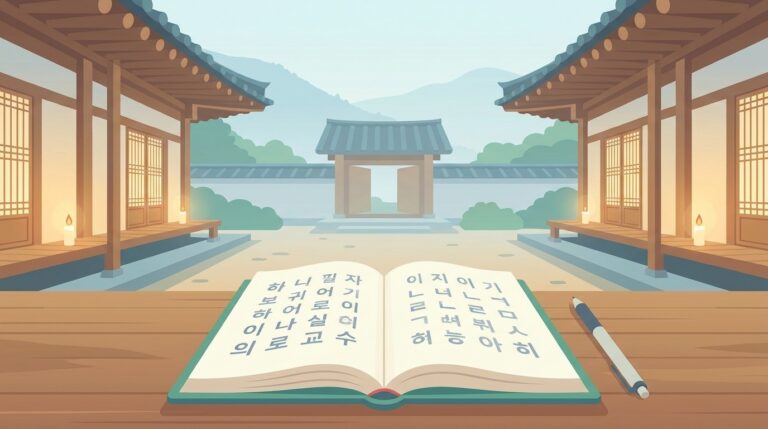
Phase 1: 공감 (A Peaceful Morning at the Temple)
안녕하세요! 매일한글 에디터입니다.
Imagine this: It is 4:30 AM in the deep, mist-covered mountains of Gangwon-do. The fragrance of damp pine needles hangs crisp in the dawn air, punctuated only by the rhythmic, hollow clack-clack of a wooden temple drum (moktak, 목탁). You step into the quiet main dharma hall, bathed in warm candlelight, your body exhausted from city life. Then, you begin the ritual: 108 mindful prostrations (108배).
At first, your knees protest, your thighs burn, and your mind races: Did I submit that report? Why is my lower back tight? How many bows are left? But somewhere around the 40th bow, something remarkable happens. The chatter fades away. Each rise and descent becomes rhythmic, almost weightless. By the time your forehead rests against the wooden floor for the 108th time, you feel a deep, steady calm you haven’t felt in years.
Most Korean textbooks teach elementary expressions like “피곤해요” (I am tired) or “마음이 편해요” (I feel comfortable). However, when experiencing a Korean temple stay—or navigating any deep moment of self-reflection—you need words that capture physical release and mental tranquility. Today’s B1 lesson is built directly from real student stories who sought sanctuary in temples like Haeinsa and Woljeongsa. By the end of this guide, you will be able to describe your personal healing journey in vivid, natural Korean that native speakers will truly resonate with.
Phase 2: 핵심 표현 3선 심층 분석 (Top 3 Core Expressions)
1. 한 배 한 배 절을 올릴 때마다 (Han bae han bae jeoreul ollil ttaemada)
- Pronunciation: [Han bae han bae jeo-reul ol-lil ttae-ma-da] (Think of “bae” like the English word “bay”, and “ollil” gliding smoothly like “all-real” spoken rapidly).
- Meaning: Literal: “Every time offering a bow one by one” | Actual Nuance: “With every single mindful prostration I made…”
- K-Culture Moment: Frequently heard in reflective healing shows and travel documentaries (such as Hyori’s Homestay or My Liberation Notes) when characters retreat to quiet temples to rebuild their emotional foundation.
- Editor’s Insight: Notice the verb 올리다 (to raise/offer up) instead of the plain verb 하다 (to do). In Korean culture, prostrating before the Buddha or an elder is not an ordinary physical workout—it is an act of offering respect and humility. Doubling the counter (한 배 한 배) paints a picture of slow, deliberate patience.
- Situation Spectrum: Casual ⚠️ | Semi-formal ✅ | Formal ✅
- 🤔 Think About It: In English, we usually say “as I bowed repeatedly,” emphasizing continuous action. Korean isolates each bow as an individual act of presence (one bow, then another bow). How does counting single actions change your state of mind?
2. 머릿속을 채우던 잡념이 가라앉았어요 (Meoritsogeul chae-u-deon jamnyeomi gara-anjasseoyo)
- Pronunciation: [Meo-rit-sso-geul chae-u-deon jam-nyeo-mi ga-ra-an-ja-sseo-yo] (Notice the sound change in 잡념: ‘b’ assimilates before ‘n’, sounding like [jam-nyeom], similar to “jam-yum”).
- Meaning: Literal: “The miscellaneous thoughts filling inside my head sank down” | Actual Nuance: “All the mental clutter and racing worries finally settled down.”
- K-Culture Moment: When celebrities open up on talk shows like You Quiz on the Block about overcoming creative burnout, they often describe this exact sensation of quiet recovery.
- Editor’s Insight: 잡념 (jamnyeom) refers specifically to scattered, intrusive, or unproductive thoughts. The verb 가라앉다 (to settle / sink) is used when sediment in muddy water sinks to the bottom, leaving the surface crystal clear. It is the perfect poetic metaphor for meditation.
- Situation Spectrum: Casual ✅ | Semi-formal ✅ | Formal ✅
- 🤔 Think About It: English speakers often talk about “clearing” the mind, implying wiping a chalkboard clean. Korean envisions thoughts “settling down” like tea leaves. Which mental image feels more forgiving to you?
3. 마음이 한결 가벼워졌어요 (Maeumi han-gyeol gabyeowo-jyeosseoyo)
- Pronunciation: [Mae-u-mi han-gyeol ga-byeo-wo-jyeo-sseo-yo] (The word “han-gyeol” sounds crisp, rhyming with the English word “pure”).
- Meaning: Literal: “My heart/mind became lighter by an entire layer” | Actual Nuance: “A heavy weight has been completely lifted off my shoulders.”
- K-Culture Moment: The signature reaction uttered by guests after taking part in 차담 (chadam—tea and life talk with a Buddhist monastic monk).
- Editor’s Insight: 한결 is a wonderful B1-level adverb meaning “markedly,” “noticeably,” or “all the more.” Adding 한결 elevates the sentence far beyond simple textbook phrases like “마음이 더 좋아요” (My mind is more good).
- Situation Spectrum: Casual ✅ | Semi-formal ✅ | Formal ✅
- 🤔 Think About It: In Korean, 마음 (maeum) stands for both the “heart” and the “mind.” Why do you think Korean conceptualizes intellectual thoughts and raw emotions in the exact same emotional organ?
Phase 3: 교과서 한국어 vs 진짜 한국어 (Textbook vs. Real Korean)
Situation 1: Describing feeling refreshed after intense exercise or meditation
- 📖 교과서 한국어: 제 스트레스가 없어졌어요. (Je seuteureseuga eopseojyeosseoyo.) — “My stress disappeared.”
- 🗣️ 진짜 한국어: 땀 흘리고 나니까 온몸이 아주 개운해요! (Ttam heulligo nanikka onmomi aju gae-unhaeyo!) — “Now that I’ve broken a good sweat, my whole body feels remarkably refreshed!”
- 💡 왜 다를까? Koreans love the sensory word 개운하다 (gae-un-hada). It expresses that unique physical and mental catharsis felt after a hot bath, a spicy soup, or a deeply satisfying workout.
Situation 2: Explaining that your complex worries are sorted out
- 📖 교과서 한국어: 이제 걱정을 안 해요. (Ije geokjeongeul an haeyo.) — “I don’t worry now.”
- 🗣️ 진짜 한국어: 복잡했던 머릿속이 싹 정리됐어요. (Bokjapaetdeon meoritsogi ssak jeongnidaesseoyo.) — “The chaotic tangle in my head has been swept completely clean.”
- 💡 왜 다를까? Real conversations feature vivid mimetic words like 싹 (cleanly, completely) paired with spatial organization metaphors like 정리되다 (to get organized).
Phase 4: K-Culture 딥다이브 & 비언어적 매너 (Manners & Culture)
4-1. 눈치 (Nunchi) & Non-verbal Manners in a Temple
- 합장 (Hapjang – Palm-to-Palm Greeting): Whenever you pass a monk, temple staff, or fellow participant, bring both palms together flat in front of your chest and bow your upper body roughly 30 to 45 degrees. Do not give high-fives or loud greetings.
- 차수 (Chaesu – Walking Posture): When walking around temple courtyards or hallways, rest your right hand softly over your left hand right above your navel. Avoid swinging your arms casually or walking with hands buried in your pockets.
- Eye Gaze: Keep your gaze lowered about two steps ahead on the ground. Direct, unblinking eye contact inside shrines can unintentionally feel confrontational.
4-2. Culture Code: The Rise of Secular Temple Stays
In modern South Korea, temple stays are not solely religious pilgrimages. With the hyper-competitive pressure of corporate life and academic testing, young Koreans in their 20s and 30s book temple weekends as a therapeutic digital detox. Popular media, including variety programs like I Live Alone and food documentaries showcasing monastic vegan masters like Ven. Jeong Kwan, have made temple food (사찰음식) and 108 bows an iconic self-care trend.
Phase 5: 실전 롤플레이 시나리오 (Real-Life Roleplay Scenario)
Setting: A quiet wooden tea pavilion at Woljeongsa Temple. Morning sunlight streams through paper hanji sliding doors.
Characters:
* 정우 스님 (Monk Jeongwoo): Warm, serene, gently pouring steeped wild chrysanthemum tea.
* Elena (B1 Student): A traveler who completed the sunrise 108 prostrations.
정우 스님: 차 한잔 드세요. 새벽 예불과 108배를 마쳤는데, 몸은 좀 어떠신가요?
(Cha hanjan deuseyo. Saebyeok yebulgwa baek-pal-baereul machyeonneunde, momeun jom eotteosingayo?)
🎭 [Gently sets down a porcelain teacup with both hands]
“Please have some tea. You have finished the dawn service and 108 bows; how does your body feel?”
Elena: 감사합니다, 스님. 솔직히 처음에는 무릎도 쑤시고 조금 힘들었어요.
(Gamsahamnida, seunim. Soljiki cheoeumeneun mureupdo ssusigo jogeum himdeureosseoyo.)
🎭 [Holds the warm cup with both hands, smiling shyly]
“Thank you, Sunim. Honestly, at first my knees ached and it was a bit tough.”
정우 스님: 누구나 처음에는 그렇지요. 무거운 마음이 몸으로 먼저 나타나니까요.
(Nuguna cheoeumeneun geureochiyo. Mugeoun maeumi momeuro meonjeo natananikkayo.)
🎭 [Nods warmly with understanding eyes]
“Everyone feels that way initially. A burdened mind manifests in the body first.”
Elena: 맞아요. 그런데 한 배 한 배 절을 올릴 때마다 머릿속을 채우던 잡념이 차분하게 가라앉았어요.
(Majayo. Geureonde han bae han bae jeoreul ollil ttaemada meoritsogeul chae-udeon jamnyeomi chabunhage gara-anjasseoyo.)
🎭 [Exhales softly, shoulders visibly relaxed]
“That’s right. But with every single bow I made, the distracting thoughts filling my head quietly settled down.”
정우 스님: 절을 하면서 스스로를 비워내는 법을 배우신 겁니다.
(Jeoreul hamyeonseo seuseuroreul biwonaeneun beobeul baeusin geomnida.)
🎭 [Refills the tea gently]
“Through bowing, you have learned how to empty yourself.”
Elena: 네, 땀을 흠뻑 흘렸더니 온몸도 개운하고 마음이 한결 가벼워졌어요.
(Ne, ttameul heumppeok heullyeotdeoni onmomdo gaeunhago maeumi han-gyeol gabyeowo-jyeosseoyo.)
🎭 [Takes a quiet sip of the aromatic tea]
“Yes, after breaking a deep sweat, my entire body feels refreshed and my heart is so much lighter.”
정우 스님: 그 가벼운 마음을 일상으로 돌아가서도 오래 간직하세요.
(Geu gabyeoun maeumeul ilsangeuro doragaseodo orae ganjikhaseyo.)
🎭 [Brings palms together in gentle hapjang]
“Please cherish that lightness of heart for a long time, even when you return to daily life.”
Elena: 꼭 그럴게요, 스님. 좋은 말씀 마음에 깊이 새기겠습니다.
(Kkok geureolgeyo, seunim. Joeun malsseum maeume gipi saegigesseumnida.)
🎭 [Bows head respectfully over the teacup]
“I definitely will, Sunim. I will carve your kind words deeply into my heart.”
🔀 인터랙티브 분기점 (Interactive Decision Point)
Imagine Sunim asks you: “Elena-ssi, what was the most memorable moment during the prostrations?” What would you reply?
- Choice A (Best): “숨이 가빠질 때마다 호흡에 집중했더니, 잡념이 사라지고 오직 지금 이 순간만 남았어요.”
(Every time I got out of breath, I focused on my breathing; distracting thoughts vanished and only this present moment remained.)
👉 Feedback: ⭐⭐⭐ Exceptional! Shows profound philosophical understanding and high-intermediate fluency. - Choice B (Risk): “다리가 너무 부러질 것처럼 아파서 중간에 도망치고 싶었어요!”
(My legs hurt so much they felt broken, so I wanted to run away halfway through!)
👉 Feedback: ⚠️ Honest and funny, but slightly too colloquial and blunt for a formal tea session with a monastic monk. - Choice C (Bad): “108번 다 채워서 숙제 끝난 것처럼 속이 시원해요.”
(Because I filled all 108 counts, I feel relieved like finishing homework.)
👉 Feedback: 🚫 Misses the spiritual point of the activity by framing self-reflection merely as a chore or metric checklist.
Phase 6: 10초 감정 섀도잉 드릴 (10-Second Emotion Shadowing)
Practice pausing at the slashes (/) and capturing the precise emotional tone indicated in the brackets:
[🧘 차분하고 경건하게 / Calm & Reverent]
한 배 한 배 / 절을 올릴 때마다 / 머릿속 잡념이 / 차분하게 가라앉았어요.
(Han bae han bae / jeoreul ollil ttaemada / meoritsok jamnyeomi / chabunhage gara-anjasseoyo.)-
[🌿 한숨 돌리며 개운하게 / Relieved & Refreshed]
땀을 흘리고 나니까 / 온몸이 개운하고 / 마음이 한결 가벼워졌어요.
(Ttameul heulligo nanikka / onmomi gaeunhago / maeumi han-gyeol gabyeowo-jyeosseoyo.) -
[🍵 따뜻하고 진솔하게 / Warm & Sincere]
스님과 따뜻한 차를 마시니 / 복잡했던 생각들이 / 싹 풀리네요.
(Seunimgwa ttatteutan chareul masini / bokjapaetdeon saenggakdeuri / ssak pullineyo.)
Phase 7: K-Culture 미니 사전 (Mini Dictionary)
- 108배 (Baek-pal-bae)
Translation: 108 Prostrations
Usage: Bowing 108 times represents extinguishing the 108 earthly illusions and agonies (번뇌, beonnoe) that plague the human mind. In daily Korean life, it is also practiced widely as low-impact, meditative mindful exercise. - 발우공양 (Baru-gongyang)
Translation: Formal Monastic Meal
Usage: An eco-friendly Buddhist dining ritual using four nesting wooden bowls (baru). Participants eat in absolute silence and clean the bowls completely using water and a slice of pickled radish, leaving zero food waste behind. - 차담 (Chadam)
Translation: Tea Time with a Monk
Usage: An intimate conversation where visitors sip traditional green or herbal tea with a monk, freely asking questions about stress, relationship turmoil, or life’s purpose. - 묵언 (Mugeon)
Translation: Noble Silence
Usage: A dedicated practice of intentional silence during meals or meditation to quiet verbal impulses and tune in deeply to one’s internal sensations.
Phase 8: 여행자를 위한 생존 키트 (Traveler’s Survival Kit)
서바이벌 표현 TOP 3 (Top Survival Phrases)
- 신발은 어디에 벗어 두면 되나요? (Sinbareun eodie beoseo dumyeon doenayo?)
— “Where should I take off and place my shoes?”
Pro Tip: Temples maintain shoe racks outside main wooden halls. Place your shoes facing outward toward the courtyard, not inward toward the doors. - 공양 시간은 몇 시부터인가요? (Gongyang siganeun myeot sibuteoingayo?)
— “What time does the monastic meal start?”
Pro Tip: Monastic meals run on precise military schedules (Breakfast ~06:00, Lunch ~11:30, Dinner ~17:30). If you arrive late after the wooden chime rings, doors will close. - 법당 안에서 사진 촬영을 해도 괜찮나요? (Beopdang aneseo sajin chwaryeongeul haedo gwaenchanhnayo?)
— “Is it okay to take photos inside the shrine hall?”
Pro Tip: Photography is generally welcomed outside in courtyards, but strictly forbidden inside halls enshrining statues or during ongoing ceremonies.
Editor’s Travel Note
- Official Booking: Always book your stay through the bilingual 대한불교조계종 한국 템플스테이 공식 웹사이트 rather than third-party resellers to access both “Relaxation type (휴식형)” and “Experience type (체험형)” programs.
- Essential Navigation: Google Maps frequently fails on Korean mountain trails. Ensure you complete your 네이버 지도 앱 다운로드 before departing Seoul so you can track rural bus routes directly to temple gates.
- Wardrobe Etiquette: Temples provide uniform vests and baggy pants (수련복), but you must bring thick socks. Walking barefoot on polished temple wood is deemed impolite and will make your feet freeze in morning air.
Phase 9: “한 발 더 깊이” (Going Deeper: The Philosophy of Lowering Oneself)
In Korean Buddhist thought, the physical act of bowing is referred to as 하심 (Hashim), which translates directly to “lowering one’s mind.” When you prostrate, your forehead, elbows, and knees touch the coldest, lowest surface in the room. In modern urban society, we spend our days elevating ourselves—protecting our ego, flaunting status on social feeds, and comparing achievements.
Prostrating 108 times is an intentional surrender of that burden. You lower your physical body to the ground so that your pride has nowhere left to fall. When there is no ego left to defend, your racing worries dissolve naturally into the stillness of the floor.
💬 Your Turn: Have you ever engaged in a physical activity—like long-distance running, swimming, or yoga—that quieted your mental chatter? How do you describe that feeling in your native language? Share your reflection with us in the comments!
Phase 10: FAQ & 흔한 실수 (FAQ Schema & Common Mistakes)
Q: Do I need to be a practicing Buddhist to join a Korean Temple Stay?
A: Not at all. Over 70% of foreign participants and many Korean guests identify as secular or follow other faiths. Temple stays are designed as cultural and mindfulness retreats. If you prefer not to bow for religious reasons, you can simply sit quietly and observe.
Q: What if my knees hurt and I cannot finish all 108 bows?
A: Monks will always tell you that sincere intention matters far more than physical numbers. If your knees ache, you can do 반배 (banbae)—a simple standing half-bow—or sit comfortably in quiet breath meditation (참선).
Q: Is talking completely forbidden during the stay?
A: No. Silence is strictly observed only during formal meals (발우공양) and meditation blocks (참선). During tea time (차담) or strolls around the temple grounds, casual, respectful conversation is welcome.
🚨 흔한 실수 (Common Mistakes) TOP 3
- Stepping on the wooden door threshold (문턱, munteok):
Incorrect: Stepping directly onto the raised wooden beam at the entrance of temple buildings.
Correct Action: Step cleanly over the threshold. Stepping on it is believed to bring bad luck and damages delicate historical wood. - Walking through the central door:
Incorrect: Entering through the grand center door (어간문) of the Main Buddha Hall.
Correct Action: Enter and exit exclusively through the side doors. The center path is traditionally reserved for high-ranking masters and spiritual ceremonies. - Leaving food behind after Baru Gongyang:
Incorrect: Taking large portions and leaving rice or soup dregs in the wooden bowls.
Correct Action: Take modest amounts. Monastic tradition requires cleaning every bowl with a slice of radish and hot water, which is then mindfully consumed to produce zero waste.
Phase 11: 액션 미션 & 참여 유도 (Action Missions)
- 🥉 Bronze Mission (Solo Practice): Read the following sentence out loud three times, matching the natural rising and falling rhythm:
“한 배 한 배 절을 올릴 때마다 머릿속 잡념이 차분하게 가라앉았어요.” - 🥈 Silver Mission (Social Journaling): Take a photo of your favorite calming space (a quiet desk, a cup of tea, or nature) and post it to Instagram or your study notes with this Korean caption:
“오늘 하루, 마음이 한결 가벼워졌어요 🍵 (Today, my heart feels noticeably lighter).” - 🥇 Gold Mission (Real Interaction): When you visit Korea or meet a temple stay coordinator, bow politely with 합장 and say:
“스님과 차담을 나누며 마음을 비우고 싶어요.” (I would love to share tea with the monk and clear my mind). - 🎮 K-Culture Mission: Watch any healing K-drama clip or variety show (like Three Meals a Day or a temple vlog) and listen for when someone uses the word 개운하다 or 비우다. Write down the context in your notebook!
Phase 12: 인터랙티브 퀴즈 챌린지 (Interactive Quiz Challenge)
1. Situational Understanding
Your Korean friend asks how your weekend retreat went. You want to express that all your cluttered anxieties completely disappeared after morning meditation. Which sentence is the most natural and nuanced?
* (A) 제 스트레스가 100% 죽었어요.
* (B) 머릿속을 채우던 복잡한 잡념이 차분하게 가라앉았어요.
* (C) 제 머리가 청소기로 청소되었어요.
2. Fill-in-the-Blank
Fill in the blank with the appropriate B1 adverb meaning “markedly / noticeably”:
따뜻한 차를 마시고 나니 마음이 [ ] 가벼워졌어요.
3. True / False Cultural Etiquette
- Statement: When walking through the main courtyard of a temple, it is respectful to hold your hands together over your stomach in the 차수 (Chaesu) posture.
(True / False)
👉 정답과 해설 확인하기 (Click to reveal answers & explanations!)
- Question 1 Answer: (B)
Explanation: (B) uses the natural metaphor 잡념이 가라앉다 (clutter settles down). Option (A) is an awkward literal translation, and Option (C) sounds like a vacuum cleaner literally invaded your skull! - Question 2 Answer: 한결 (han-gyeol)
Explanation: 한결 beautifully intensifies the transformation toward emotional lightness and relief. - Question 3 Answer: True
Explanation: 차수 (Chaesu)—resting your hands together at the navel—demonstrates calm humility and mindfulness while walking on sacred ground.







