

Phase 1: 공감 (Story-driven Opening)
안녕하세요! 매일한글 에디터입니다.
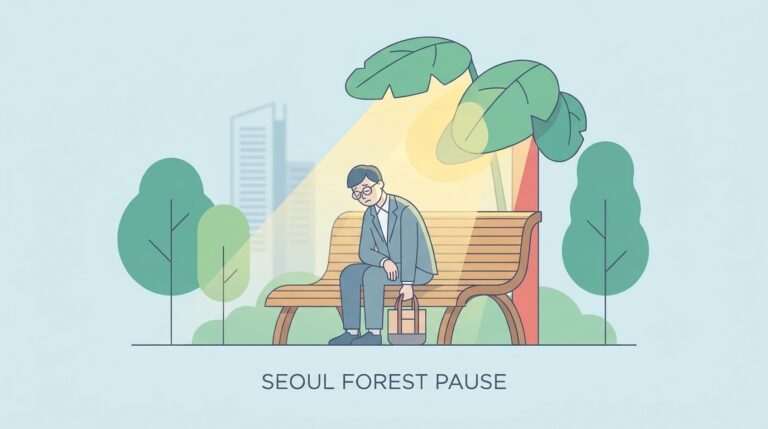
Picture this: It’s 11:45 PM on a drizzly Tuesday night in Teheran-ro, the shimmering tech canyon of Gangnam. You are sitting at a corner desk of a high-rise office, staring at a presentation deck you have revised twenty-seven times. The glowing blue light reflects off your exhausted eyes. Down on the street, people are rushing into taxis, while across your desk, a colleague quietly downs their third iced Americano of the evening. You whisper to yourself that if you just push through this week—if every single bullet point is impeccable—you will finally feel accomplished. But instead of satisfaction, your chest feels hollow, tight, and numb.
If you have ever followed K-dramas like Misaeng (미생) or Daily Dose of Sunshine (정신병동에도 아침이 와요), you know this scene intimately. South Korea’s hyper-efficient, relentless drive—often glorified under the trendy lifestyle moniker God-saeng (갓생, living an ultra-productive life)—has a darker underside that philosopher Byung-Chul Han famously coined as the ‘Burnout Society’ (피로사회). In this environment, self-exploitation wears the deceptive mask of self-realization. Many advanced learners living or working in Korea tell me: “I know all the polite business endings, but when I break down from stress, I literally don’t know how to speak to myself in Korean without judgment.”
This guide is crafted from hundreds of candid coaching sessions with global professionals and creatives navigating Korea’s demanding cultural landscape. Today, we step beyond textbook grammar to master the nuanced, compassionate C1 vocabulary necessary to dismantle perfectionism, let go of internal pressure, and cultivate authentic emotional resilience (정서적 회복탄력성).
Phase 2: 핵심 표현 3선 심층 분석
1. 내려놓다 (Naeryeonota)
- Pronunciation: [Nae-ryeo-no-ta] (Think of ‘net’ without the t, combined with ‘ryuh’, and ‘no-tah’ like letting out a gentle breath)
- Meaning: Literally “to put down an object,” but figuratively “to let go of obsessive control, mental burdens, or unrelenting perfectionism.”
- K-Culture Moment: Frequently heard in healing reality shows like Three Meals a Day (삼시세끼) or Hyori’s Homestay (효리네 민박), where guests escape urban hustle to simply breathe: “욕심을 내려놓으니 마음이 편안해졌어요 (Yoksimeul naeryeonoeuni maeumi pyeonanhaejyeosseoyo – Once I let go of my greed and expectations, my mind found peace).”
- Editor’s Insight: While 버리다 (beorida) means to discard something useless, 내려놓다 implies honoring that you held a heavy responsibility before choosing to gently set it down on the ground. It is an act of release, not abandonment.
- Situation Spectrum: Casual (내려놔) ✅ | Semi-formal (내려놓아요) ✅ | Formal (내려놓으셔야 합니다) ✅
- 🤔 Think About It: In English, we often say “give up” or “drop it,” which can carry a subtle connotation of defeat. How does the physical imagery of “setting a heavy weight on the floor” (내려놓다) change your emotional relationship with stress?
2. 나를 보듬다 (Nareul bodeumda)
- Pronunciation: [Na-reul bo-deum-da] (Pronounce ‘bo’ as in boat, and ‘deum’ like a soft ‘hum’ with a ‘d’)
- Meaning: Literally “to cradle or hug lovingly,” but emotionally “to practice self-compassion by embracing one’s own wounded, imperfect self.”
- K-Culture Moment: In introspective indie K-pop tracks (such as songs by IU or Lee Hi’s Breathe), artists speak of gently holding one’s tired heart rather than scolding it for falling short.
- Editor’s Insight: The verb 보듬다 carries the tactile warmth of a parent wrapping both arms around a shivering child to shelter them from cold wind. Using it with oneself (스스로를 보듬다) reflects a sophisticated emotional maturity in Korean, acknowledging vulnerability without self-pity.
- Situation Spectrum: Casual (보듬어줘) ✅ | Semi-formal (보듬어줘요) ✅ | Formal (보듬어야 합니다) ✅
- 🤔 Think About It: Many Western self-help frameworks emphasize “fixing” oneself. In contrast, does “embracing oneself” (보듬다) feel more forgiving of human fragility?
3. 있는 그대로 (Inneun geudaero)
- Pronunciation: [In-neun geu-dae-ro] (Sounds like ‘in-noon guh-day-ro’)
- Meaning: “Just as it is / Unconditionally / Without cosmetic filters or unrealistic adjustments.”
- K-Culture Moment: Heard constantly in deep talk segments on YouTube talk shows like Suchwita or Fairy Jaehyung, when creators discuss artistic identity: “남들의 시선보다 있는 그대로의 내 모습을 사랑하고 싶어요 (Namdeurui siseonboda inneun geudaeroui nae moseubeul saranghago sipeoyo – Rather than caring about others’ gazes, I want to love myself just as I am).”
- Editor’s Insight: In a society dominated by nunchi (social radar) and external metrics of success (체면, face-saving), stating that something is valuable 있는 그대로 is a radical act of emotional defiance.
- Situation Spectrum: Casual (있는 그대로) ✅ | Semi-formal (있는 그대로 받아들여요) ✅ | Formal (있는 그대로 수용합니다) ✅
- 🤔 Think About It: Why does modern society make it so difficult to accept things 있는 그대로 without constantly feeling an impulse to optimize or monetize?
Phase 3: 교과서 한국어 vs 진짜 한국어
Situation 1: Deciding to stop overworking after recognizing signs of severe burnout
- 📖 교과서 한국어: 저는 완벽주의를 버리고 충분한 휴식을 취해야 합니다. (Jeoneun wanbyeokjuuireul beorigo chungbunhan hyusigeul chwihaeya hamnida. – I must discard perfectionism and take sufficient rest.)
- 🗣️ 진짜 한국어: 오늘은 무리하지 말고, 일단 뇌 좀 비우고 쉬어야겠어요. (Oneureun murihaji malgo, ildan noe jom biugo swieoyagesseoyo. – I shouldn’t push myself today; I really just need to empty my brain and decompress.)
- 💡 왜 다를까? Textbook Korean sounds like a clinical prescription written by an HR director. Native speakers at a C1 level express psychological exhaustion through visceral, idiomatic phrases like ‘뇌를 비우다’ (to empty one’s brain) or ‘숨을 돌리다’ (to catch one’s breath).
Situation 2: Consoling an accomplished colleague who feels they failed an assignment
- 📖 교과서 한국어: 당신은 충분히 뛰어난 인재이니 자책하지 마십시오. (Dangsineun chungbunhi ttwieonan injaeini jachaekhaji masipsio. – You are an adequately outstanding talent, so please do not blame yourself.)
- 🗣️ 진짜 한국어: 너무 다 짊어지려고 하지 마요. 지금 이 정도로도 충분히 애썼어요. (Neomu da jilmeojiryeogo haji mayo. Jigeum i jeongdorodo chungbunhi aesseosseoyo. – Don’t try to shoulder everything alone. You’ve truly exerted enough effort already.)
- 💡 왜 다를까? Using formal words like ‘인재’ (human asset) depersonalizes emotional pain. Real empathy relies on metaphorically relieving their burden (‘짊어지다’, to shoulder a load) and validating their lived labor (‘애쓰다’).
Phase 4: K-Culture 딥다이브 & 비언어적 매너
4-1. 눈치 (Nunchi) & Non-verbal Etiquette for Burnout
When a friend or coworker in Korea hits emotional rock bottom, loud optimism (“Cheer up! You can do it!”) is often perceived as exhausting, or even tone-deaf toxic positivity (무책임한 위로). Instead, practice quiet nunchi:
* The Beverage Placement: Silently sliding a warm canned yuzu tea or an iced decaf latte onto their desk without saying a word, accompanied by a quick, gentle nod.
* The Gentle Eye Contact: Avoid intense, piercing stares when someone looks drained. Look down slightly at your shared notebook or the table, creating a low-pressure perimeter where they don’t feel scrutinized.
* The Soft Sigh of Solidarity: A subtle “에휴…” (Ehyu…) followed by a compassionate tilt of the head conveys far deeper shared humanity than an elaborate speech.
4-2. Cultural Code: From “갓생” (God-saeng) to “멍때리기” (Space-out Therapy)
Over the last decade, South Korea transitioned through intense extremes: from the post-war catch-up mentality (빨리빨리, hurry-hurry) to the hyper-regimented aesthetic routine of 갓생 (waking up at 5:00 AM, exercising, studying stock markets, studying foreign languages).
However, the resulting psychological exhaustion has triggered an immense cultural counter-movement known as 힐링 (healing) and 멍때리기 (meong-ttaerigi)—the art of deliberately spacing out. From Han River Space-Out Competitions (한강 멍때리기 대회) to forest bathing cafes in Gangwon-do where smartphones are checked at the door, modern Koreans are actively unlearning toxic performance culture. Choosing 자기자비 (self-compassion) over self-flagellation is no longer considered laziness; it is increasingly celebrated as the highest tier of self-preservation.
Phase 5: 실전 롤플레이 시나리오
Setting: A quiet third-floor café in Seongsu-dong overlooking the rain-soaked canopy of Seoul Forest. Soft lofi instrumental music plays in the background.
Characters:
* 민우 (Minwoo): A high-performing senior project lead, clutching a lukewarm cup of tea, staring blankly out the window with tense shoulders.
* Learner (You): A close friend and peer who knows how brutally Minwoo pushes himself.
Dialogue:
- 민우: 이번 프로젝트, 솔직히 제가 다 망친 것 같아요. 조금만 더 꼼꼼하게 검토했더라면 이런 오류는 안 났을 텐데…
(Ibeon peurojekteu, soljikhi jega da mangchin geot gatayo. Jogeumman deo kkomkkomhage geomtohaetdeoramyeon ireon oryuneun an nasseul tende… – Honestly, I feel like I ruined this entire project. If only I had reviewed it more meticulously, this error wouldn’t have occurred…)
🎭 [고개를 떨구고 마른세수를 하며 깊은 한숨을 내쉰다] -
Learner: 민우 씨, 그건 팀 전체가 함께 확인했어야 할 문제예요. 혼자 다 짊어지려고 하지 마세요.
(Minwoo ssi, geugeon tim jeonchega hamkke hwaginhaesseoya hal munjeyeyo. Honja da jilmeojiryeogo haji maseyo. – Minwoo, that was an issue the entire team should have checked together. Please don’t try to shoulder it all by yourself.)
🎭 [민우의 눈을 재촉하지 않고 편안한 시선으로 바라보며] -
민우: 그래도 팀장으로서 제 기준치에 못 미쳤다는 게 너무 괴로워요. 저 자신한테 실망스러워서 잠도 안 와요.
(Geuraedo timjangeuroseo je gijunchie mot michyotdaneun ge neomu goerowoyo. Je jasinhante silmangseureowoseo jamdo an wayo. – Still, as the lead, the fact that I fell short of my own standards is excruciating. I’m so disappointed in myself that I can’t sleep.)
🎭 [찻잔 손잡이를 하얗게 질리도록 꽉 쥐며] -
Learner: 완벽해야 한다는 강박을 조금만 내려놓으면 어떨까요? 지금은 자책할 때가 아니라 민우 씨 마음을 먼저 보듬어야 할 때예요.
(Wanbyeokhaeya handaneun gangbageul jogeumman naeryeonoeumyeon eotteolkkayo? Jigeumeun jachaekhal ttaega anira Minwoo ssi maeumeul meonjeo bodeum-eoya hal ttaeyeyo. – How about letting go of the obsession to be perfect just a little? Right now isn’t the time for self-reproach; it’s time to cradle your own heart first.)
🎭 [목소리 톤을 낮추어 차분하고 부드럽게 전달한다] -
민우: 마음을 보듬는다고요? 솔직히 저는 쉬는 것조차 죄책감이 들어요. 뒤처질까 봐 두렵고요.
(Maeumeul bodeumneundagoyo? Soljikhi jeoneun swineun geotjocha joechaekgami deureoyo. Dwijyeojilkka bwa duryeopgoyo. – Cradle my heart? Honestly, even taking time off fills me with guilt. I’m terrified of falling behind.)
🎭 [자조적인 미소를 지으며 고개를 젓는다] -
Learner: 번아웃이 온 건 그동안 치열하게 달렸다는 증거예요. 있는 그대로의 민우 씨도 충분히 가치 있어요.
(Beon-ausi on geon geudong-an chiyeolhage dallyeotdaneun jeungeoyeyo. Inneun geudaeroui Minwoo ssido chungbunhi gachi isseoyo. – Experiencing burnout is proof that you ran fiercely until now. Just as you are, you are already worthy.)
🎭 [따뜻한 차 한 모금을 권하며] -
민우: …있는 그대로의 나를 인정하는 법을 제가 완전히 잊고 살았나 봐요. 그 말을 들으니 울컥하네요.
(…Inneun geudaeroui nareul injeonghaneun beobeul jega wanjeonhi itgo saranna bwayo. Geu mareul deureuni ulkeokhaneyo. – …I guess I completely forgot how to accept myself just as I am. Hearing that makes a wave of emotion rise up.)
🎭 [어깨에 들어갔던 힘이 스르르 풀리며 엷은 미소를 띤다] -
Learner: 오늘은 우리 일 얘기는 완전히 접어두고, 숲길이나 걸으면서 머리 좀 식혀요.
(Oneureun uri il yaegineun wanjeonhi jeobeodugo, supgirina georeumyeonseo meori jom sikhyeoyo. – Today, let’s fold up work talk completely, take a walk along the forest path, and clear our heads.)
🎭 [가방을 챙겨 일어나며 밖을 가리킨다]
🔀 인터랙티브 분기점 (Interactive Decision Point)
At turn 4, if Minwoo says he feels disappointed in himself, what do you say next?
- Option A: “남들도 다 그 정도로 고생해요. 정신력으로 버텨야죠!” (Everyone suffers that much. You must endure through pure willpower!)
- Feedback [Bad 🚫]: This is classic toxic resilience (정신론). Invalidating burnout in Korean corporate culture builds deep resentment and causes the other person to immediately withdraw.
- Option B: “내려놓는 것도 용기예요. 일단 오늘은 아무 생각 말고 푹 쉬어요.” (Setting down the burden is also an act of courage. For today, don’t think about anything and rest deeply.)
- Feedback [Best ✨]: Perfect C1 empathetic formulation. It re-frames letting go as an active virtue rather than a failure, providing psychological safety.
- Option C: “회사 그만두고 한 달 동안 해외여행이나 다녀오세요.” (Just quit the company and go travel abroad for a month.)
- Feedback [Risk ⚠️]: Too dramatic and unrealistic for someone facing professional stakes. It dismisses their reality rather than guiding emotional resilience.
Phase 6: 10초 감정 섀도잉 드릴
Practice these lines out loud. Notice the breath marks (/) and embody the emotional stage direction.
[🥺 깊은 피로를 인정하듯, 낮고 덤덤하게]
“너무 오래 달려왔더니… / 이제는 숨이 턱 끝까지 찼어요.”
(Neomu orae dallyeowatdeoni… / ijeneun sumi teok kkeutkkaji chasseoyo. – Having run for so long… / my breath has caught right at my throat.)-
[🌿 단호하면서도 다정하게, 귓가에 위로를 건네듯]
“완벽하지 않아도 괜찮아요. / 그 무거운 짐, / 이제 그만 내려놓으세요.”
(Wanbyeokhaji anado gwaenchanayo. / Geu mugeoun jim, / ije geuman naeryeonoeuseyo. – It is okay not to be perfect. / That heavy burden, / please set it down now.) -
[🤍 가슴에 손을 얹고 스스로를 다독이듯]
“스스로를 채찍질하지 말고… / 오늘만큼은 있는 그대로 / 나를 보듬어줄래요.”
(Seuseuroreul chaecchikjilhaji malgo… / oneulmankeumeun inneun geudaero / nareul bodeumeojullaeyo. – Instead of whipping myself… / just for today, / I will embrace myself as I am.)
Phase 7: K-Culture 미니 사전
- 자기자비 (Jagi-jabi) [Self-Compassion]
- Usage: Derived from Buddhist philosophy and clinical psychology, this term contrasts with 자기비하 (self-deprecation) and 자기착취 (self-exploitation). Used widely in high-level counseling podcasts, HR seminars, and personal essays.
- 번아웃 증후군 (Beon-aut Jeunghugun) [Burnout Syndrome]
- Usage: Widely discussed across Seoul’s business hubs. Often paired with physical symptoms like 무기력증 (lethargy) and 수면장애 (sleep disturbance).
- 현타 (Hyeonta) [Reality-Check Breakdown / Sudden Cynicism]
- Usage: Abbreviation for 현실 자각 타임 (Reality Realization Time). Describes the crushing moment when you suddenly realize that endless hustling brings no genuine spiritual fulfillment: “야근 끝나고 텅 빈 지하철을 타는데 불현듯 현타가 왔어 (Taking the empty subway after overtime, sudden existential disillusionment hit me).”
- 멍때리기 (Meong-ttaerigi) [Intentional Zoning Out]
- Usage: The deliberate practice of putting the mind in idle mode. Subcategories include 불멍 (spacing out watching a campfire), 물멍 (spacing out looking at water/ocean), and 숲멍 (spacing out looking at the woods).
Phase 8: 여행자를 위한 생존 키트
서바이벌 표현 TOP 3
- “혼자 조용히 생각할 시간이 좀 필요해요.”
(Honja joyonghi saenggakhal sigani jom piryohaeyo. – I need some time alone to think quietly.)- Pro Tip: Use this gracefully when Korean coworkers or travel companions pressure you to join a 2nd or 3rd round of drinking (2차, 3차).
- “오늘은 조금 쉬엄쉬엄 갈게요.”
(Oneureun jogeum swieom-swieom galgeyo. – I will take things slowly and easily today.)- Pro Tip: An elegant idiom indicating you will work or travel at a relaxed pace without dropping responsibilities.
- “괜찮아요, 그럴 수도 있죠.”
(Gwaenchanayo, geureol sudo itjyo. – It’s okay, that kind of thing happens.)- Pro Tip: The ultimate phrase to defuse perfectionism in social situations when someone makes a mistake.
Editor’s Travel Note: Escaping Urban Overstimulation
When the sensory overload of Myeongdong or Hongdae overwhelms you, head to healing sanctuaries:
* Temple Stay at Jingwansa (진관사): Located in Bukhansan National Park, this serene temple offers sound meditation and temple cuisine devoid of harsh spices.
* Seoul Forest Mindful Walk: Walk along the ginkgo paths early in the morning before crowds arrive. Make sure to download and check the 네이버 지도 앱 다운로드 to locate quiet benches tucked away from main thoroughfares.
Phase 9: “한 발 더 깊이” (생각 질문)
In Korean linguistic structure, the word for “human being” is 인간 (人間, Ingan)—combining “person” (人) and “between” (間). This implies that a self does not exist in complete isolation; our identity is forged in the space between people. While this creates unparalleled communal warmth (정, Jeong), it also creates an intense cultural anxiety of being judged by the group, leading to chronic perfectionism and performance anxiety. When we practice 자기자비, we create a sacred, non-judgmental space between our inner observer and our wounded ego, allowing us to survive the demands of collective life.
💬 Your Turn: In your home culture, how do you verbally separate your productivity from your personal self-worth? Share your native phrases in the comments below!
Phase 10: FAQ & 오해 방지
Q: Does saying ‘내려놓다’ mean that I am giving up on my ambitions?
A: Not at all. In high-level Korean, 포기하다 (to give up) denotes abandoning an objective due to frustration or lack of capability. In contrast, 내려놓다 is viewed as a mindful, intentional decision to stop obsessing over an outcome you cannot control, preserving your energy for what truly matters.
Q: Can I use ‘나를 보듬다’ in an office meeting with my boss?
A: No. 보듬다 is an emotionally intimate, poetic verb. In a formal corporate evaluation with superiors, express self-care professionally using: “자기관리(Self-management)를 통해 업무 집중도를 높이겠습니다” or “재정비의 시간을 갖겠습니다” (I will take time to regroup).
Q: What is the difference between ‘쉬다’ and ‘마음을 비우다’?
A: 쉬다 refers to physical rest (sleeping, taking a holiday). 마음을 비우다 (to empty one’s heart/mind) refers to psychological detoxification—letting go of greed, lingering grudges, or anxiety about performance.
🚨 흔한 실수 (Common Mistakes) 경고판
- Mistake: Saying “저는 저를 포기했어요” when you mean you stopped stressing.
- Why it’s wrong: This literally means “I have given up on myself as a human being.”
- Correct Action: Say “욕심을 내려놓았어요” (I let go of excessive desire/expectations).
- Mistake: Overusing “힘내세요!” to someone experiencing severe burnout.
- Why it’s wrong: To an empty battery, telling them to “squeeze out strength” feels like an unbearable demand.
- Correct Action: Say “애쓰지 않아도 돼요” (You don’t need to struggle so hard) or “푹 쉬어도 괜찮아요” (It’s okay to rest completely).
- Mistake: Translating “I don’t care” as “상관없어요” during emotional discussions.
- Why it’s wrong: 상관없어요 often sounds dismissive, cold, or irritated.
- Correct Action: Say “신경 쓰지 않으셔도 돼요” (You don’t have to concern yourself) or “그냥 털어내세요” (Just brush it off).
Phase 11: 액션 미션 & 참여 유도
- 🥉 Bronze Mission (Solo): Stand in front of your mirror before going to bed tonight. Place your hand on your heart and say aloud three times: “오늘 하루도 충분히 애썼어. 내일의 나에게 조금 내려놓자.” (I worked hard enough today. Let’s leave a little bit of the load for tomorrow’s me.)
- 🥈 Silver Mission (Social): Write a brief social media post or journal entry in Korean describing one burden you are choosing to set down this week, using the pattern: “[Burdensome thought]을/를 내려놓기로 했습니다.”
- 🥇 Gold Mission (Real-world): The next time a Korean colleague or friend sighs heavily about work, resist giving practical advice. Instead, offer them a warm beverage and say: “너무 애쓰지 마요. 지금도 충분해요.”
🎮 K-Culture Mission: Watch Episode 5 of the K-drama Daily Dose of Sunshine (정신병동에도 아침이 와요). Spot the moment when characters talk about “complimenting themselves” (칭찬일기) and notice how the verb 보듬다 is reflected in their recovery.
Phase 12: 인터랙티브 퀴즈 챌린지
Q1. [상황 판단] A junior coworker at your Seoul branch has been pulling all-nighters for two weeks straight, constantly saying “제가 완벽하게 해내야 해요” (I must execute this perfectly). Which response demonstrates the highest emotional resilience and cultural nuance?
* A) “네, 완벽주의가 성공의 비결이에요.” (Yes, perfectionism is the secret to success.)
* B) “그냥 회사 그만두고 쉬세요.” (Just quit the company and rest.)
* C) “기준치를 조금만 내려놓아도 괜찮아요. 건강보다 중요한 건 없어요.” (It’s okay to lower your standards just a bit. Nothing is more important than your health.)
* D) “정신력이 약해서 그래요.” (It’s because your mental fortitude is weak.)
Q2. [빈칸 채우기] Fill in the blank with the most natural C1 phrase:
“남들의 기준에 나를 맞추려 하지 말고, ________ 내 모습을 인정해 주는 연습이 필요합니다.”
(Instead of trying to fit myself into others’ standards, I need the practice of accepting myself ________.)
Q3. [True / False 문화 퀴즈]
In Korean corporate and social contexts, practicing 멍때리기 (meong-ttaerigi) or speaking openly about burnout is still universally treated as a shameful sign of failure. (True / False)
정답 및 해설 확인하기 (Click to reveal answers)
- Q1 정답: C) Setting reasonable boundaries (기준치를 내려놓다) affirms their effort while protecting their psychological safety. A promotes self-exploitation, B is dangerously extreme, and D is offensive victim-blaming.
- Q2 정답: 있는 그대로 (또는 있는 그대로의)
- 해설: ‘있는 그대로’ fits seamlessly before nouns or actions to express loving acceptance without filters or modifications.
- Q3 정답: False
- 해설: While old-school work environments still persist, modern Korean society has embraced mindfulness, mental health discourse, and competitions celebrating 멍때리기 as essential countermeasures to national burnout.
- 해설: While old-school work environments still persist, modern Korean society has embraced mindfulness, mental health discourse, and competitions celebrating 멍때리기 as essential countermeasures to national burnout.






