

Phase 1: Empathy (Opening Story)
안녕하세요! 매일한글 에디터입니다. (Hello! This is your Daily Hangul editor.)
Picture this: You just spent an exhilarating afternoon in Hongdae—browsing indie clothing racks, sipping an iced Americano at a cozy cafe, and picking up limited-edition K-pop albums. Exhausted but happy, you step onto the bustling green Line 2 subway train. You pop your tote bag onto the overhead rack, plug in your earbuds, and get lost in a new K-drama soundtrack.
Suddenly, the chime rings: “This stop is Hongik Univ., Hongik Univ. Station.” In a rush to meet a friend, you squeeze through the crowd and step onto the platform. Two seconds later, cold panic hits your chest. Wait… where is my bag?!
You whirl around just in time to see the stainless steel doors slide shut with your bag still sitting up on the rack. The train glides away into the tunnel. You are standing on the platform, your pulse racing, thinking: “How on earth do I explain this in Korean? What if it’s gone forever?”
Take a deep breath! Seoul’s transit system is world-renowned not just for its speed and cleanliness, but for an astonishing lost-and-found recovery rate (often exceeding 80%!). But here is the catch: because Seoul Subway Line 2 is a massive circular loop, you must tell the station staff exactly where you got off and which direction the train was traveling. Today, based on real emergency encounters from our Daily Hangul learners, we will master the exact A2-level sentence structure that turns subway panic into an instant relief story.
Phase 2: Top 3 Key Expressions Deep Dive
1. 제가 내린 곳은 홍대입구역이에요 (Je-ga nae-rin go-seun Hong-dae-ip-gu-yeok-i-e-yo)
- Pronunciation: [Jae-gah nae-reen go-seun Hong-dae-ip-goo-yuck-ee-eh-yoh] (Think of ‘Jae’ like the name Jay, and ‘rin’ like rinse without the ‘se’)
- Meaning: “The place where I got off is Hongik Univ. Station.”
- K-Culture Moment: You will hear this exact noun-modifying structure (~ㄴ 곳은, the place where…) in investigative K-dramas like Signal or Stranger whenever witnesses retrace their steps with station officers.
- Editor’s Insight: At level A2, instead of simply saying “홍대입구역에 내렸어요” (I got off at Hongdae), stating “제가 내린 곳은…” (The place where I got off is…) frames the physical location as the central topic. Station officers appreciate this because it immediately helps them identify the station code and platform camera.
- Situation Spectrum: Casual: ⚠️ | Semi-formal: ✅ | Formal: ✅
- 🤔 Think About It: English puts the action first (“I got off at Hongik Univ. Station”), but Korean places the topic noun right in front (“As for the place where I got off…”). How does shifting the focus onto the location change how quickly the listener understands your emergency?
2. 시청 방면 열차였어요 (Si-cheong bang-myeon yeol-cha-yeoss-eo-yo)
- Pronunciation: [See-chuhng bahng-myuhn yuhl-chah-yuhss-uh-yoh] (Pronounce ‘chuhng’ like ‘young’ with a Ch, and ‘yeoss’ like yacht with an s ending)
- Meaning: “It was a train bound for City Hall.”
- K-Culture Moment: In Seoul, Subway Line 2 does not have simple “Northbound” or “Southbound” signs because it is a giant circle. Transit announcements always say: “이번 열차는 시청 방면 외선순환 열차입니다” (This train is the outer circle train bound for City Hall).
- Editor’s Insight: The word 방면 (bang-myeon) means “bound for” or “direction of”. On Line 2, simply saying “Line 2” is useless to staff because trains run in both directions simultaneously. Saying “[Major Landmark Station] + 방면” is the ultimate cheat code.
- Situation Spectrum: Casual: 🚫 | Semi-formal: ✅ | Formal: ✅
- 🤔 Think About It: Does your hometown transit use cardinal directions (East/West) or terminal stations (Bound for X)? How does navigating a circular line change your mental map of a city?
3. 물건을 두고 내렸어요 (Mul-geon-eul du-go nae-ryeoss-eo-yo)
- Pronunciation: [Mool-guhn-eul doo-goh nae-ryuhss-uh-yoh] (Say ‘Mool’ like pool with an M, and ‘doo’ like dew)
- Meaning: “I left an item behind and got off.”
- K-Culture Moment: The quintessential romantic comedy trope: the protagonist leaves their umbrella, sketchbook, or shopping bag on the subway, sparking an encounter with the lost-and-found clerk!
- Editor’s Insight: This combines 두다 (to place/leave behind) and 내리다 (to alight/get off) using the connector -고 (-go). Saying “가방을 잃어버렸어요” (I lost my bag) sounds like you dropped it somewhere on the street, whereas “두고 내렸어요” clarifies that it is still sitting inside the vehicle.
- Situation Spectrum: Casual: ⚠️ | Semi-formal: ✅ | Formal: ✅
- 🤔 Think About It: Why does Korean have a dedicated compound verb phrase for “leaving something behind while disembarking”? What does this say about the everyday importance of public transportation in Korean lifestyle?
Phase 3: Textbook Korean vs. Real Korean
Scenario 1: Explaining what happened to the station staff
- 📖 교과서 한국어 (Textbook): 저는 가방을 분실했습니다. (Jeo-neun ga-bang-eul bun-sil-haess-seum-ni-da.) — “I have experienced a loss of my personal bag.”
- 🗣️ 진짜 한국어 (Real Life): 지하철에 가방을 두고 내렸어요! (Ji-ha-cheol-e ga-bang-eul du-go nae-ryeoss-eo-yo!) — “I left my bag behind on the subway!”
- 💡 왜 다를까? (Why the difference?): “분실하다” is a Sino-Korean legalistic term found on official paperwork. Native speakers speaking to real humans express the direct physical sequence of events using “두고 내리다”.
Scenario 2: Asking if someone turned your item in
- 📖 교과서 한국어 (Textbook): 습득물이 보관되어 있습니까? (Seup-deuk-mul-i bo-gwan-doe-eo it-seum-ni-kka?) — “Is an acquired article currently retained?”
- 🗣️ 진짜 한국어 (Real Life): 혹시 들어온 거 있나요? (Hok-si deu-reo-on geo it-na-yo?) — “By any chance, has anything come in yet?”
- 💡 왜 다를까? (Why the difference?): Using 혹시 (by any chance) instantly softens your tone from an aggressive interrogation into a polite, natural Korean inquiry, and “들어온 거” (things that arrived/came in) sounds effortless.
Phase 4: K-Culture Deep Dive & Non-Verbal Manners
4-1. 눈치 (Nunchi) & Body Language
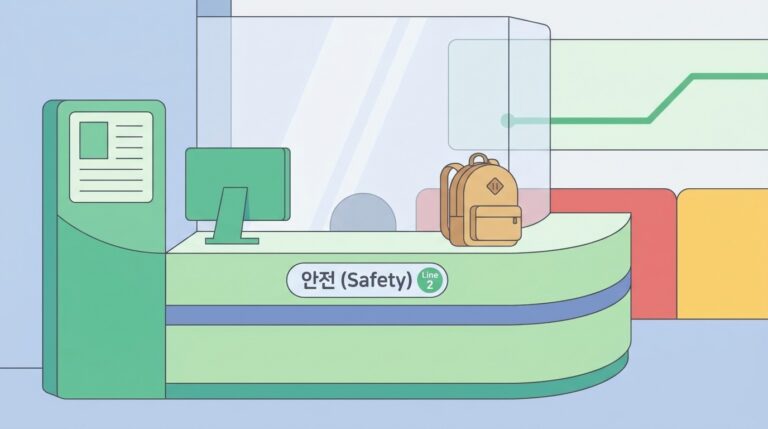
When you rush into the subway station office—marked as 고객안전실 (Customer Safety Room)—remember that station managers are juggling safety monitors, train schedules, and gate alerts.
* The 15-degree Courtesy Bow: Do not knock loudly or shout from the doorway. Walk inside, make eye contact, bow your head slightly, and say “저기요, 죄송한데요…” (Excuse me, I am so sorry to bother you…).
* Two-Hand Phone Display: If you used your T-Money card or mobile transit card, open your transit transaction log and present the phone using both hands. Showing the exact time you tapped out through the turnstile provides the staff with an instant timestamp to check security feeds.
4-2. Cultural Code: The Seoul Subway Line 2 Phenomenon
Seoul Subway Line 2 (The Green Circle) is the beating heart of Seoul. It carries over 2 million passengers daily. Because it loops continuously, Koreans orient themselves using major central hubs as compass points: 시청 방면 (City Hall direction – clockwise/inner loop) versus 신촌/홍대 방면 (Sinchon/Hongdae direction). In K-pop songs and indie dramas, Line 2 is often depicted as the symbol of youthful hustle, connecting the college towns of Hongdae and Sinchon to the corporate skyscrapers of Gangnam and City Hall.
Phase 5: Real-World Roleplay Scenario
Setting: Inside the 고객안전실 (Customer Safety Room) at Hongik University Station. Station Manager Mr. Park is sitting behind his desk reviewing transit logs. Alex, an exchange student, rushes in.
- Alex: 저기요, 죄송한데 열차에 가방을 두고 내렸어요. (Jeo-gi-yo, joe-song-han-de yeol-cha-e ga-bang-eul du-go nae-ryeoss-eo-yo.)
🎭 [Approaching the counter with an apologetic half-bow, hands clasped together]— “Excuse me, I am sorry, but I left my bag on the train.” - Manager Park: 아, 그러세요? 언제쯤 내리셨어요? (A, geu-reo-se-yo? Eon-je-jjeum nae-ri-syeoss-eo-yo?)
🎭 [Looking up with concern, picking up a notepad]— “Oh, really? About what time did you get off?” - Alex: 방금 5분 전에 내렸어요. (Bang-geum o-bun jeon-e nae-ryeoss-eo-yo.)
🎭 [Checking wrist watch and pointing back toward the gate]— “Just about 5 minutes ago.” - Manager Park: 어느 역에서 내리셨고, 어느 쪽으로 가던 열차인가요? (Eo-neu yeok-e-seo nae-ri-syeot-go, eo-neu jjok-eu-ro ga-deon yeol-cha-in-ga-yo?)
🎭 [Tapping a pen on the transit route map]— “Which station did you get off at, and which direction was the train heading?” - Alex: 제가 내린 곳은 홍대입구역이고 시청 방면 열차였어요. (Je-ga nae-rin go-seun Hong-dae-ip-gu-yeok-i-go Si-cheong bang-myeon yeol-cha-yeoss-eo-yo.)
🎭 [Speaking clearly, emphasizing station and direction]— “The place where I got off is Hongik Univ. Station, and it was a train bound for City Hall.” - Manager Park: 네, 확인했습니다. 혹시 몇 번째 칸에서 타셨는지 기억나세요? (Ne, hwak-in-haess-seum-ni-da. Hok-si myeot beon-jjae kan-e-seo ta-syeon-neun-ji gi-eok-na-se-yo?)
🎭 [Opening the station intercom system]— “Got it. By any chance, do you remember which car number you boarded?” - Alex: 4-2번 문에서 탔어요! 검은색 백팩이에요. (Sa-da-si-i-beon mun-e-seo tat-eo-yo! Geom-eun-saek baek-paek-i-e-yo.)
🎭 [Gesturing the size on their shoulders]— “I boarded at door 4-2! It is a black backpack.” - Manager Park: 좋습니다. 지금 바로 다음 역 직원에게 연락해 볼게요! (Jot-seum-ni-da. Ji-geum ba-ro da-eum yeok jik-won-e-ge yeol-lak-hae bol-ge-yo!)
🎭 [Picking up the hotline phone to call the next station]— “Great. I will contact the staff at the upcoming station right now!”
🔀 Interactive Decision Point
The manager turns back to you while holding the phone and asks: “가방 안에 귀중품이나 특징이 있나요?” (Are there any valuables or distinct features inside the bag?) How do you respond?
- Option A: “지갑이랑 파란색 카카오프렌즈 파우치가 들어 있어요.” (Ji-gab-i-rang pa-ran-saek Ka-ka-o-peu-ren-jeu pa-u-chi-ga deu-reo it-eo-yo.)
- Outcome (BEST): Precise, visual, and unmistakable. Mentioning a specific recognizable Korean character pouch allows the station staff at the next stop to verify your bag in under 3 seconds.
- Option B: “그냥 제 가방이에요. 빨리 찾아주세요.” (Geu-nyang je ga-bang-i-e-yo. Ppal-li cha-ja-ju-se-yo.)
- Outcome (BAD): Saying “It’s just my bag, please hurry” provides zero identifying details and sounds impolite, causing unnecessary delays.
- Option C: “비싼 거 많으니까 잃어버리면 안 돼요!” (Bi-ssan geo man-eu-ni-kka il-eo-beo-ri-myeon an dwae-yo!)
- Outcome (RISK): Shouting “There are expensive things inside, so it cannot be lost!” creates panic and defensiveness rather than giving actionable search criteria.
Phase 6: 10-Second Emotion Shadowing Drill
Practice these lines out loud with the designated emotional tempo to build natural muscle memory!
- [😰 Panic & Urgency]
저기요, / 지하철에 / 가방을 두고 내렸어요!
(Jeo-gi-yo, / ji-ha-cheol-e / ga-bang-eul du-go nae-ryeoss-eo-yo!)
“Excuse me, / on the subway / I left my bag behind and got off!” -
[🧐 Calm & Articulate Precision]
제가 내린 곳은 / 홍대입구역이고 / 시청 방면 열차였어요.
(Je-ga nae-rin go-seun / Hong-dae-ip-gu-yeok-i-go / Si-cheong bang-myeon yeol-cha-yeoss-eo-yo.)
“The place where I got off / is Hongik Univ. Station / and it was a train bound for City Hall.” -
[🙏 Earnest, Polite Hope]
혹시 / 들어온 분실물 / 있나요?
(Hok-si / deu-reo-on bun-sil-mul / it-na-yo?)
“By any chance, / has any lost property / arrived yet?”
Phase 7: K-Culture Mini Dictionary
- 고객안전실 (Go-gaek-an-jeon-sil)
Translation: Customer Safety Room / Station Office.
Daily Usage: Found near the turnstiles at every subway station. This is your primary emergency contact point for lost items, fare errors, or medical assistance. - 방면 (Bang-myeon)
Translation: Bound for / Direction.
Daily Usage: Placed after major terminal or landmark station names (e.g., “강남 방면” = Gangnam bound) to indicate train heading. - 탑승 위치 (Tap-seung wi-chi)
Translation: Boarding location (Platform car and door number).
Daily Usage: Marked as numbers painted on the platform edge glass doors (e.g., 4-2 means 4th train car, 2nd sliding door). - 유실물센터 (Yu-sil-mul-sen-teo)
Translation: Subway Lost and Found Center.
Daily Usage: If items are not retrieved at the station on the same day, they are transferred to central hub offices like the City Hall Station or Wangsimni Station lost-and-found centers.
Phase 8: Traveler’s Survival Kit
Top 3 Survival Phrases for Transit Emergencies
- 이 열차 시청 가요? (I yeol-cha Si-cheong ga-yo?)
Romanization: [Ee yuhl-chah See-chuhng gah-yoh?]
Pro Tip: Before boarding Line 2 in doubt, quickly ask the commuter next to you while pointing toward the open door. - 고객안전실이 어디에 있어요? (Go-gaek-an-jeon-sil-i eo-di-e it-eo-yo?)
Romanization: [Goh-gaek-ahn-juhn-sheel-ee uh-dee-eh eet-uh-yoh?]
Pro Tip: Ask any uniformed gate worker or cleaner if you cannot spot the safety office signs. - 제 가방을 찾아주실 수 있나요? (Je ga-bang-eul cha-ja-ju-sil su it-na-yo?)
Romanization: [Jae gah-bahng-eul chah-jah-joo-sheel soo eet-nah-yoh?]
Pro Tip: A gentle, respectful way to say “Could you please help me find my bag?”
Editor’s Travel Note: Lost Item Digital Tracking
If you leave the station before recovering your item, do not lose hope! The Korean National Police Agency operates an all-inclusive lost-and-found portal. Bookmark the National Police Lost and Found Portal (LOST112) to search categorized items by date, line, and photo. Additionally, check the Seoul Metro Official Lost and Found Guide for designated station storage hours and transfer procedures.
Phase 9: 한 발 더 깊이 (One Step Deeper)
In many international metropolises, leaving a phone or designer wallet on a subway car often means bidding it farewell forever. In South Korea, however, a blend of pervasive high-resolution CCTV infrastructure and deep-rooted civic trust means items are routinely handed directly to station masters without a single won missing. But because Korean society operates on rapid communal efficiency, public workers expect callers to provide objective, logistical coordinates—direction, station name, time, and door number—rather than emotional venting. By mastering precision phrases like “시청 방면” and “홍대입구역”, you are participating in Korea’s cultural contract of collective responsibility.
💬 Your Turn: Have you ever lost an item while traveling abroad? How would you have described your lost belongings using today’s Korean phrases? Let’s talk in the comments below!
Phase 10: FAQ & Common Mistakes
Q: What happens to my lost item if nobody claims it today?
A: Subway stations hold items locally for about 1 to 3 days. Afterward, items are securely transferred to the central Seoul Metro Lost and Found Centers (located at major hubs like City Hall Station, Wangsimni Station, or Express Bus Terminal). After roughly a week, unclaimed goods are logged into the national police system (LOST112).
Q: I don’t know the exact door number (e.g., 4-2) where I got on. Is that a dealbreaker?
A: Not at all! The door number speeds things up, but providing the exact tap-out time from your transportation card and your travel direction (방면) is more than enough for staff to narrow down the train.
Q: Can a foreign tourist retrieve their item without a Korean ID or phone number?
A: Yes! Bring your original passport to the customer office. The staff will cross-reference your passport name and have you sign a simple receipt log to confirm retrieval.
🚨 Common Mistakes Alert (흔한 실수 TOP 3)
- ❌ Mistake 1: Simply shouting “2호선이에요!” (It’s Line 2!)
Correct Action: Always attach the direction keyword: “2호선 시청 방면이에요” (It is Line 2, bound for City Hall). - ❌ Mistake 2: Using “잃어버렸어요” (I lost it) when you left it on the seat.
Correct Action: Use “두고 내렸어요” (I left it behind and got off). It alerts the staff to inspect the moving train rather than the station platform floor. - ❌ Mistake 3: Leaving the station immediately and waiting until tomorrow.
Correct Action: The first 15 minutes are golden. Trains take 2–3 minutes between stations. If you report it immediately, staff can telephone the conductor at the very next stop while the train is in motion!
Phase 11: Action Missions
- 🥉 Bronze Mission (Solo Practice): Stand in front of your mirror and practice saying: “제가 내린 곳은 홍대입구역이고 시청 방면 열차였어요” 3 times in under 10 seconds without checking your notes.
- 🥈 Silver Mission (Community Share): Write down your daily commute route in Korean in the comments below using the formula:
[My Station]역 + [Direction Station] 방면! - 🥇 Gold Mission (Real Life Application): Next time you board any subway in Korea, locate the platform door number beneath your feet (e.g., 2-3) and note the next major station destination on the electronic overhead monitor.
- 🎮 K-Culture Mission: Watch any episode of a transit-heavy K-drama (like My Liberation Notes) and spot the platform signage indicating “~방면”.
Phase 12: Interactive Quiz Challenge
Test what you have learned today! (Click the toggles to see the answer and explanation.)
Quiz 1. Situation Check
You left your shopping bag on Line 2 heading toward Gangnam, and you just got off at Jamsil Station. Which sentence is the most accurate to say to the station manager?
* A) 제가 탄 곳은 강남역이고 잠실 방면이었어요.
* B) 제가 내린 곳은 잠실역이고 강남 방면 열차였어요.
* C) 잠실역에서 가방을 버리고 내렸어요.
👉 Click to view the correct answer!
Correct Answer: B
Explanation: “제가 내린 곳은 잠실역이고” (The place where I got off is Jamsil Station) accurately identifies your current station, and “강남 방면 열차였어요” correctly specifies the train’s direction. Option A says you got on at Gangnam, and Option C mistakenly uses ‘버리다’ (to throw away/discard)!
Quiz 2. Fill in the Blank
Complete the sentence to mean: “I left my umbrella on the train and got off.”
열차에 우산을 (________) 내렸어요.
👉 Click to view the correct answer!
Correct Answer: 두고
Explanation: “두고 내리다” is the essential compound expression meaning “to leave (something) behind and alight”.
Quiz 3. True or False
Line 2 in Seoul is a circular route, so telling the station manager just “Line 2 (2호선)” without a destination direction (방면) is sufficient to pinpoint your train.
* [ ] True
* [ ] False
👉 Click to view the correct answer!
Correct Answer: False
Explanation: Because Line 2 runs both clockwise (내선순환) and counter-clockwise (외선순환) at all times, you must always specify the destination direction using “~ 방면” (e.g., 시청 방면) so staff know which train to intercept!







