

Phase 1: Empathy & Hook
안녕하세요! 매일한글 에디터입니다. (Hello! I am your Daily Hangul editor.)
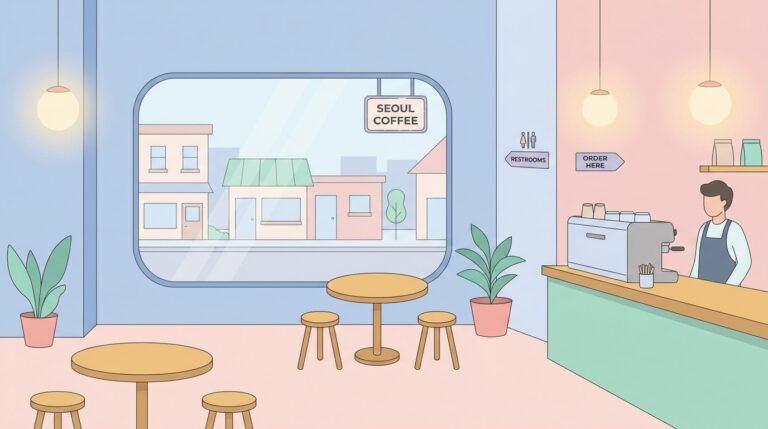
Picture this: You are relaxing in a hip Seongsu cafe after a long day of exploring Seoul. Suddenly, you urgently need to find the restroom. You summon your courage, approach the barista, and ask for help. She smiles kindly and says: “밖으로 나가셔서 왼쪽에 있어요!”
Your mind goes blank. You understood “restroom”, but which way was “왼쪽” again? Left? Right?
Don’t worry—almost every beginner gets stuck here! Mastering directional words like 위 (up), 아래 (down), 앞 (front), 뒤 (back), and 옆 (side) is your ultimate travel survival skill. Built on real student experiences, this guide will help you navigate Seoul with total confidence!
Phase 2: Top 3 Core Expressions Deep-Dive
1. 왼쪽에 화장실이 있어요 (Oenjjoge hwajangsiri isseoyo)
- Pronunciation: Oen-jjog-e hwa-jang-shil-i i-sseo-yo (Sounds like “When-choke-eh hwa-jang-sheel-ee ee-sseo-yo”)
- Meaning: Literal: “At the left, a restroom exists.” | Nuance: “The restroom is on the left.”
- K-Culture Moment: You will hear this in almost every K-drama office or cafe scene when a visitor politely asks the receptionist for directions.
- Editor’s Insight: The word ‘쪽’ (jjok) means “side” or “direction”, and ‘-에’ (e) is the location-marking particle. Putting them together, ‘왼’ (left) + ‘쪽’ (side) + ‘에’ (at) forms “on the left side”.
- Situation Spectrum: Casual: ⚠️ (Say 왼쪽에 있어) | Semi-formal: ✅ | Formal: ✅ (Say 왼쪽에 있습니다)
- 🤔 Think About It: English uses prepositions before nouns (“on the left”), while Korean attaches location markers after direction nouns (“왼쪽-에”). How does seeing space from general direction to specific particle change your spatial thinking?
2. 이쪽에 있어요 (Ijjoge isseoyo)
- Pronunciation: I-jjog-e i-sseo-yo (Sounds like “Ee-choke-eh ee-sseo-yo”)
- Meaning: Literal: “It exists on this side.” | Nuance: “It’s right over this way.”
- K-Culture Moment: A warm staff member at a K-BBQ restaurant guiding you toward the self-service side-dish (banchan) refill counter.
- Editor’s Insight: When you are flustered and cannot remember left or right, ‘이쪽’ (this way) paired with a friendly gesture is the ultimate native shortcut.
- Situation Spectrum: Casual: ⚠️ | Semi-formal: ✅ | Formal: ✅
- 🤔 Think About It: Korean pairs demonstratives (이 = this, 그 = that near you, 저 = that far away) directly with direction words. Why is physical proximity so central in everyday Korean speech?
3. 엘리베이터 옆에 있어요 (Ellibeiteo yeope isseoyo)
- Pronunciation: El-li-be-i-teo yeop-e i-sseo-yo (Sounds like “El-lee-bay-ee-tuh yawp-eh ee-sseo-yo”)
- Meaning: Literal: “At the elevator’s side, it exists.” | Nuance: “It’s right next to the elevator.”
- K-Culture Moment: Finding facilities inside expansive Seoul subway stations or multi-story department stores.
- Editor’s Insight: ‘옆’ (yeop) denotes adjacency. In compact Korean urban buildings, major fixtures like stairs (계단) or elevators (엘리베이터) serve as the primary spatial anchors.
- Situation Spectrum: Casual: ⚠️ | Semi-formal: ✅ | Formal: ✅
- 🤔 Think About It: Instead of saying “next to the elevator”, Korean orders it as “elevator next-at” (엘리베이터 옆에). Notice how Korean sets the broad anchor first before pinpointing the exact spot!
Phase 3: Textbook Korean vs. Real Korean
Situation 1: Asking where the restroom is
- 📖 교과서 한국어: 화장실이 어디에 위치해 있습니까? (Hwajangsiri eodie wichihae isseumnikka? — “Where is the restroom located?”)
- 🗣️ 진짜 한국어: 저기요, 화장실 어디예요? (Jeogiyo, hwajangsil eodieyo? — “Excuse me, where is the restroom?”)
- 💡 왜 다를까? Real-life conversation favors the conversational question ending ‘-어디예요?’ over rigid Sino-Korean nouns like ‘위치’ (location/position).
Situation 2: Being directed down a hallway
- 📖 교과서 한국어: 좌측으로 향하여 걸어가십시오. (Jwachugeuro hyanghayeo georeogasipsio. — “Proceed toward the left sector.”)
- 🗣️ 진짜 한국어: 왼쪽으로 쭉 가시면 돼요. (Oenjjogeuro jjuk gasimyeon dwaeyo. — “Just go straight to the left.”)
- 💡 왜 다를까? Native speakers rely on vivid sound/manner words like ‘쭉’ (jjuk — straight ahead) paired with the gentle suggestion ending ‘-시면 돼요’ (you can just…).
Phase 4: K-Culture Deep Dive & Non-Verbal Manners
4-1. Nunchi & Gestures: The Polite Open Palm
When asking or giving directions in Korea, pointing directly with a single index finger can appear abrupt or accusatory. Instead, Koreans use an open hand with the palm turned slightly upward when indicating “이쪽” (this direction) or “저쪽” (that direction). When approaching a staff member, combine a slight head nod (목례) with a gentle “저기요…” (Excuse me…). This polite demeanor instantly triggers their nunchi (quick social situational awareness) and earns you eager, patient guidance!
4-2. Culture Code: The Secret World of Seoul Cafe Restrooms
In trend-heavy neighborhoods like Yeonnam-dong or Ikseon-dong, cafes occupy historic alley houses or compact storefronts. Restrooms are often located half a flight up the communal staircase (“계단 반 층 위”) or behind the exterior hallway door. Furthermore, most are secured by digital keypads. Knowing words like ‘밖’ (outside), ‘계단 옆’ (beside the stairs), and ‘비밀번호’ (door passcode) is practically mandatory to avoid being locked out!
Phase 5: Real-World Roleplay Scenario
Setting: A stylish minimalist cafe near Seongsu Station.
Characters: Minji (Friendly Cafe Barista) & You (A customer holding an empty cup with urgent business).
- Turn 1 (You): 저기요, 죄송한데요… (Jeogiyo, joesonghandeyo… / Excuse me, I’m sorry to bother you…) [🎭 Fidgeting slightly and speaking politely]
- Turn 2 (Minji): 네, 고객님! 무엇을 도와드릴까요? (Ne, gogaeknim! Mueoseul dowadeurilkkayo? / Yes, customer! How can I help you?) [🎭 Smiling warmly while pausing espresso extraction]
- Turn 3 (You): 화장실이 어디에 있어요? (Hwajangsiri eodie isseoyo? / Where is the restroom?) [🎭 Glancing around looking slightly lost]
- Turn 4 (Minji): 아, 매장 밖으로 나가셔서 왼쪽에 있어요! (A, maejang bakkeuro nagasyeoseo oenjjoge isseoyo! / Ah, step outside the cafe and it’s on the left!) [🎭 Guiding with an open palm toward the main glass exit]
- Turn 5 (You): 밖으로 나가서 왼쪽이요? (Bakkeuro nagaseo oenjjogiyo? / Go outside and turn left?) [🎭 Pointing open-palmed to confirm direction]
- Turn 6 (Minji): 네, 엘리베이터 바로 옆이에요. 비밀번호는 영수증 아래에 있어요! (Ne, ellibeiteo baro yeopieyo. Bimilbeonhoneun yeongsujeung araee isseoyo! / Yes, right next to the elevator. The door passcode is at the bottom of your receipt!) [🎭 Tapping a finger near the bottom of the printed receipt]
- Turn 7 (You): 아, 엘리베이터 옆! 정말 감사합니다. (A, ellibeiteo yeop! Jeongmal gamsahamnida. / Ah, next to the elevator! Thank you so much.) [🎭 Bowing head with palpable relief]
- Turn 8 (Minji): 아니에요! 편하게 다녀오세요. (Anieyo! Pyeonhage danyeooseyo. / Not at all! Take your time.) [🎭 Waving pleasantly]
🔀 Interactive Decision Point
You walk outside, turn left, and reach the door next to the elevator. It has a digital keypad with illuminated blue numbers. What should you do next?
* Option A: Knock loudly on the door shouting “열어주세요!” (Open please!).
* Feedback: [Bad] Banging on private commercial doors causes unwarranted stress to whoever is inside or nearby. Keep calm!
* Option B: Look at the bottom of your receipt for the 4-digit code (비밀번호) and press it followed by the asterisk ().
* *Feedback: [Best] Perfect execution! Korean cafes print door codes right on the receipt (“영수증 아래”). You slipped in smoothly like a local!
* Option C: Turn around and march back into the barista counter space to search for a physical metal key.
* Feedback: [Risk] Walking into staff-only kitchen counters violates personal boundaries in Korea. Always ask verbally first!
Phase 6: 10-Second Emotional Shadowing Drill
Practice these natural rhythms out loud using the emotional cues and slash / pause markers:
- [🥺 Urgent & Desperate]
저기요… / 화장실 / 어디예요?
(Jeogiyo… / hwajangsil / eodieyo?) -
[💡 Clarifying & Bright]
밖으로 나가서 / 왼쪽 / 맞아요?
(Bakkeuro nagaseo / oenjjok / majayo?) -
[😊 Relieved & Polite]
엘리베이터 옆에 / 있군요! / 감사합니다!
(Ellibeiteo yeope / itgunyo! / Gamsahamnida!)
Phase 7: K-Culture Mini Dictionary
- 왼쪽 (Oenjjok) | Noun: Left (side) | Formed from ‘왼’ (left) and ‘쪽’ (direction). The universal word heard on subway announcements and pedestrian GPS navigation.
- 오른쪽 (Oreunjjok) | Noun: Right (side) | The opposite of 왼쪽. Handy mnemonic: “오른” sounds slightly like “all right”!
- 옆 (Yeop) | Noun: Beside / Next to | Fundamental spatial locator. Used in common phrases like ‘옆집’ (next-door house) or ‘편의점 옆’ (beside the convenience store).
- 비밀번호 (Bimilbeonho) | Noun: Password / Passcode | Often clipped into the ultra-common slang abbreviation “비번” (bi-beon) by young Koreans when asking for Wi-Fi or door lock codes.
Phase 8: Traveler’s Survival Kit
TOP 3 Survival Expressions
- 화장실 어디예요? (Hwajangsil eodieyo?) — “Where is the restroom?”
Pro Tip: Memorize this as one single melody. Add a gentle head bow for immediate friendly assistance. - 왼쪽이에요, 오른쪽이에요? (Oenjjogieyo, oreunjjogieyo?) — “Is it to the left or to the right?”
Pro Tip: Use this quick follow-up whenever a local points vaguely in a hurry. - 비밀번호 있어요? (Bimilbeonho isseoyo?) — “Is there a passcode?”
Pro Tip: Ask this before leaving the cafe counter so you don’t have to make two trips in an emergency!
Editor’s Travel Note
Standard global maps often lack accurate indoor walking routes across Korean cities. Before embarking on your journey, check our recommended Naver Map app installation guide to search for public facilities and subway exits effortlessly. When inside subway stations, simply watch the hanging ceiling signage: follow the figures paired with arrows pointing 위 (straight ahead), 왼쪽 (left), or 오른쪽 (right).
Phase 9: A Step Deeper (Reflective Essay)
In Korean, spatial orientation is rarely absolute or detached. While Western navigation frequently relies on cardinal coordinates (North, South, East, West) or egocentric left-right perspectives, the Korean language visualizes space relationally. Expressions like “우리 옆” (next to us), “가게 앞” (in front of the shop), and “이쪽” (this side) reveal that space in Korea is always understood in relation to shared landmarks and community presence. Space is not merely a grid; it is a shared social landscape where you and your conversational partner navigate together.
💬 Your Turn: Have you ever experienced a funny or memorable moment trying to decipher bathroom directions in another country? Which direction word trips you up the most? Share your stories in the comments below!
Phase 10: FAQ & Common Mistakes
Q: How do I say “go straight” in natural spoken Korean?
A: While textbooks introduce “직진하세요” (jikjinhaseyo), Koreans in daily life almost always say “앞으로 쭉 가세요” (apeuro jjuk gaseyo), meaning “go straight toward the front.”
Q: What is the difference between ‘옆’ (yeop) and ‘근처’ (geuncheo)?
A: ‘옆’ refers to something directly adjacent or right beside an anchor point (e.g., “next to the door”). In contrast, ‘근처’ means the general vicinity or neighborhood (e.g., “near the station”).
Q: Can I omit the particle ‘-에’ (-e) when speaking?
A: In fast casual conversations, locals sometimes drop ‘-에’ (e.g., “왼쪽 있어”). However, as an A1 beginner, practicing with ‘-에’ (“왼쪽에 있어요”) ensures clear grammar and prevents sounding blunt.
🚨 흔한 실수 (Common Mistakes) Warning Board
- Mixing up 왼쪽 (left) and 오른쪽 (right):
Correct Action: Remember the “O” sound rule: 오른쪽 (O-reun-jjok) = OK / Right side! 왼쪽 (Oen-jjok) = West / Left side. - Reversing word order (English preposition order):
Correct Action: Beginners often say “옆 엘리베이터” (next to elevator). Remember: Landmark first, direction second! Always say 엘리베이터 옆에 (elevator next-to). - Dropping honorifics with staff:
Correct Action: Never shout “화장실 어디야?” to a shop owner. Always maintain the polite ‘-요’ form: 화장실 어디예요?.
Phase 11: Action Missions
- Bronze Mission (Solo): Look around your desk right now. Point to three objects and say aloud in Korean: “[Object] 왼쪽에 있어요”, “[Object] 오른쪽에 있어요”, and “[Object] 앞에 있어요”.
- Silver Mission (Social): Snap a quick photo of your coffee cup today and share it on Instagram or X with the caption: “화장실은 왼쪽에 있어요! ☕️🗺️ @DailyHangul” to practice typing direction terms.
- Gold Mission (Real-World): The next time you visit a Korean cafe, restaurant, or language exchange meetup, ask the staff: “저기요, 화장실 어디예요?” without glancing at your notes!
- 🎮 K-Culture Mission: Watch an episode of any slice-of-life K-Drama (such as Hospital Playlist). Listen closely for the word “이쪽” (this way) whenever characters guide each other through building hallways!
Phase 12: Interactive Quiz Challenge
Test what you learned today! Think through each question, then click the toggle to reveal the explanations.
1. Situational Judgment:
You are in a busy bakery. You want to ask where the restroom is politely. Which sentence is the most natural?
(a) 야! 화장실 어디냐?
(b) 저기요, 화장실 어디예요?
(c) 화장실 위치를 즉시 서술하십시오.
2. Fill-in-the-Blank:
Complete the sentence to mean “It is next to the stairs“:
“계단 ________ 있어요.”
3. True or False:
In Korean cafes, the restroom door passcode is often printed at the bottom of the receipt (영수증 아래). (True / False)
Click here for Answers and Explanations
- Answer: (b) — “저기요, 화장실 어디예요?” is polite, warm, and natural for daily situations. (a) is disrespectful to strangers, and (c) is unnaturally robotic.
- Answer: 옆에 (yeope) — Spatial anchor formula: Noun (계단) + Position (옆) + Location Particle (에).
- Answer: True — Door passcodes (비밀번호) are frequently stamped or printed at the bottom of customer receipts in Korea!







