

Navigating LASIK and SMILE Consultations in Korea: Choosing Real Care Over Factory Clinics
Phase 1: Empathy (Immersive Storytelling Opening)
안녕하세요! 매일한글 에디터입니다. (Hello! This is your Daily Hangul editor.)
Picture this: You are walking out of Gangnam Station Exit 10. Towering glass buildings reflect the midday sun, and every second billboard screams a promotion: “Same-Day SMILE LASIK! Special Event Price: 990,000 KRW! Free Pre-Op Exam!” If you have ever worn thick glasses during a rainy Korean summer or suffered dry eyes from cheap cosmetic lenses while watching your favorite K-pop idols at a dome concert, your heart probably skipped a beat. “Could I really fix my vision in a single afternoon for the price of a mid-tier smartphone?”
Our American learner, Sarah, fell into this exact dilemma last month. Tempted by a splashy Instagram ad, she walked into a mega-clinic with a waiting lounge that looked like an airport terminal. White marble, iPad check-ins, complimentary espresso bars—and hundreds of patients moving through automated inspection stations like smartphone parts on an assembly line. When she finally met a doctor, the consultation lasted barely three minutes before a sales coordinator handed her a consent waiver. Feeling uneasy, Sarah walked away without signing.
Instead, she dug through Korean neighborhood community boards (like Blind and mom cafes) and booked an exam at a boutique clinic where the chief surgeon conducts the tests personally and walks you through 50+ corneal biometric checkpoints. As Sarah told us: “Since you only get one pair of eyes, I chose my clinic based on the surgeon’s track record and aftercare rather than flash-sale pricing.”
Navigating pre-op consultations for LASIK (라식), LASEK (라섹), or SMILE (스마일라식) in Korea requires more than dictionary vocabulary. You need the exact conversational tools to decode clinic sales talk, interrogate side effects, and advocate for your ocular safety. This guide is crafted directly from the real experiences of our international community in Seoul to ensure your vision journey is safe, empowered, and crystal clear.
Phase 2: Core 3 Expressions In-Depth Analysis
1. 공장형 안과 (Gong-jang-hyeong an-gwa)
- Pronunciation: [Gong-jang-hyeong an-gwa] (Sounds like gong + jahng + hy-ung + ahn-gwah — think of hitting a temple gong, then “young” with an h, followed by “on-gwa”).
- Meaning: Literal: “Factory-style eye clinic” / Practical Nuance: A high-volume, discount-driven clinic that prioritizes patient turnover, often shuffling you between multiple generic doctors and sales managers.
- K-Culture Moment: Seen frequently in medical satire K-dramas like Doctor Romantic or YouTube vlogs where Korean creators compare boutique private practices to giant high-turnover medical hubs in Gangnam or Apgujeong.
- Editor’s Insight: The word “공장형” (factory-type) is used across Korean consumer culture—from skin clinics (공장형 피부과) to fitness centers. It implies lightning-fast speed and low costs, but warns of minimal personalization and poor post-op responsibility.
- Situation Spectrum: Casual: ✅ | Semi-formal: ✅ | Formal: ⚠️
- 🤔 Think About It: In many Western countries, medical advertising is strictly regulated or subdued. Why do you think Korea’s hyper-competitive private healthcare market gave birth to terms like “공장형”?
2. 사후 관리 시스템 (Sa-hu gwan-ri si-seu-tem)
- Pronunciation: [Sa-hu gwal-li si-seu-tem] (Note the consonant assimilation: gwan-ri flows into gwal-li, sounding like sah-who gwahl-lee see-soo-tem).
- Meaning: Literal: “Post-management system” / Practical Nuance: Structured aftercare and long-term complication warranty, including regular follow-ups, free corrective enhancements, and emergency dry-eye treatments.
- K-Culture Moment: In Korean lifestyle vlogs titled “내돈내산 라식 후기” (My Own Money, My Own Purchase LASIK Review), YouTubers emphasize whether a clinic offers a “평생 보장 증서” (Lifetime Warranty Certificate) under their 사후 관리 program.
- Editor’s Insight: In Korean medical negotiations, asking about 사후 관리 shows that you are an informed consumer who cannot be brushed off with empty marketing promises. It shifts the power dynamic in the consultation room immediately.
- Situation Spectrum: Casual: ⚠️ | Semi-formal: ✅ | Formal: ✅
- 🤔 Think About It: How does your home country’s healthcare system handle postoperative liability compared to Korea’s contract-like clinic warranty certificates?
3. 집도의의 임상 경험 (Jip-do-ui-ui im-sang gyeong-heom)
- Pronunciation: [Jip-do-ui-ui im-sang gyeong-heom] (Sounds like jeep-doh-ee-ui eem-sahng gyung-hum).
- Meaning: Literal: “The operating surgeon’s clinical experience” / Practical Nuance: The primary operating doctor’s surgical caseload, complication management record, and specialized tenure—not just the brand reputation of the hospital.
- K-Culture Moment: Standard phrase heard in Korean investigative journalism programs like PD Note or medical dramas when uncovering ghost surgeries (유령 수술) where celebrity clinics swap the lead doctor while the patient is under anesthesia.
- Editor’s Insight: “집도의” refers explicitly to the hands-on lead surgeon holding the laser or microkeratome, distinguishing them from the “상담의” (consulting doctor) who merely greets you before passing you over.
- Situation Spectrum: Casual: 🚫 | Semi-formal: ✅ | Formal: ✅
- 🤔 Think About It: In English, we often refer to “the clinic’s reputation.” Notice how Korean patients pinpoint “집도의” (the exact surgeon). What does this reveal about accountability in Korean medicine?
Phase 3: Textbook Korean vs. Real Korean
Situation 1: Declining a discounted flash-sale package
- 📖 교과서 한국어 (Textbook Korean):
“이 수술은 너무 비싸고 마음에 들지 않아서 다른 병원에 가보겠습니다.”
(I will go to another clinic because this surgery is too expensive and I do not like it.) - 🗣️ 진짜 한국어 (Real Korean):
“이벤트 가격도 좋지만, 평생 한 번뿐인 눈이라 집도의 원장님 경력이랑 사후 보장 위주로 조금 더 비교해보고 결정할게요.”
(Event pricing is tempting, but since you only get one pair of eyes, I want to compare surgeons’ experience and aftercare guarantees before deciding.) - 💡 왜 다를까? (Why is it different?): Textbook phrasing sounds blunt and confrontational. Real native speakers use softening framing (“이벤트 가격도 좋지만…”) while asserting strict standards around quality and anatomical safety.
Situation 2: Asking if the consulting doctor will actually perform the surgery
- 📖 교과서 한국어 (Textbook Korean):
“당신이 저를 직접 수술합니까?”
(Do you directly operate on me?) - 🗣️ 진짜 한국어 (Real Korean):
“오늘 상담해 주신 대표 원장님께서 수술 집도와 수술 후 첫 진료까지 전담해 주시는 건가요?”
(Will the head director consulting me today take full charge of both operating and my first post-op checkup?) - 💡 왜 다를까? (Why is it different?): Asking “당신” (you) directly to a Korean medical professional sounds aggressive and unnatural. Specifying “집도와 첫 진료 전담” (in charge of both surgery and initial follow-up) tactfully rules out shadow doctors without causing offense.
Phase 4: K-Culture Deep Dive & Non-Verbal Nuance
4-1. Nunchi (눈치) & Body Language in Korean Clinics
When entering an ophthalmology clinic in Gangnam, your posture speaks before your Korean does. High-pressure sales coordinators (상담 실장) are trained to read whether a patient is an impulse buyer or an analytical researcher.
* The Stance: Keep a calm, unhurried posture. Avoid nodding enthusiastically at price discounts or “today-only” fee reductions.
* Eye Contact: While listening to the technician explain your corneal thickness (각막 두께) or pupil diameter (동공 크기), maintain steady eye contact and gently touch your notebook or examination sheet. This signals that you are cross-referencing their data.
* Polite Skepticism: When hearing promotional promises, a slow nod combined with a deliberate head tilt and the phrase “부작용 가능성도 객관적으로 짚어주시겠어요?” (Could you also objectively highlight the potential side effects?) instantly commands clinical respect.
4-2. Cultural Code Analysis: The “Ppalli-Ppalli” Dilemma in Korean Healthcare
South Korea’s private healthcare system is internationally renowned for unmatched diagnostic efficiency. You can complete 60 distinct eye tests—from endothelial cell counts (각막 내피세포) to optic nerve scans—in under 90 minutes. However, this same “빨리빨리” (hurry-hurry) culture can create the “Factory Clinic” phenomenon.
To maximize returns on ultra-expensive German femtosecond lasers (like the VisuMax 800), high-volume clinics schedule back-to-back surgeries every 15 minutes. Savvy Korean patients counteract this by practicing “발품 팔기” (selling foot-effort: visiting at least 3 distinct clinics for identical dilated-pupil tests). Understanding this cultural dynamic empowers you: you do not have to accept the clinic’s timetable. Prioritizing thoroughness over Korean speed is respected by high-tier doctors.
Phase 5: Real-Life Roleplay Scenario
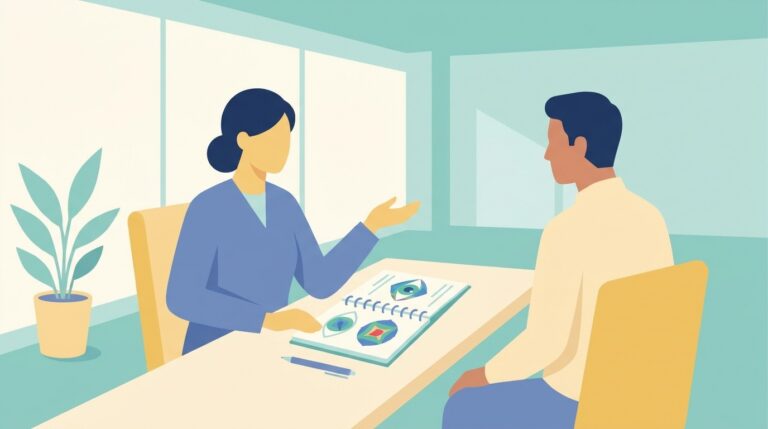
Setting: Gangnam Bright Eye Clinic (강남밝은안과), Consultation Room 3. Soft instrumental lo-fi music plays. Dr. Min-woo Kang sits across from you, reviewing your high-resolution corneal topography charts on a dual monitor.
Characters:
* 강민우 원장 (Dr. Min-woo Kang): Veteran ophthalmologist with 18 years of refractive surgery experience. Direct, composed, values informed patients.
* 학습자 (You): An observant, safety-focused international resident who has finished a 2-hour pre-op exam.
- 턴 1 (Doctor):
“검사 결과 보니까 각막 두께는 540마이크론으로 충분한 편인데, 야간 동공 크기가 7.2mm로 평균보다 조금 큰 편이시네요.”
(Geomsa gyeolgwa bonikka gakmak dukke-neun 540 ma-i-keu-ron-euro chungbunhan pyeon-inde, yagan donggong keugi-ga 7.2mm-ro pyeong-gyun-boda jogeum keun pyeon-isineyo.)
“Looking at your exam results, your corneal thickness is sufficient at 540 microns, but your scotopic pupil size is 7.2mm, which is slightly larger than average.”
🎭 Monitors glow with color-coded corneal maps as Dr. Kang taps a pen on the pupil graph. -
턴 2 (You):
“그렇군요. 동공이 크면 야간 빛 번짐이나 눈부심 부작용이 생길 가능성이 더 높지 않나요?”
(Geureokunyo. Donggong-i keumyeon yagan bit beonjim-ina nunbusim bujagyong-i saenggil ganeungseong-i deo nopji anneayo?)
“I see. If my pupils are large, isn’t there a higher risk of side effects like night glare or halos?”
🎭 Leaning forward slightly, referencing your handwritten checklist. -
턴 3 (Doctor):
“정확히 알고 계시네요. 절삭 범위를 광학부 기준 6.8mm 이상 넓히지 않으면 야간 운전 시 빛 번짐을 크게 느끼실 수 있습니다.”
(Jeonghwakhi algo gyesineyo. Jeolsak beomwi-reul gwanghakbu gijun 6.8mm isang neolphiji aneumyeon yagan unjeon si bit beonjim-eul keuge neukkisil su itseumnida.)
“You are precisely correct. Unless we widen the optical ablation zone beyond 6.8mm, you could experience noticeable glare when driving at night.”
🎭 Nodding with approval at your informed question. -
턴 4 (You):
“평생 단 한 번뿐인 소중한 눈이라 가격 할인 이벤트보다는 안전성이 최우선입니다. 원장님 임상 케이스 중에 저랑 비슷한 환자분 경과는 어땠나요?”
(Pyeongsaeng dan han beonppunin sojunghan nun-ira gagyeok harin ibenteu-bodaneun anjeonseong-i choe-useon-imnida. Wonjangnim imsang ke-i-seu jung-e jeorang biseuthan hwanja-bun gyeonggwa-neun eottaennayo?)
“Since you only get one pair of eyes, safety is my absolute priority over flash-sale discounts. In your clinical cases, how did patients with profiles like mine progress?”
🎭 Calm, steady tone with polite two-handed open gesture. -
턴 5 (Doctor):
“제 집도 기준으로는 잔여 각막량을 380마이크론 이상 안전하게 남기고 맞춤형 스마일라식으로 진행하면 건조증과 빛 번짐을 최소화할 수 있습니다.”
(Je jipdo gijun-euro-neun janyeo gakmakryang-eul 380 ma-i-keu-ron isang anjeonhage namgigo matchumhyeong seuma-il-ra-sik-euro jinhaenghamyeon geonjojeung-gwa bit beonjim-eul choesohwahal su itseumnida.)
“By my surgical protocol, retaining a safe residual corneal bed of over 380 microns and proceeding with customized SMILE minimizes both dry eye and glare.”
🎭 Pulling up real post-op recovery data curves on the left monitor. -
턴 6 (You):
“원장님께서 당일 집도부터 수술 3개월 차 정기검진까지 전담으로 봐주시는 사후 관리 시스템인가요?”
(Wonjangnim-kkeseo dang-il jipdo-buteo susul sam-gae-wol cha jeong-gigeomjin-kkaji jeondam-euro bwajusineun sa-hu gwan-ri si-seu-tem-ingayo?)
“Is this an aftercare system where you personally oversee everything from the operation day up to the 3-month periodic checkup?”
🎭 Direct eye contact with gentle, earnest intonation. -
턴 7 (Doctor):
“물론입니다. 저희는 페이닥터 교체 없이 제가 끝까지 전담 진료하며, 6개월 차 각막 지형도 추적 검사까지 무상 지원합니다.”
(Mollon-imnida. Jeohi-neun pe-i-dak-teo gyo-che eop-si je-ga kkeut-kkaji jeondam jinryo-hamyeo, yuk-gae-wol cha gakmak jihyeongdo chujeok geomsa-kkaji musang jiwon-hamnida.)
“Of course. We never swap in substitute doctors; I personally manage your care until the end, including complimentary 6-month corneal topography tracking.”
🎭 Signs his clinical name stamp onto the diagnostic file. -
턴 8 (You):
“상세하게 설명해 주셔서 신뢰가 가네요. 오늘 주신 정밀 검사 차트 토대로 신중히 고민하고 연락드리겠습니다.”
(Sangsehage seolmyeonghae jusyeoseo sinrhoe-ga ganeyo. Oneul jusin jeongmil geomsa chateu todae-ro sinjunghi gomin-hago yeonrak-deurigesseumnida.)
“Your detailed explanation gives me great confidence. I will consider everything carefully based on today’s detailed exam charts and contact you.”
🎭 Polite 15-degree seated bow while holding the medical dossier with both hands.
🔀 Interactive Choice Point
At this moment, the clinic’s sales coordinator steps in and says: “If you reserve today before 4 PM, we can knock off an additional 300,000 KRW from the customized SMILE package! How would you respond?”
- Choice A: “너무 싸네요! 지금 당장 예약금 걸고 오늘 바로 수술받을게요!” (That is so cheap! I’ll put down a deposit right now and do the surgery today!)
- Feedback: ❌ Bad Choice. Giving in to instant discount pressure at eye clinics risks hasty surgery on pupils that are still dilated from atropine drops, compromising laser alignment precision.
- Choice B: “당일 할인 혜택도 감사하지만, 산동제 약효 빠지고 검사 결과를 다른 병원 데이터와 객관적으로 비교해본 뒤 결정하겠습니다.”
- Feedback: 🏆 Best Choice. Politely asserts that your dilated pupils (산동제 효과) must normalize and that you will make an objective, unpressured decision after comparing data.
- Choice C: “왜 자꾸 재촉하세요? 여기 혹시 공장형 사기 병원인가요?”
- Feedback: ⚠️ Risk Choice. While skeptical, calling the staff a “fraudulent factory clinic” to their face burns medical bridges and creates unnecessary hostility in what should be a professional consultation.
Phase 6: 10-Second Emotional Shadowing Drill
Listen closely, align your breath, and mimic the natural rhythmic pauses (/) and emotions of an assertive, sophisticated patient:
[🧐 꼼꼼하고 차분하게 - Inquiring & Analytical]
“눈 수술인 만큼 / 단순 이벤트 가격보다는 / 집도의의 임상 경험을 / 가장 중요하게 보고 있어요.”
(Nun susul-in mankeum / dansun ibenteu gagyeok-bodaneun / jip-do-ui-ui im-sang gyeong-heom-eul / gajang jung-yohage bogo isseoyo.)-
[🩺 진지하고 확인하듯이 - Serious & Checking Boundaries]
“수술 중에 / 돌발 상황이 생겼을 때 / 대처할 수 있는 / 응급 시스템과 사후 관리 보장이 / 완비되어 있나요?”
(Susul jung-e / dolbal sanghwang-i saenggyeosseul ttae / daecheohal su inneun / eunggeup si-seu-tem-gwa sa-hu gwan-ri bojang-i / wanbi-doeeo innayo?) -
[😌 안도하며 신뢰 어린 목소리로 - Composed, Discerning & Firm]
“상세한 수치 분석 감사합니다. / 산동제 안약 기운이 다 빠진 뒤 / 신중하게 수술 일정을 잡겠습니다.”
(Sangsehan suchi bunseok gamsahamnida. / Sandongje anyak gi-un-i da ppajin dwi / sinjunghage susul iljeong-eul japgesseumnida.)
Phase 7: K-Culture Mini Dictionary
| # | Term (Hangul / Romanization) | Translation | Real-World Cultural / Clinic Context |
|---|---|---|---|
| 1 | 산동제 (San-dong-je) | Pupil-dilating eye drops | Diagnostic drops used to examine your retina. Causes blurred near-vision for 4-6 hours. Never sign surgical contracts while under their influence! |
| 2 | 잔여 각막량 (Jan-yeo gakmak-ryang) | Residual corneal thickness | The holy grail of laser eye surgery safety. Korean safety standards strictly demand leaving at least 300~350+ microns to avoid corneal ectasia (keratoconus). |
| 3 | 페이닥터 (Pe-i-dak-teo) | Employed associate doctor | A salaried physician hired by hospital owners. In high-turnover “factory” clinics, pay-doctors frequently rotate, risking broken post-op continuity. |
| 4 | 빛 번짐 (Bit beon-jim) | Light halos / Starbursting | The most common side effect discussed on Korean forums. Critical for night drivers or those working under heavy neon stadium lighting. |
Phase 8: Traveler & Expat Medical Survival Kit
Top 3 Survival Phrases for Clinic Visits
- “각막 두께랑 절삭량 수치 적힌 검사지 사본 받을 수 있을까요?”
(Gakmak dukke-rang jeolsakryang suchi jeokhin geomsaji sabon badeul su isseulkkayo?)- Pro Tip: Always request hard-copy prints of your corneal thickness and ablation depth. Reputable Korean clinics provide this willingly; evasive clinics may not.
- “만약 목표 시력이 안 나오거나 퇴행이 오면 재교정은 무료인가요?”
(Manyak mokpyo siryeok-i an na-o-geona toehaeng-i omyeon jae-gyojeong-eun muryo-ingayo?)- Pro Tip: Clarifies whether secondary enhancements for myopic regression (퇴행) are covered under their warranty without surprise fees.
- “수술 당일 집도의 원장님이 지정되는 방식인가요?”
(Susul dang-il jip-do-ui wonjangnim-i jijeong-doeneun bangsik-ingayo?)- Pro Tip: Ask this to ensure you do not get assigned a random on-duty surgeon on the morning of surgery.
Editor’s Travel & Clinical Logistics Note
- Navigating to Medical Hubs: Major refractive centers are clustered around Gangnam Station (Line 2 / Shinbundang Line) and Apgujeong Station (Line 3). Instead of general search engines, use Naver Map App Download to read authentic Korean patient reviews under the “MY플레이스” (MY Place) verified receipt tab.
- Post-Op Commute: Dilated or freshly operated eyes cannot endure harsh subway fluorescent lighting or smartphone screens. Bring polarized sunglasses with 100% UV protection and set up a ride-hailing service in advance via Kakao T Taxi Calling rather than wandering through multi-level underground metro stations.
- Payment Method: Medical tax refunds (사후 면세) are available for tourists at certified clinics with eligible passports. Check if your clinic has a dedicated Tax Refund kiosk.
Phase 9: “Step Deeper” (Reflective Cultural Essay)
In Korean society, the phrase “몸이 천 냥이면 눈은 구백 냥” (If the whole body is worth a thousand nyang, the eyes are worth nine hundred) has been passed down for centuries. It reflects the philosophical conviction that vision is the anchor of personal vitality. In contemporary Korea, where pristine appearance and hyper-efficient productivity are prized, vision correction is viewed almost as a rite of passage for university students entering the corporate battlefield or completing military duty.
Yet, this relentless drive for convenience has sparked a counter-cultural movement among young Koreans: prioritizing clinical integrity over slick marketing. Choosing a physician based on ethics and post-op care rather than flash discounts demonstrates true maturity in consumer culture. It signifies an understanding that healthcare is not a fast-food transaction, but a human partnership.
💬 Your Turn: Have you ever experienced medical care or aesthetic consultations abroad? What matters most to you: lightning-fast convenience and discount pricing, or a personal, long-term relationship with your doctor? Share your perspective in the comments below!
Phase 10: FAQ & Common Mistakes
Q: Can I undergo eye surgery on the same day as my comprehensive pre-op exam (당일 수술)?
A: While many Gangnam clinics advertise “One-Day LASIK,” ethical ophthalmologists recommend against it if your pupils were dilated with strong mydriatic drops (산동제). Dilated pupils impair the laser’s iris-tracking precision. It is far safer to rest your eyes for at least 24 to 48 hours before surgery.
Q: What is the main difference between SMILE (스마일라식) and traditional LASEK (라섹) in Korea?
A: Traditional LASEK removes the corneal surface epithelium, requiring 4-5 days of painful recovery and bandage lenses, but preserves maximum residual cornea. SMILE uses a femtosecond laser to cut a microscopic internal lenticule removed through a 2mm keyhole incision, allowing you to wash your face and exercise the very next day.
Q: Why do Korean clinics offer large discounts for “DNA testing” (아벨리노 각막이상증)?
A: Testing for Avellino corneal dystrophy is mandatory before laser surgery to prevent blindness caused by laser trauma. Some discount clinics bundle this test as an “event perk,” but reputable clinics consider it a non-negotiable basic protocol and will show you official genetic lab certificates.
🚨 Common Mistakes Alert
- Mistake 1: Wearing soft contact lenses right before your exam.
- Why it hurts: Lenses distort corneal topography curves, giving false readings for laser calibration.
- Correct Action: Stop wearing soft lenses for at least 3-5 days (hard/RGP lenses for 10-14 days) before your diagnostic exam.
- Mistake 2: Signing clinic waivers without asking for the surgeon’s name.
- Why it hurts: Leaves you vulnerable to substitute/shadow surgeons on busy Saturdays.
- Correct Action: Confirm the surgeon’s full name in writing on the consent form: “수술 동의서에 오늘 상담해 주신 집도의 원장님 성함 적어주세요.”
- Mistake 3: Traveling alone without UV-blocking sunglasses.
- Why it hurts: Direct sunlight immediately after corneal laser procedures induces hyperpigmentation and severe corneal haze.
- Correct Action: Bring heavy dark sunglasses and a wide-brimmed bucket hat directly to the clinic.
Phase 11: Action Missions
- 🥉 Bronze Mission (Solo Practice): Read the Phase 6 Shadowing Drills out loud 3 times. Record your voice on your smartphone and compare your pause markers (
/) with our phonetic breakdown. - 🥈 Silver Mission (Community Exploration): Visit YouTube and search “스마일라식 부작용 솔직 후기” (SMILE LASIK Honest Side Effects Review). Note down two recurring vocabulary words you hear Korean patients mention about their recovery.
- 🥇 Gold Mission (Real-Life Application): Next time you visit a doctor, pharmacy, or skincare clinic, politely decline a rushed recommendation using the softening sentence pattern: “~도 좋지만, 조금 더 비교해보고 신중히 결정할게요.”
- 🎮 K-Culture Media Mission: Watch Episode 1 of any medical K-drama (like Hospital Playlist or Ghost Doctor). Spot the moment a physician is introduced as “집도의” and listen to the respectful, serious tone used by the surgical staff!
Phase 12: Interactive Quiz Challenge
Test your knowledge before booking your medical trip! Select your answer, then click the toggle to reveal the detailed breakdown.
1. Situational Judgment
Question: A clinic counselor says: “오늘 당일 예약하시면 수술비 50만 원 할인에 DNA 유전자 검사도 공짜로 해드려요!” (If you book today, we give 500k KRW off and free DNA testing!) How do you assertively decline with high-level etiquette?
a) “돈 없으니까 그냥 무료 검사만 받고 갈게요.”
b) “파격적인 혜택은 감사하지만, 평생 쓸 눈이라 며칠간 검사 데이터와 사후 보장 조건을 신중히 따져본 뒤 결정하겠습니다.”
c) “거짓말 마세요. 다른 병원이 훨씬 더 싸던데요?”
👉 Click to Reveal Answer & Feedback
- Correct Answer: b)
- Feedback: Choice (b) displays high-level communicative competence (B2 CEFR level). It acknowledges the counselor’s offer politely (“파격적인 혜택은 감사하지만…”) while establishing unyielding boundaries regarding bodily safety and thorough data comparison. Choice (a) sounds childish, and choice (c) is unnecessarily confrontational.
2. Fill-in-the-Blank
Question: Complete the sentence with the appropriate medical term:
“대형 병원의 저렴한 가격에 현혹되기보다, 실제로 내 눈을 수술해 주시는 ( )의 수술 이력과 임상 케이스를 꼼꼼하게 따져봐야 합니다.”
👉 Click to Reveal Answer & Feedback
- Correct Answer: 집도의 (Lead Operating Surgeon)
- Explanation: While “의사” (doctor) or “원장님” (clinic director) fit grammatically, 집도의 is the precise clinical term specifying the individual surgeon who actually holds surgical instruments and operates on your eyes.
3. Cultural True or False
Question: “In South Korea, it is considered rude and offensive to ask an ophthalmologist for a printout of your corneal topography charts and diagnostic measurements after an exam.” (True / False?)
👉 Click to Reveal Answer & Feedback
- Correct Answer: False!
- Explanation: Requesting your test data (검사 차트 사본) is standard practice for educated Korean patients practicing “발품 팔기” (gathering multiple medical opinions). Conscientious clinics provide these records willingly as a demonstration of diagnostic confidence and transparency.







