

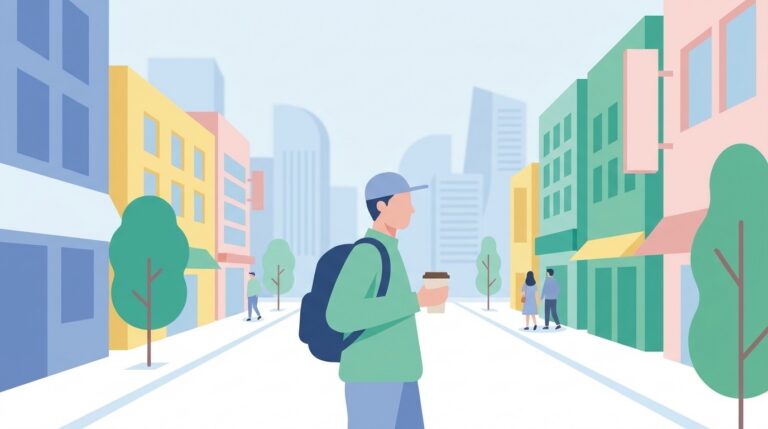
Phase 1: Empathy (Story-Driven Opening)
안녕하세요! 매일한글 에디터입니다. (Annyeonghaseyo! I am your Daily Hangul editor.)
Picture this: You are having the absolute time of your life wandering through the vibrant, neon-lit alleys of Hongdae or the mouth-watering food stalls of Myeongdong. You just devoured a piping-hot, honey-filled hotteok (sweet pancake) or finished an iconic A-A (iced Americano, the unofficial national drink of South Korea). Your belly is happy, your K-drama playlist is buzzing in your earphones, and you feel like the main character in your own Seoul romance.
Then, reality hits. You look at your hand. You are clutching a sticky paper cup, a wooden skewer dripping in sauce, and three crumpled napkins. You look around to toss them away… but there is nothing. No big green bins, no wire baskets, absolutely zero trash cans in sight for blocks. You walk one block, two blocks, five blocks, clutching your greasy trash like an unwanted souvenir. Panic sets in: Can I throw this here? Will people judge me? Why does a hyper-modern metropolis have nowhere to throw trash?!
Take a deep breath! You haven’t entered the Twilight Zone. Every single international traveler experiences this exact moment of mild panic. In this guide, backed by real feedback from hundreds of our beginner students, you will learn the exact phrases to locate bins effortlessly, understand the cultural reason behind Seoul’s ‘vanishing trash cans,’ and dispose of your street food wrappers like a courteous, savvy local.
Phase 2: Top 3 Core Expressions Deep-Dive
Here are the three golden keys you need to handle waste in Korea without breaking a sweat.
1. 쓰레기통 어디 있어요? (Sseuregitong eodi isseoyo?)
- Pronunciation: [Sseu-reh-gi-tong uh-di ee-ssuh-yo?] (Sound analogy: Think of saying ‘Surrey’ + ‘key’ + ‘tongue’ fast, followed by ‘uh-dee is-saw-yo’)
- Meaning: Literal: “Trash can, where is it?” | Real Nuance: “Excuse me, where is the trash bin?”
- K-Culture Moment: You will often hear travelers and variety show casts (like in Running Man) murmuring this exact phrase while holding empty drink bottles in street markets.
- Editor’s Insight: This is the single most practical phrase for absolute beginners. The suffix -요 (-yo) makes it polite and safe to use with clerks, security guards, and passersby.
- Situation Spectrum: Casual ⚠️ | Semi-formal ✅ | Formal ✅
- 🤔 Think About It: In English, we often ask “Do you have a trash can?” In Korean, asking “Where is it?” assumes the facility exists somewhere nearby, saving conversational steps.
2. 이거 버려도 돼요? (Igeo beoryeodo dwaeyo?)
- Pronunciation: [Ee-guh buh-ryuh-doh dway-yo?] (Sound analogy: ‘Eagle’ without the ‘l’ -> Ee-guh, followed by ‘butter’ without ‘tt’ -> ‘buh-ryuh’, ending with ‘doh dway-yo’)
- Meaning: Literal: “May I throw this away?” | Real Nuance: “Can I dispose of this here? / Could you toss this for me?”
- K-Culture Moment: Seen constantly at convenience store counters when a customer hands an empty packaging wrapper to the cashier.
- Editor’s Insight: If you are at a cafe, takeout kiosk, or convenience store (like GS25 or CU), do not just dump your trash in their private counter bins without asking. Asking this shows immediate cultural competence (nunchi).
- Situation Spectrum: Casual ⚠️ | Semi-formal ✅ | Formal ✅
- 🤔 Think About It: Why ask permission before throwing something away? In Korea, waste disposal costs money for business owners, making your polite question a mark of mutual respect.
3. 쓰레기 버리는 데 있어요? (Sseuregi beorineun de isseoyo?)
- Pronunciation: [Sseu-reh-gi buh-ri-neun deh ee-ssuh-yo?]
- Meaning: Literal: “Is there a place where trash is thrown?” | Real Nuance: “Is there a trash disposal area around here?”
- K-Culture Moment: Often used by locals visiting massive public spaces like the Hangang (Han River) parks after a picnic with fried chicken and ramen.
- Editor’s Insight: Sometimes public places do not have a traditional ‘can’ (tong), but rather an open recycling zone. Asking for ‘de’ (place) shows you understand there might be a dedicated sorting station.
- Situation Spectrum: Casual ⚠️ | Semi-formal ✅ | Formal ✅
- 🤔 Think About It: Notice how the language shifts from seeking an object (sseuregitong) to seeking an allocated community zone (beorineun de).
Phase 3: Textbook Korean vs. Real Korean
Many phrasebooks teach stilted, antique expressions that make you sound like a 1980s municipal manual. Let’s swap them for authentic street Korean!
- Situation 1: Asking someone where to toss a wrapper
- 📖 교과서 한국어: “휴지통이 어디에 위치해 있습니까?” (Hyujitongi eodie wichihae itseumnikka? – In which location is the waste receptacle situated?)
- 🗣️ 진짜 한국어: “저기요, 쓰레기통 어디 있어요?” (Jeogiyo, sseuregitong eodi isseoyo? – Excuse me, where is the trash can?)
- 💡 왜 다를까?: Hyujitong specifically refers to tissue bins in bathrooms or desks. In daily public life, everyone says Sseuregitong, and ending with -습니까 sounds overly militaristic.
- Situation 2: Asking a store clerk to throw away your cup
- 📖 교과서 한국어: “이 쓰레기를 수거해 주시겠습니까?” (I sseuregireul sugeohae jusigesseumnikka? – Would you collect this waste?)
- 🗣️ 진짜 한국어: “이거 버려주실 수 있어요?” (Igeo beoryeojusil su isseoyo? – Could you throw this away for me?) or simply “이거 버려도 돼요?” (Igeo beoryeodo dwaeyo?)
- 💡 왜 다를까?: Sugeo (collection) is administrative terminology used by waste trucks and city councils. Real humans use beorida (to throw away).
Phase 4: K-Culture Deep Dive & Non-Verbal Manners
4-1. 눈치 (Nunchi) & Gestures
When looking for trash disposal in public:
1. The Two-Handed Cup Handover: If a friendly cafe worker or convenience store clerk agrees to take your empty cup, never hand it over with one hand like a baton. Support your right forearm with your left hand or hold the cup with both hands while giving a slight nod. This gesture instantly melts away any awkwardness.
2. The Peek Before Dumping: Never walk into a private shop just to use their bin without buying anything. If you desperately need to throw something away, make gentle eye contact, bow your head 15 degrees, and ask: “저기요, 죄송한데요… 이거 버려도 돼요?” (Jeogiyo, joesonghandeyo… igeo beoryeodo dwaeyo? / Excuse me, I’m sorry to bother you… may I throw this away?).
4-2. The Mystery of the Missing Bins (Cultural Code)
Why are there almost no street trash cans in Seoul?
In 1995, South Korea revolutionized waste management by introducing the Jongnyangje (종량제) system—a volume-rate pay-as-you-go garbage bag policy. Before this, people were stuffing their household garbage bags into public street bins to avoid paying waste disposal fees. To solve the problem, city governments removed thousands of street trash cans!
As a result, Koreans adapted by holding onto their trash until reaching home, an office, or their next transit hub. When you see Koreans holding an empty beverage cup for twenty minutes down the street, it is not laziness—it is a collective social contract of responsible disposal.
Phase 5: Real-World Roleplay Scenario
Setting: You are at a bustling GS25 convenience store in Hongdae. You just finished a cup of hot tteokbokki bought from an outdoor stall outside, and you are holding the greasy paper container.
Characters: Alex (Traveler) & Minho (Convenience Store Clerk).
- Alex: 저기요, 죄송한데요… (Jeogiyo, joesonghandeyo… / Excuse me, I am sorry to bother you…) 🎭 Holding the empty cup cautiously with both hands, making polite eye contact.
- Minho: 네, 어서오세요! 뭐 찾으세요? (Ne, eoseo-oseyo! Mwo chajeuseyo? / Yes, welcome! What are you looking for?) 🎭 Beaming a friendly smile while scanning items behind the counter.
- Alex: 쓰레기통이 어디 있어요? (Sseuregitong eodi isseoyo? / Where is the trash can?) 🎭 Looking around the aisles with an apologetic smile.
- Minho: 아, 문 옆에 분리수거함 있어요. (A, mun yeope bunrisugeoham isseoyo. / Ah, there is a recycling bin right next to the entrance door.) 🎭 Pointing politely with an open palm toward the glass door.
- Alex: 아, 문 옆에요? 이거 버려도 돼요? (A, mun yeopeyo? Igeo beoryeodo dwaeyo? / Ah, next to the door? Can I throw this away here?) 🎭 Showing the street food cup.
- Minho: 네! 국물만 없으면 플라스틱 쪽에 넣으시면 돼요. (Ne! Gungmulman eopseumyeon peullaseutik jjoge neoeusimyeon dwaeyo. / Yes! As long as there is no soup left, you can put it in the plastic section.) 🎭 Giving an encouraging nod.
- Alex: 아하, 감사합니다! 좋은 하루 보내세요! (Aha, gamsahamnida! Joeun haru bonaeseyo! / Aha, thank you so much! Have a nice day!) 🎭 Bowing slightly and sorting the item into the designated container.
- Minho: 네, 감사합니다! 안녕히 가세요! (Ne, gamsahamnida! Annyeonghi gaseyo! / Yes, thank you! Goodbye!)
🔀 Interactive Decision Point
You bought an iced tea from a street cafe, drank it halfway, and now want to get rid of the plastic cup containing melted ice before entering a fashion boutique. What do you do?
- Option A: Walk up to a convenience store counter, drop the dripping iced cup directly onto the counter, and say “버려요!” (Beoryeoyo!).
- Outcome (Risk): The clerk will likely look alarmed! Leaving liquids inside recyclable plastic creates a mess and violates waste regulations. The phrasing is also bluntly casual.
- Option B: Empty the liquid/ice into a public restroom sink first, then ask the convenience store clerk: “이거 버려도 돼요?” (Igeo beoryeodo dwaeyo?).
- Outcome (Best): Perfect 100-point etiquette! Disposing of liquid beforehand enables seamless recycling, and your polite question makes the staff happy to help you.
- Option C: Leave the cup discreetly on a street transformer box or electrical panel outside the store.
- Outcome (Bad): This is illegal littering (mudan tugi). Korea has ubiquitous CCTV networks, and street littering damages neighborhood cleanliness. Avoid this at all costs!
Phase 6: 10-Second Emotion Shadowing Drill
Imitate native speech cadence by following these emotion checkpoints and pauses marked by /.
[🥺 Hesitant & Extremely Polite]
저기요… / 쓰레기통 / 어디 있어요?
(Jeogiyo… / sseuregitong / eodi isseoyo?)-
[🙏 Inquiring & Gentle]
이거 / 버려도 / 돼요?
(Igeo / beoryeodo / dwaeyo?) -
[😊 Bright & Warmly Grateful]
도와주셔서 / 정말 감사합니다!
(Dowajusyeoseo / jeongmal gamsahamnida!)
Phase 7: K-Culture Mini Dictionary
- 쓰레기통 (Sseuregitong) | Trash can / Waste bin
- Everyday usage: General term for any container designated for non-recyclable or general waste.
- 분리수거 (Bunrisugeo) | Waste sorting / Recycling separation
- Everyday usage: The system of dividing trash into paper (jong-i), plastic (peullaseutik), glass cans (can/yuri), and general waste (ilban sseuregi).
- 종량제 봉투 (Jongnyangje bongtu) | Official municipal prepaid trash bag
- Everyday usage: Color-coded plastic bags purchased at convenience stores required for throwing away household waste.
- 무단투기 (Mudan-tugi) | Illegal dumping / Littering
- Everyday usage: Frequently seen on street warning signs: “쓰레기 무단투기 금지” (Illegal waste dumping prohibited, fine up to 1,000,000 KRW).
Phase 8: Traveler’s Survival Kit
Top 3 Immediate Survival Phrases
- 화장실 어디예요? (Hwajangsil eodiyeyo?) | Where is the restroom? (Pro Tip: Subway station restrooms almost always have clean waste bins and recycling bins right by the entryway!)
- 이거 버려주세요. (Igeo beoryeojuseyo.) | Please throw this away. (Pro Tip: Use this when handing over trash at the specific shop where you originally bought the item.)
- 재활용 어디예요? (Jaehwalyong eodiyeyo?) | Where is recycling? (Pro Tip: Essential at food courts and train stations where general trash and plastic are strictly divided.)
Editor’s Travel Note: Where to Find Secret Trash Bins
- Subway Stations: The most reliable public trash bins in major Korean cities are located inside subway stations, usually situated right next to the ticket turnstiles or outside the station restrooms.
- Convenience Stores: GS25, CU, and 7-Eleven almost always feature indoor recycling bins. If you purchase even a small water bottle or pack of gum, you can comfortably discard your clean street trash there.
- Navigation Guide: When wandering through unknown alleys, check the [Naver Map app download for smart travel] to locate the nearest subway entrance or public community center (Jumin Center) which always offer waste disposal facilities.
Phase 9: Going Deeper (Cultural Reflection)
In many Western cultures, public hygiene is viewed as an institutional obligation: taxpayers fund municipal cleaners, so city halls install thousands of bins on street corners.
In contrast, modern Korean urbanism approaches public cleanliness through the lens of community solidarity and civic consideration. The lack of street bins turns trash management into an individual responsibility rather than a public burden. Koreans do not expect someone else to clean up after their personal snack breaks; carrying your trash until you find a suitable location reflects your respect for shared public space. It proves that clean cities are not built on abundant trash cans, but on communal discipline.
💬 Your Turn: Does your home country provide public bins on every street corner, or do citizens carry their litter home? Share your cultural perspective in the comments below!
Phase 10: FAQ & Avoiding Misunderstandings
Q: Can I throw away personal street trash in the outdoor bins of private cafes?
A: It is generally frowned upon. Korean small business owners pay for private commercial waste disposal bags. If you did not purchase anything from the cafe, walking up to their patio bin to dump leftover boba cups is considered impolite. Always ask first with “이거 버려도 돼요?”
Q: What should I do if my takeout drink still has liquid and ice inside?
A: Never discard a cup full of liquid into general bins or recycling bags. It attracts pests and ruins recyclable items. Look for a restroom to pour out the liquid, or ask a cafe counter: “얼음만 버려주실 수 있나요?” (Eoreumman beoryeojusil su innayo? / Could you dump just the ice for me?).
Q: Are there fines for leaving trash on the street in Korea?
A: Yes! Leaving cups, cigarette butts, or food waste on the streets can incur a littering fine ranging from 50,000 KRW to 1,000,000 KRW depending on the district under Korea’s Waste Management Act.
🚨 Common Mistakes Warning Board
- Boarding a Seoul City Bus with Takeout Drinks: Seoul city buses strictly ban passengers from boarding with open cups of coffee or street food skewers to prevent spills. Drink it or throw it away before the bus arrives!
- Tossing Unwashed Food Containers into Plastic Recycling: Containers covered in red tteokbokki sauce or oil cannot be recycled as plastic. Rinse them with water first, or discard them in the general waste (ilban sseuregi) bin.
- Mumbling “Where is trash?” in English: Locals in smaller stalls might feel shy answering in English. Smiling and offering the clear, beginner-friendly Korean sentence “쓰레기통 어디 있어요?” instantly bridges the gap.
Phase 11: Action Missions
- 🥉 Bronze Mission (Solo Practice): Stand in front of your mirror and practice saying: “저기요, 쓰레기통 어디 있어요?” 5 times until the words flow without pausing.
- 🥈 Silver Mission (Social Challenge): Next time you grab a drink, snap a quick photo of the cup and post it on your Instagram Story or Threads with the Korean caption: 쓰레기통 찾는 중! (Looking for the trash can!) and tag
#DailyHangul. - 🥇 Gold Mission (Real-world Challenge): Next time you visit a Korean convenience store or local Korean restaurant in your city, ask the clerk “이거 버려도 돼요?” before handing over an empty tissue or receipt!
- 🎮 K-Culture Media Mission: Watch any travel vlog or K-drama episode where characters eat street food at the Hangang park (such as Hospital Playlist or Weightlifting Fairy Kim Bok-joo). Pay close attention to how they collect their trash in bags before standing up!
Phase 12: Interactive Quiz Challenge
Test your new Korean street survival skills!
- Situational Judgment: You just ate a waffle skewer on the streets of Insadong. You spot a staff member standing near a convenience store door. What is the most polite way to ask where to dispose of it?
- A) 쓰레기통 줘요! (Sseuregitong jwoyo!)
- B) 저기요, 쓰레기통 어디 있어요? (Jeogiyo, sseuregitong eodi isseoyo?)
- C) 휴지통을 내놓으십시오. (Hyujitongeul naenoh-eusipsio.)
- Fill in the Blank: Fill in the missing question word:
- “저기요, 쓰레기통이 _______ 있어요?” (Excuse me, where is the trash can?)
- True or False Cultural Trivia: South Korea removed many public street trash cans in 1995 to encourage the pay-as-you-go garbage bag system (Jongnyangje).
- [ True / False ]
👉 Click to Reveal Answers & Explanations
- Question 1 Answer: B!
- Explanation: “저기요, 쓰레기통 어디 있어요?” is warm, natural, and respectful. Option A means “Give me a trash can!” (demanding), and Option C sounds like an absurd historical royal decree.
- Question 2 Answer: 어디 (eodi)
- Explanation: “어디” means “where”. Together, “어디 있어요?” forms the essential phrase “Where is it?”.
- Question 3 Answer: True!
- Explanation: Street bins were systematically reduced in 1995 to prevent citizens from illegally disposing of domestic household waste into public bins without purchasing municipal trash bags.
- Explanation: Street bins were systematically reduced in 1995 to prevent citizens from illegally disposing of domestic household waste into public bins without purchasing municipal trash bags.







