

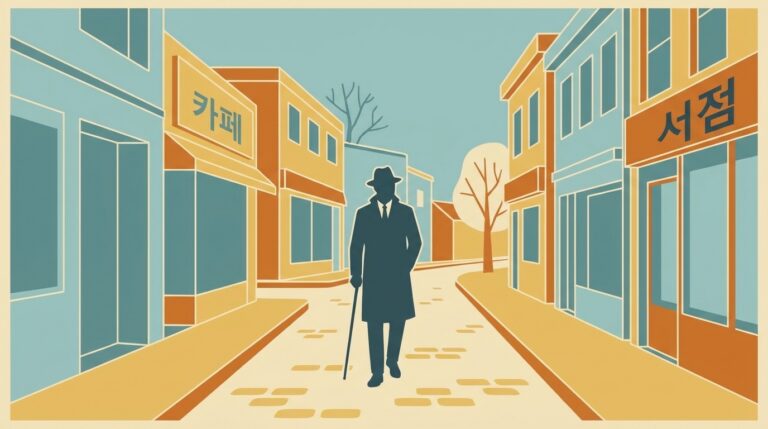
Strolling Through 1930s Gyeongseong: How Yi Sang and Kubo Redefined Korean Modernist Literature
Phase 1: Empathy (Immersive Opening)
안녕하세요! 매일한글 에디터입니다. (Hello! This is your Daily Hangul editor.) Have you ever found yourself wandering through the trendy, cafe-strewn alleys of modern Seoul—perhaps in Euljiro or Seochon—only to wonder what this electric, dizzying metropolis felt like nearly a century ago? For advanced Korean learners reaching for the heights of C2 fluency, diving into 1930s modernist literature often feels like hitting an impenetrable wall of linguistic riddles and colonial trauma. Many advanced students tell me: “Editor, I can read contemporary news and academic papers with ease, but the moment I open Yi Sang’s ‘The Wings’ (날개) or Park Tae-won’s ‘A Day in the Life of Kubo the Novelist’ (소설가 구보씨의 일일), the syntax collapses into stream-of-consciousness chaos!”
Take heart! That dizziness you feel is precisely what the colonial flâneurs (산책자) of 1930s Gyeongseong (colonial Seoul) intended for you to experience. Caught between the dazzling influx of modern department stores and the suffocating loss of national sovereignty, writers like Yi Sang and Park Tae-won transformed psychological fragmentation and paralyzing ennui (gwon-tae) into high art. By mastering the nuanced narrative strategies and evocative philosophical vocabularies of this era, you will not only unlock the crown jewels of Korean intellectual discourse, but you’ll also be able to articulate the deepest layers of psychological interiority in modern conversational and academic Korean. This comprehensive guide synthesizes years of university seminar breakdowns and native feedback into one seamless cultural roadmap. Let’s step back in time together.
Phase 2: In-Depth Breakdown of 3 Core Expressions
1. 박제된 천재 (Bak-je-doen cheon-jae)
- Pronunciation: [Bak-je-doen cheon-jae] (Think of bak-jeh sounding like “puck-che” with an unreleased ‘k’, followed by cheon-jae, rhyming with “fun-day”.)
- Meaning: Literally “a taxidermied genius”; metaphorically refers to an extraordinary mind stripped of its vitality, trapped in an inescapable, suffocating environment.
- K-Culture Moment: Quoted whenever an exceptionally talented artist, intellectual, or character in a highbrow drama (like Chicago Typewriter or Mr. Sunshine) finds their potential stymied by historical catastrophe or bureaucratic mediocrity.
- Editor’s Insight: Originating from the famous opening line of Yi Sang’s 1936 masterpiece The Wings (“‘박제(剝製)가 되어 버린 천재’를 아시오?”), this phrase does not merely mean someone is wasted; it implies an agonizing preservation of outward perfection while the internal soul has been systematically hollowed out.
- Situation Spectrum: Casual: 🚫 | Semi-formal: ⚠️ | Formal: ✅
- 🤔 Think About It: Does your native tongue distinguish between someone who simply wastes their talent and someone whose genius is preserved yet lifelessly immobilized by their society?
2. 권태에 짓눌리다 (Gwon-tae-e jin-nul-li-da)
- Pronunciation: [Gwon-tae-e jin-nul-li-da] (Gwon rhymes with “swan”, tae sounds like “meh” with a ‘t’, and jin-nul-li-da rolls smoothly like “chin-nool-lee-da”.)
- Meaning: Literally “to be crushed down by ennui”; describes a state where chronic existential boredom and psychological fatigue become physically oppressive.
- K-Culture Moment: Used in cerebral cinema and indie webtoons to capture modern Seoulites burning out under repetitive capitalist productivity—echoing colonial intellectuals staring out of tearoom windows.
- Editor’s Insight: Notice the passive verb 짓눌리다 (to be pressed flat/weighed down). In Korean literature, gwon-tae is not a state of lazy leisure; it is an active external force that suffocates agency, making it an indispensable expression for post-modern psychological analysis.
- Situation Spectrum: Casual: ⚠️ | Semi-formal: ✅ | Formal: ✅
- 🤔 Think About It: How does phrasing boredom as an oppressive external weight (짓눌리다) change how we take responsibility for our existential dread?
3. 정처 없이 배회하다 (Jeong-cheo eop-si bae-hoe-ha-da)
- Pronunciation: [Jeong-cheo eop-si bae-hoe-ha-da] (Jeong-cheo like “jung-chuh”, eop-si like “up-she”, and bae-hoe like “bear-way”.)
- Meaning: Literally “to wander without a set destination”; capturing the physical and psychological wandering of a modern flâneur.
- K-Culture Moment: Depicted in period films where a trench-coat-clad intellectual drifts aimlessly through Seoul’s Gwanghwamun or Jongno, observing society with detached, voyeuristic irony.
- Editor’s Insight: While 산책하다 (san-chaek-ha-da) means taking a pleasant, refreshing stroll, 배회하다 (bae-hoe-ha-da) carries an undercurrent of displacement, alienation, or seeking something that can never be found.
- Situation Spectrum: Casual: ⚠️ | Semi-formal: ✅ | Formal: ✅
- 🤔 Think About It: In an age dominated by Google Maps and hyper-efficient commuting, what does the act of “aimless drifting” (정처 없는 배회) reveal about our relationship to urban spaces?
Phase 3: Textbook Korean vs. Real Native Korean
Scenario 1: Describing a mental breakdown or wandering state of mind
- 📖 교과서 한국어 (Textbook): 저는 요즘 도시를 산책하며 많은 생각을 정리하고 있습니다. (Jeoneun yojeum dosireul sanchaekhamyeo maneun saenggakeul jeongrihago itsseumnida. / “These days, I stroll through the city and organize my thoughts.”)
- 🗣️ 진짜 한국어 (C2 Real-life Literary Conversational): 정처 없이 거리를 유영하며 파편화된 잡념들을 그냥 흘려보내고 있어요. (Jeongcheo eopsi georireul yuyeonghamyeo papyeonhwadoen jamnyeomdeureul geunyang heullyeobonaego isseoyo. / “I’m just drifting aimlessly through the streets, letting fragmented thoughts float away.”)
- 💡 왜 다를까? (Cultural Insight): Standard textbooks teach 산책 (stroll) as a health-oriented, organized activity. Intellectual natives use aquatic metaphors like 거리를 유영하다 (“swimming/drifting through the streets”) to evoke Kubo’s signature flâneur stance of passive, aesthetic observation.
Scenario 2: Expressing existential exhaustion or chronic urban apathy
- 📖 교과서 한국어 (Textbook): 매일 같은 일상이 반복되어서 너무 심심하고 지루합니다. (Maeil gateun ilsangi banbokdoeeoseo neomu simsimhago jiruhapnida. / “Every day repeats itself, so I am very bored.”)
- 🗣️ 진짜 한국어 (C2 Real-life Literary Conversational): 일상의 기계적 반복에 짓눌려 지독한 권태감에 사로잡혀 있달까요. (Ilsang-ui gigyejeok banboge jinnullyeo jidokan gwontaegame sarojapyeo itdalkkayo. / “I feel as though I’m held hostage by acute ennui, crushed beneath the mechanical repetition of daily life.”)
- 💡 왜 다를까? (Cultural Insight): While 심심하다 suggests passing, lighthearted boredom (like waiting for a friend), 권태감에 사로잡히다 captures that deep, existential malaise first canonized by Yi Sang in 1930s essayist prose.
Phase 4: K-Culture Deep Dive & Non-Verbal Nuance
4-1. Nunchi & The Flâneur’s Gaze (산책자의 시선과 비언어적 태도)
In 1930s Gyeongseong, the flâneur was an anomaly. Under colonial police surveillance, walking without purpose was suspicious. To adapt, writers adopted what sociologists call the 무심한 응시 (detached, indifferent gaze).
* Body Language & Gaze: When discussing or channeling modernist interiority, Koreans soften their eye contact. Rather than fixing your gaze directly on your conversational partner, cast your eyes slightly downward at a forty-five-degree angle—as if looking at the rim of your coffee cup—before offering a nuanced reflection.
* Vocal Pace: Drop your vocal register and lengthen your end-vowels slightly (~있달까요, ~랄까). This signals modesty, deep contemplation, and intellectual modesty (겸손한 자의식).
4-2. Cultural Code Analysis: From “Cafe Jebi” to Euljiro Retro Cafes
In 1933, Yi Sang opened Cafe Jebi (제비 다방, “The Swallow Cafe”) in Jongno. It was not merely a coffee shop; it was an epicenter of the avant-garde avant-la-lettre—a dimly lit sanctuary where artists smoking Western cigarettes discussed Dadaism while surrounded by colonial austerity.
Today, this exact sensibility is reincarnated in the retro cafes (다방 style) tucked inside the industrial alleyways of Euljiro and Seochon. When modern Koreans seek out “hip” vintage spaces that deliberately reject high-gloss minimalism in favor of peeling paint and ticking clocks, they are indulging in a nostalgic simulation of that 1930s modernist interiority. Understanding this literary heritage bridges the gap between seeing Seoul as a mere futuristic metropolis and experiencing it as a layered palimpsest of historical melancholy.
Phase 5: Real-Life Roleplay Scenario
Setting: An intimate literary book club inside a hidden vintage salon in Euljiro, Seoul. Rain taps against the frosted windowpane as vinyl jazz spins in the background. You are discussing colonial modernist fiction with Professor Min-woo, a literary critic.
Characters:
* 교수 민우 (Prof. Min-woo): Insightful, soft-spoken modern literature specialist.
* 줄리안 (Julian – You): An advanced Korean learner exploring 1930s psychological realism.
교수 민우: 줄리안 씨, 이상의 ‘날개’ 첫 구절을 읽었을 때 어떤 인상을 받으셨나요?
(Julian-ssi, Yi Sang-ui ‘Nalgae’ cheot gujeoreul ilgeosseul ttae eotteon insangeul badeusyeotnayo?)
[Julian, what impression did you get when you first read the opening line of Yi Sang’s ‘The Wings’?]
줄리안: 🎭 (찻잔을 매만지며 나지막한 목소리로) ‘박제된 천재’라는 은유가 식민지 지식인의 마비된 내면을 단적으로 보여주는 것 같았어요.
(‘Bakjedoen cheonjae’raneun eun-yuga sikminji jisigin-ui mabidoen naemyeoneul danjeogeuro boyeojuneun geot gatasseoyo.)
[(Toying with the teacup, in a soft voice) The metaphor of the ‘taxidermied genius’ seemed to vividly capture the paralyzed interiority of the colonial intellectual.]
교수 민우: 정곡을 찌르셨네요. 그렇다면 박태원의 ‘소설가 구보씨의 일일’ 속 산책은 ‘날개’와 어떻게 다르던가요?
(Jeonggokeul jjireusyeotneyo. Geureotdamyeon Park Tae-won-ui ‘Soseolga Gubossi-ui Iril’ sok sanchaegeun ‘Nalgae’wa eotteoke dareudeongayo?)
[You hit the nail on the head. Then how does the wandering in Park Tae-won’s ‘A Day in the Life of Kubo the Novelist’ differ from ‘The Wings’?]
줄리안: 🎭 (창밖의 빗줄기를 잠시 응시하다가) 구보는 경성 거리를 배회하며 군중 속의 고독과 권태를 미시적으로 관찰하더군요.
(Guboneun Gyeongseong georireul baehoehamyeo gunjung sok-ui godokkwa gwontaereul misijeogeuro gwanchalhadeogun-yo.)
[(Gazing briefly at the rain outside the window) Kubo roams the streets of Gyeongseong, microscopically observing the loneliness and ennui within the crowd.]
교수 민우: 맞습니다. 경성이라는 근대 도시의 풍경을 ‘의식의 흐름’ 기법으로 해체한 셈이죠.
(Matseumnida. Gyeongseong-iraneun geundae dosi-ui punggyeongeul ‘uisik-ui heureum’ gippeobeuro haechehan sem-ijyo.)
[Precisely. He effectively deconstructed the modern urban landscape of Gyeongseong through stream-of-consciousness.]
줄리안: 🎭 (고개를 끄덕이며 공감하는 미소를 띠고) 식민지적 근대라는 기형적 현실 속에서 분열된 자아를 지키려는 처절한 몸부림이었던 셈이네요.
(Sikminjijeok geundaeraneun gihyeongjeok hyeonsil sok-eseo bunyeoldoen ja-areul jikimyeoneun cheojeolhan momburim-ieotdeon sem-ineeyo.)
[In other words, it was a desperate struggle to preserve a fragmented self amidst the monstrous reality of colonial modernity.]
교수 민우: 훌륭한 통찰입니다! 그 내면의 분열이 바로 전후 분단문학으로 이어지는 교량 역할을 하니까요.
(Hullyunghan tongcharimnida! Geu naemyeon-ui bunyeori baro jeonhu bundanmunhageuro ieojineun gyoryang yeokhareul hanikkayo.)
[Brilliant insight! Because that very psychological fracture serves as a bridge leading into post-war division literature.]
줄리안: 🎭 (안도하며 단정한 제스처로) 선생님의 설명을 들으니 파편화된 서사 구조가 비로소 입체적으로 다가옵니다.
(Seonsaengnim-ui seolmyeongeul deureuni papyeonhwadoen seosa gujoga biroso ipchejeogeuro dagawomnida.)
[Hearing your explanation makes the fragmented narrative structure finally feel multi-dimensional.]
🔀 Interactive Choice Junction (Next Turn Options)
How would you formulate your concluding reflection in this salon?
- Option A: “옛날 소설이라서 어휘가 너무 난해해서 읽는 내내 고생했어요.” (It was an old novel, so the vocabulary was too difficult and I struggled the whole time.)
- Option B: “결국 이상의 ‘날개야 다시 돋아라’라는 외침은 현실 도피가 아니라, 주체성을 회복하려는 실존적 비명이었군요.” (Ultimately, Yi Sang’s cry ‘Wings, sprout again’ wasn’t escapism, but an existential scream to reclaim agency.)
- Option C: “식민지 시대 소설은 너무 우울해서 요즘 정서와는 전혀 맞지 않는 것 같아요.” (Colonial-era novels are so depressing that they feel totally incompatible with contemporary sentiments.)
Feedback:
* Option A (Bad): While honest, it drags a high-level theoretical discussion down into basic language-learning woes, disrupting the intellectual rapport.
* Option B (Best!): Spot-on! Synthesizes the core motif of the text with existential philosophical terminology (주체성, 실존적), perfectly matching C2 discourse.
* Option C (Risk): Dismissive. It overlooks how modern Korean literature directly inherits this modernist psychological isolation, potentially offending a dedicated scholar.
Phase 6: 10-Second Emotion Shadowing Drill
Practice these lines using the slash markings / for natural pause breaks and rhythm.
[😔 나지막하고 깊은 고뇌에 차서 / Soft, deeply reflective]
박제된 천재의 비극은 / 시대의 폭력 앞에서 / 자아를 해체할 수밖에 없었던 데 / 있습니다.
(Bakjedoen cheonjae-ui bigeukeun / sidae-ui pokryeok ap-eseo / ja-areul haechehal subakke eopseotdeon de / itsseumnida.)
[“The tragedy of the taxidermied genius / lies in having had no choice / but to deconstruct the self / before the violence of the era.”]-
[🤔 담담하면서도 날카로운 관찰자의 태도로 / Detached, incisive flâneur gaze]
군중 속을 배회할수록 / 도시의 현란한 불빛 이면에 도사린 / 지독한 권태가 / 더욱 선명해집니다.
(Gunjung sokeul baehoehal-surok / dosi-ui hyeonranhan bulbit imyeone dosarin / jidokan gwontaega / deouk seonmyeonghaejimnida.)
[“The more one wanders amidst the crowd / the more vividly apparent becomes / the acute ennui / lurking behind the dazzling city lights.”] -
[🕊️ 억눌린 해방감을 폭발시키듯 고조되게 / Burgeoning, desperate liberation]
날개야 / 다시 돋아라 / 한 번만 더 날아보자꾸나!
(Nalgaeya / dasi dodara / han beonman deo narabojakkuna!)
[“Wings / sprout again / let us fly just once more!”]
Phase 7: K-Culture Mini Dictionary (4 Essential Modernist Concepts)
-
모던뽀이 / 모던껄 (Modern Boy / Modern Girl – [Mo-deon-ppo-i / Mo-deon-kkeol])
- Definition: 1920s–1930s Westernized intellectuals and youth in colonial Korea known for eccentric fashion (fedoras, bobbed hair, horn-rimmed glasses) and avant-garde consumer tastes.
- Context: Today, Koreans use this ironically to describe someone dressing in vintage European chic or frequenting antique gramophone bars.
- 산책자 / 만보객 (Flâneur / Urban Wanderer – [San-chaek-ja / Man-bo-gaek])
- Definition: The literary archetype who roams city avenues without functional purpose, critically observing urban commodification.
- Context: Common in modern urban design essays, indie travel vlogs, and essays analyzing pedestrian culture in Jongno or Seongsu-dong.
- 의식의 흐름 (Stream of Consciousness – [Ui-sik-ui Heu-reum])
- Definition: A narrative technique capturing uninterrupted, non-linear psychological associations.
- Context: In modern everyday Korean, used playfully when someone rambles without a filter: “미안, 지금 의식의 흐름대로 말했어.” (“Sorry, I was just speaking straight stream-of-consciousness.”)
- 식민지 근대성 (Colonial Modernity – [Sik-min-ji Geun-dae-seong])
- Definition: The historical paradox where technological modernization and urban development were intrinsically coupled with colonial subjugation.
- Context: Crucial in academic discussions, film critiques of Korean period cinema, and sociopolitical debates regarding Seoul’s historical architecture.
Phase 8: Traveler’s Survival Kit
Survival Expressions for Literary Explorers
- “이상 작가의 친필 원고나 관련 전시물이 어디에 보관되어 있나요?”
(Isang jakga-ui chinpir wongo-na gwanryeon jeonsimuri eodie bogwandoeeo innayo?)
Pro Tip: Use this at the National Museum of Korean Literature or literary archives to bypass surface tours and access specialty archival collections. -
“이 근방에 1930년대 적산가옥이나 근대 건축 양식이 남아있는 골목이 있을까요?”
(I geunbange 1930-nyeondae jeoksan-gaogina geundae geonchuk yangsigi nama-inneun golmogi isseulkkayo?)
Pro Tip: Asking heritage docents in Seochon or Mullae-dong this phrase unlocks insider paths away from crowds. -
“소설가 구보씨의 일일 동선을 따라 걸어보고 싶은데, 청계천 출발 지점이 어디인가요?”
(Soseolga Gubossi-ui iril dongseoneul ttara georeobogo sipeunde, Cheonggyecheon chulbal jijeomi eodiingayo?)
Pro Tip: Perfect for historical walking tours in central Seoul tracing Kubo’s literary route.
Editor’s Literary Travel Note
- Yi Sang’s House (이상의 집): Located in Tongin-dong, Seochon. It’s preserved on the site where Yi Sang spent most of his youth. You can read reprints of his work over tea. Install the official Naver Map App Download to find its tucked-away entrance, as foreign map apps often mislocate tiny Seochon alleyways.
- Modern Walk Route: Start at Gwanghwamun, stroll down Cheonggyecheon, walk past Shinsegae Department Store (formerly the colonial Mitsukoshi Department Store, the roof of which serves as the backdrop for the climax of The Wings), and finish in the historic printing alleys of Euljiro.
Phase 9: “Going Deeper” (한 발 더 깊이)
Colonial modernity in Korean literature represents a profound paradox: it gifted writers the tools of self-interrogation while robbing them of a sovereign home. While Western flâneurs like Baudelaire strolled Paris with privileged leisure, Park Tae-won’s Kubo wandered Gyeongseong burdened by economic destitution and political censorship. Yi Sang’s protagonist in The Wings confines himself to a sunless six-mat room, emasculated and dependent on his sex-worker wife, emerging only at night to gaze blankly at the neon signboards of foreign commerce.
This split self (분열된 자아) echoes powerfully down the generations. From the traumatized post-war refugees of division literature to the hyper-exhausted white-collar workers in modern K-dramas like My Liberation Notes, the feeling of being an “internal exile” within one’s own city remains a defining heartbeat of the Korean psyche.
💬 Your Turn: Have you ever felt like a stranger or a detached observer within the bustling crowds of your own hometown? How does your culture view the tension between urban progress and psychological alienation? Drop your reflections in the comments below!
Phase 10: FAQ & Common Misconceptions
Q: Why do Yi Sang’s poems and stories often omit punctuation and proper spacing?
A: Yi Sang was heavily influenced by Dadaism, Surrealism, and his original training as an architectural draftsman. By deleting commas, periods, and standard word spacing (띄어쓰기), he visually replicated the dizzying claustrophobia, speeding locomotives, and fractured psychological interiority of a colonized individual.
Q: Is Park Tae-won’s ‘Kubo’ an autobiographical character?
A: Yes, to a very large extent. Park Tae-won’s pen name was indeed ‘Gubo’ (구보/丘步, meaning “hill-walking”). The character’s physical myopia, his anxious hypochondria, his habit of noting down snippets on cigarette packs, and his bachelor lifestyle reflected Park’s actual experiences living in colonial Jongno.
Q: How did stream-of-consciousness influence later post-war Korean fiction?
A: It shattered the rigid, moralizing didacticism of early 20th-century Korean realism. When post-war and post-modern writers tackled national division and rapid 1970s industrialization, they adopted these interior narrative tools to expose how collective sociopolitical violence fractures private, personal human souls.
🚨 Common Mistakes Warning Board
- Mistake: Confusing 권태 (Ennui/existential malaise) with 피로 (Physical fatigue).
- Correct Action: Don’t say “야근해서 권태가 와요” (wrong); say “끝없는 야근의 굴레 속에서 삶의 권태를 느껴요” (natural and literary).
- Mistake: Pronouncing 박제 (taxidermy) as [bak-jeh] with an English ‘k’ release.
- Correct Action: Ensure the /ㄱ/ patchim stays strictly unreleased behind your velum before transitioning to the /ㅈ/ sound: [Bak-jje].
- Mistake: Assuming 모던 (Modern) in 1930s literature always has a positive, celebratory connotation.
- Correct Action: Understand that in Korean literary studies, modern almost always carries ironic, tragic undertones due to the colonial context.
Phase 11: Action Missions & Community Challenges
- 🥉 Bronze Mission (Solo Practice): Read the final paragraph of Yi Sang’s The Wings out loud three times, matching the dramatic rhythm from Phase 6.
- 🥈 Silver Mission (Community Engagement): Take a photo of an intriguing urban street corner in your neighborhood. Post it on Instagram with the caption: “정처 없이 거리를 배회하며 도심의 권태를 곱씹는 중.” Tag
#DailyHangulLiteraryChallenge. - 🥇 Gold Mission (Real-life Execution): Next time you visit a cafe or book salon in Korea, use the term ‘의식의 흐름’ or ‘내면 서사’ when sharing your perspective on a book or film with a native friend!
- 🎮 K-Culture Mission: Watch the classic Korean biographical film Dongju: The Portrait of a Poet (동주) or the retro-modernist drama Chicago Typewriter (시카고 타자기), and note down every scene where characters linger in modern tearooms (다방).
Phase 12: Interactive Quiz Challenge
1. Situational Judgment: You are discussing a character in a Korean drama who appears glamorous on the outside but is spiritually broken by high-pressure societal expectations. Which literary phrase best captures their essence?
* A) 박제된 천재 (A taxidermied genius)
* B) 산책하는 군중 (A walking crowd)
* C) 무지개빛 청춘 (Rainbow-colored youth)
2. Fill-in-the-Blank: 도시의 소음 속에서 목적지 없이 떠도는 산책자의 행위를 가리켜 ‘거리를 ______ 배회하다’라고 표현합니다.
3. True or False: 1930년대 소설에서 ‘권태’는 단지 할 일이 없어서 생기는 단순한 심심함을 의미한다. (True / False)
👉 Click to reveal answers & explanations!
- Answer: A) 박제된 천재
- Explanation: Yi Sang’s metaphor applies precisely to brilliant individuals whose agency has been immobilized and preserved like a specimen.
- Answer: 정처 없이 (Jeong-cheo eop-si)
- Explanation: ‘정처 없이’ means without a predetermined destination or anchor.
- Answer: False
- Explanation: As explored in Phase 2 and Phase 9, 권태 represents an existential, suffocating malaise bred by colonial subjugation and urban modernization, not trivial boredom!
- Explanation: As explored in Phase 2 and Phase 9, 권태 represents an existential, suffocating malaise bred by colonial subjugation and urban modernization, not trivial boredom!






