

Phase 1: 공감 (Story Immersion Opening)
안녕하세요! 매일한글 에디터입니다. (Hello! This is your Daily Hangul editor.)
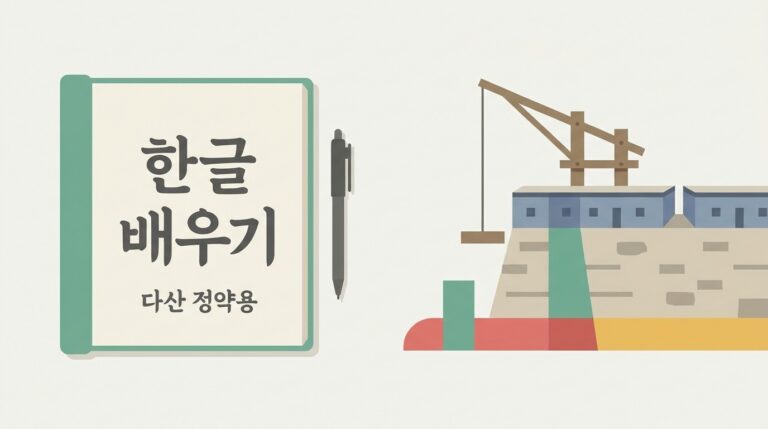
Imagine walking along the majestic brick-and-granite ramparts of Suwon Hwaseong Fortress on a crisp autumn afternoon. You’re accompanied by Korean colleagues or grad school peers who suddenly begin debating the intellectual paradigm of the late Joseon dynasty. Someone gestures toward the defensive battlements and exclaims, “정약용의 실학 사상이야말로 인문학과 공학의 진정한 통섭이지!” (Jeong Yak-yong’s Silhak thought is the ultimate consilience of humanities and engineering!). While you comprehend every individual word, you suddenly feel a linguistic wall: How do native intellectuals articulate nuanced historical synthesis, pragmatic governance, and interdisciplinary mastery without sounding like an antique textbook?
For advanced Korean learners navigating CEFR C2, the biggest hurdle is rarely basic vocabulary—it is mastering high-register intellectual discourse (담화) where philosophical heritage seamlessly informs modern conceptual debates. In Korean boardrooms, academia, and cultural critiques, concepts like 실사구시 (seeking truth from facts) and 이용후생 (benefiting the people through practical technology) are constantly resurrected to analyze everything from AI ethics to urban architecture. Drawing from a decade of field experience mentoring diplomats, researchers, and cultural curators, this guide will empower you to articulate complex intellectual synthesis with effortless eloquence and cultural authority.
Phase 2: 핵심 표현 3선 심층 분석 (Deep Dive: 3 Core Expressions)
1. 실사구시 (實事求是)
- Pronunciation: [Sil-sa-gu-si] (Think of the quick glide “seal-sah-goo-shee” with crisp, even cadence)
- Meaning: Literally “seeking truth from actual facts”; functionally represents an empirical, pragmatic worldview that rejects hollow dogma in favor of verifiable evidence.
- K-Culture Moment: Frequently quoted in political debates, editorial columns, and high-end tech documentaries when contrasting rigid administrative red tape with field-tested solutions.
- Editor’s Insight: This four-character idiom (사자성어) is the intellectual crown jewel of late Joseon Silhak. When you deploy this at the C2 level, it demonstrates that you value pragmatic outcomes over theoretical posturing. It elevates your analytical register instantly.
- Situation Spectrum:
- Casual: ⚠️ (Can sound overly academic among close peers unless used ironically)
- Semi-formal: ✅ (Excellent in project reviews and creative strategy pitch meetings)
- Formal: ✅ (Standard in scholarly critique, keynote addresses, and high-level negotiations)
- 🤔 Think About It: Does your native tongue distinguish between mere “pragmatism” and an ethical devotion to empirical truth as late Joseon Silhak scholars did?
2. 이용후생 (利用厚生)
- Pronunciation: [I-yong-hu-saeng] (Sounds like “ee-yong-hoo-seng” with a soft, elongated ‘oo’)
- Meaning: Literally “making use of abundant resources to enrich people’s daily livelihoods”; denotes people-centric technological innovation.
- K-Culture Moment: Seen in historical television dramas (사극) such as The Red Sleeve or modern infrastructure retrospectives describing King Jeongjo and Dasan Jeong Yak-yong’s social safety nets.
- Editor’s Insight: While contemporary Korean often borrows loanwords like 테크놀로지 (technology), using 이용후생 signals a deep comprehension of public-interest engineering. It highlights technology created to lift societal burdens rather than pursue profit alone.
- Situation Spectrum:
- Casual: 🚫 (Too lofty for a casual cafe chat)
- Semi-formal: ✅ (Brilliant in urban planning debates, ESG reports, or public policy forums)
- Formal: ✅ (Indispensable in humanities lectures, governance essays, and statecraft analysis)
- 🤔 Think About It: How does your cultural background define the primary purpose of technological advancement: commercial efficiency or collective welfare?
3. 문과적 소양과 이공계적 지성의 통섭 (Consilience of Humanistic Literacy and Scientific Intellect)
- Pronunciation: [Mun-gwa-jeok so-yang-gwa i-gong-gye-jeok ji-seong-ui tong-seop] (Flows smoothly: “moon-gwa-jeok so-yang-gwa ee-gong-gye-jeok jee-seong-eui tong-seop”)
- Meaning: Literally “the interweaving of liberal arts cultivation and natural science intelligence”; signifies true Renaissance polymathy.
- K-Culture Moment: Prominently featured in Korean tech launches, cultural seminars, and humanities panel broadcasts exploring Dasan’s invention of the Geojunggi (pulley crane) during the construction of Suwon Hwaseong.
- Editor’s Insight: 통섭 (consilience / interdisciplinary synthesis) is a favorite concept among contemporary Korean intellectuals. Pair it with Dasan’s balance between Confucian statecraft (경세유표/목민심서) and mechanical engineering to sound exceptionally erudite.
- Situation Spectrum:
- Casual: 🚫 (Excessively formal for ordinary social settings)
- Semi-formal: ✅ (Impressive in job interviews, university seminars, or intellectual dinner parties)
- Formal: ✅ (Ideal for academic publications, cultural criticism, and keynote panels)
- 🤔 Think About It: In many Western traditions, arts and sciences were historically separated into rigid faculties. How does the Joseon concept of holistic statecraft reframe this boundary?
Phase 3: 교과서 한국어 vs 진짜 한국어 (Textbook vs. Real Native C2 Korean)
Situation 1: Highlighting an Interdisciplinary Problem Solver
- 📖 교과서 한국어: 정약용 선생은 인문학도 잘하고 과학 기술도 잘 아는 훌륭한 학자였습니다. (Jeong Yak-yong seonsaeng-eun inmunhak-do jalhago gwahak gisul-do jal aneun hullyunghan hakjayeotseumnida.)
- Translation: Master Jeong Yak-yong was an excellent scholar who was good at both humanities and scientific technology.
- 🗣️ 진짜 한국어 (C2 Polymath Register): 다산은 유학적 경학을 뼈대로 삼고 서구 과학기술을 유연하게 접목한 전형적인 통섭형 르네상스 지성이죠. (Dasan-eun yuhak-jeok gyeonghag-eul ppyadae-ro samgo seogu gwahakgisul-eul yuyeonhage jeobmokhan jeonhyeongjeogin tongseophyeong reunesangseu jiseong-ijyo.)
- Translation: Dasan was the archetypal consilient Renaissance mind who used Confucian classical studies as his scaffolding while flexibly incorporating Western science and technology.
- 💡 왜 다를까?: High-register conversational Korean moves beyond elementary qualifiers like “잘하고” (good at) to metaphorical frameworks like “뼈대로 삼다” (use as scaffolding) and descriptive compounds like “통섭형 인재” (interdisciplinary talent).
Situation 2: Urging a Pivot from Empty Theory to Actionable Solutions
- 📖 교과서 한국어: 우리는 이론적인 이야기만 하지 말고 현실적인 방법을 찾아야 합니다. (Urineun ironjeogin iyagiman haji malgo hyeonsiljeogin bangbeob-eul chaj-aya hamnida.)
- Translation: We should not talk only about theoretical stories, but must find realistic methods.
- 🗣️ 진짜 한국어 (C2 Pragmatic Statecraft Register): 이제 공리공론식 탁상공론은 접어두고, 철저히 실사구시적인 관점에서 현장 맞춤형 해법을 도출합시다. (Ije gongnigongnon-sik taksanggongnon-eun jeobeodugo, cheoljeohi silsagusijeogin gwanjeom-eseo hyeonjang matchumhyeong haebeob-eul dochulhabsida.)
- Translation: Let us shelve hollow metaphysical debates and derive field-tailored solutions from a strictly empirical, reality-based perspective.
- 💡 왜 다를까?: Native intellectual rhetoric frequently employs the contrast between 공리공론 / 탁상공론 (armchair empty debate) and 실사구시 (empirical truth-seeking) to forcefully pivot discussions toward practicality.
Phase 4: K-Culture 딥다이브 & 비언어적 매너 (Deep Dive & Non-Verbal Manners)
4-1. Nunchi & Intellectual Demeanor: The Art of Kyomson (겸손)
Engaging in high-level intellectual discussions in Korea requires calibrated body language:
* The Modest Nod (고개 끄덕임): When citing classical concepts like Dasan’s Mokmin Simseo (목민심서), avoid sounding boastful. Slightly lower your chin, keep your posture relaxed yet attentive, and deliver the concept as a shared cultural treasure rather than a personal lecture.
* Open Palm Gesture: Never point fingers when referencing architectural features at historical sites like Suwon Hwaseong. Present your hand flat, palm tilted upward at a 45-degree angle. This reflects reverence toward traditional craftsmanship and public legacy.
* Measured Cadence: Rush-speaking dilutes the weight of Sino-Korean terminology. Speak with measured breath, pausing slightly after idioms like 실사구시 to allow listeners to absorb the philosophical gravity.
4-2. Cultural Code: The Suwon Hwaseong Synthesis
Suwon Hwaseong Fortress is not merely an architectural wonder; it is a physical monument to late Joseon Silhak ideology. Commissioned by King Jeongjo and engineered with Dasan Jeong Yak-yong’s revolutionary Geojunggi (pulley crane), it slashed construction time from ten years to just thirty-four months while ensuring that every stonemason and laborer was formally registered and paid fair wages—a profound realization of 이용후생. When discussing historical K-dramas or traveling along the fortress, linking engineering ingenuity to human rights and statecraft demonstrates the pinnacle of Korean cultural fluency.
Phase 5: 실전 롤플레이 시나리오 (Real-Life Roleplay Scenario)
Setting: The Suwon Hwaseong Museum archives room. You are speaking with Dr. Kang Min-seok (강민석 학예연구관), a senior curator specializing in late Joseon military architecture and Silhak literature.
- Turn 1 (Dr. Kang): 여기 정조 대왕과 다산 선생의 서신을 보시면, 화성 축조 당시 거중기 제작 지침이 아주 상세히 기록되어 있습니다. 놀랍지 않습니까? (Yeogi Jeongjo daewang-gwa Dasan seonsaeng-ui seosin-eul bosimyeon, Hwaseong chukjo dangsi geojunggi jejak jichim-i aju sangsehi girokdoe-eo itseumnida. Nollapji anseumnikka? / 🎭 Dr. Kang spreads open a reproduced copy of the royal construction archives with gentle, gloved hands, eyes sparkling with pride.)
- Turn 2 (You): 네, 정말 감탄스럽습니다. 다산 선생이 경학에만 매몰되지 않고 기중가설(起重架說) 같은 서양 공학 원리를 기탄없이 수용했던 태도가 돋보이네요. (Ne, jeongmal gamtanseoreopseumnida. Dasan seonsaeng-i gyeonghage-man maemoltoeji anko gijung-gaseol gateun seoyang gonghak wonri-reul gitan-eopsi su-yonghaetteon taedo-ga dotbo-ineyo. / 🎭 Nod slowly while leaning in slightly, acknowledging the document with respectful eye contact.)
- Turn 3 (Dr. Kang): 맞습니다. 당시 성리학적 명분론이 지배적이던 조정에서 그런 기술적 접근을 주장하기가 결코 쉽지 않았을 텐데요. (Matseumnida. Dangsi seongnihak-jeok myeongbullon-i jibaejeog-ideon jojeong-eseo geureon gisuljeok jeopgeun-eul jujuanghagiga gyeolko swipji anatseul tendeyo. / 🎭 Furrows brow thoughtfully, reflecting on the historical political resistance.)
- Turn 4 (You): 바로 그 지점에서 다산의 이용후생 정신이 빛을 발하는 것 같습니다. 기술 혁신을 민생 안정의 핵심 도구로 본 혜안이었죠. (Baro geu jijeom-eseo Dasan-ui iyonghusaeng jeongsin-i bicheul balhaneun geot gatseumnida. Gisul hyeoksin-eul minsaeng anjeong-ui haeksim dogu-ro bon hye-an-ieotjyo. / 🎭 Use an open-palm gesture toward the schematic diagrams of the pulley crane.)
- Turn 5 (Dr. Kang): 과연 깊이 있게 통찰하고 계시는군요. 거중기 덕분에 백성들의 노역 부담도 획기적으로 줄지 않았습니까? (Gwayeon gipi itge tongchalhago gyesineungunyo. Geojunggi deokbune baekseongdeul-ui no-yeok budam-do hoekgijeog-euro julji anatseumnikka? / 🎭 Smiles warmly, visibly impressed by your conceptual depth.)
- Turn 6 (You): 그렇습니다. 단순한 축성을 넘어 백성의 삶을 구제하고자 했던 실사구시적 고뇌가 화성 성벽 곳곳에 녹아 있는 셈입니다. (Geureotseumnida. Dansunhan chukseong-eul neomeo baekseong-ui salm-eul gujehagoja haetteon silsagusijeok gonoe-ga Hwaseong seongbyeok gotgos-e noga inneun sem-imnida. / 🎭 Speak in a calm, appreciative tone, keeping your hands clasped lightly in front.)
- Turn 7 (Dr. Kang): 동감입니다. 유학적 인본주의와 자연과학적 합리주의의 만남, 이것이야말로 우리가 본받아야 할 지점이지요. (Donggam-imnida. Yuhak-jeok inbonjuui-wa jayeongwahak-jeok hamnijuui-ui mannam, igeos-iyamallo uriga bonbad-aya hal jijeom-ijiyo. / 🎭 Closes the folio reverently and nods with genuine scholarly kinship.)
- Turn 8 (You): 네, 과거의 유산에 머물지 않고 현대의 융복합 패러다임에도 큰 귀감이 되는 불멸의 성취라고 생각합니다. (Ne, gwageo-ui yusan-e meomulji anko hyeondae-ui yungbokhap paereodaim-edo keun gwigam-i doeneun bulmyeol-ui seongchwirago saenggakhamnida. / 🎭 Offer a soft smile and an appreciative bow of the head.)
🔀 Interactive Choice Point
How do you bridge Dasan’s philosophy to contemporary Korean society?
* Choice A: “결국 다산의 철학은 오늘날 한국의 K-Tech 혁신과 인본주의적 복지 정책의 원류라고 볼 수 있겠네요.” (Dasan’s philosophy can ultimately be seen as the origin of today’s K-tech innovation and humanist welfare policy.)
* Choice B: “그냥 옛날 학자가 돌 드는 기계 하나 잘 만든 거 아닌가요?” (Isn’t it just an old scholar who built a good rock-lifting machine?)
* Choice C: “화성은 멋있지만 조선은 유교 때문에 결국 망했으니 실학도 실패작이죠.” (Hwaseong is cool, but Joseon collapsed because of Confucianism, so Silhak was a failure too.)
Feedback:
* Choice A (Best): 🌟 Perfect! It reflects profound historiographical respect and bridges cultural legacy with modern pride.
* Choice B (Bad): ❌ Reductive and dismissive; minimizes centuries of interdisciplinary statecraft to simple gadgetry.
* Choice C (Risk): ⚠️ Historically inflammatory; overlooks the deep structural reforms achieved and halts intellectual dialogue.
Phase 6: 10초 감정 섀도잉 드릴 (10-Second Emotional Shadowing Drill)
Master rhythmic phrasing with calibrated pauses (/) and emotional cues:
[🧐 학구적이고 진지하게 / Scholarly & Analytical]
다산의 학문은 / 관념적 탁상공론을 탈피하여 / 실사구시를 온전히 구현했습니다.
(Dasan-ui hangmun-eun / gwannyeomjeok taksanggongnon-eul talpihayeo / silsagusi-reul onjeonhi guhyeonhaetseumnida.)
“Dasan’s scholarship / broke free from abstract armchair theories / and fully embodied empirical truth-seeking.”-
[🤩 감탄하며 경의를 담아 / Awestruck & Respectful]
인문학적 통찰과 / 공학적 정밀함이 결합된 화성은 / 이용후생의 살아있는 결정체입니다!
(Inmunhak-jeok tongchal-gwa / gonghak-jeok jeongmilham-i gyeolhapdoen Hwaseong-eun / iyonghusaeng-ui sarainneun gyeoljeongche-imnida!)
“Combining humanistic insight / with engineering precision, / Hwaseong Fortress is the living crystallization of pragmatic welfare!” -
[🤝 정중하고 확신에 차서 / Polite & Confident in Synthesis]
온고지신의 정신으로 / 다산의 통섭적 지혜를 / 현대 기술 윤리에 투영해 보아야 합니다.
(Ongojisin-ui jeongsin-euro / Dasan-ui tongseopjeok jihye-reul / hyeondae gisul yulli-e tuyeonghae bo-aya hamnida.)
“In the spirit of learning from the past to innovate the new, / we must project Dasan’s consilient wisdom / onto contemporary tech ethics.”
Phase 7: K-Culture 미니 사전 (Mini Dictionary: 4 Key Terms)
- 거중기 (Geojunggi – [Geo-jung-gi])
- Translation: Pulley Crane / Compound Pulley Hoist.
- Usage: Dasan’s iconic invention utilizing fixed and movable pulleys to lift massive boulders with a fraction of the workforce during the construction of Suwon Hwaseong. Symbolizes mechanical ingenuity placed at the service of human labor.
- 목민관 (Mongmingwan – [Mok-min-gwan])
- Translation: Shepherd of the People / Mindful Public Administrator.
- Usage: Stemming from Dasan’s Mokmin Simseo (목민심서), this term is widely used today in news media and civil service seminars to describe honest, empathetic, and incorruptible public officials.
- 경세유표 (Gyeongseyupo – [Gyeong-se-yu-pyo])
- Translation: Treatise on Statecraft / Institutional Reform.
- Usage: Dasan’s seminal work detailing holistic state restructuring—ranging from agrarian land reform to taxation and industrial promotion. Frequently cited in economic history and administrative strategy.
- 온고지신 (Ongojisin – [On-go-ji-sin])
- Translation: Reviewing the old to understand the new.
- Usage: A cherished cultural principle invoked when traditional values (Confucian ethics, artisanal heritage) are recontextualized to solve cutting-edge contemporary dilemmas.
Phase 8: 여행자를 위한 생존 키트 (Traveler’s Survival Kit)
Top 3 Survival Expressions at Historical Sites
- 이 건축물에 실학 사상이 어떻게 반영되어 있나요?
- Romanization: I geonchungmul-e silhak sasang-i eotteoke banyeongdoe-eo innayo?
- Pro Tip: Use this at Suwon Hwaseong ticket booths or with docents to prompt detailed, intellectual explanations rather than basic tourist overviews.
- 거중기 모형 작동 시연은 어디서 볼 수 있습니까?
- Romanization: Geojunggi mohyeong jakdong siyeon-eun eodiseo bol su itseumnikka?
- Pro Tip: Perfect for visiting the Suwon Hwaseong Museum or Hwaseong Haenggung to observe functional scaled recreations of Dasan’s mechanical crane.
- 문화해설사 투어를 예약하고 싶은데요.
- Romanization: Munhwahaeseolsa tueo-reul yeyakhago sipeunde-yo.
- Pro Tip: Free or low-cost expert cultural interpreter services are widely available in Korea; asking for one unlocks graduate-level historical commentary.
Editor’s Travel Note
When heading south from Seoul to Suwon, take the Seoul Subway Line 1 or the KTX train to Suwon Station, then hop on a local bus directly to Paldalmun or Janganmun. To navigate real-time historical routes and fortress circuits without getting lost in alleyways, use the 네이버 지도 앱 다운로드 to check accurate walking courses along the defensive walls. Most heritage centers now offer bilingual audio guides via smartphone QR codes, so make sure your T-money card is topped up and your domestic mobile data is ready for interactive exhibits.
Phase 9: “한 발 더 깊이” (Deep Cultural Reflection)
In Western intellectual historiography, the scientific revolution often developed by challenging ecclesiastical and humanistic doctrines. In late Joseon Korea, however, Dasan Jeong Yak-yong did not abandon classical Confucian moral philosophy (경학) to embrace mechanical engineering (기학); rather, he recognized that true human virtue (仁) remained incomplete if ordinary people broke their backs hauling granite. For Dasan, drawing up blueprints for the Geojunggi was not a detached industrial pursuit—it was an ethical imperative to protect human dignity. This harmonized unity of technical mastery and ethical responsibility remains a defining cornerstone of modern Korean institutional conscience.
💬 Your Turn: How does your home culture navigate the tension between rapid technological disruption and humanistic ethics? Share your perspective in the comments below using the idiom 실사구시!
Phase 10: FAQ & 흔한 실수 방지 (FAQ & Pitfalls)
Q: What is the exact distinction between 실학 (Silhak) and traditional 성리학 (Neo-Confucianism)?
A: While Neo-Confucianism focused heavily on metaphysical moral refinement and social order, Silhak (Practical Learning) emerged within Confucianism as a reformist movement emphasizing empirical evidence, socioeconomic welfare, technology, and governance restructuring to solve real-world crises.
Q: Can I use the word “통섭” (Tongseop) in regular everyday workplace conversations?
A: Yes, but keep it in strategic contexts! In software engineering, UX design, or marketing meetings, phrases like “기획과 기술의 통섭” (the consilience of planning and technology) sound very polished and visionary.
Q: Did Dasan Jeong Yak-yong invent the pulley crane all by himself?
A: Dasan synthesized European mechanical principles found in Johann Schreck’s Qiqi Tushuo (기기도설, Diagrams of Extraordinary Machines) with Joseon’s unique logistical and material realities, producing an innovative hybrid crane specifically calibrated for heavy fortress granite.
🚨 흔한 실수 (Common Mistakes) 경고판
- Mistake: Pronouncing 실사구시 as [Sil-sa-gu-si] with a heavy English “R” sound.
- Correction: Keep the ‘ㄹ’ tongue-tap light against the alveolar ridge; say crisp [Sil-sa-gu-si].
- Mistake: Confusing 실사구시 (seeking truth from facts) with 단순한 실용주의 (simple commercial opportunism).
- Correction: Always remember that 실사구시 contains an intellectual search for truth (求是), not just financial utility.
- Mistake: Calling Suwon Hwaseong a mere “castle” (성).
- Correction: Refer to it as a fortified administrative city or fortress (성곽 도시 / 화성 성곽) to reflect its comprehensive municipal and defensive design.
Phase 11: 액션 미션 & 참여 유도 (Action Missions)
- 🥉 Bronze Mission (Solo Shadowing): Read the Phase 6 shadowing drill aloud 3 times, paying close attention to pausing at
/and infusing high-register gravitas into the idioms. - 🥈 Silver Mission (Social Reflection): Write a 2-sentence post on your social media or language journal describing a modern technological gadget that represents 이용후생 (enriching people’s lives).
- 🥇 Gold Mission (Real-World Engagement): Visit a local museum, Korean cultural center, or historical drama discussion board and post an analytical query: “이 유물에는 실사구시와 이용후생의 가치가 어떻게 반영되어 있나요?”
- 🎮 K-Culture Mission: Watch an episode of a Korean historical drama (사극) set in the late Joseon era (such as The Red Sleeve or Yi San) and spot how royal scholars debate statecraft reforms!
Phase 12: 인터랙티브 퀴즈 챌린지 (Interactive Quiz Challenge)
1. Situational Judgment
Your project manager asks how the team should tackle an unexpected software deployment bottleneck caused by conflicting theories among engineers. Which response demonstrates the highest level of C2 statecraft Korean?
* (A) 그냥 대충 쉬운 거 골라서 빨리 끝냅시다.
* (B) 탁상공론은 그만두고, 로그 데이터를 철저히 검증하는 실사구시적 접근이 필요합니다.
* (C) 옛날 정약용 선생처럼 성을 새로 지으면 문제가 해결될 것입니다.
2. Fill-in-the-Blank
다산 정약용은 백성의 고통을 줄이고자 거중기를 설계하여 ( )의 정신을 몸소 실천했습니다.
* Word Bank: [이용후생 / 공리공론 / 탁상공론]
3. True / False Cultural Insight
- Statement: Dasan Jeong Yak-yong rejected all Confucian ethical values when designing the defensive structures and machines for Suwon Hwaseong. (T / F)
정답 및 해설 확인하기 (Click for Answers & Explanations)
- Situational Judgment Answer: (B)
- Explanation: Choice (B) elegantly contrasts 탁상공론 (armchair empty debate) with 실사구시 (empirical truth-seeking), demonstrating master-level executive leadership.
- Fill-in-the-Blank Answer: 이용후생 (Iyonghusaeng)
- Explanation: Dasan designed the crane to ease civilian labor burdens, which exemplifies “benefiting the people and enriching livelihoods through practical technology.”
- True / False Answer: False (F)
- Explanation: Dasan never rejected Confucian humanism. Rather, he united classical moral philosophy (경학) with applied science (공학), grounding engineering achievements in moral compassion for the common people.
- Explanation: Dasan never rejected Confucian humanism. Rather, he united classical moral philosophy (경학) with applied science (공학), grounding engineering achievements in moral compassion for the common people.







