

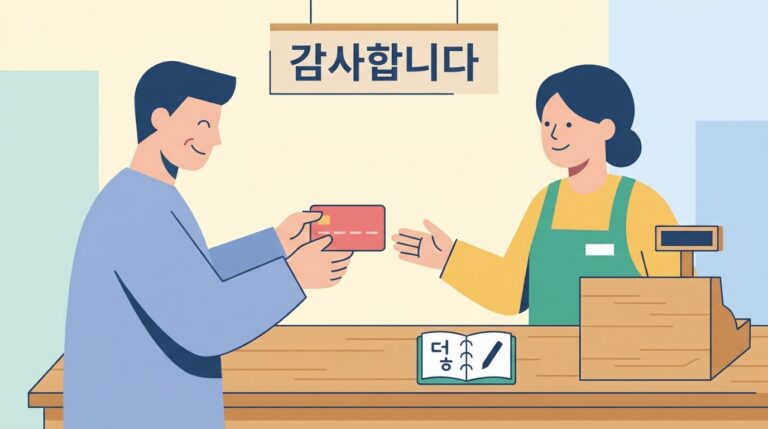
How to Pay by Card in Korea Like a Local: Your Go-To Restaurant Guide
Phase 1: Empathy (Story-Driven Opening)
안녕하세요! 매일한글 에디터입니다. (Hello! I am your Daily Hangul editor.)
Picture this: You just indulged in a sizzling, bubbling bowl of kimchi-jjigae at an authentic, cozy alleyway diner in Hongdae. Your stomach is blissful, the savory aromas linger, and your fingers slide toward your wallet. You pull out your shiny travel credit card and stride to the front counter. The restaurant owner—a smiling Imo-nim (auntie) in a floral apron—looks up, ready to punch in your total. Suddenly, stage fright strikes! Your mind goes completely blank. Do you tap the card? Do you insert the chip? Do you wait for a check at your dining table like back home? Most importantly, how on earth do you say, “I will pay by card” without sounding like a robotic translation tool?
If you have ever felt that tiny spike of panic at a Korean checkout counter, take a deep breath. You are definitely not alone! In fact, over 80% of our beginner learners tell us that paying the bill is their most nerve-wracking daily interaction. But here is the good news: Korea is one of the most cashless, card-friendly societies on the planet. Mastering just one or two crisp phrases will transform you from a confused tourist into a smooth, respectful local who can handle any dining bill in seconds. Let’s make you confident at the register!
Phase 2: 3 Core Expressions
1. 카드로 계산할게요 (Kadeuro gyesanhalgeyo)
- Pronunciation: Kah-deu-ro gyeh-sahn-hahl-geh-yo (Think: “Card” + “row” + “gay-sahn-hal-gay-yo”)
- Meaning: Literally “I will calculate by card.” / Actual Nuance: “I’ll pay by card, please.”
- K-Culture Moment: You will hear this exact line in virtually every contemporary K-drama restaurant scene—like when friends in Business Proposal casually step up to pay after a hearty dinner.
- Editor’s Insight: The word 계산 (gyesan) means calculation or bill, and the particle -로 (-ro) means “by means of.” While it sounds formal in literal translation, it is the gold-standard polite sentence for dining out.
- Situation Spectrum:
- Casual: ⚠️ 카드로 할게 (Kadeuro halge – friends only!)
- Semi-formal: ✅ 카드로 계산할게요 (Kadeuro gyesanhalgeyo – perfect for staff)
- Formal: ✅ 카드로 결제하겠습니다 (Kadeuro gyeoljehagetsseumnida – business formal)
- 🤔 Think About It: In English, we usually say “Just on card, please.” Notice how Korean explicitly states the action of calculating (계산). What does this tell you about clarity in Korean business etiquette?
2. 카드 돼요? (Kadeu dwaeyo?)
- Pronunciation: Kah-deu dway-yo? (Rhymes with “Card” + “day-oh” blended into “dway-yo”)
- Meaning: Literally “Is card acceptable/possible?” / Actual Nuance: “Do you take cards?”
- K-Culture Moment: Classic outdoor street food tent (Pojangmacha) moments where hungry characters check if they can swipe plastic for spicy tteokbokki.
- Editor’s Insight: 돼요 (dwaeyo) comes from 되다 (doeda), meaning “to work” or “to be possible.” It is the Swiss Army knife of spoken Korean when you need to ask permission quickly.
- Situation Spectrum:
- Casual: ⚠️ 카드 돼? (Kadeu dwae?)
- Semi-formal: ✅ 카드 돼요? (Kadeu dwaeyo? – polite and widely accepted)
- Formal: ✅ 카드 결제 가능한가요? (Kadeu gyeolje ganeunghangayo?)
- 🤔 Think About It: Why do you think short expressions like dwaeyo dominate everyday spoken encounters over long grammatical sentences?
3. 영수증은 버려주세요 (Yeongsujeungeun beoryeojuseyo)
- Pronunciation: Young-soo-jeung-eun buh-ryuh-joo-seh-yo
- Meaning: Literally “As for the receipt, please discard it.” / Actual Nuance: “No receipt needed, thank you!”
- K-Culture Moment: Bustling morning coffee shops in Gangnam where busy office workers grab their morning Iced Americano and rush out without touching the receipt paper.
- Editor’s Insight: In Korea, eco-consciousness and digital receipts are everywhere. Cashiers will almost always ask if you need paper. If you don’t, this phrase saves paper and time.
- Situation Spectrum:
- Casual: 🚫 영수증 버려줘 (Yeongsujeung beoryeojwo – impolite to clerks!)
- Semi-formal: ✅ 영수증은 버려주세요 (Yeongsujeungeun beoryeojuseyo)
- Formal: ✅ 영수증은 안 주셔도 됩니다 (Yeongsujeungeun an jusyeodo doemnida)
- 🤔 Think About It: How does your home country handle paper receipts compared to Korea’s quick “toss it” routine?
Phase 3: Textbook Korean vs. Real Korean
Situation 1: Letting the clerk know your payment method
- 📖 교과서 한국어 (Textbook): 신용카드로 결제하겠습니다. (Sin-yong-kadeu-ro gyeol-je-ha-get-seum-ni-da.) — “I shall execute payment via credit card.”
- 🗣️ 진짜 한국어 (Real-life): 카드로 할게요. (Kadeu-ro hal-ge-yo.) — “I’ll do card!”
- 💡 왜 다를까? Textbook phrases are created for official, stiff scenarios. Real locals keep it short and friendly using 할게요 (halgeyo – I will do) instead of heavy corporate jargon.
Situation 2: Politely waving off the printed paper receipt
- 📖 교과서 한국어 (Textbook): 영수증을 발급하지 않아도 무방합니다. (Yeong-su-jeung-eul bal-geup-ha-ji an-a-do mu-bang-ham-ni-da.) — “It is permissible to not issue a receipt voucher.”
- 🗣️ 진짜 한국어 (Real-life): 영수증은 괜찮아요! (Yeong-su-jeung-eun gwaen-chan-a-yo!) — “I’m good without a receipt!”
- 💡 왜 다를까? 괜찮아요 (gwaenchana-yo) is the ultimate polite refusal tool in Korean. It softens the denial without making you sound cold.
Phase 4: K-Culture Deep Dive & Non-verbal Etiquette
4-1. 눈치 (Nunchi) & Gestures: The Two-Handed Hand-Off
In Korea, hands speak louder than words. Handing over your payment card with just one limp hand or flicking it onto the counter is considered rude and dismissive.
* The Golden Pose: Hold the card with both hands as you extend it forward with a subtle nod.
* The Pro Alternative: If one hand is holding your phone or shopping bag, hold the card with your right hand while lightly supporting your right forearm or wrist with your left fingertips. This subtle sign of respect will earn you an immediate warm smile from the shopkeeper!
4-2. Culture Code: Where is the Bill?
In Western dining, you raise a hand and ask, “Check, please!” while staying seated. In Korea, this will leave you waiting forever!
Almost all casual and mid-tier restaurants use a 주문서 (jumunseo – order slip) placed on your table inside a small plastic holder or wooden block. When you finish eating, pick up that paper slip, walk up to the cash register (카운터 – counter) near the restaurant exit, and present it together with your card. Also, tipping is strictly non-existent; don’t leave extra change on the counter, as the owner will chase you down the street thinking you forgot your money!
Phase 5: Real-World Roleplay Scenario
Setting: A warm, wood-paneled bibimbap restaurant in Insadong. Soft traditional instrumental music plays in the background, punctuated by the cheerful clatter of stone bowls.
Character: Imo-nim (The radiant, speedy restaurant owner with a bright apron).
- Turn 1 (You): 잘 먹었습니다! 계산해 주세요. (Jal meogeossseumnida! Gyesanhae juseyo.)
- 🎭 Approaches the counter carrying the table’s order slip with a satisfied smile.
- “Thank you for the delicious meal! Please calculate the bill.”
- Turn 2 (Owner): 네~ 맛있게 드셨어요? 총 구천 원입니다. (Ne~ mas-itge deusyeosseoyo? Chong gu-cheon-won-imnida.)
- 🎭 Taps the screen of the POS register briskly.
- “Yes~ Did you enjoy the food? It is 9,000 won in total.”
- Turn 3 (You): 네, 정말 맛있었어요! 카드로 계산할게요. (Ne, jeongmal mas-isseosseoyo! Kadeuro gyesanhalgeyo.)
- 🎭 Pulls out the card smoothly.
- “Yes, it was delicious! I will pay by card.”
- Turn 4 (Owner): 네, 카드 여기에 꽂아주세요. (Ne, kadeu yeogi-e kkoj-a-juseyo.)
- 🎭 Points with both fingers to the card terminal slot.
- “Sure, please insert the card right here.”
- Turn 5 (You): 네, 여기요. (Ne, yeogiyo.)
- 🎭 Inserts the card chip-first into the terminal slot.
- “Alright, here it is.”
- Turn 6 (Owner): 결제 완료되셨습니다. 영수증 필요하세요? (Gyeolje wanryo-doesyeosseumnida. Yeongsujeung piryohaseyo?)
- 🎭 Tears off the receipt slip and tilts head inquisitively.
- “Payment completed. Do you need a receipt?”
- Turn 7 (You): 아니요, 영수증은 버려주세요! (Aniyo, yeongsujeungeun beoryeojuseyo!)
- 🎭 Shakes head gently with an easygoing hand wave.
- “No, please throw away the receipt!”
- Turn 8 (Owner): 네! 감사합니다, 또 오세요~ (Ne! Gamsahamnida, tto oseyo~)
- 🎭 Bows head lightly with a generous maternal smile.
- “Okay! Thank you, please come again~”
🔀 Interactive Decision Point!
The owner turns to you and asks: “영수증 드릴까요?” (Yeongsujeung deurilkkayo? – Shall I give you the receipt?) What is your best move?
- Option A: “영수증 버려주세요!” (Yeongsujeung beoryeojuseyo!)
- 🏆 Best Choice: Clear, polite, and completely natural. The owner drops the receipt in the recycle bin instantly.
- Option B: “돈 없어요!” (Don eopseoyo!)
- ❌ Bad Choice: This means “I don’t have money!” Saying this right after inserting your card will cause sheer panic and confusion.
- Option C: “네, 영수증 주세요.” (Ne, yeongsujeung juseyo.)
- ⚠️ Neutral / Risk: Perfectly correct if you actually track expenses or need tax receipts! But don’t say this out of habit if you plan to abandon the slip on the floor.
Phase 6: 10-Second Emotion Shadowing Drill
Practice reading these out loud at normal conversational speed! Follow the slash marks (/) for natural rhythm pauses:
[😊 Cheerful & Grateful]
잘 먹었습니다! / 카드로 / 계산할게요!
(Jal meogeossseumnida! / Kadeuro / gyesanhalgeyo!)-
[🙋 Inquiring & Polite]
저기요, / 카드 / 돼요?
(Jeogiyo, / kadeu / dwaeyo?) -
[👋 Breezy & Relaxed]
영수증은 / 괜찮아요!
(Yeongsujeungeun / gwaenchana-yo!)
Phase 7: K-Culture Mini Dictionary
- 계산 (Gyesan) | Calculation / Bill
- The root word for finishing transactions everywhere from luxury boutiques to noodle stalls.
- 영수증 (Yeongsujeung) | Receipt
- The paper proof of payment. Essential to recognize on automated kiosk touchscreens.
- 일시불 (Il-si-bul) | Lump-sum payment (One-time pay)
- When paying higher amounts, the machine or cashier might ask, “일시불이요?” to verify you are not splitting into monthly installments.
- 서명 / 싸인 (Seomyeong / Ssa-in) | Signature
- For purchases over 50,000 KRW, clerks will point to an electronic touchpad and say “싸인해 주세요” (Please sign).
Phase 8: Survival Kit for Travelers
TOP 3 Survival Phrases for Dining Out
- 카드로 할게요 (Kadeuro halgeyo) — “I’ll pay by card.”
- Pro Tip: When your brain feels fried after a long travel day, this 5-syllable lifesaver never fails.
- 따로 계산할게요 (Ttaro gyesanhalgeyo) — “We will pay separately.”
- Pro Tip: Crucial for splitting the bill with travel companions without awkward calculator gesturing.
- 포장해 주세요 (Pojanghae juseyo) — “Please pack this to go.”
- Pro Tip: Portion sizes in Korea can be huge. Use this to take leftovers home safely.
Editor’s Travel Note:
- Bookmark our Naver Map navigation setup guide to discover card-accepting, highly-rated local eateries off the beaten path.
- Cash vs. Card Reality: Credit cards (Visa, Mastercard) are accepted in 99% of brick-and-mortar stores, public transit, and taxis. However, always tuck 20,000 KRW in cash into your pocket for vibrant traditional market snack stalls in places like Gwangjang Market!
Phase 9: A Step Deeper (Reflective Insight)
In modern Korean society, paying the bill is tied intimately to 정 (Jeong – relational warmth and bonding). For decades, fighting vigorously over who covers the bill was the peak demonstration of friendship and hospitality. While younger generations today comfortably split payments (often called Dutch Pay or 더치페이), stepping forward to declare “제가 계산할게요” (I will pay) remains an honored gesture of generosity. When you confidently hand your card over with both hands, you participate in a tradition of mutual honor that goes far beyond a financial transaction.
💬 Your Turn: In your home country, do people fight over who pays the bill, or is splitting strictly down to the cent expected? Tell us your funniest restaurant bill story in the comments below!
Phase 10: FAQ & Avoiding Misunderstandings
Q: Do foreign credit cards work on Korean payment terminals?
A: Yes! Most international chip cards (Visa, Mastercard, Amex) work seamlessly. If prompted for PIN or signature, simply sign your name on the digital touchpad or enter your 4-digit PIN.
Q: Why did the cashier look puzzled when I waited at my table for the check?
A: In Korea, table-side payment is almost exclusively reserved for fine dining hotel restaurants. In normal diners, you take your table slip to the register near the door!
Q: What if a street vendor tells me “현금만 돼요” (Hyeon-geum-man dwaeyo)?
A: That means “Cash only.” While rare in regular buildings, tiny cart stalls (Pojangmacha) often operate strictly on cash or direct Korean bank transfers.
🚨 Common Mistakes (흔한 실수) Warning Board
- Tipping at the counter: Never leave extra tips! It creates paperwork headaches and confuses the staff.
- Correct Action: Just say 감사합니다 (Gamsahamnida – Thank you) with a courteous bow.
- Tossing the card with one hand: Never flick or slide your card across the plastic shield.
- Correct Action: Present it with both hands or support your wrist.
- Looking for a card swipe strip: Korea almost exclusively uses IC chip insertion or contactless taps.
- Correct Action: Face the gold chip forward and insert it straight into the front slot of the terminal.
Phase 11: Action Mission & Engagement
Take action today with our 3-step mastery challenge:
* 🥉 Bronze Level: Stand before a mirror with a credit card. Practice handing it out with both hands while vocalizing: “카드로 계산할게요!” 5 times.
* 🥈 Silver Level: Post an Instagram Story or tweet tagging @DailyHangul using the hashtag #KoreanPaymentHacks with your favorite Korean food.
* 🥇 Gold Level: Step into a Korean grocery, bakery, or cafe in your city, order an item, and complete payment using: “카드로 할게요!”
🎮 K-Culture Mission: Next time you watch an episode of an ongoing K-drama, listen closely during any convenience store or pub scene. Spot the moment someone hands over their card and shout out the phrase you learned today!
Phase 12: Interactive Quiz Challenge
Test your real-world restaurant skills!
1. Situational Judgment
You finished your meal and walked up to the counter. The cashier announces the total. Which response is the most natural, polite way to indicate card payment?
* A) 카드로 해라 (Kadeuro haera)
* B) 카드로 계산할게요 (Kadeuro gyesanhalgeyo)
* C) 돈 던질게요 (Don deonjilgeyo)
👉 Click to reveal the answer and explanation!
Correct Answer: B
Explanation: 카드로 계산할게요 is the exact balance of politeness and natural clarity. Option A is an impolite command used only towards young children, while Option C means “I will throw money at you!”
2. Fill-in-the-Blank
Complete the sentence to politely decline a paper receipt:
“영수증은 _______.” (Hint: It means “It’s okay / No thanks”)
👉 Click to reveal the answer and explanation!
Correct Answer: 괜찮아요 (gwaenchana-yo) or 버려주세요 (beoryeojuseyo)
Explanation: Both 영수증은 괜찮아요 (“Receipt is okay without”) and 영수증은 버려주세요 (“Please toss the receipt”) are native-grade responses!
3. Cultural True or False
True or False: When dining in standard Korean restaurants, you should stay in your chair and wave your hand to request the credit card payment machine at your table.
👉 Click to reveal the answer and explanation!
Correct Answer: False!
Explanation: Grab your bill slip from your table and bring it over to the front register (카운터) by the exit to pay like a seasoned native traveler.






