

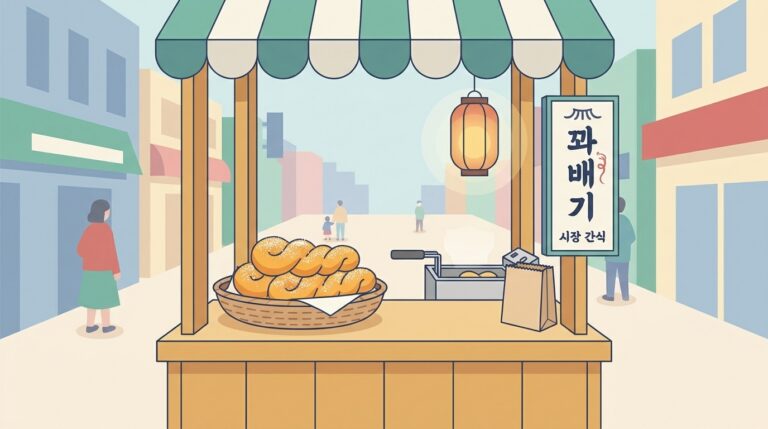
Phase 1: Empathy (Story-Driven Opening)
안녕하세요! (Annyeonghaseyo!) It’s your Daily Hangul editor here, your 10-year local culture navigator. Picture this: you are walking through the buzzing alleys of Mangwon Market on a crisp Seoul afternoon. The air is thick with the mouthwatering aromas of sizzling savory pancakes, spicy rice cakes, and hot oil. Suddenly, you hit a massive roadblock—a winding queue stretching down the narrow pedestrian lane.
At the front of the line, a giant sign reads Chapsal Kkwabaegi (찹쌀 꽈배기 – Glutinous Rice Twisted Donuts). The vendor lifts a golden, twisted braid straight from the bubbling fryer, rolls it generously in fine white sugar, and places it steaming hot into a paper cup. Your stomach rumbles, but your brain hesitates: Is it really worth standing in line for 20 minutes? How do I even order? What do I say when I take that first heavenly bite?
Many of our beginner learners tell us: “I wanted to join the queue, but I felt intimidated by the fast-moving crowd and didn’t know how to praise the food properly!” Don’t worry. Today, you will master the ultimate foodie phrasebook for Korean traditional markets so you can navigate the lines like a seasoned local, order with flair, and express authentic satisfaction.
Phase 2: Core Expressions Deep Dive
1. 줄 서서 기다린 보람이 있어요 (Jul seoseo gidarin borami isseoyo)
- Pronunciation: [Jul seo-seo gi-da-rin bo-ra-mi i-sseo-yo] (Sounds like: Jool suh-suh kee-dah-reen boh-rah-mee ee-ssuh-yoh)
- Meaning: Literally “There is a fruit/reward for lining up and waiting” → “It was totally worth waiting in line!”
- K-Culture Moment: You’ll hear food vloggers and celebrities on shows like Amazing Saturday or Street Food Fighter take a bite of food from a famous eatery and exclaim this with starry eyes.
- Editor’s Insight: The word 보람 (boram) means a sense of worthwhile accomplishment or reward after hard work. When you use this with a stall owner, their face will instantly beam with pride.
- Situation Spectrum:
- Casual (Friends): 줄 서서 기다린 보람이 있어! (Jul seoseo gidarin borami isseo!) ✅
- Semi-formal (Polite standard): 줄 서서 기다린 보람이 있어요. (Jul seoseo gidarin borami isseoyo.) ✅
- Formal (Official): 줄 서서 기다린 보람이 있습니다. (Jul seoseo gidarin borami itseumnida.) ⚠️ (A bit too stiff for a snack stand)
- 🤔 Think About It: In English, we simply say “It was worth the wait.” Why do you think Korean uses the word 보람 (fruitful reward)? How does that reflect the value placed on shared patience in Korean culture?
2. 쫄깃쫄깃해요 (Jjolgit-jjolgithaeyo)
- Pronunciation: [Jjol-git-jjol-gi-thae-yo] (Think of a double ‘jj’ like the sharp click in ‘pizza’, followed by a punchy ‘git’)
- Meaning: “It’s chewy / bouncy / springy!”
- K-Culture Moment: In Korea, “chewy” isn’t tough or rubbery; it is the holy grail of food textures. From tteokbokki to kkwabaegi, every top snack must have this bounce.
- Editor’s Insight: Doubling the word to 쫄깃쫄깃 (jjolgit-jjolgit) emphasizes the playful, bouncy mouthfeel of glutinous rice (chapsal). Saying this proves you understand true K-Food texture appreciation.
- Situation Spectrum:
- Casual: 완전 쫄깃쫄깃해! (Wanjeon jjolgit-jjolgithae!) ✅
- Semi-formal: 정말 쫄깃쫄깃해요. (Jeongmal jjolgit-jjolgithaeyo.) ✅
- Formal: 매우 쫄깃합니다. (Mae-u jwalgitamnida.) ⚠️ (Too clinical)
- 🤔 Think About It: Western culinary culture often celebrates “crispy” or “tender.” Why is a stretchy, bouncy texture so beloved in Korean comfort food?
3. 설탕 많이 묻혀주세요 (Seoltang mani muchyeojuseyo)
- Pronunciation: [Seol-tang ma-ni mu-chyeo-ju-se-yo] (Sounds like: Sull-tahng mah-nee moo-chyuh-joo-seh-yoh)
- Meaning: “Please coat it with plenty of sugar!”
- K-Culture Moment: Watch any market scene in a K-drama: the vendor asks, “설탕 묻혀요? (Sugar coated?)” and the true sweet tooth always requests a double-roll!
- Editor’s Insight: The verb 묻히다 (muchida) means to coat, smudge, or dust something onto a surface. You can also specify 설탕 조금만 묻혀주세요 (Seoltang jogeumman muchyeojuseyo – Just a little sugar, please) if you prefer subtle sweetness.
- Situation Spectrum:
- Casual: 설탕 많이 묻혀줘! (Seoltang mani muchyeojwo!) 🚫 (Do not use with market elders!)
- Semi-formal: 설탕 많이 묻혀주세요. (Seoltang mani muchyeojuseyo.) ✅ (Perfect and respectful)
- Formal: 설탕을 많이 묻혀 주십시오. (Seoltangeul mani muchyeo jusipsio.) ⚠️ (Sounds like a military request)
- 🤔 Think About It: Notice how Korean uses ~해 주세요 (~hae juseyo – please do for me) instead of just demanding an item. How does this soften your request?
Phase 3: Textbook Korean vs. Real-World Korean
Situation 1: Praising the Chewy Texture
- 📖 Textbook Korean: 이 도넛은 탄력이 아주 좋습니다. (I doneoseun tanryeogi aju joseumnida. – This doughnut has very good elasticity.)
- 🗣️ 진짜 한국어 (Real-World): 와, 진짜 쫄깃쫄깃해요! (Wa, jinjja jjolgit-jjolgithaeyo! – Wow, it’s seriously so chewy and bouncy!)
- 💡 Why the Difference? Koreans rarely use formal physics terms like “탄력 (elasticity)” for food in casual speech. Onomatopoeic and mimetic words like 쫄깃쫄깃 convey immediate sensory pleasure.
Situation 2: Expressing That the Queue Was Worth It
- 📖 Textbook Korean: 대기한 시간이 아깝지 않습니다. (Daegihan sigani akkapji anseumnida. – The waiting time was not wasted.)
- 🗣️ 진짜 한국어 (Real-World): 기다린 보람이 있네요! (Gidarin borami inneeyo! – It was totally worth waiting for!)
- 💡 Why the Difference? Native speakers focus on the positive emotional reward (보람) rather than calculating lost time.
Phase 4: K-Culture Deep Dive & Non-Verbal Manners
4-1. Nunchi (눈치) & Stallside Manners
Traditional markets like Gwangjang and Mangwon are fast-paced environments. Space is tight, and vendors are juggling boiling oil and dozens of hungry patrons.
* Keep the Flow: When queuing, stay aligned with the yellow floor line or follow the vendor’s pointing finger. Don’t block adjacent fruit or vegetable stalls.
* The Two-Handed Handover: Always receive your piping-hot donut and pass your card or cash using both hands (or one hand supporting your forearm). A slight 15-degree nod shows immense respect to older stall owners (sajangnim or imonim).
* Eating While Walking? While finger foods are common, standing right in front of the stall doorway to eat causes congestion. Step slightly to the designated side counter or a quiet market corner before devouring your treat.
4-2. The Soul of Matjip (맛집) Culture
Why do Koreans willingly wait 40 minutes for a $1 snack? In Korean modern culture, queueing at a renowned 맛집 (matjip – legendary eatery) is a communal bonding ritual. Standing in line heightens anticipation. Sharing that first hot bite of 겉바속촉 (geot-ba-sok-chok – crispy outside, soft inside) kkwabaegi turns simple nourishment into a shared victory celebration.
Phase 5: Real-World Roleplay Scenario
Setting: A vibrant, fragrant stall inside Mangwon Market. The steam is rising from the frying pan. The friendly vendor (이모님 – Imonim) is deftly twisting freshly rolled dough with lightning speed.
- Character: Auntie Vendor (이모님), You (학습자)
- 이모님: 다음 분! 몇 개 드릴까요? (Daeum bun! Myeot gae deurilkkayo?)
- 🎭 Action: Wipes brow with apron and smiles briskly at you.
- “Next person! How many can I get for you?”
- You: 찹쌀 꽈배기 세 개 주세요! (Chapsal kkwabaegi se gae juseyo!)
- 🎭 Action: Holds up three fingers with a friendly smile.
- “Three glutinous rice twisted donuts, please!”
- 이모님: 설탕 묻혀 드려요? (Seoltang muchyeo deuryeoyo?)
- 🎭 Action: Tongs hovering over a large tray of sparkling sugar.
- “Shall I coat them in sugar?”
- You: 네! 설탕 많이 묻혀주세요. (Ne! Seoltang mani muchyeojuseyo.)
- 🎭 Action: Nods enthusiastically with sparkling eyes.
- “Yes! Please coat them with lots of sugar.”
- 이모님: 여기요, 갓 튀겨서 뜨거우니까 조심해요! (Yeogiyo, gat twigyeoseo tteugeounikka josimhaeyo!)
- 🎭 Action: Places three golden donuts into small paper cups and hands them over.
- “Here you go! They are freshly fried and very hot, so be careful!”
- You: 감사합니다! (Gamsahamnida!)
- 🎭 Action: Takes the cup using both hands with a respectful nod.
- “Thank you!”
- You: (한 입 먹고) 와, 줄 서서 기다린 보람이 있게 쫄깃해요! (Wa, jul seoseo gidarin borami itge jjolgit-haeyo!)
- 🎭 Action: Takes a bite, looks pleasantly surprised, and gives a thumb up.
- “(After one bite) Wow, it’s so chewy it was totally worth waiting in line!”
- 이모님: 아이고, 맛있게 먹어줘서 고마워요! 또 와요! (Aigo, masitge meogeojwoseo gomawoyo! Tto wayo!)
- 🎭 Action: Chuckles warmly, visibly touched by your compliment.
- “Oh my, thank you for enjoying it so much! Come again!”
🔀 Interactive Choice Point
The vendor asks: “설탕 묻혀 드려요? (Shall I coat them in sugar?)” How do you respond?
- Option A: “설탕 많이 묻혀주세요!” (Seoltang mani muchyeojuseyo!)
- Feedback (Best Choice): 🌟 Natural, polite, and guarantees the ultimate authentic sweet taste!
- Option B: “설탕 줘.” (Seoltang jwo.)
- Feedback (Bad Choice): ❌ This is impolite half-talk (banmal). Market owners are elders; never drop the polite ~요.
- Option C: “안 먹어요.” (An meogeoyo.)
- Feedback (Risk Choice): ⚠️ Grammatically means “I don’t eat it” rather than “No sugar, please.” The vendor might think you are canceling your order! Instead, say: “설탕은 빼주세요 (Seoltangeun bpaejuseyo – Please leave out the sugar)”.
Phase 6: 10-Second Emotional Shadowing Drill
Practice these lines out loud! Follow the pause markers (/) and embody the emotion tag:
[😊 Starving & Excited]- 찹쌀 꽈배기 / 세 개 주세요! (Chapsal kkwabaegi / se gae juseyo!)
- Pause slightly after the item name to let the vendor register your order quantity.
[😋 Pure Culinary Bliss]- 와! / 진짜 / 쫄깃쫄깃해요! (Wa! / Jinjja / jjolgit-jjolgithaeyo!)
- Stress the “쫄 (jjol)” with a punchy, bouncy tone to mimic the food texture!
[💖 Deep Heartfelt Appreciation]- 줄 서서 기다린 / 보람이 있어요! (Jul seoseo gidarin / borami isseoyo!)
- Slow down on “보람이 (borami)” with a warm, genuine pitch rise.
Phase 7: K-Culture Mini Dictionary
- 꽈배기 (Kkwabaegi)
- Literal / Everyday Meaning: Twisted bread/donut. In slang, it can also playfully describe someone with a twisted, sarcastic attitude (“왜 말을 꽈배기처럼 꼬아서 해? – Why are you twisting your words?”).
- 보람 (Boram)
- Literal / Everyday Meaning: The rewarding sense of purpose or satisfaction after investing effort, time, or emotion. Essential in workplace reviews and hobby discussions.
- 겉바속촉 (Geot-ba-sok-chok)
- Literal / Everyday Meaning: Short for 겉은 바삭하고 속은 촉촉하다 (Crispy on the outside, moist on the inside). The universal standard of excellence for fried food in Korean gastronomy.
- 덤 (Deom)
- Literal / Everyday Meaning: An extra freebie or bonus item thrown in by a generous market vendor. E.g., ordering 5 donuts and receiving 1 extra for free is the magic of deom.
Phase 8: Traveler’s Survival Kit
Top 3 Market Survival Phrases
- 1. 카드 돼요? (Kadeu dwaeyo?)
- Meaning: “Do you take credit cards?”
- Pro Tip: While most market vendors take cards today, having crisp 1,000 KRW and 5,000 KRW bills ready speeds up service exponentially during peak rush hours.
- 2. 갓 나온 걸로 주세요. (Gat naon geollo juseyo.)
- Meaning: “Please give me the ones that just came out of the fryer.”
- Pro Tip: Use this politely if you notice a fresh batch being pulled out!
- 3. 종이컵 하나 더 주실 수 있나요? (Jong-ikeop hana deo jusil su innayo?)
- Meaning: “Could I get one more paper cup, please?”
- Pro Tip: Kkwabaegi are served piping hot in small paper cups. Ask for an extra cup to share with your travel buddy!
Editor’s Travel Note
Before heading to Mangwon or Gwangjang Market, make sure you complete your Naver Map App Download and Setup. Google Maps often fails to show real-time opening hours and alleyway market stalls in South Korea. Look out for stalls labeled 수제 찹쌀 꽈배기 (Handmade Glutinous Rice Donuts) for the freshest, artisanal experience.
Phase 9: A Step Deeper (Reflective Essay)
In Western dining, waiting in line for fast food is often viewed as an inefficiency or an inconvenience. But in Korean food alleys, queueing is an integral part of the communal culinary experience. The shared ritual of waiting in cold weather builds a collective bond among strangers, culminating in the sweet reward of hot dough.
When you tell a market stall vendor that “줄 서서 기다린 보람이 있어요 (It was worth waiting in line),” you are not merely evaluating food quality; you are validating their tireless, manual labor at the boiling fryer. You are completing the circle of traditional Korean jeong (affectionate community connection).
💬 Your Turn: What is one street food in your own country that people are willing to queue up for 30 minutes or more? How would you describe its texture in Korean? Share your thoughts in the comments below!
Phase 10: FAQ & Common Pitfalls
Q: Can I ask the vendor not to put sugar on my kkwabaegi?
A: Absolutely! Just say “설탕 묻히지 말아주세요 (Seoltang muchiji marajuseyo – Please don’t coat it in sugar)” or simply “설탕 빼주세요 (Seoltang bpaejuseyo – Please leave out the sugar).” Traditional kkwabaegi dough has a subtle natural sweetness, so eating it plain is also delicious.
Q: What is the polite way to get the vendor’s attention at a loud market?
A: Never shout “Hey!” or “Look here!” Instead, make gentle eye contact and call out “사장님! (Sajangnim – Boss/Proprietor!)” or, if the vendor is a middle-aged woman, you can affectionately say “이모님! (Imonim – Auntie!).”
Q: Is kkwabaegi the same as a Western glazed donut?
A: Not at all! While Western donuts usually use standard yeast wheat flour, Korean traditional market kkwabaegi incorporate a significant ratio of 찹쌀 (chapsal – sweet glutinous rice flour), giving them an unmistakable mochi-like, stretchy chew (jjolgit-ham).
🚨 Common Mistakes Alert
- Mistake: Calling an older stall owner “아줌마 (Ajumma)”.
- Correct Action: While not grammatically incorrect, “Ajumma” can sound blunt or dismissive today. Always upgrade to 사장님 (Sajangnim) or 이모님 (Imonim).
- Mistake: Handing over a 50,000 KRW bill for a 1,000 KRW donut during rush hour.
- Correct Action: Keep 1,000 KRW bills handy or ask “계좌이체 돼요? (Gyejw-a-iche dwaeyo? – Can I do a bank transfer?)” or “카드 돼요? (Kadeu dwaeyo? – Do you take card?)”.
- Mistake: Confusing 바삭해요 (Basakhaeyo – It’s crispy) with 쫄깃해요 (Jjolgithaeyo – It’s chewy).
- Correct Action: Fresh kkwabaegi is both! Use the compound expression 겉은 바삭하고 속은 쫄깃해요 (Geoteun basakhago sogeun jjolgithaeyo – Crispy outside, chewy inside) to impress everyone.
Phase 11: Action Missions
- 🥉 Bronze Mission (Solo Practice): Stand in front of your mirror with a pastry or snack. Say aloud three times: “진짜 쫄깃쫄깃해요! (Jinjja jjolgit-jjolgithaeyo!)” with genuine enthusiasm.
- 🥈 Silver Mission (Social Share): Snap a photo of your favorite chewy snack, post it on your Instagram Story or Threads, and tag it with
#DailyHanguland the caption: “줄 서서 기다린 보람이 있어요!” - 🥇 Gold Mission (Real-World Execution): Visit a local Korean bakery (like Paris Baguette or Tous Les Jours) or a Korean market in your city. Order using “~ 세 개 주세요” and thank the cashier with a respectful two-handed receipt.
🎮 K-Culture Media Mission: Watch an episode of tvN’s Amazing Saturday (놀라운 토요일). Listen closely during the snack rounds (간식 타임) to see if you can spot the cast yelling “쫄깃해!” or “겉바속촉!”.
Phase 12: Interactive Quiz Challenge
1. Situational Judgment:
You waited 15 minutes at Gwangjang Market, took a piping hot bite of a twisted donut, and want to compliment the vendor. Which phrase is the most natural and appreciative?
* A) 시간이 너무 많이 걸렸어요. (Sigani neomu mani geollyeosseoyo.)
* B) 줄 서서 기다린 보람이 있게 쫄깃해요! (Jul seoseo gidarin borami itge jjolgit-haeyo!)
* C) 이 빵은 탄력이 아주 뛰어납니다. (I ppangeun tanryeogi aju ttwieonamnida.)
2. Fill-in-the-Blank:
Complete the sentence to ask for plenty of sugar coating:
* “설탕 많이 ________ 주세요!”
* (1) 빼 (bpae)
* (2) 묻혀 (muchyeo)
* (3) 던져 (deonjyeo)
3. True or False:
* True or False: In Korean traditional food culture, the word “쫄깃쫄깃” describes an unpleasant, overcooked, rubbery texture.
🔍 Tap here to reveal the answers and explanations!
- Answer: B
- Explanation: Option B directly compliments both the texture and the rewarding experience of queueing. Option A complains about the wait time, and Option C sounds like an academic food laboratory report!
- Answer: (2) 묻혀 (muchyeo)
- Explanation: 묻히다 is the correct verb for coating or dusting sugar onto food. (1) means to leave out, and (3) means to throw!
- Answer: False
- Explanation: “쫄깃쫄깃” represents one of the most celebrated and desirable mouthfeels in Korean food culture!
- Explanation: “쫄깃쫄깃” represents one of the most celebrated and desirable mouthfeels in Korean food culture!






