

We Audited Hiring and Credit Algorithms to Eliminate Demographic Biases: Master C1 Corporate AI Governance in Korean
Phase 1: 공감 (Story-Driven Opening)
안녕하세요! 매일한글 에디터입니다. (Hello! This is your Daily Hangul editor.)
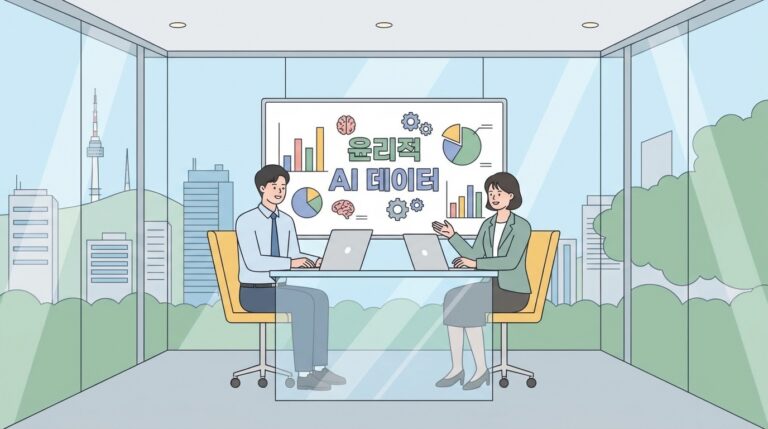
Picture this: You are sitting in an ultra-modern glass conference room in Pangyo Techno Valley—Korea’s buzzing Silicon Valley. Outside, sleek tech shuttles glide past headquarters of Kakao, Naver, and cutting-edge fintech unicorns. Inside, the atmosphere is freezing cold, and it’s not just the central air conditioning.
Your AI Ethics Task Force just audited the preliminary test runs of your enterprise’s newly deployed recruitment screener and credit scoring models. The shocking discovery? The automated pipeline disproportionately penalized female applicants for senior engineering tracks and rejected credit evaluations for applicants over fifty-five due to skewed historical datasets. The Managing Director looks right at you and asks: “알고리즘 편향성 검증 리포트 어떻게 됐습니까?” (What happened to the algorithmic bias audit report?)
At a C1 professional level, replying with textbook phrases like “컴퓨터가 이상해서 고쳤어요” (The computer was weird so we fixed it) will instantly erase your executive credibility. In the Korean tech ecosystem, conversations around AI 거버넌스 (AI Governance) and 책임 있는 인공지능 (Responsible AI) require nuanced, sophisticated terminology. This lesson is built directly from debriefings with foreign tech leads in Seoul who needed to command respect during board-level compliance reviews. Let’s bridge that gap together!
Phase 2: 핵심 표현 3선 심층 분석 (Top 3 Core Expressions)
1. 편향성을 배제하다 (Pyeonhyangseong-eul baejehada)
- Pronunciation: [Pyeon-hyang-seong-eul bae-je-ha-da] (Sounds like: “Pyeon” as in Pyeon-ui-jeom [convenience store] + “Hyang” like an incense aroma + “Bae-je” similar to “Beijing” without the ‘ing’)
- Meaning: Literal: To rule out partiality / Real Nuance: Systematically auditing and filtering demographic or cognitive bias from algorithms.
- K-Culture Moment: Reminiscent of the corporate battlegrounds in tech dramas like Search: WWW (검색어를 입력하세요 WWW), where directors defend algorithm integrity against boardroom interference.
- Editor’s Insight: Casual speakers might use “편견을 없애다” (to remove prejudice), but in technical governance, 배제하다 (to rule out/eliminate) paired with 편향성 (bias/skewness) signals legal and statistical rigor.
- Situation Spectrum: Casual 🚫 | Semi-formal ⚠️ | Formal ✅
- 🤔 Think About It: English often uses “mitigate bias,” but Korean corporate governance frequently prefers the resolute verb 배제하다 (complete elimination). Why do Korean compliance declarations lean toward absolute commitments?
2. 공정성을 입증하다 (Gongjeongseong-eul ipjeunghada)
- Pronunciation: [Gong-jeong-seong-eul ip-jeung-ha-da] (Sounds like: “Gong” as in a brass gong + “Jeong” like the quintessential Korean virtue of warm affection + “Ip-jeung” like ‘leap-jung’)
- Meaning: Literal: To substantiate fairness / Real Nuance: Providing transparent, empirical proof and algorithmic audit trails that stand up to regulatory scrutiny.
- K-Culture Moment: Seen during tense regulatory audit sequences in dramas like Agency (대행사), where executives present hard statistical metrics to survive parliamentary audits.
- Editor’s Insight: Don’t confuse 입증하다 (substantiate/prove via evidence) with simple 증명하다 (prove/demonstrate). In legal compliance and XAI (Explainable AI), “입증” carries the legal burden of proof.
- Situation Spectrum: Casual 🚫 | Semi-formal ⚠️ | Formal ✅
- 🤔 Think About It: How does the fierce national discourse on “공정” (fairness/meritocracy) among Korea’s youth shape corporate responsibility in automated hiring?
3. 사회적 신뢰를 확보하다 (Sahoejeok sinroe-reul hwakbohada)
- Pronunciation: [Sa-hoe-jeok sil-loe-reul hwak-bo-ha-da] (Crucial assimilation rule: 신뢰 sounds like [실뢰 – sil-loe] due to liquid consonant assimilation!)
- Meaning: Literal: To secure societal trust / Real Nuance: Building sustainable public acceptance and ESG credibility for an AI product.
- K-Culture Moment: The iconic press conference apology or turnaround speech in Chaebol dramas like Queen of Tears (눈물의 여왕), re-anchoring public faith after a tech crisis.
- Editor’s Insight: 확보하다 (to secure/retain) is an indispensable C-suite verb. You don’t just “get” trust; you strategically secure it against potential regulatory fines.
- Situation Spectrum: Casual 🚫 | Semi-formal ✅ | Formal ✅
- 🤔 Think About It: Why does Korean corporate philosophy emphasize “사회적” (societal) trust over mere “고객” (customer) trust in high-stakes algorithms?
Phase 3: 교과서 한국어 vs 진짜 한국어 (Textbook vs. Real Korean)
Situation 1: Reporting audit results on hiring models
- 📖 교과서 한국어: 우리는 알고리즘에 문제가 없도록 확인했습니다. (Urineun algo-rijeume munjega eopdorok hwaginhaesseumnida. – We checked so that the algorithm has no problems.)
- 🗣️ 진짜 한국어: 채용 모델 전반의 인구통계학적 편향성을 전수 감사하여 공정성 지표를 확보했습니다. (Chaeyong model jeonban-ui ingutong-gyehakjeok pyeonhyangseong-eul jeonsu gamsahayeo gongjeongseong jipyoreul hwakbohaesseumnida. – We conducted an exhaustive audit of demographic bias across all hiring models to secure fairness metrics.)
- 💡 왜 다를까? Textbook Korean sounds like an intern reporting a task. C1 professionals use terms like 전수 감사 (complete census audit) and 공정성 지표 (fairness metrics) to convey thoroughness.
Situation 2: Proposing a safeguard against age/credit bias
- 📖 교과서 한국어: 나이나 성별 때문에 차별하면 안 됩니다. (Naina seongbyeol ttaemune chabyeolhamyeon an doemnida. – You should not discriminate because of age or gender.)
- 🗣️ 진짜 한국어: 특정 집단에 대한 구조적 왜곡이 발생하지 않도록 상시 모니터링 체계를 고도화해야 합니다. (Teukjeong jipdane daehan gujojeok waegogi balsaenghaji antorok sangsi moniteoring chegyereul godohwahae-ya hamnida. – We must advance our continuous monitoring architecture to prevent structural distortion against specific demographic groups.)
- 💡 왜 다를까? In executive meetings, avoid moralizing sentences with “차별하면 안 됩니다”. Instead, frame the argument around risk governance: 구조적 왜곡 (structural distortion) and 체계 고도화 (system advancement/optimization).
Phase 4: K-Culture 딥다이브 & 비언어적 매너 (Deep Dive & Non-Verbal Manners)
4-1. 눈치 (Nunchi) & Boardroom Manners
When auditing AI systems for Korean firms, pointing out bias can unintentionally make the model development team lose face (체면 손상).
* The Cushion Opener: Before presenting critical audit discrepancies, preface with deferential phrasing: “다각도의 검토 결과, 선제적 리스크 관리를 위해 공유해 드릴 부분이 있습니다.” (Based on multi-faceted reviews, there are elements we would like to share for preemptive risk management.)
* Two-Handed Device Presentation: When handing over an iPad or audit printout to executive directors, support your right forearm with your left hand. Maintain soft eye contact rather than an aggressive, unwavering stare.
4-2. The Cultural Code: “공정” (Fairness) in Digital Korea
In contemporary South Korea, fairness in employment examinations (공채) and credit evaluation is a paramount social sensitivity. An algorithm caught discriminating against demographic segments can trigger virality on tech forums like Blind (블라인드) and lead to direct parliamentary scrutiny. Your mastery of Responsible AI phrasing is not just tech jargon—it is an indispensable crisis management shield.
Phase 5: 실전 롤플레이 시나리오 (Real-World Roleplay Scenario)
Setting: A high-level AI Ethics Committee meeting at NeoFin Korea in Pangyo.
Character: Team Lead Park (박 팀장) – A sharp, detail-oriented Head of Compliance with zero tolerance for vague answers.
- [Turn 1] 박 팀장: 이번에 배포 예정인 신용 평가 및 채용 스크리닝 알고리즘의 편향성 검토는 마무리되었습니까? (Ibeone baepo yejeong-in sin-yong pyeongga mit chaeyong seukeurining algo-rijeum-ui pyeonhyangseong geomtoneun mamurideueotseumnikka? / 🎭 Checking spreadsheet with a stern frown / Has the bias review for our upcoming credit evaluation and hiring algorithms been finalized?)
- [Turn 2] You: 네, 성별과 연령 등 인구통계학적 변수가 결과에 미치는 영향을 전수 조사했습니다. (Ne, seongbyeol-gwa yeonryeong deung ingutong-gyehakjeok byeonsuga gyeolgwawa-e michineun yeonghyang-eul jeonsu josahaesseumnida. / 🎭 Confidently leaning forward with posture upright / Yes, we performed an exhaustive audit on how demographic variables such as gender and age impact outcomes.)
- [Turn 3] 박 팀장: 구체적으로 어떤 편향이 감지되었고, 어떻게 대응하셨나요? (Guchejeog-euro eotteon pyeonhyang-i gamjideueotgo, eotteoke daeeunghasyeonnayo? / 🎭 Adjusting glasses and looking directly at you / Specifically, what biases were detected, and how did you counter them?)
- [Turn 4] You: 특정 연령대에서 대출 한도 산정이 보수적으로 편향되는 패턴을 발견하여 가중치를 재조정했습니다. (Teukjeong yeonryeongdae-eseo daechul hando sanjeong-i bosujeog-euro pyeonhyangdoe-neun paeteon-eul balgyeonhayeo gajungchireul jaejojoenghaesseumnida. / 🎭 Pointing to the trend line on the slide / We identified a pattern where credit limit calculation skewed overly conservative for specific age cohorts, and recalibrated the weighting parameters.)
- [Turn 5] 박 팀장: 채용 알고리즘에서도 유사한 왜곡이 있었습니까? (Chaeyong algo-rijeum-eseodo yusahan waegog-i isseotseumnikka? / 🎭 Crossing arms, deeply intrigued / Were there similar distortions in the recruitment algorithm?)
- [Turn 6] You: 과거 합격 데이터의 성별 쏠림 현상을 학습한 것을 확인하고, 합성 데이터를 활용해 균형을 맞췄습니다. (Gwageo hapgyeok de-iteo-ui seongbyeol ssolrim hyeonsang-eul hakseuphan geos-eul hwaginhago, hapseong de-iteoreul hwalyonghae gyunhyeong-eul matchwotseumnida. / 🎭 Nodding smoothly to acknowledge the finding / We verified that it learned historical gender imbalances from legacy hire records, and balanced it utilizing synthetic data.)
- [Turn 7] 박 팀장: 좋습니다. 그렇다면 외부 감사나 감독 당국의 검증에도 문제없겠군요? (Jotseumnida. Geureotdamyeon oebu gamsana gamdok dangguk-ui geomjeung-edo munjeeopgetgunyo? / 🎭 Expression softening into approval / Excellent. Then there will be no issues during external regulatory audits?)
- [Turn 8] You: 네, 알고리즘의 설명 가능성을 입증할 수 있도록 전 과정의 감사 로그를 체계화했습니다. (Ne, algo-rijeum-ui seolmyeong ganeungseong-eul ipjeunghal su itdorok jeon gwajeong-ui gamsa rogeureul chegye-hwahaesseumnida. / 🎭 Handing over the bound governance portfolio with both hands / Yes, we have systematized audit logs across all processes to substantiate algorithmic explainability.)
🔀 인터랙티브 분기점 (Choose Your Response)
If Director Park suddenly asks: “What if civic tech watchdogs question our model’s fairness metrics tomorrow?”
- Option A: “검증 프레임워크와 감사 보고서를 투명하게 공개하여 모델의 공정성을 객관적으로 입증하겠습니다.” (We will transparently publish our audit report and verification framework to objectively prove model fairness.)
- Feedback: Best! Demonstrates decisive executive composure, transparency, and statistical preparedness.
- Option B: “우리는 규정을 다 지켰으니 외부에서 뭐라 하든 상관없습니다.” (We followed all regulations so it doesn’t matter what outsiders say.)
- Feedback: Risk! Tone-deaf to Korean ESG governance and corporate reputation risks.
- Option C: “엔지니어들에게 알고리즘을 다시 손보라고 하겠습니다.” (I will tell the engineers to tweak the algorithm again.)
- Feedback: Bad. Sounds reactive, unconfident, and sheds professional leadership.
Phase 6: 10초 감정 섀도잉 드릴 (Emotional Shadowing Drill)
Practice reading these out loud at executive tempo! Mimic the rhythm and pauses marked by /.
- [📊 자신감 있고 단호하게 – Confident and Resolute]
“채용 알고리즘 전반의 / 성별 편향성을 완벽히 배제하여 / 공정성을 확보했습니다.”
(Chaeyong algo-rijeum jeonban-ui / seongbyeol pyeonhyangseong-eul wanbyeokhi baejehayeo / gongjeongseong-eul hwakbohaesseumnida.) -
[🛡️ 신중하고 설득력 있게 – Prudent and Persuasive]
“신용 평가 모델의 / 인구통계학적 왜곡을 보정함으로써 / 사회적 신뢰를 구축하겠습니다.”
(Sin-yong pyeongga model-ui / ingutong-gyehakjeok waegog-eul bojeongham-eurosseo / sahoejeok sinroe-reul guchukhagetseumnida.) -
[🤝 정중하면서도 당당하게 – Polite yet Authoritative]
“설명 가능한 AI 체계를 기반으로 / 감독 당국의 공정성 기준을 / 완벽히 충족했습니다.”
(Seolmyeong ganeunghan AI chegyereul giban-euro / gamdok dangguk-ui gongjeongseong gijun-eul / wanbyeokhi chungjokhaesseumnida.)
Phase 7: K-Culture 미니 사전 (Mini Dictionary)
- 공정성 (Gongjeongseong – Algorithmic Fairness/Parity): In modern Korean society, this refers not just to mathematical equality, but to the ethical imperative that digital systems do not entrench historical privileges.
- 설명 가능성 (Seolmyeong Ganeungseong – Explainability / XAI): The technical and governance ability to clearly articulate why a neural network reached a specific hiring or credit conclusion without relying on “black box” excuses.
- 책임 있는 인공지능 (Chaegim Inneun Ingongjineung – Responsible AI): A core KPI across Korean big-tech and banking conglomerates, integrating corporate governance, data privacy, and ethical compliance.
- 합성 데이터 (Hapseong De-iteo – Synthetic Data): Artificially generated datasets used by Korean AI data teams to balance out skewed real-world demographic representations without violating the Personal Information Protection Act (개인정보보호법).
Phase 8: 여행자 & 직장인을 위한 생존 키트 (Survival Kit)
Corporate Tech Survival TOP 3
- “감사 로그 확인 부탁드립니다.” (Gamsa rogeu hwag-in butakdeurimnida.) – Please verify the audit logs. (Use this with data engineers when verifying model weights).
- “편향성 리스크를 사전에 차단했습니다.” (Pyeonhyangseong riseukeureul sajeone chadanhaesseumnida.) – We preemptively blocked bias risks. (Essential during C-level governance decks).
- “설명 가능한 지표를 마련했습니다.” (Seolmyeong ganeunghan jipyoreul maryeonhaesseumnida.) – We established explainable metrics. (Perfect when handling legal compliance checks).
Editor’s Pangyo Travel Note
Visiting Korea’s tech corridor in Pangyo or Gangnam Teheran-ro for business meetings? Make sure to prepare beforehand by checking your navigation using 네이버 지도 앱 다운로드. When exchanging corporate business cards (명함) before tech meetings, stand up, offer your card with both hands with the Korean text facing your counterpart, and inspect their title carefully for three seconds before resting it on the table next to your laptop.
Phase 9: “한 발 더 깊이” (Cultural Essay)
In South Korea’s fast-paced tech climate, the phrase “빨리빨리” (hurry, hurry) propelled the country into world-leading digital infrastructure. However, the corporate landscape is undergoing a profound paradigm shift. The historical rush to automate is now heavily counterbalanced by a societal demand for systemic fairness. In an intensely competitive job market, an algorithm that screens resumes or assigns credit limits without ethical transparency is no longer seen as cutting-edge innovation—it is seen as an existential regulatory risk. Embracing Responsible AI vocabulary proves you understand that in contemporary Korea, technical brilliance without ethical accountability is an empty shell.
💬 Your Turn: Does your home country prioritize algorithmic transparency primarily through market self-regulation or state-enforced statutory audits? How would you describe that approach in Korean?
Phase 10: FAQ & 오해 방지 (FAQ & Common Mistakes)
Q: Can I use “편견” instead of “편향” when talking about algorithm models?
A: While “편견 (prejudice)” refers to subjective human attitudes or personal biases, “편향 (bias/skewness)” is the accurate statistical, mathematical, and governance term. Always use 데이터 편향 (data bias) or 알고리즘 편향성 (algorithmic bias) in business meetings.
Q: What is the subtle difference between “배제하다” and “제거하다”?
A: 제거하다 (to eliminate/remove) implies physically getting rid of an existing foreign entity (e.g., removing a bug or virus). 배제하다 (to exclude/rule out) signifies proactively establishing a policy or filter so that partiality never enters the decision-making process at all.
Q: How do I express “XAI” naturally in Korean meetings?
A: You can say “XAI” directly, but when addressing directors or preparing documentation, use the full Sino-Korean term: 설명 가능한 인공지능 (Explainable AI).
🚨 흔한 실수 (Common Mistakes)
- Mistake 1: Saying “우리는 차별을 뺐어요” (We took out discrimination).
- Correct Action: Say “편향성을 배제했습니다” (We ruled out bias).
- Mistake 2: Pronouncing 신뢰 as [sin-roe].
- Correct Action: Pronounce it as [sil-loe] through standard Korean phonological assimilation.
- Mistake 3: Using plain casual forms like “문제없어요” during executive reviews.
- Correct Action: Utilize professional conclusive registers like “공정성 검증을 마쳤습니다” (Fairness verification has been completed).
Phase 11: 액션 미션 & 참여 유도 (Action Missions)
- 🥉 Bronze Mission (Solo Shadowing): Record yourself saying “인구통계학적 편향성을 배제하여 공정성을 입증했습니다” three times with crisp pronunciation and natural pauses.
- 🥈 Silver Mission (Community Sharing): Share this post on LinkedIn or your favorite language exchange server with your own take on AI corporate ethics.
- 🥇 Gold Mission (Real-world Execution): Use at least two C1 terms from today’s lesson in your next Korean-language tech standup, Slack update, or business correspondence.
- 🎮 K-Culture Mission: Open Korean tech media sites like GeekNews or tech sections on Naver News and search for the keyword “인공지능 윤리 가이드라인” (AI Ethics Guidelines) to observe these phrases in real-time headlines!
Phase 12: 인터랙티브 퀴즈 챌린지 (Interactive Quiz Challenge)
1. 상황 판단 (Context Assessment)
You are defending your company’s credit evaluation scoring pipeline in front of the Financial Supervisory Service (금융감독원). Which response exhibits executive C1 mastery?
* A) 데이터가 이상해서 대충 고쳤습니다.
* B) 알고리즘 편향성을 전수 검증하여 설명 가능성과 공정성을 확보했습니다.
* C) 인공지능이 알아서 판단하므로 차별은 불가능합니다.
2. 빈칸 채우기 (Fill in the Blank)
특정 성별이나 연령에 불이익이 가지 않도록 모델의 인구통계학적 [ _____ ]을 철저히 배제했습니다.
(Hint: The technical noun meaning bias/skewness)
3. 문화 상식 True/False (Cultural True/False)
In professional Korean business etiquette, handing an audit report or governance documentation to an executive with one hand while holding a coffee cup in the other is considered a sign of confident, modern leadership. (T/F)
👉 클릭하여 정답 및 해설 확인 (Click to view Answers & Explanations)
1. 정답: B
해설: Option B captures the exact C1 register required for regulatory scrutiny. Option A is colloquial and unprofessional, while Option C shows catastrophic ignorance of AI black-box risks.
2. 정답: 편향성 (Pyeonhyangseong / Bias)
해설: 인구통계학적 편향성 (demographic bias) is the definitive phrase used in corporate audit frameworks.
3. 정답: False
해설: Even in youthful Pangyo startups, presenting governance portfolios or business cards requires two hands to maintain professional respect and avoid appearing dismissive.







