

Phase 1: Empathy & Narrative Opening
안녕하세요! 매일한글 에디터입니다. (Hello! This is your Daily Hangul editor.)
Have you ever been completely glued to a high-stakes K-drama like Itaewon Class or Queen of Tears during that pivotal moment when the protagonist faces total ruin? The boardroom is silent, the investors are walking out, and the main character looks up with steady eyes and announces a plan with zero safety net. When watching those scenes, many of our advanced learners reach out to me with a common frustration: “I know polite phrases like ‘열심히 하겠습니다 (I’ll do my best)’, but how do I express that raw, back-against-the-wall grit that commands genuine respect in Korean?”
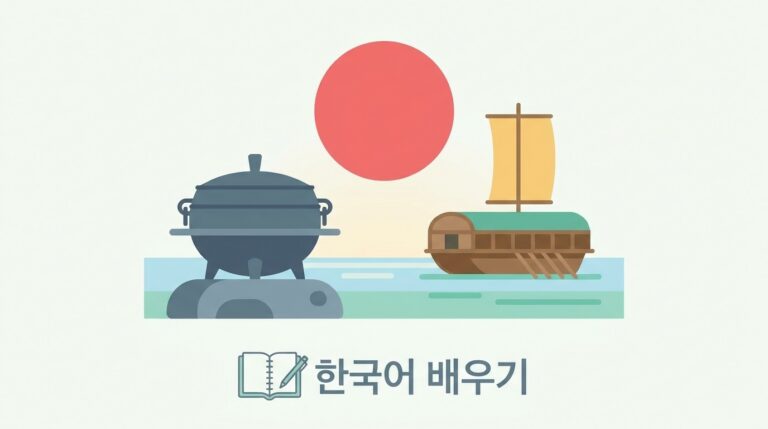
When the stakes are existential, textbook politeness can sound surprisingly weak. In sophisticated Korean business and narrative storytelling, native speakers rely on the historical weight of four-character idioms (사자성어, Sajaseongeo) to signal unshakeable determination. At the very summit of these expressions sits 파부침주 (破釜沈舟, Pabuchimju)—literally smashing your own iron cauldrons and sinking your own boats so retreat is physically impossible. In this guide, backed by years of corporate coaching and cultural navigation, we will unpack how to wield this phrase and its sister idioms to project C1-level authority, whether you are pitching an ambitious vision, steering a crisis team, or analyzing top-tier Korean media.
Phase 2: Core Expressions Deep Dive
1. 파부침주 (破釜沈舟)
- Pronunciation: Pa-bu-chim-ju (Sounds like Pah as in pasta + Boo + Chim like chimney + Zoo with a soft ‘j’)
- Meaning: Literal: “Smash the cooking pots, sink the boats” | Nuance: Burning all bridges behind you; entering a contest or ordeal with absolute, lethal resolve and zero intention of turning back.
- K-Culture Moment: A startup founder in a drama rejecting a predatory buyout offer, gathering their core team, and declaring that they are wagering every single asset on their final product launch.
- Editor’s Insight: Pabuchimju originates from the ancient Battle of Julu, where General Xiang Yu ordered his troops to sink their vessels after crossing the river. In modern Korean, it is reserved for life-defining gambits—entering an election, founding a venture, or taking the ultimate licensing examination.
- Situation Spectrum: Casual 🚫 | Semi-formal ⚠️ | Formal ✅
- 🤔 Think About It: In English, “burning bridges” usually carries a negative nuance about destroying personal relationships. Why does Korean culture celebrate “sinking boats” as a mark of heroic leadership?
2. 배수의 진 (背水之陣)
- Pronunciation: Bae-su-ui jin (Sounds like Bae like ‘best’ + Soo + Ui pronounced like ‘eh’ + Jean)
- Meaning: Literal: “Setting up a battle camp with one’s back against the river” | Nuance: Making a final stand where retreat means drowning; fighting with concentrated desperation because failure is fatal.
- K-Culture Moment: A national sports coach addressing the locker room in a World Cup elimination match, reminding the team that there is no tomorrow if they yield an inch.
- Editor’s Insight: Unlike Pabuchimju, which emphasizes the proactive destruction of one’s escape routes, Baesuui jin focuses on the spatial reality of having no room left to back up. It is almost always paired with the verb 치다 (to cast/pitch): 배수의 진을 치다 (Baesuuijineul chida).
- Situation Spectrum: Casual ⚠️ | Semi-formal ✅ | Formal ✅
- 🤔 Think About It: Compare this to the English phrase “back against the wall.” Does the Korean water metaphor (수/水) feel more perilous to you than a solid wall?
3. 사즉생 (死則生)
- Pronunciation: Sa-jeuk-saeng (Sounds like Sah + Jeuk like ‘jerk’ without the ‘r’ + Saeng like ‘sang’)
- Meaning: Literal: “Resolve to die, and you will live” | Nuance: Paradoxical victory through self-sacrifice; shedding the fear of defeat to attain absolute focus and triumph.
- K-Culture Moment: Epic historical productions depicting Admiral Yi Sun-sin (이순신 장군) rallying twelve battle-worn ships against hundreds of enemy vessels at the Battle of Myeongnyang.
- Editor’s Insight: This is the most solemn phrase in the crisis lexicon. It should never be used lightly or flippantly; native speakers reserve it for situations demanding moral courage or communal survival.
- Situation Spectrum: Casual 🚫 | Semi-formal ⚠️ | Formal ✅
- 🤔 Think About It: How does this martial paradox reflect the high-pressure endurance demanded in modern Korean competitive environments, such as high-stakes state examinations?
Phase 3: Textbook Korean vs. Real Korean
Situation 1: Committing to a High-Risk Business Venture
- 📖 교과서 한국어: 이번 사업에 최선을 다해 실패하지 않도록 하겠습니다. (Ibeon saeobe choeseoneul dahae silpaehaji antorok hagetseumnida.)
- “I will do my best in this business so that we do not fail.”
- 🗣️ 진짜 한국어: 파부침주의 각오로 이번 프로젝트에 제 모든 것을 걸었습니다. (Pabuchimju-ui gagoro ibeon peurojekteue je modeun geoseul georeotseumnida.)
- “With the resolve of Pabuchimju, I have staked everything on this project.”
- 💡 왜 다를까?: The textbook version sounds like a student fulfilling an assignment. The native version signals visionary weight, showing executive commitment that earns the trust of partners.
Situation 2: Entering the Final Phase of an Impossible Task
- 📖 교과서 한국어: 더 열심히 노력해서 끝까지 포기하지 않겠습니다. (Deo yeolsimhi noryeokhaeseo kkeutkkaji pogihaji anketseumnida.)
- “I will try harder and not give up until the end.”
- 🗣️ 진짜 한국어: 이제 더 물러설 곳도 없습니다. 배수의 진을 치고 정면 돌파하겠습니다. (Ije deo mulleoseol gotdo eopseumnida. Baesuuijineul chigo jeongmyeon dolpahagetseumnida.)
- “There is nowhere left to retreat. We draw the line of no return and break through head-on.”
- 💡 왜 다를까?: Native professionals respect the explicit acknowledgment of danger (물러설 곳이 없다). Facing a crisis directly (정면 돌파) carries far more emotional traction than generic effort.
Phase 4: K-Culture Deep Dive & Non-Verbal Manners
4-1. Nunchi & Physical Presence
When using solemn idioms like Pabuchimju, verbal delivery is only half the message. Your non-verbal presence (태도) dictates whether you sound authentically resolute or melodramatic.
* Gaze (눈빛): Maintain unwavering, centered eye contact. Do not dart your eyes around or blink rapidly, which signals hesitation.
* Vocal Pitch & Cadence: Drop your vocal register down half an octave. Speak slower than usual, anchoring your breath in your diaphragm (단전).
* Body Posture: Keep your spine straight, shoulders square, and rest your hands firmly on the conference table or your knees. Avoid casual gestures, hand-waving, or self-deprecating chuckles immediately after saying the phrase.
4-2. Cultural Code Analysis: The Survival Instinct in K-Media
From the survival dynamics of Squid Game and Physical: 100 to the corporate turnarounds in Reborn Rich, modern Korean entertainment is permeated with the philosophy of total commitment. This cultural archetype stems from Korea’s history: a geographically compact nation surrounded by great powers, forced to overcome natural resource scarcity and reconstruct its entire infrastructure after the Korean War. During the 1997 Asian Financial Crisis (the “IMF Crisis”), citizens nationwide famously donated their personal gold heirlooms to bail out national foreign reserves. This collective memory makes idioms like Pabuchimju resonate deeply—not as reckless gambling, but as the supreme virtue of choosing active defiance over passive defeat.
Phase 5: Real-Life Roleplay Scenario
Setting: The late-night strategy room of a Seoul-based tech startup. The runway is down to three months, and a major venture capital evaluation happens tomorrow morning.
Characters:
* 이사님 (Director Park): A seasoned, realistic operations director with high standards.
* 알렉스 (Alex): The lead product strategist (Played by you, C1 Korean speaker).
- Turn 1 (Director Park):
- 🎭 깊은 한숨을 쉬며 서류를 내려놓는다 (Sighs deeply and sets down the paperwork)
- 알렉스 씨, 내일 투자 유치 실패하면 다음 달부터 전사 급여 지급도 불투명해요. 정말 이 수정안으로 갈 겁니까? (Alex-ssi, naeil tuja yuchi silpaehamyeon daeum dalbuteo jeonsa geubyeo jigeupdo bultumyeonghaeyo. Jeongmal i sujeong-aneuro gal geomnikka?)
- “Alex, if tomorrow’s pitch fails, payroll next month is uncertain. Are you truly going forward with this revised proposal?”
- Turn 2 (Alex):
- 🎭 눈을 똑바로 바라보며 확신에 찬 목소리로 (Looking directly into Park’s eyes with steady conviction)
- 네, 이사님. 기존 기획으로는 시장의 판도를 바꿀 수 없습니다. 파부침주의 심정으로 모든 기능을 이 핵심 가치 하나에 맞췄습니다. (Ne, isanim. Gijon gihoegeuroneun sijang-ui pandoreul bakkul su eopseumnida. Pabuchimju-ui simjeong-euro modeun gineung-eul i haeksim gachi hana-e matchwotseumnida.)
- “Yes, Director. Sticking to the old plan won’t change the game. With the mindset of Pabuchimju, I have aligned every single feature around this core value.”
- Turn 3 (Director Park):
- 🎭 안경을 벗으며 미간을 찌푸린다 (Removes his glasses and furrows his brow)
- 배수의 진을 치겠다는 건 알겠는데, 실패했을 때의 리스크는 감당할 수 있겠어요? (Baesuuijineul chigetdaneun geon algetneunde, silpaehaesseul ttae-ui riseukeuneun gamdanghal su itgesseoyo?)
- “I understand you are taking a last stand, but can you bear the risk if it falls through?”
- Turn 4 (Alex):
- 🎭 단호하게 고개를 끄덕인다 (Nods decisively)
- 퇴로를 열어두면 팀 전체가 절박해질 수 없습니다. 이번 승부에 제 모든 역량을 걸었습니다. (Toeroreul yeoreodumyeon tim jeonchega jeolbakhaejil su eopseumnida. Ibeon seungbue je modeun yeongnyang-eul georeotseumnida.)
- “If we leave an exit route open, the team will lose its urgency. I have staked my entire credibility on this play.”
- Turn 5 (Director Park):
- 🎭 잠시 침묵 후 알렉스의 눈빛을 살핀다 (Pauses in silence, observing Alex’s steady gaze)
- 그 정도로 결연하다면, 반대할 명분이 없네요. 대표님 앞에서도 그렇게 당당할 수 있겠어요? (Geu jeongdoro gyeolyeonhadamyeon, bandaehal myeongbuni eomneyo. Daepyoniim apeseodo geureoke dangdanghal su itgesseoyo?)
- “If your resolve is that absolute, I have no grounds to object. Can you stand that confident before the CEO?”
- Turn 6 (Alex):
- 🎭 자료를 반듯하게 정리하며 미소를 띤다 (Neatly organizes the presentation deck with a composed smile)
- 물론입니다. 사즉생의 각오로 발표 준비 완벽하게 마쳤습니다. (Mollonimnida. Sajeuksaeng-ui gagoro balpyo junbi wanbyeokhage machyeotseumnida.)
- “Of course. I have completed the final preparations with do-or-die determination.”
- Turn 7 (Director Park):
- 🎭 알렉스의 어깨를 가볍게 두드린다 (Taps Alex lightly on the shoulder)
- 좋습니다. 그럼 내일 프레젠테이션은 알렉스 씨 리드하에 전면 승부로 갑시다. (Jotseumnida. Geureom naeil peurejenteisyeoneun Alex-ssi rideuhae jeonmyeon seungburo gapsida.)
- “Good. Then tomorrow’s presentation goes under your lead as an all-out effort.”
- Turn 8 (Alex):
- 🎭 단단한 어조로 목례한다 (Bows slightly with firm composure)
- 믿어주셔서 감사합니다. 반드시 결과로 증명해 보이겠습니다. (Mideojusyeoseo gamsahamnida. Bandeusi gyeolgwaro jeungmyeonghae boigetseumnida.)
- “Thank you for your trust. I will unequivocally prove it with results.”
🔀 Interactive Decision Point
Suppose Director Park asks: “What happens to your career if the client explicitly rejects our stance tomorrow?”
- Option A: “어쩔 수 없죠. 다른 회사로 이직하면 됩니다.” (Eojjeol su eopjyo. Dareun hoesaro ijikhamyeon doemnida. / “Nothing can be done. I’ll just move to another firm.”)
- Feedback [Bad]: Completely undermines your professionalism and reveals a lack of loyalty, destroying executive trust.
- Option B: “아마 잘 될 거예요. 너무 걱정 마세요.” (Ama jal doel geoyeyo. Neomu geokjeong maseyo. / “It will probably be fine. Don’t worry so much.”)
- Feedback [Risk]: Sounds overly naive and trivializes the severe commercial danger your team is confronting.
- Option C: “파부침주라 했습니다. 실패는 염두에 두지 않고 오직 돌파구만 찾겠습니다.” (Pabuchimjura haetseumnida. Silpaeneun yeomdue duji anko ojik dolpaguman chatgetseumnida. / “As I said, it is Pabuchimju. I am not entertaining failure; I will only focus on breaking through.”)
- Feedback [Best]: Demonstrates exceptional C1 rhetorical command, unshakeable courage, and strategic alignment with senior leadership.
Phase 6: 10-Second Emotional Shadowing Drill
Read these sentences aloud, pausing precisely at the / marks and channeling the indicated emotional state.
[🔥 비장하고 단호하게 - Solemn & Resolute]- 이번 시험만큼은 / 파부침주의 각오로 / 임하겠습니다.
- (Ibeon siheommakeumeun / pabuchimju-ui gagoro / imhagetseumnida.)
- “For this examination at least / with the resolve of smashing cauldrons and sinking boats / I will face it.”
[💼 침착하지만 결연하게 - Calm yet Unyielding]- 더 물러설 곳은 없습니다. / 여기서 배수의 진을 치겠습니다.
- (Deo mulleoseol goseun eopseumnida. / Yeogiseo baesuuijineul chigetseumnida.)
- “There is nowhere left to step back. / Right here, we take our final stand.”
[⚡ 모든 두려움을 내려놓고 - Releasing All Fear]- 사즉생의 정신으로 부딪치면 / 반드시 길은 열립니다.
- (Sajeuksaeng-ui jeongsineuro buditchimyeon / bandeusi gireun yeollimnida.)
- “If we collide head-on with a do-or-die spirit / a path will inevitably open up.”
Phase 7: K-Culture Mini Dictionary
- 각오 (Gago) | Mental determination / Resolve
- Beyond mere “wishing,” Gago refers to the internal psychological preparedness to endure suffering or hardship to achieve a goal.
- 결단력 (Gyeoldallyeok) | Decisiveness / Courage to cut ties
- The quality of making bold choices without lingering regret; highly prized in corporate managers and community figures.
- 배수진 (Baesujin) | The river-backed defense line / Last resort defense
- Often used as a noun in casual news headlines (e.g., “야당, 장외 투쟁으로 배수진” — Opposition party adopts a last-resort stand through street demonstrations).
- 총력전 (Chongnyeokjeon) | All-out war / Mobilization of total strength
- Applied routinely to non-military contexts like college entrance admissions (수능 총력전) or marketing blitz campaigns.
Phase 8: Traveler’s Survival Kit
High-stakes determination isn’t just for business executives; travelers face critical crossroads too—like sprinting for the last KTX train or resolving an urgent lodging error.
Top 3 Crisis Survival Expressions
- 정말 물러설 곳이 없어서 그럽니다. 꼭 좀 도와주세요.
- Jeongmal mulleoseol gosi eopseoseo geureomnida. Kkok jom dowajuseyo.
- Pro Tip: Use this polite appeal when dealing with stranded transit situations or sold-out emergency tickets to communicate genuine desperation.
- 이번 일정은 차질 없이 반드시 진행해야 합니다.
- Ibeon iljeong-eun chajil eopsi bandeusi jinhaenghae-ya hamnida.
- Pro Tip: Essential when coordinating with private tour guides or transport drivers when timing is down to the wire.
- 다른 대안이 없습니다. 이 방법으로 밀고 나가야 합니다.
- Dareun dae-ani eopseumnida. I bangbeobeuro milgo nagaya hamnida.
- Pro Tip: Perfect for resolving travel group stalemates when an immediate, decisive route selection must be made.
Editor’s Travel Note
When navigating Korea’s ultra-efficient urban centers, missing a critical connection can disrupt tight itineraries. Keep your essentials ready by reviewing our verified guides: download the [KakaoMap transit application guide] to track real-time bus arrivals down to the second, and make sure your payments are secure with a [NAMANE prepaid card registration] before venturing beyond metropolitan subway lines.
Phase 9: Going One Step Deeper
In contemporary Western professional culture, maintaining flexible pivot points, preserving backup plans, and establishing distinct work-life boundaries are viewed as prudent risk management. In contrast, the lingering classical Korean linguistic aesthetic places enormous moral beauty upon 일편단심 (unwavering singular loyalty) and 파부침주 (destroying all alternative retreats).
This distinction does not suggest Korean culture is reckless; rather, it reflects a society where collective survival often demanded 100% emotional synchronization. When an individual declares Pabuchimju, they are signaling to their colleagues: “I am not holding anything back for self-preservation. If we go down, I go down with you.” This shared vulnerability builds profound solidarity (정, Jung).
💬 Your Turn: What is the equivalent idiom or cultural expression in your native language when someone enters a challenge with zero backup plan? Share your thoughts and stories in the comments below!
Phase 10: FAQ & Common Mistakes
Q: Can I use ‘파부침주’ in a romantic context when confessing my feelings?
A: While technically understandable, it sounds overly historic and intense—almost like you are declaring war! For romantic confessions, stick to phrases like “진심으로 다가가고 싶어요” (I want to approach you with all my heart) instead of declaring that you smashed your cauldrons.
Q: What is the grammatical difference between ‘파부침주’ and ‘배수의 진’?
A: Pabuchimju functions as a standalone noun or a modifier with 각오 (e.g., 파부침주의 각오), emphasizing the action of cutting off escape. 배수의 진 is almost always paired with the verb 치다 (배수의 진을 치다), emphasizing the geographical/situational state of having your back to the wall.
Q: Are four-character idioms commonly used by younger Koreans in daily text messages?
A: In casual KakaoTalk messages among friends, younger speakers often abbreviate or use slang. However, in job cover letters (자기소개서), formal team meetings, public speeches, and university essays, using Sajaseongeo accurately instantly marks you as an articulate, highly educated C1 speaker.
🚨 Common Mistakes Alert
- Mistake 1: Using it for trivial daily tasks.
- Incorrect: “오늘 다이어트 파부침주로 할 거야!” (Overly melodramatic for skipping snacks)
- Correction: Keep it for life-changing endeavors: career transitions, major athletic tournaments, or long-term investments.
- Mistake 2: Mixing up ‘배수의 진을 치다’ with ‘배은망덕하다’.
- Incorrect: Using 배수 confused with 배은 (ingratitude).
- Correction: 배수 (背水) means back to the water; 배은 (背恩) means betraying kindness.
- Mistake 3: Saying the idiom with a giggling or uncertain tone.
- Correction: These idioms demand grounded posture and vocal gravity. If delivered casually, native listeners will assume you are being sarcastic.
Phase 11: Action Missions
- 🥉 Bronze Mission (Solo Practice):
- Record your voice delivering the three Shadowing Drill sentences from Phase 6. Listen back to ensure you hit the vocal drop on 파부침주 and 배수의 진.
- 🥈 Silver Mission (Social Connection):
- Write a one-sentence personal resolution on Instagram or Threads about a project you are currently tackling: “[목표], 파부침주의 각오로 해내겠습니다!” and tag
#DailyHangul.
- Write a one-sentence personal resolution on Instagram or Threads about a project you are currently tackling: “[목표], 파부침주의 각오로 해내겠습니다!” and tag
- 🥇 Gold Mission (Real-World Execution):
- In your next Korean 1-on-1 tutoring session, language exchange, or workplace standup, describe a difficult dilemma you solved by using 배수의 진을 쳤어요.
- 🎮 K-Culture Mission:
- Watch an episode of a Korean historical drama (사극) or a sports documentary this week. Spot whether the subtitles or dialogue feature 배수진 or 결사대!
Phase 12: Interactive Quiz Challenge
Quiz 1: Situational Judgment
Which of the following situations is the most natural context for using the idiom ‘파부침주 (Pabuchimju)’?
* (A) Choosing between an Iced Americano and a Latte at a cafe.
* (B) A veteran chef closing their successful restaurant to stake their life savings on opening an authentic traditional dining space overseas.
* (C) Buying a discounted subway pass at the station counter.
🔍 Click to Reveal Answer & Explanation
Correct Answer: (B)
Explanation: Pabuchimju denotes surrendering all safe options and committing everything to a single high-stakes endeavor. Sinking the boats perfectly mirrors closing an existing successful shop to venture into a risky dream.
Quiz 2: Fill in the Blank
Fill in the missing particle and verb collocation commonly used with 배수의 진:
“우리는 더 물러설 곳이 없다. 여기서 배수의 진을 ( ) 싸워야 한다.”
🔍 Click to Reveal Answer & Explanation
Correct Answer: 치고 (chigo)
Explanation: The fixed idiomatic collocation is 배수의 진을 치다 (to pitch a battle camp with one’s back to the water). Conjugated with the connective particle -고, it becomes 치고.
Quiz 3: Cultural True or False
Statement: Admiral Yi Sun-sin’s famous military maxim “사즉생 생즉사 (死則生 生則死)” means that soldiers who actively run away to preserve their lives will guarantee the survival of their entire fleet.
🔍 Click to Reveal Answer & Explanation
Correct Answer: False
Explanation: The maxim means: “Those who seek death (are willing to sacrifice their lives) will live; those who seek to save their lives (through fear or cowardice) will perish.” It honors fearless commitment in the face of crisis.







