

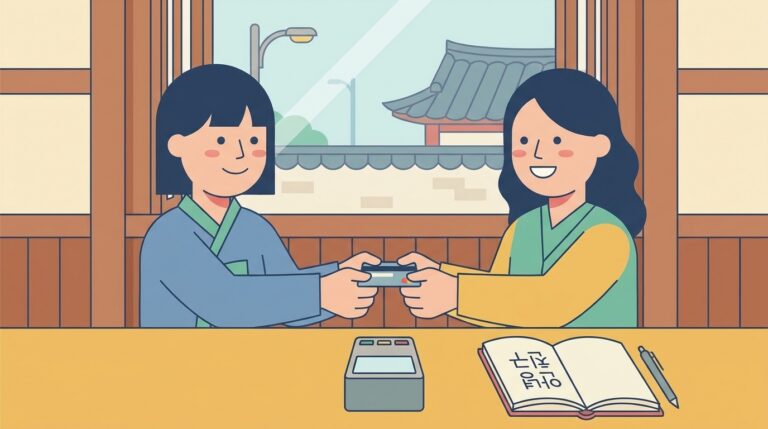
Phase 1: Empathy & Story Opening
안녕하세요! 매일한글 에디터입니다.
Have you ever experienced that heart-thumping, slightly chaotic moment at the end of a delicious meal in Seoul? Picture this: you are sitting around a sizzling Korean BBQ grill with your Korean friends. The pork belly is completely devoured, the side dishes are scraped clean, and everyone starts putting on their coats to head toward the cash register. You genuinely want to show your heartfelt gratitude and treat everyone today, but as the cashier rings up the bill, your mind goes blank. You freeze, fumble with your card, and before you can utter a word, your Korean friend quickly taps their credit card first! You missed your chance, feeling flustered and wishing you knew the exact magic words to say, “Dinner is on me today!”
Mastering how to pay the bill and take leftover food to go is not just about getting fed—it is the quickest route to building real, warm social bonds in Korea. This guide is crafted directly from our classroom coaching sessions at Daily Hangul to help absolute beginners handle any restaurant counter with swagger and ease.
Phase 2: Top 3 Core Expressions
1. 제가 오늘 쏠게요! (Je-ga o-neul ssol-ge-yo!)
- Pronunciation: Je-ga o-neul ssol-ge-yo! (Sound analogy: Think of shooting an arrow with a crisp ssol like the English word “soul” with a punchy double-s, followed by geh-yo).
- Meaning: Literal: “I will shoot today!” | Real Nuance: “It’s on me today!” / “Dinner is my treat!”
- K-Culture Moment: In K-dramas, whenever a lead character lands a promotion or a new job, they happily slap the table and yell this line to their celebrating friends.
- Editor’s Insight: The verb 쏘다 (sso-da) literally translates to “shoot” (like firing a weapon or launching an arrow), but colloquially it means firing treats at your friends with generosity!
- Situation Spectrum: Casual: ✅ | Semi-formal: ✅ | Formal: ⚠️ (Use 제가 계산하겠습니다 in strict corporate settings)
- 🤔 Think About It: In English, we say “It’s on me” as if placing a bill on one’s shoulders. Why do you think Korean slang conceptualizes buying a meal as “shooting” (쏘다) energy and resources forward?
2. 계산해 주세요. (Gye-san-hae ju-se-yo.)
- Pronunciation: Gye-san-hae ju-se-yo. (Sound analogy: Say gay-sahn quickly, then add hae joo-say-yo like “juice” without the ‘s’).
- Meaning: Literal: “Please calculate.” | Real Nuance: “Check, please.” / “Could I pay the bill?”
- K-Culture Moment: Walking up to the register near the restaurant exit and making eye contact with the owner while holding your card.
- Editor’s Insight: In Korea, waiters rarely bring the bill to your table (except at high-end Western restaurants). You normally take your printed table receipt to the front counter and use this phrase.
- Situation Spectrum: Casual: ⚠️ | Semi-formal: ✅ | Formal: ✅
- 🤔 Think About It: Notice the root word 계산 (calculation). How does politely asking someone to calculate compare to asking for the “check” or the “bill” in your language?
3. 남은 거 포장해 주세요. (Nam-eun geo po-jang-hae ju-se-yo.)
- Pronunciation: Nam-eun geo po-jang-hae ju-se-yo. (Sound analogy: Nam-eun like “numb-un”, geo like “guh”, and po-jang like “poh-jahng”).
- Meaning: Literal: “Please pack the remaining things.” | Real Nuance: “Could I get this wrapped to go, please?”
- K-Culture Moment: When you order way too much Korean fried chicken or spicy braised ribs and cannot bear to leave those precious pieces behind.
- Editor’s Insight: While doggy bags used to be uncommon for delicate raw foods, modern Korean casual restaurants are delighted to pack savory mains, fried dishes, and stew-based items for you.
- Situation Spectrum: Casual: ⚠️ | Semi-formal: ✅ | Formal: ✅
- 🤔 Think About It: In some dining cultures, taking food home can feel awkward. In Korea, finishing or saving food reflects respect for the cook’s hard work!
Phase 3: Textbook Korean vs. Real Korean
Situation 1: Offering to pay for the group meal
- 📖 교과서 한국어 (Textbook): 제가 음식값을 지불하겠습니다. (Je-ga eum-sik-gap-seul ji-bul-ha-get-seum-ni-da. – I will pay the cost of the food.)
- 🗣️ 진짜 한국어 (Real-life): 오늘 제가 쏠게요! (O-neul je-ga ssol-ge-yo! – Today it’s on me!)
- 💡 왜 다를까? (Why is it different?): Textbook forms sound like a rigid corporate press release. Real Koreans use playful, punchy verbs like 쏘다 (sso-da) to create friendly, warm dining memories.
Situation 2: Asking to split the bill at the counter
- 📖 교과서 한국어 (Textbook): 각자 나누어서 계산합시다. (Gak-ja na-nu-eo-seo gye-san-hap-si-da. – Let us calculate divided individually.)
- 🗣️ 진짜 한국어 (Real-life): 따로 계산해 주세요! (Tta-ro gye-san-hae ju-se-yo! – Please charge us separately!)
- 💡 왜 다를까? (Why is it different?): Cashiers appreciate concise operational words. Saying 따로 (tta-ro – separately) makes processing multiple payment cards quick and hassle-free.
Phase 4: K-Culture Deep Dive & Non-Verbal Manners
4-1. 눈치 (Nunchi) & Polite Gestures
When it comes time to pay, you will witness the legendary “Korean Card Duel.” Friends will jokingly push each other’s arms away to reach the terminal first! If you want to declare that it is truly your treat:
* Step up early: Walk toward the counter slightly before your group stands up.
* The Two-Hand Handoff: Always hand your card or cash over using both hands, or support your right wrist/forearm with your left hand. This subtle gesture shows deep respect and humility (공손한 태도).
* Eye Contact: Smile warmly at the cashier and friend, holding steady eye contact rather than looking down nervously.
4-2. Cultural Code: The Art of “Round Two” (1차와 2차)
In Korea, fighting aggressively over splitting a single bill down to the cent during your first hangout can sometimes dampen the mood. Instead, Koreans practice reciprocal treating: if you pay for the hearty BBQ dinner (1차, Round 1), your dining companion will almost certainly smile and say, “커피는 내가 살게!” (Keo-pi-neun nae-ga sal-ge! – I will buy the coffee for Round 2!). Accepting this rhythm shows emotional intelligence and keeps friendships blossoming.
Phase 5: Real-World Roleplay Scenario
- Setting: A bustling, aromatic spicy chicken galbi (닭갈비) restaurant in Mapo, Seoul.
- Characters:
- You (Alex): A bright A1 Korean learner visiting Seoul.
- Min-woo (민우): Your warm, energetic Korean language partner.
- Cashier (이모님 – Imonim): A cheerful restaurant owner standing by the POS terminal.
— Dialogue Starts —
- Turn 1 (Min-woo): 아, 진짜 배부르다! 알렉스, 맛있게 먹었어? (A, jin-jja bae-bu-reu-da! Al-rek-seu, ma-sit-ge meog-eot-eo? – Ah, I’m so full! Alex, did you enjoy the food?)
- Turn 2 (You): 🎭 Patting stomach happily and pointing to the counter
네, 진짜 맛있었어요! 이모님, 계산해 주세요! (Ne, jin-jja ma-sit-eot-eo-yo! I-mo-nim, gye-san-hae ju-se-yo! – Yes, it was delicious! Auntie, check please!) - Turn 3 (Cashier): 🎭 Tapping on the cash register screen with a warm smile
네~ 닭갈비 2인분에 치즈 추가해서 3만 원이에요. (Ne~ dak-gal-bi i-in-bun-e chi-jeu chu-ga-hae-seo sam-man won-i-e-yo. – Sure~ 2 servings of chicken galbi plus cheese comes to 30,000 won.) - Turn 4 (Min-woo): 🎭 Quickly pulling his leather wallet from his back pocket
내가 낼게! 카드 여기 있습니다. (Nae-ga nael-ge! Ka-deu yeo-gi it-seum-ni-da. – I’ll pay! Here is my card.) - Turn 5 (You): 🎭 Gently placing your hand over Min-woo’s card and smiling brightly
민우 씨, 안 돼요! 오늘 제가 쏠게요! (Min-u ssi, an dwae-yo! O-neul je-ga ssol-ge-yo! – Min-woo, no way! It’s on me today!) - Turn 6 (Min-woo): 🎭 Laughing in surprise at your smooth Korean phrase
와, 한국어 대박! 정말? 고마워, 잘 먹을게! (Wa, han-gug-eo dae-bak! Jeong-mal? Go-ma-wo, jal meog-eul-ge! – Wow, your Korean is awesome! Really? Thank you, I’ll enjoy your treat!) - Turn 7 (You): 🎭 Holding your credit card firmly with two hands and handing it to the cashier
여기 카드 있어요. 그리고 남은 거 포장해 주세요! (Yeo-gi ka-deu it-eo-yo. Geu-ri-go nam-eun geo po-jang-hae ju-se-yo! – Here is my card. And please pack the leftovers to go!) - Turn 8 (Cashier): 🎭 Nodding approvingly and taking the card with both hands
학생 한국말 너무 잘하네! 포장 금방 해줄게요! (Hak-saeng han-gung-mal neo-mu jal-ha-ne! Po-jang geum-bang hae-jul-ge-yo! – You speak Korean so well! I’ll wrap it up in just a moment!)
— Dialogue Ends —
🔀 Interactive Decision Point
When Min-woo pulls out his card at Turn 4, what is your best course of action?
- Choice A: Offer your card with two hands and say: “오늘 제가 쏠게요!” with a confident smile.
- Outcome (Best): Perfect cultural timing! Min-woo feels respected and promises to buy the dessert café right after.
- Choice B: Grab Min-woo’s wallet and yell: “안 돼! 내 돈!” (An dwae! Nae don! – No! My money!).
- Outcome (Bad): Extremely awkward! Physical wrestling over wallets can cause discomfort and spill items on the floor.
- Choice C: Look at the floor and say nothing because you are shy.
- Outcome (Risk): Min-woo pays, and you miss your valuable opportunity to practice real-life Korean and show gratitude.
Phase 6: 10-Second Emotion Shadowing Drill
Read these aloud, hitting the exact rhythm breaks marked by /:
[😊 자신 있고 당당하게 - Confident & Proud]
오늘 / 제가 / 쏠게요!
(O-neul / je-ga / ssol-ge-yo!)-
[🙋 정중하고 친절하게 - Polite & Friendly]
이모님, / 계산해 / 주세요.
(I-mo-nim, / gye-san-hae / ju-se-yo.) -
[😋 기대하며 귀엽게 - Excited & Hopeful]
남은 거 / 포장해 / 주세요!
(Nam-eun geo / po-jang-hae / ju-se-yo!)
Phase 7: K-Culture Mini Dictionary
- 쏘다 (Sso-da) | To treat / To buy someone food or drinks
- Common Usage: Used constantly among peers, university classmates, and coworkers when celebrating good news. (e.g., 커피 쏠게! – I’ll treat for coffee!)
- 더치페이 (Deo-chi-pe-i) / N분의 1 (En-bun-ui-il) | Splitting the bill evenly
- Common Usage: The Konglish term 더치페이 or mathematical slang N분의 1 is commonly used by university students and younger generations after large group gatherings.
- 영수증 (Yeong-su-jeung) | Receipt
- Common Usage: Cashiers often ask, “영수증 필요하세요?” (Yeong-su-jeung pil-yo-ha-se-yo? – Do you need a receipt?). You can reply: “버려 주세요.” (Beo-ryeo ju-se-yo. – Please discard it.)
- 포장 (Po-jang) | Takeout / Packaging
- Common Usage: When entering casual diners, say “포장해 주세요” if you want takeout rather than dining in.
Phase 8: Survival Kit for Travelers
Survival Expressions TOP 3
- 1. 따로따로 계산할게요. (Tta-ro-tta-ro gye-san-hal-ge-yo.)
- Romanization: Tta-ro-tta-ro gye-san-hal-ge-yo.
- Pro Tip: Use this when you are with international travel friends and each person wants to swipe their own card.
- 2. 영수증은 버려 주세요. (Yeong-su-jeung-eun beo-ryeo ju-se-yo.)
- Romanization: Yeong-su-jeung-eun beo-ryeo ju-se-yo.
- Pro Tip: Korea is nearly paperless. If you don’t need a tax receipt, keep this phrase handy to save paper.
- 3. 이거 포장돼요? (I-geo po-jang-dwae-yo?)
- Romanization: I-geo po-jang-dwae-yo?
- Pro Tip: Before ordering, ask this to verify if the restaurant allows takeout for that specific menu item.
Editor’s Travel Note
- Cash or Card? Over 95% of Seoul establishments are cashless. Always carry an international debit/credit card or IC transport card (T-money).
- Digital Navigation: Never get lost looking for famous restaurants by installing the [official Naver Map navigation application] or browsing local food recommendations via the [KakaoMap transit and discovery guide].
Phase 9: “One Step Deeper” (Cultural Reflection)
In many Western cultures, independence and precise accounting are prioritized during group dinners, making individual bills (Dutch pay) the standard default. However, Korean dining traditions are deeply rooted in the concept of 정 (Jeong)—an invisible bond of warmth, community, and mutual care. Picking up the check is viewed not as a financial loss, but as an affectionate investment in the relationship. The unspoken promise is simple: “I take care of you today, you take care of me tomorrow.”
💬 Your Turn: In your home culture, how do friends handle the bill when dining out together? Do you split it equally down to the last coin, or do people take turns paying? Share your story in the comments below!
Phase 10: FAQ & Common Mistakes
Q: Can I use “제가 쏠게요” with my boss or a senior professor?
A: It is better to use slightly more formal phrasing! 제가 쏠게요 is friendly and somewhat casual slang. If you are treating an esteemed professor or executive, say: “제가 대접하겠습니다” (Je-ga dae-jeop-ha-get-seum-ni-da. – I would like to treat you to this meal).
Q: Do I need to leave a tip at Korean restaurants after saying this?
A: Absolutely not! Tipping does not exist in South Korea. The price listed on the menu includes all service charges and value-added tax (VAT). Leaving money on the table will likely cause the server to chase you down the street to return your forgotten change!
Q: What if the restaurant does not pack leftovers?
A: While most savory BBQ, pizza, and chicken spots happily pack leftover dishes, some raw fish (회) or hotpot soup restaurants may decline due to food safety regulations during hot summer months.
🚨 Common Mistakes Warning Board
- Mistake: Handing a credit card with one single hand or tossing it on the counter.
- Correct Action: Always present the card using both hands with a gentle bow of your head.
- Mistake: Waiting at the table for 15 minutes waiting for the waiter to bring the bill.
- Correct Action: Take your table ticket directly to the counter near the main exit to make payment.
- Mistake: Confusing 더치페이 (Dutch pay) with 포장 (takeout).
- Correct Action: Practice 따로 계산 (tta-ro gye-san – separate pay) and 포장 (po-jang – takeout) distinctly.
Phase 11: Action Mission & Engagement
- 🥉 Bronze Mission (Solo Shadowing): Stand in front of your mirror with a card in both hands and practice saying “오늘 제가 쏠게요!” 5 times with a bright, confident voice.
- 🥈 Silver Mission (Social Share): Snap a photo of your next meal, tag @DailyHangul, and write the caption: “오늘 밥은 제가 쏠게요! 🍜”.
- 🥇 Gold Mission (Live Execution): Visit a local Korean restaurant or convenience store. Hand over your card using both hands and smoothly say “계산해 주세요” and “영수증은 버려 주세요” to the staff.
- 🎮 K-Culture Mission: Watch the next episode of your favorite K-drama and spot whether the characters use the verb 쏘다 (sso-da) when celebrating after work!
Phase 12: Interactive Quiz Challenge
Test your knowledge with these three quick scenarios:
1. Situation Judgment: You had a fantastic dinner with your Korean friend and want to treat them today. What is the most natural sentence to say?
* A) 영수증 주세요. (Yeong-su-jeung ju-se-yo.)
* B) 오늘 제가 쏠게요! (O-neul je-ga ssol-ge-yo!)
* C) 남은 거 포장해 주세요. (Nam-eun geo po-jang-hae ju-se-yo.)
2. Fill-in-the-Blank: You ordered too much food and want to take the leftovers home. Complete the sentence:
* “이모님, 남은 거 [ ______ ]해 주세요!”
3. True or False (Culture Check): In South Korea, it is polite to leave a 15% tip on top of the bill when treating your friends.
* (True / False)
👉 Click here to reveal the answers and explanations!
- Answer: B (오늘 제가 쏠게요! is the natural, friendly way to announce you are treating everyone!).
- Answer: 포장 (Po-jang) (포장해 주세요 means please pack it to go!).
- Answer: False (There is no tipping culture in Korea; prices include all tax and service!).







