

The Whispering Snow: Aesthetics of Pure Native Korean Poetic Vocabulary for Winter
Phase 1: Empathy (Immersive Opening)
안녕하세요! 매일한글 에디터입니다. (Hello! I am your Daily Hangul editor.)
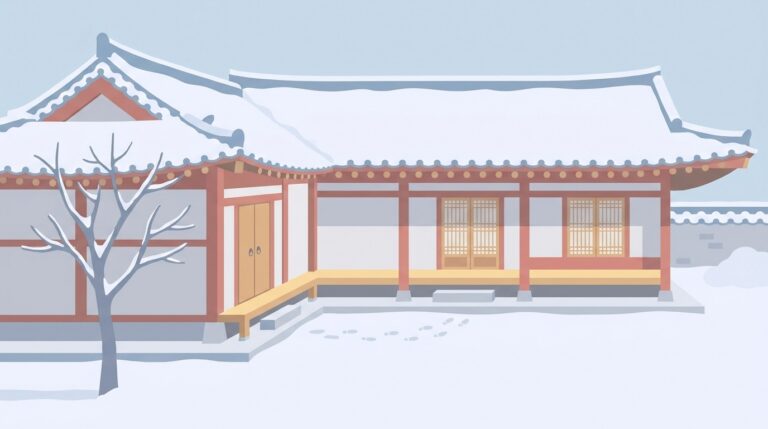
Picture this: You are sitting beside the wooden lattice window of an antique Hanok teahouse nestled along the stone walls of Jeongdong-gil. The winter sky deepens into a bruised, pearlescent slate. Suddenly, the first white flecks begin to drift past the eaves. Your Korean companion gazes out, sighs softly, and whispers a word that sounds less like a meteorological report and more like a line of classical verse. You want to join the moment, but your instinct pulls you back to beginner-level textbooks: “눈이 와요 (Nuni wayo / It is snowing).”
While grammatically flawless, that phrase falls utterly flat against the sheer sensory richness unfolding before you. In standard textbooks, snow is merely 눈 (nun). But in native Korean (순우리말, Sun-urimal), snow is a living, breathing presence. Korean ancestors did not view snowfall as a uniform white sheet; they differentiated it into dozens of tactile, visual, and acoustic identities based on moisture content, flake diameter, wind shear, and seasonal timing.
For advanced learners at the C1–C2 threshold, the real barrier is rarely complex grammatical syntax—it is the absence of sensory resonance. When you master these poetic pure Korean words, you stop translating weather reports from your native language and begin experiencing winter through the collective soul of Korean culture. Drawing from over a decade of coaching high-level learners and analyzing literary archives, this guide will transform your winter vocabulary from flat definitions into vivid sensory poetry.
Phase 2: Core 3 Expressions In-Depth
함박눈 (Hambangnun) • 소복소복 (Sobok-sobok) • 도둑눈 (Doduknun)
1. 함박눈 (Hambangnun)
- Pronunciation: [Ham-bang-nun] (Glide through the first syllable like the English word “hum,” then open gently into “bahng” before landing softly on “noon”.)
- Meaning: Literal: Ham-basket/bowl snow | Nuance: Exceptionally large, feathery, moisture-laden snowflakes that drift down slowly on windless, relatively gentle winter days.
- K-Culture Moment: The quintessential cinematic confession scene in classic winter K-dramas (such as Guardian: The Lonely and Great God or Crash Landing on You), where thick, downy flakes cling dramatically to dark wool coats and long eyelashes without melting instantly.
- Editor’s Insight: The prefix 함박 originates from 함박꽃 (peony) and 함지박 (a wide, generous wooden bowl). It evokes abundance, warmth, and blossoming joy. Unlike stinging sub-zero blizzards, 함박눈 brings a profound sense of hush and emotional warmth to Koreans, transforming urban concrete into an ethereal wonderland.
- Situation Spectrum: Casual ✅ | Semi-formal ✅ | Formal ✅
- 🤔 Think About It: Why does Korean culture associate heavy, damp snowfall with the generous shape of a wooden bowl (함지박) and a broad smile (함박웃음)? How does your native language poetically frame the visual generosity of weather?
2. 소복소복 (Sobok-sobok)
- Pronunciation: [So-bok-so-bok] (Enunciate with a light, whispered breath; imagine tapping velvet twice with the tip of your finger.)
- Meaning: Literal: In pillowy heaps | Nuance: A sensory mimetic adverb (의태어) capturing the quiet, tender, and unhurried accumulation of soft snow on flat surfaces like stone walls, pine boughs, and tiled roofs.
- K-Culture Moment: An atmospheric indie cinema scene (reminiscent of the quiet rural winter in Little Forest) where the camera lingers on morning light breaking over an undisturbed courtyard where snow has accumulated silently throughout the night.
- Editor’s Insight: Pay close attention to Korean sound symbolism (음상, Eumsang). The bright, lightweight vowels ‘ㅗ’ (o) convey delicate softness. If the snow were heavier, bulkier, or messy, Koreans would switch to darker vowels: 수북수북 (Subuk-subuk). Using 소복소복 paints an image of pristine, reverent stillness.
- Situation Spectrum: Casual ✅ | Semi-formal ✅ | Formal (Literary/Essay) ✅
- 🤔 Think About It: How does phonetic weight alter visual perception in your native language? What vowel sounds evoke delicacy versus physical heaviness?
3. 도둑눈 (Doduknun)
- Pronunciation: [Do-dung-nun] (Notice the nasal assimilation: the ending ‘k’ sound in 도둑 assimilates into a soft ‘ng’ before the ‘n’ in 눈.)
- Meaning: Literal: Thief snow | Nuance: Snow that slips into the world unannounced in the dead of night, startling you with a spotless white landscape when you open the curtains at dawn.
- K-Culture Moment: Contemporary Korean lifestyle essayists or morning radio hosts greeting early listeners with: “어젯밤 도둑눈이 다녀갔네요 (A thief snow visited us quietly last night).”
- Editor’s Insight: Calling snow a “thief” (도둑) is an expression of supreme affection, not resentment. It stole past your senses while you slept, leaving behind the gift of an immaculate world. It embodies the animistic intimacy Koreans traditionally hold with natural cycles.
- Situation Spectrum: Casual ✅ | Semi-formal ✅ | Formal (Literary/Broadcast) ✅
- 🤔 Think About It: Personifying the weather as a nocturnal visitor reveals a culture that sees nature as an active conversational partner. Does your language have an affectionate metaphor for unexpected weather?
Phase 3: Textbook Korean vs. Real Korean
Situation 1: Describing sudden, stinging pellet snow during a blustery afternoon
- 📖 교과서 한국어: “작고 단단한 눈이 바람과 함께 내리고 있습니다.” (Jakgo dandanhan nuni baramgwa hamkke naerigo itseumnida. / Small, hard snow is falling together with wind.)
- 🗣️ 진짜 한국어: “창밖을 보니 싸락눈이 매섭게 흩날리네요.” (Changbakk-eul boni ssarangnuni maeseopge heutnallineyo. / Looking out the window, stinging pellet-snow is scattering fiercely.)
- 💡 왜 다를까?: Native Korean rarely combines analytical adjectives (작고 단단한) to describe snowfall. Instead, advanced speakers deploy dedicated sensory nouns like 싸락눈 (graupel/pellet snow) paired with emotive verbs like 흩날리다 (to scatter flutteringly).
Situation 2: Noting that the snowfall was so slight it only leaves faint tracks
- 📖 교과서 한국어: “눈이 아주 적게 와서 발자국 모양만 조금 보입니다.” (Nuni aju jeokge waseo baljaguk moyangman jogeum boimnida. / Very little snow came, so only footprint shapes are slightly visible.)
- 🗣️ 진짜 한국어: “겨우 발자취나 비출 자국눈이 스쳤을 뿐이에요.” (Gyeou baljachwina bichul jaguknuni seuchyeosseul ppunieyo. / It was merely a trace-snow that brushed by, barely enough to show footsteps.)
- 💡 왜 다를까?: C2 mastery means condensing entire clauses of circumstantial explanation into elegant compound nouns like 자국눈 (trace-snow), instantly conveying exact depth and visual texture.
Phase 4: K-Culture Deep Dive & Non-verbal Manners
4-1. Nunchi (눈치) & The Kinetic Etiquette of Snow
In Korea, snow is an aesthetic collective experience before it is an inconvenience. When the first heavy snowfall blankets a university campus or an office alleyway in Gwanghwamun, notice the immediate communal shift: voices drop an octave, footsteps soften, and people gaze skyward in shared reverent silence.
- The Gaze: Do not immediately pull out your phone to complain about transit delays unless you are in a formal crisis. Unspoken etiquette (눈치, Nunchi) suggests sharing a three-second lingering gaze out the window with colleagues before remarking on the beauty.
- The Footsteps: When stepping onto a pristine, untouched stretch of snow in a courtyard or park, Koreans often step lightly (살금살금, Salgeum-salgeum) along the edges to preserve the immaculate visual canvas for others.
4-2. Cultural Code: Jeongjungdong (靜中動) & Winter Resonance
Korean aesthetics cherish 정중동—dynamic movement within profound stillness. Pure Korean snow vocabulary reflects an agricultural philosophy where winter was not dead time, but the Earth resting beneath a quilt (눈이불, Nun-ibul). In classic Korean modern poetry (such as the works of Baek Seok or Jeong Ji-yong) and in contemporary indie lyrics, snow categories serve as psychological mirrors. 함박눈 signals destined romantic forgiveness, while 싸락눈 signifies the biting trials of solitude. Recognizing these subtleties turns Korean literature from black-and-white text into full-sensory cinema.
Phase 5: Real-World Roleplay Scenario
Setting: An intimate, wooden-counter tea atelier in Samcheong-dong overlooking an ancient brick courtyard during an unexpected dusk snowfall.
Character: Master Han (한 명장), a 68-year-old artisan potter and essayist known for his sharp aesthetic eye and dry warmth.
[Scene Start]
Master Han: “차 한잔 들게나. 창밖을 보게, 하늘빛이 묵직해지더니 눈송이가 예사롭지 않구먼.”
(Cha hanjan deulgena. Changbakk-eul boge, haneulbichi mukjikhaejideoni nunsong-iga yesaropji ankgumeon.)
“Have a cup of tea. Look out the window; the sky grew heavy and the flakes are quite extraordinary.”
🎭 따뜻한 백자 찻잔을 두 손으로 조용히 밀어 건네며 창가를 응시한다.
Learner: “정말이네요, 선생님. 송이가 주먹만 하게 흩날리는 것이 완연한 함박눈입니다.”
(Jeongmarineyo, seonsaengnim. Song-iga jumeokman hage heutnallineun geosi wanyeonhan hambangnun-imnida.)
“Indeed, Master. The flakes are scattering as large as fists—it is unmistakable hambangnun.”
🎭 김이 피어오르는 잔을 받쳐 들며 창틀 너머로 떨어지는 눈발을 응시한다.
Master Han: “그렇지. 바람 한 점 없으니 장독대 위로 소복소복 쌓이겠어.”
(Geureotji. Baram han jeom eopseuni jangdokdae wiro sobok-sobok ssahigesseo.)
“Indeed. Without a single breath of wind, it will pile up softly and gracefully over the clay earthenware jars.”
🎭 처마 끝에서 춤추듯 떨어지는 눈덩이를 바라보며 흐뭇한 미소를 짓는다.
Learner: “네, 어젯밤 새벽길을 몰래 하얗게 덮고 간 도둑눈과는 사뭇 다른 결이 느껴집니다.”
(Ne, eojetbam saebyeokgireul mollae hayake deopgo gan doduknungwaneun samut dareun gyeori neukkyeojimnida.)
“Yes, it carries an entirely different texture from the thief-snow that slipped in to carpet the dawn roads last night.”
🎭 찻잔의 온기를 손바닥 전체로 느끼며 차분하게 운을 뗀다.
Master Han: “자네, 우리말의 숨결을 아주 깊이 헤아리는구먼. 눈의 무게를 안다는 건 마음의 깊이를 아는 것과 같지.”
(Jane, urimar-ui sumgyeor-eul aju gipi he-arineungumeon. Nun-ui mugereul andaneun geon ma-eum-ui gipireul aneun geotgwa gatji.)
“You perceive the living breath of our language so deeply. Knowing the weight of snow is like knowing the depth of the human heart.”
🎭 안경 너머로 흥미로운 눈빛을 반짝이며 고개를 끄덕인다.
Learner: “하지만 기온이 내려가면 이 포근한 눈도 밤새 굳어 빙판이 될까 걱정스럽기도 합니다.”
(Hajiman gion-i naeryeogamyeon i pogeunhan nundo bamsae gudeo bingpan-i doelkka geokjeongseureopgido hamnida.)
“Still, I also worry that if the temperature drops, this cozy snow might freeze overnight into treacherous black ice.”
🎭 차를 조심스럽게 한 모금 머금은 후 창밖 골목길 경사를 살핀다.
Master Han: “그것도 삶의 이치지. 자네, 내일 아침 길을 나설 땐 어떤 눈을 밟고 싶은가?”
(Geugeotdo salm-ui ichiji. Jane, naeil achim gireul naseol ttaen eotteon nuneul balpgo sipeun-ga?)
“That too is the law of life. Tell me, when you step out tomorrow morning, what kind of snow do you wish to tread upon?”
🎭 주전자를 들어 맑은 황금빛 차를 빈 잔에 채워주며 묻는다.
Learner: “발걸음마다 조용히 길을 내어줄 가벼운 자국눈이면 족할 것 같습니다.”
(Balgeoreummada joyonghi gireul nae-eojul gabyeoun jaguknun-imyeon jokal geot gatseumnida.)
“A light trace-snow that quietly yields a path beneath each step would be more than enough.”
🎭 잔을 살짝 들어 예를 표하며 담담하고 그윽하게 화답한다.
[Scene End]
🔀 Interactive Decision Point
How would you answer Master Han’s question: “내일 아침 길을 나설 땐 어떤 눈을 밟고 싶은가? (What kind of snow do you wish to tread upon tomorrow morning?)”
- Option A: “흙빛을 살포시 덮으며 발자취만 정갈하게 남겨주는 ‘자국눈’이면 좋겠습니다. 지나온 길을 가만히 돌아보게 하니까요.” (I hope for trace-snow that softly veils the soil and cleanly holds only footprints, prompting quiet reflection on where one has walked.)
- Outcome (Best): Master Han smiles warmly and pours you a rare reserve green tea. You demonstrated not just lexical accuracy, but the philosophical introspection innate to pure Korean sensory language.
- Option B: “차라리 날카로운 싸락눈이 내려서 아무도 집 밖으로 못 나오면 좋겠습니다. 조용하잖아요.” (I’d rather have sharp pellet-snow fall so nobody can leave their homes. At least it would be quiet.)
- Outcome (Bad): The atmosphere turns frosty. Stating a wish for harsh, isolating pellet-snow sounds misanthropic and violates the shared communal warmth of a winter tea session.
- Option C: “눈은 어차피 다 차가운 눈일 뿐이니 아무 눈이나 상관없습니다.” (Snow is just cold snow anyway, so any kind is fine with me.)
- Outcome (Risk): Master Han quietly changes the subject to mundane topics. While not grammatically incorrect, you broke the poetic mood by reducing poetic aesthetics to flat physical matter.
Phase 6: 10-Second Emotional Shadowing Drill
Master the natural pitch glide and pauses. Slashes (/) indicate breath pauses; bold marks dynamic rhythmic emphasis.
[😌 서정적이고 아련하게 / With deep contemplative tenderness]
창밖을 보아라, / 바람 한 점 없이 / 마당 가득 / 함박눈이 / 소복소복 쌓여가는구나.
(Changbakk-eul bo-ara, / baram han jeom eopsi / madang gadeuk / hambangnuni / sobok-sobok ssahyeoganeunguna.)
"Look out the window; without a single breath of wind, generous hambangnun gathers softly across the courtyard."
[😲 은밀하고 신비로운 발견의 톤 / With hushed, enchanted wonder]
어젯밤 세상 모르게 잠든 사이, / 창틀 위로 / 도둑눈이 / 하얗게 다녀갔네요.
(Eojetbam sesang moreuge jamdeun sai, / changteul wiro / doduknuni / hayake danyeogatneyo.)
"While we slept oblivious to the world last night, thief-snow silently visited our window frame in brilliant white."
[🥶 볼을 에이는 듯 단단하고 건조하게 / Crisp, brisk, and bracing]
문틈으로 새어드는 바람이 차더니, / 마른 가지 위로 / 싸락눈이 / 바스락거리며 부딪히네요.
(Munteumeuro sae-eodeuneun barami chadeoni, / mareun gaji wiro / ssarangnuni / baseurakgeorimyeo budichineyo.)
"The draft through the door frame felt biting, and now pellet-snow rustles crisply against the dry branches."
Phase 7: K-Culture Mini Dictionary
- 싸락눈 (Ssarangnun) | Granular pellet-snow / Graupel
- Usage: Used when round, hard, millet-like grains of frozen precipitation rattle against windows or sting your cheeks. In business or casual small talk: “퇴근길에 싸락눈이 떨어지니 우산 단단히 챙기세요 (Pellet-snow is falling for your commute home, so grip your umbrella firmly).”
- 자국눈 (Jaguknun) | Trace-depth snow / Footprint snow
- Usage: Snow that falls so lightly and thinly that it barely covers the ground, only sufficient to leave faint shoe prints. Often used in modern Korean prose to describe fleeting moments or transient emotional states.
- 마수걸이눈 (Masugeorinun) | The premiere seasonal snowfall
- Usage: Derived from 마수걸이 (the very first transaction made by a shopkeeper in the morning). It refers to the authentic maiden snowfall of the winter that sets the emotional tone for the entire season.
- 수북수북 (Subuk-subuk) | Heaping in voluminous bulk (Mimetic)
- Usage: The heavier, denser counterpart to 소복소복. Used when heavy, wet snow piles high on shoulders, parked cars, or trees: “눈이 치울 새도 없이 수북수북 쌓이네 (The snow is piling up heavily before we even have a chance to clear it).”
Phase 8: Traveler’s Survival Kit
Top 3 Poetic Survival Phrases
- “골목길에 눈이 얼어붙었으니 발밑 조심하세요.”
(Golmokgire nuni eorobeuteosseuni balmit josimhaseyo.)
Pro Tip: A sophisticated, caring greeting to use with taxi drivers, guesthouse hosts, or café owners during sub-zero mornings. - “나뭇가지마다 하얀 눈꽃이 참 소복하게 피었네요.”
(Namutgajimada hayan nunkkochi cham sobokhage pieotneyo.)
Pro Tip: 눈꽃 (snow flowers / rime on trees) combined with 소복하게 will instantly charm any native speaker when traveling through snowy mountainous regions like Gangwon-do or Pyeongchang. - “오늘은 날이 풀려서 눈이 폭신폭신해요.”
(Oneureun nari pullyeoseo nuni poksin-poksinhayeo.)
Pro Tip: Use 폭신폭신 (soft and springy) to praise the snow’s texture when visiting outdoor ski resorts or Hanok parks.
Editor’s Travel Note: Navigating Snowy Korea
- Essential Winter Transit Booking: If traveling to mountain towns like Gangneung or Daegwallyeong to witness classic snowscapes, avoid slick highway buses and book high-speed rail via the official 코레일톡 앱 승차권 예매 platform.
- Local Walking Navigation: Icy alleyways in historic quarters like Bukchon or Seochon freeze rapidly. Before walking, verify elevations and heated sidewalks by downloading the 네이버 지도 앱 길찾기.
- Local Hack: Look out for heated public benches (온열의자) at major Seoul bus stops. Sitting on these warm stone surfaces while watching 함박눈 fall is one of modern Korea’s most comforting daily street luxuries.
Phase 9: “One Step Deeper” (Philosophical Essay)
In contemporary Western urbanity, snowfall is frequently categorized as an infrastructural disruption—flights get canceled, roads are salted, and schedules are derailed. Traditional Korean culture, deeply rooted in centuries of communal agrarian rhythms, developed an entirely different relationship with winter’s precipitation. Snow was neither an enemy nor mere dead ice; it was a protective mantle (눈이불) shielding barley shoots from catastrophic deep-freeze winds.
Every shift in moisture, flake diameter, and wind resistance had practical and spiritual implications. When the snow fell dry and pellet-hard (싸락눈), the farmer braced for biting winds; when it blossomed in massive, gentle clumps (함박눈), it signaled the quiet, soil-enriching moisture that presaged an abundant spring. By preserving these sensory classifications in pure native Korean (순우리말), modern speakers inherit a lens of extraordinary tenderness toward the natural world. Weather is never an abstract condition happening outside; it is a shared sensory poem happening with you.
💬 Your Turn: Does your native culture distinguish winter precipitation by sensory texture, or does it rely mostly on technical meteorological measurements? Share your native language’s most evocative winter word in the comments below!
Phase 10: FAQ & Misconception Prevention
Q: What is the emotional nuance difference between ‘소복소복’ and ‘수북수북’?
A: It hinges entirely on Korean sound symbolism (음상). 소복소복 uses the bright vowel ‘ㅗ’ (o), evoking a scene that is light, pristine, tender, and aesthetically pleasing—like powdered snow settling quietly over a stone lantern. 수북수북 employs the dark vowel ‘ㅜ’ (u), which physically conveys heavy volume, substantial weight, and bulk. While you praise an untouched garden covered 소복소복, you describe the snow you must shovel off your windshield as piled up 수북수북.
Q: Is ‘첫눈’ (First snow) considered a pure native Korean word, and why is it so iconic?
A: Yes, 첫눈 (첫 [first, pure native prefix] + 눈 [snow, pure native noun]) is 100% 순우리말. In Korea, the very first recorded snowfall of the year carries immense cultural weight. Folklore says that if you confess your feelings to someone or spend time with your crush during 첫눈, your love will endure. Modern smartphone messengers like KakaoTalk even display falling snow animations across their interface the day the Korea Meteorological Administration officially declares 첫눈 in Seoul.
Q: Can I use poetic terms like ‘도둑눈’ or ‘자국눈’ in formal business discussions?
A: In a purely technical business presentation on logistics or supply chains, stick to formal Sino-Korean meteorological terms like 강설 (gangseol / snowfall) or 적설량 (jeokseollyang / snow accumulation). However, during the crucial initial small-talk phase (아이스브레이킹) before a board meeting or client dinner on a snowy morning, deploying 도둑눈 or 함박눈 demonstrates an astonishingly sophisticated, culturally fluent command of native nuance.
🚨 Common Mistakes Warning Board
- Mistake 1: Calling large, beautiful snowflakes 싸락눈 because you thought it meant “soft snow.”
- Why it’s wrong: 싸락눈 comes from 싸라기 (broken rice grains). It refers to hard, granular pellets that sting your face in blustery conditions.
- Correct Action: Use 함박눈 when admiring picturesque, fluffy flakes.
- Mistake 2: Relying exclusively on adverbs of quantity like 많이 (a lot): “눈이 많이 와요.”
- Why it’s wrong: While grammatically fine, it strips your Korean of depth at the C2 level.
- Correct Action: Replace flat quantity with vivid mimetic texture: “눈이 펑펑 쏟아지네요” (Snow is cascading down vigorously) or “소복소복 쌓이네요” (It is gathering softly).
- Mistake 3: Treating 도둑눈 as an actual crime or complaint.
- Why it’s wrong: Non-native speakers sometimes hear 도둑 (thief) and assume someone committed theft in the snow.
- Correct Action: Recognize it as a celebrated literary term for unexpected, pristine snow that fell silently while everyone was asleep.
Phase 11: Action Missions & Community
The 3-Tier Challenge
- 🥉 Bronze Mission (Solo Mastery): Stand before a mirror and shadow the Phase 6 drill three times, focusing on shifting your facial expression from warmth (함박눈) to bracing sharpness (싸락눈).
- 🥈 Silver Mission (Social Immersion): Find a winter photo on Instagram or take one out your window. Post it with a caption using at least two pure Korean sensory words (e.g., “어젯밤 다녀간 도둑눈 덕분에 온 세상이 소복소복 하얗네요.”).
- 🥇 Gold Mission (Real-World Execution): In your next language exchange or conversation with a native speaker, deliberately reject the phrase “눈이 와요”. Instead, describe the snowfall’s specific weight and movement using 함박눈, 싸락눈, or 자국눈.
🎮 K-Culture Mission
Cue up winter classic ballads on your music app—such as Park Hyo-shin’s Wild Flower (야생화) or classic winter drama OSTs. Track how many times sensory pure-Korean nature vocabulary appears in the lyrics to evoke human longing.
Phase 12: Interactive Quiz Challenge
1. Context Judgment
You are standing outside with an elderly Korean novelist on a completely calm, wind-still afternoon. Massive, soft flakes are descending slowly, resting like white cotton on your coat without melting right away. Which observation earns you the highest praise for stylistic nuance?
- A) “선생님, 싸락눈이 참 매섭게 떨어지네요.”
- B) “선생님, 바람도 없는데 함박눈이 참 포근하게 내려앉네요.”
- C) “선생님, 눈이 정말 많이, 세게 오고 있습니다.”
2. Fill-in-the-Blank
바람이 몹시 불더니, 부드럽던 눈발이 창문을 톡톡 때리는 딱딱한 ( )(으)로 바뀌었다.
(The wind blew fiercely, and the soft snow turned into hard, grain-like [ ] that tapped sharply against the windowpane.)
3. True / False
- Q: The word 도둑눈 is considered an offensive term used exclusively in rural dialects to describe weather that damages crop sheds.
- [ True / False ]
👉 Click here to reveal the answers and explanations
1. Answer: B
* Explanation: Large, gentle, downy snowflakes falling in calm conditions are the textbook definition of 함박눈. Option A is incorrect because 싸락눈 refers to hard, stinging pellets. Option C is grammatically basic textbook Korean that lacks sensory refinement.
2. Answer: 싸락눈 (Ssarangnun)
* Explanation: Hard, granular, rice-like snow that taps against windows in windy conditions is named 싸락눈.
3. Answer: False
* Explanation: 도둑눈 is an affectionate, poetic literary noun describing pristine snow that fell silently overnight without waking anyone. It is neither offensive nor a slang term.







