

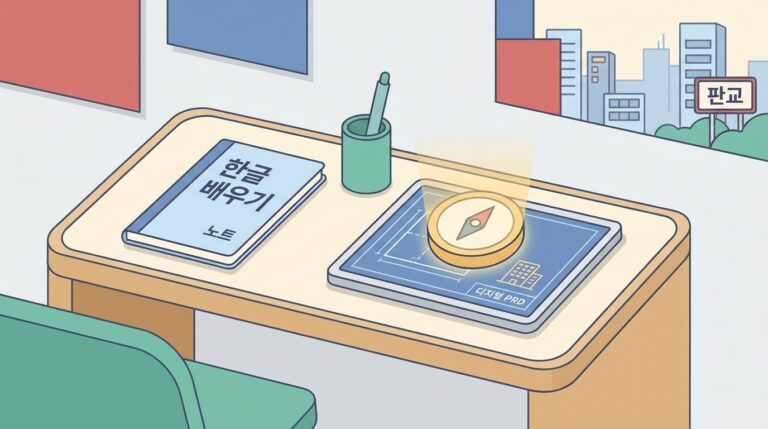
The PM Compass: How a Solid PRD Eliminates Chaos in Korean Tech
Phase 1: Empathy (Story-Driven Opening)
안녕하세요! 매일한글 에디터입니다. (Hello! This is your Daily Hangul editor.)
Picture this: You are sitting in a glass-walled conference room overlooking the bustling streets of Pangyo Techno Valley—Korea’s Silicon Valley. It is 6:30 PM on a Thursday. Your engineering lead taps his pen impatiently on his MacBook, the UI designer looks on the verge of tears, and the business development lead just walked in asking, “Can we also squeeze in Kakao Pay recurring billing before next Monday’s release?”
If you have watched K-Dramas like Start-Up (스타트업) or Search: WWW (검색어를 입력하세요 WWW), you might remember Nam Do-san and Seo Dal-mi passionately arguing over whiteboard wireframes. In real Korean tech offices, passionate debates can quickly turn into dreaded “meeting loops” (회의의 늪) if your specs are ambiguous. Scope creep sneaks in, stakeholders misunderstand deliverables, and suddenly you are dragged into four follow-up huddles a day just to clarify what a single button should do.
Here is the secret: In Korean business culture, where speed (빨리빨리) meets high-context consensus building, a bulletproof Product Requirements Document (PRD) is not just documentation—it is your ultimate compass (나침반). By learning how to set boundaries, declare spec freezes, and align cross-functional teams in natural, professional B2-level Korean, you will command respect, protect your engineers’ focus, and slash endless meetings down to zero.
Phase 2: Core Expressions In-Depth
1. 이번 스프린트에서는 스펙을 동결하겠습니다
- Pronunciation: [Ibeon seupeurinteueseoneun seupegeul donggyeolhagetseumnida] (Sounds like: Ee-beon spray-teu-eh-seo-noon spek-eul dong-gyeol-ha-get-soom-nee-da)
- Meaning: Literal: “In this sprint, we will freeze the specs.” / Pragmatic: “No more feature requests or scope modifications are allowed for this delivery cycle.”
- K-Culture Moment: The climactic sprint review meeting in Start-Up, where Dal-mi has to firmly tell stakeholders that additional AI bells and whistles must wait until the next version.
- Editor’s Insight: The word 동결 (freeze) is borrowed from financial and technical jargon (e.g., 자산 동결 / asset freeze). Using it alongside the polite formal ending ~겠습니다 signals strong professional conviction without sounding rude or combative.
- Situation Spectrum:
- Casual (반말): 🚫 이번 스프린트는 스펙 동결이야. (Only acceptable among co-founders or close peers over drinks)
- Semi-formal (해요체): ⚠️ 이번 스프린트는 스펙 동결할게요. (Good for fast-paced 1-on-1 Slack chats)
- Formal (하십시오체): ✅ 이번 스프린트에서는 스펙을 동결하겠습니다. (Standard, authoritative for all-hands and kickoffs)
- 🤔 Think About It: In many Western tech hubs, a PM might casually say, “Let’s lock this down.” In Korean, using a decisive Sino-Korean term like 동결 (凍結) creates institutional weight, shielding the team from executive meddling.
2. PRD에 싱크를 맞춰서 작업해 주세요
- Pronunciation: [PRDe singkeureul matchwoseo jageophae juseyo] (Sounds like: PRD-eh sing-keu-reul maht-chwoh-seo jah-geop-hae joo-seh-yo)
- Meaning: Literal: “Please work by matching the sync to the PRD.” / Pragmatic: “Please ensure all implementation aligns strictly with the single source of truth in the PRD.”
- K-Culture Moment: The portal strategy meetings in Search: WWW, where Bae Ta-mi reins in rogue design changes by referencing the core project brief.
- Editor’s Insight: ‘싱크를 맞추다’ (to sync) is omnipresent in Korean tech spaces (판교어 / Pangyo-speak). Pairing it with ~아/어 주세요 keeps the request cooperative yet binding.
- Situation Spectrum:
- Casual: 🚫 PRD 보고 싱크 맞춰 줘. (Too blunt for cross-functional peers)
- Semi-formal: ✅ PRD에 싱크를 맞춰서 작업해 주세요. (Perfect for everyday Jira/Slack ticket descriptions)
- Formal: ✅ PRD 기준에 싱크를 맞추어 진행해 주시기 바랍니다. (Best for official release sign-offs)
- 🤔 Think About It: Notice the verb 맞추다 (to adjust/fit together). It emphasizes mutual coordination rather than top-down command, aligning with Korean group harmony.
3. 불필요한 회의를 줄이고 문서로 소통합시다
- Pronunciation: [Bulpillyohan hoe-uireul jurigo munseoro sotonghapsida] (Sounds like: Bool-peel-yo-hahn hway-eui-reul joo-ree-go moon-seo-ro soh-tong-hahp-shee-dah)
- Meaning: Literal: “Let’s reduce unnecessary meetings and communicate via documents.” / Pragmatic: “Let’s cut the calendar clutter and keep our alignment asynchronous via documentation.”
- K-Culture Moment: A modern IT startup CEO announcing an async-first transition on KakaoWork or Slack to boost developer productivity.
- Editor’s Insight: The suggestive formal ending ~합시다 (Let’s do…) should be used carefully. When said by a project lead or PM during retrospectives, it acts as an inspiring call to action. To higher executives, soften it to “~하면 좋겠습니다” (It would be great if we…).
- Situation Spectrum:
- Casual: ⚠️ 회의 줄이고 노션으로 얘기하자. (Casual between friendly teammates)
- Semi-formal: ✅ 비효율적인 미팅은 줄이고 문서로 소통해요. (Friendly yet professional)
- Formal: ✅ 불필요한 회의를 최소화하고 문서 중심의 소통을 제안드립니다. (Top-tier diplomacy for senior stakeholders)
- 🤔 Think About It: Korean workplace culture historically favored in-person meetings (대면 회의) for reading non-verbal cues. Proposing async documentation shows modern tech maturity.
Phase 3: Textbook Korean vs. Real Korean
Situation 1: Declaring Feature Scope Lock
- 📖 교과서 한국어 (Textbook): 더 이상 기능을 추가하지 않기로 결정했습니다. (Deo isang gineungeul chugahaji ankiro gyeoljeonghaetseumnida. / We have decided not to add any more functions.)
- 🗣️ 진짜 한국어 (Real Pangyo Tech): 이번 버전 범위는 여기서 픽스하고, 추가 요청은 백로그로 넘기겠습니다. (Ibeon beojeon beomwineun yeogiseo pikseuhago, chuga yocheongeun baekrogeuro neomgigetseumnida. / Let’s fix this version’s scope here and push any additional requests to the backlog.)
- 💡 왜 다를까?: Korean tech workers constantly blend English tech jargon (픽스/Fix, 백로그/Backlog) with functional Korean particles. Saying ‘기능을 추가하지 않겠다’ sounds robotic, whereas ‘범위를 픽스한다’ is the natural industry standard.
Situation 2: Asking if Everyone Is Aligned
- 📖 교과서 한국어 (Textbook): 모두 제 생각과 같은 의견이십니까? (Modu je saenggakgwa gateun uigyeon-isipnikka? / Do all of you share the same opinion as mine?)
- 🗣️ 진짜 한국어 (Real Pangyo Tech): 지금까지 내용 다들 얼라인(Align)되셨을까요? (Jigeumkkaji naeyong dadeul eollain-doesyeosseulkkayo? / Is everyone aligned on what we’ve covered so far?)
- 💡 왜 다를까?: Directly asking if people “agree with me” puts Korean colleagues on the spot. Asking ‘얼라인되셨을까요?’ uses polite honorific questioning to confirm shared understanding without forcing immediate personal compliance.
Phase 4: K-Culture Deep Dive & Non-Verbal Manners
4-1. Nunchi (눈치) & Non-Verbal Communication in Tech Reviews
In a Korean sprint planning or PRD walk-through, silence from senior engineers or designers rarely means “100% agreement.” Often, it means they foresee a critical technical debt or UI bottleneck but are reluctant to bluntly contradict the PM in front of the group.
- The Head Tilt & Inhaled Breath: If an engineering manager tilts their head slightly and inhales through their teeth (“씁…”), your PRD has hit an unaddressed technical hurdle. Do not push for an immediate “Yes.” Instead, pause and ask: “혹시 기술적으로 병목이 생길 만한 부분이 있을까요?” (Hoksi gisuljeogeuro byeongmogi saenggil manhan bubuni isseulkkayo? / Could there be any potential technical bottlenecks here?)
- Screen Sharing Etiquette: When presenting a PRD on Notion or Confluence, zoom to 125%, hover your cursor over the specific user story you are reading, and pause after every functional block. Rushing through text makes stakeholders feel sidelined.
4-2. Culture Code: The “Pangyo Way” (판교 스타일)
Modern Korean startups balance two conflicting values: the traditional respect for hierarchy and the modern Silicon Valley drive for psychological safety (심리적 안전감). To manage this, Korean PMs act less like authoritative bosses and more like “servant navigators.”
Writing an exhaustive, crystal-clear PRD is seen as a badge of deep respect toward developers and designers. When your documentation answers edge cases before they are even asked, you earn “개발자들의 신뢰” (developer trust)—the highest currency any tech product manager can possess in Korea.
Phase 5: Real Role-Play Scenario
Setting: A hybrid planning room at a fast-growing Fintech startup in Gangnam. PM Alex (알렉스) is presenting the final v2.1 PRD to Senior Tech Lead Minjun (민준 팀장).
- Turn 1 (Alex):
- 🎭 Standing by the display, pointing to the user flow on the Notion PRD.
- 팀장님, 이번 송금 개편 PRD 검토해 보셨을까요?
- (Timjangnim, ibeon songgeum gaepyeon PRD geomtohae bosyeosseulkkayo?)
- “Team Lead, have you had a chance to review the remittance revamp PRD?”
- Turn 2 (Minjun):
- 🎭 Nods slowly, scrolling through the ticket list on his laptop.
- 네, 쭉 봤습니다. 근데 결제사 API 연동 예외 케이스가 좀 빠져 있더라고요.
- (Ne, jjuk bwasseumnida. Geunde gyeoljesa API yeondong yewoe keiseuga jom ppajyeo itdeoragoyo.)
- “Yes, I looked through it. But some edge cases for payment gateway API integration seem to be missing.”
- Turn 3 (Alex):
- 🎭 Quickly takes notes and adds a comment on the document block.
- 짚어주셔서 감사합니다. 그 부분은 오늘 오후 3시 전까지 PRD에 보완해 두겠습니다.
- (Jipeojusyeoseo gamsahamnida. Geu bubuneun oneul ohu sesi jeonkkaji PRDe bowanhae dugetseumnida.)
- “Thank you for pointing that out. I will refine and update those edge cases in the PRD by 3 PM today.”
- Turn 4 (Minjun):
- 🎭 Leans back, crossing arms thoughtfully.
- 알겠습니다. 그거 외에는 플로우 자체는 깔끔하네요. 일정은 언제로 잡고 있죠?
- (Algetseumnida. Geugeo oeneun peullou jacheneun kkalkkeumhaneyo. Iljeongeun eonjero japgo itjyo?)
- “Understood. Aside from that, the flow itself is clean. What is our target timeline?”
- Turn 5 (Alex):
- 🎭 Displays the sprint roadmap slide showing the spec freeze milestone.
- 금요일까지 피드백 수렴하고, 다음 주 월요일부터는 스펙을 동결하고 개발에 집중하면 합니다.
- (Geumyoilkkaji pideubaek suryeomhago, daeum ju woryoilbuteoneun seupegeul donggyeolhago gaebare jipjunghamyeon hamnida.)
- “We collect feedback until Friday, and starting next Monday, I propose freezing specs so we can focus purely on development.”
- Turn 6 (Minjun):
- 🎭 Smiles faintly, looking visibly relieved.
- 좋습니다. 중간에 사업팀에서 기능 추가 요구 들어오면 다 막아주시는 거죠?
- (Jotseumnida. Junggane saeoptimeseo gineung chuga yogu deureoomyeon da magajusineun geojyo?)
- “Sounds great. You’ll shield us if the business team comes in midway demanding extra features, right?”
- Turn 7 (Alex):
- 🎭 Smiles back confidently with a firm, assuring nod.
- 당연하죠. 변경 사항은 무조건 다음 스프린트 백로그로 넘기겠습니다. PRD만 보고 달려주세요!
- (Dangyeonhajyo. Byeongyeong sahangeun mujogeon daeum seupeurinteu baekrogeuro neomgigetseumnida. PRDman bogo dallyeojuseyo!)
- “Of course. Any scope changes will strictly roll over to the next sprint backlog. Please just run with the PRD!”
- Turn 8 (Minjun):
- 🎭 Closes laptop screen firmly with satisfaction.
- 든든하네요. 그럼 이번 스프린트는 불필요한 미팅 없이 티켓대로 갑시다.
- (Deundeunhaneyo. Geureom ibeon seupeurinteuneun bulpillyohan miting eopsi tiketdaero gapsida.)
- “That gives me peace of mind. Let’s run this sprint straight by the tickets without needless meetings.”
🔀 Interactive Decision Point
During sprint day 4, the Marketing Director messages Alex on Slack: “Can we add a pop-up coupon banner right before the checkout button for this launch?” What is Alex’s best move?
- Choice A (The Pushover): “네, 개발팀에 확인해보고 바로 넣어볼게요!” (Sure, let me check with dev and squeeze it right in!)
- Choice B (The Compass PM – Best): “좋은 아이디어네요! 다만 현재 스펙이 동결된 상태라, 이번 배포 후 v2.2 백로그 최우선 순위로 올려서 검토하겠습니다.” (Great idea! However, specs are currently frozen, so I will prioritize this in the v2.2 backlog right after launch for review.)
- Choice C (The Wall): “스펙 동결인 거 모르세요? 절대 안 됩니다.” (Don’t you know specs are frozen? Absolutely not.)
Analysis:
* Choice A (Bad): Violates trust with engineering, breaks sprint velocity, sets a disastrous precedent for scope creep.
* Choice B (Best): Validates the stakeholder’s intent politely, upholds the spec freeze boundary without confrontation, and offers a concrete async solution.
* Choice C (Risk): Creates severe political friction in a Korean matrix organization; damages cross-departmental rapport.
Phase 6: 10-Second Emotion Shadowing Drill
- Sentence 1: Firm & Reassuring Boundary Setting
[💼 단호하면서도 든든하게 / Firm and Reassuring]- “이번 스프린트에서는 / 스펙을 확실히 동결해서 / 개발팀 리소스를 지키겠습니다.”
- (Ibeon seupeurinteueseoneun / seupegeul hwaksilhi donggyeolhaeseo / gaebaltim risoseureul jikigetseumnida.)
- Sentence 2: Polite Collaborative Alignment
[🤝 협력적이고 정중하게 / Collaborative and Respectful]- “의문점이 생기시면 / 슬랙 스레드나 / PRD 코멘트로 싱크 맞춰주세요.”
- (Uimunjeomi saenggisimyeon / seullaek seuredeuna / PRD komenteuro singkeu matchwojuseyo.)
- Sentence 3: Efficient Process Leadership
[🚀 경쾌하고 프로페셔널하게 / Brisk and Professional]- “불필요한 싱크 미팅은 줄이고, / 문서 기반으로 / 빠르게 의사결정합시다!”
- (Bulpillyohan singkeu mitingeun jurigo, / munseo gibaneuro / ppareuge uisagyeoljeonghapsida!)
Phase 7: K-Culture Mini Dictionary
- 스펙아웃 (Seu-pek-a-ut | Spec-Out)
- Meaning: Deliberately removing or de-scoping a feature from the current release to hit deadlines.
- In Context: “일정이 촉박하니 이 필터 기능은 이번 버전에서 스펙아웃하죠.” (Since timeline is tight, let’s spec-out this filter feature for this version.)
- 핑퐁 (Ping-pong | Back-and-forth ping-pong)
- Meaning: Repeated, circular discussions or messaging exchanges without clear resolution.
- In Context: “슬랙에서 핑퐁 치지 말고, PRD에 결정 사항만 아카이빙해 주세요.” (Instead of endless ping-pong on Slack, please just archive final decisions in the PRD.)
- 공유 (Gong-yu | Sharing / Alignment broadcast)
- Meaning: Broadcasting information, roadmaps, or meeting minutes across teams to build consensus.
- In Context: “수정된 PRD 링크 전사 채널에 공유드렸습니다.” (I have shared the updated PRD link to the company-wide channel.)
- 티켓 쪼개기 (Ti-ket Jjo-gae-gi | Ticket splitting / Task breakdown)
- Meaning: Breaking large user stories into atomic Jira or Linear tasks so developers can sprint without ambiguity.
- In Context: “PRD가 상세하니까 티켓 쪼개기가 훨씬 수월하네요.” (Because the PRD is so detailed, splitting tickets is much smoother.)
Phase 8: Expat Professional Survival Kit
Survival Expressions Top 3
- “PRD 최신본 확인 부탁드립니다.” (PRD choesinbon hwagin butakdeurimnida.)
- English: “Please check the latest version of the PRD.”
- Pro Tip: Whenever someone asks a question already answered in the doc, paste this with the Notion anchor link.
- “이 부분은 기획 의도와 다르게 구현된 것 같습니다.” (I bubuneun gihoek uidowa dareuge guhyeondoen geot gatseumnida.)
- English: “It seems this part was implemented differently from the intended product spec.”
- Pro Tip: The magic phrase to flag a QA bug without pointing fingers at the engineer.
- “스펙 변경이 필요하시면 변경 요청서를 작성해 주세요.” (Seupek byeonggyeongi piryohasimyeon byeongyeong yocheongseoreul jakseonghae juseyo.)
- English: “If a spec change is needed, please submit a change request form.”
- Pro Tip: The ultimate diplomatic shield to stop impromptu “drive-by” requests from leadership.
Editor’s Professional Note
Navigating Korean tech ecosystems requires utilizing the platforms local teams rely on daily. Download the desktop client for 카카오워크 (KakaoWork) or configure your workspace on Notion 한국어 템플릿 갤러리 to adopt Korean-standard PRD frameworks. When working in Korean tech clusters like Pangyo or Teheran-ro, bookmark 네이버 지도 앱 다운로드 to easily find tech meetup venues and networking cafes around Pangyo Station Exit 1.
Phase 9: “One Step Deeper” (Reflective Prompt)
In Korean corporate philosophy, consensus is known as “합의” (hab-ui). While Western tech literature often champions the “disagree and commit” mantra, Korean teams deeply value relational harmony (인화 / Inhwa). When a PM freezes specs abruptly without transparent written rationale, teammates can perceive it as authoritarian rather than disciplined.
However, when a PM puts sweat equity into a meticulous PRD that explicitly accounts for engineering edge cases and business goals, it demonstrates profound care for everyone’s time and mental health. A great PRD in Korea is not cold bureaucracy; it is an act of empathetic leadership.
💬 Your Turn: How does your current workplace handle “spec freezes” versus mid-sprint change requests? Have you ever experienced cross-cultural misunderstandings when setting product boundaries? Drop your thoughts in the comments below!
Phase 10: FAQ & Common Mistakes
Q: What is the most polite way to say “No” to a senior executive who wants to alter specs after a freeze?
A: Avoid direct negatives like “안 됩니다” (Cannot do). Instead, use the deferral technique: “대표님, 말씀해주신 방향성도 정말 좋네요. 다만 현재 스프린트 스펙이 동결된 상태라, 이번 빌드 안정성을 확보한 후 다음 주 우선순위 검토 회의 때 즉각 반영 방안을 모색해도 괜찮을까요?” (CEO, that direction is wonderful. Since current specs are frozen, may we explore integrating it right after we secure build stability next week?)
Q: Can I use English tech terms like ‘PRD’, ‘Sync’, or ‘QA’ directly in Korean sentences?
A: Absolutely! In fact, Korean startups and tech giants (Naver, Kakao, Coupang, Toss) use these daily. Just conjugate them with Korean auxiliary verbs: PRD 작성하다 (write a PRD), 싱크 맞추다 (sync up), QA 돌리다 (run QA), 릴리즈 치다 / 배포하다 (release/deploy).
Q: How do Korean engineers prefer to receive PRD comments?
A: Inline comments (인라인 코멘트) with clear context are preferred over broad general critiques. Start with positive acknowledgment before requesting changes: “이 플로우 깔끔하게 정리해주셔서 감사합니다! 혹시 네트워크 타임아웃 발생 시 에러 화면 처리는 어떻게 정의하면 좋을까요?”
🚨 Common Mistakes Board
- Mistake 1: Announcing a spec freeze casually on a private messenger chat instead of publishing an official change log.
- Correct Action: Post an official notice in the project thread with tag
@here: “[공지] v2.1 기능 스펙이 금일 18시 부로 동결(Freeze)되었습니다.”
- Correct Action: Post an official notice in the project thread with tag
- Mistake 2: Using informal command imperative (~해라 / ~해) to developers during tight crunches.
- Correct Action: Always maintain semi-formal or formal polite forms (~해주세요 / ~부탁드립니다) even under intense pressure.
- Mistake 3: Saying “회의합시다” (Let’s have a meeting) for every minor ticket ambiguity.
- Correct Action: Write a one-line comment on the PRD ticket first: “이 티켓에 기획 의도 코멘트 남겼으니 확인 부탁드립니다.”
Phase 11: Action Missions
- 🥉 Bronze Mission (Solo Practice): Read the Phase 6 shadowing sentences aloud three times using the emotion tags until your pronunciation feels natural.
- 🥈 Silver Mission (Community Alignment): On your personal study notes or social feed, write a sample Korean Slack status declaring your focus time: “현재 문서 작업 중입니다. 급한 용건은 스레드로 남겨주세요!” (Currently documenting. Please leave urgent matters in the thread!)
- 🥇 Gold Mission (Real Execution): In your next tech planning discussion or language exchange, use the phrase “이번 버전 범위를 먼저 픽스합시다” (Let’s fix this version’s scope first) to steer the conversation.
- 🎮 K-Culture Mission: Watch Episode 5 of the K-Drama Start-Up and spot how the characters debate technical feasibility versus product delivery schedules on their office whiteboard!
Phase 12: Interactive Quiz Challenge
Test your Pangyo PM fluency! Can you make the right call in these realistic tech situations?
- Situation Judgment: A designer asks you whether they can revamp the entire typography scale two days before code freeze. What is the most professional response?
- (A) 디자인 마음대로 하세요.
- (B) 이번 스프린트는 스펙 동결 단계이니, 디자인 시스템 개편 건은 다음 스프린트에 함께 논의해요.
- (C) 회의를 5번 더 열어서 결정하죠.
- Fill in the Blank: “불필요한 회의를 줄이고, Notion ______로 진행 상황을 싱크합시다.” (Hint: The Korean word for ‘document’)
- Answer: 문 __
- True or False Cultural Quiz: In a Korean tech environment, proposing asynchronous written communication instead of endless daily meetings is considered disrespectful to team leads.
- [True / False]
👉 Click here to check Answers & Explanations
- Answer: (B)
- Explanation: Choice B sets a polite but firm boundary while validating the designer’s initiative for future sprints without jeopardizing current release delivery.
- Answer: 문서 (Mun-seo)
- Explanation: 문서 means document. “문서로 진행 상황을 싱크합시다” (Let’s sync progress via documentation) is standard modern tech phrasing.
- Answer: False
- Explanation: Quite the contrary! As long as it is proposed respectfully with clear structured formats (like a well-maintained PRD), async documentation is hailed as high PM maturity in today’s leading Korean tech hubs.
- Explanation: Quite the contrary! As long as it is proposed respectfully with clear structured formats (like a well-maintained PRD), async documentation is hailed as high PM maturity in today’s leading Korean tech hubs.







