

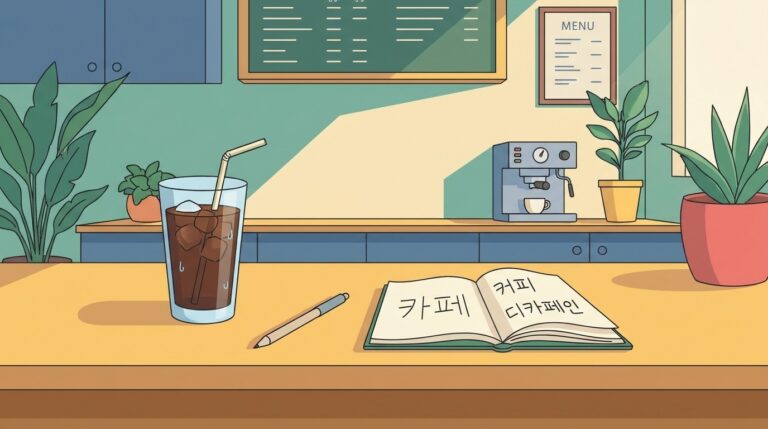
안녕하세요! 매일한글 에디터입니다.
Phase 1: Empathy (Real-Life Cafe Dilemma)
Picture this: It is 8:30 PM on a crisp evening in Seoul’s ultra-hip Seongsu-dong neighborhood. After an exciting day exploring ancient palaces and shopping through lively streets, you spot the aesthetic cafe of your dreams—warm minimalist lighting, chic concrete walls, and the intoxicating aroma of freshly ground espresso. You desperately want an iced latte to unwind, but there is just one problem: caffeine past noon keeps your eyes wide open until 4 AM. You step up to the counter, the friendly barista smiles and greets you, and your mind completely freezes. How do you say ‘Can I get this in decaf?’ in Korean?
If you have ever felt that sudden surge of counter anxiety, don’t worry—you are definitely not alone! Hundreds of our beginner students have told us about the exact same heart-racing moment. Today, you are going to master the exact, natural phrase native Koreans use to switch their beans to decaf. No awkward textbook robotic sentences, just warm, natural communication that guarantees a delicious drink and a peaceful night of sleep.
Phase 2: Top 3 Core Expressions In-depth Analysis
1. 디카페인으로 바꿀 수 있어요? (Dikafeineuro bakkul su isseoyo?)
- Pronunciation: Dee-kah-peh-een-eu-ro bahk-kool soo ee-ssuh-yo? (Think of “Dee-caffeine” pronounced with a soft Korean “p” sound instead of “f”).
- Meaning: Literal: “Can [I] change [it] to decaf?” / Actual Nuance: A very polite, natural request to substitute regular espresso beans for decaf beans.
- K-Culture Moment: You will hear this constantly in workplace K-Dramas when colleagues grab coffee during late-night overtime or weekend date scenes.
- Editor’s Insight: The particle -으로 (-euro) means “into” or “as”, and 바꿀 수 있어요? (bakkul su isseoyo?) means “can I swap/change?”. It is the golden key phrase for customization at any Korean establishment!
- Situation Spectrum: Casual: ⚠️ | Semi-formal: ✅ | Formal: ✅
- 🤔 Think About It: In English, we often say “Can I have a decaf latte?”, putting “decaf” as an adjective. Why do you think Korean conceptualizes this as “changing/swapping” (bakkuda) the default shot?
2. 디카페인 돼요? (Dikafein dwaeyo?)
- Pronunciation: Dee-kah-peh-een dway-yo? (Rhymes with “sway-yo”).
- Meaning: Literal: “Does decaf work?” / Actual Nuance: “Do you have decaf available?” or “Is decaf an option?”
- K-Culture Moment: The brisk, efficient exchange you hear in busy Gangnam subway station cafes during the morning rush hour.
- Editor’s Insight: 돼요? (Dwaeyo?) comes from the verb doeda (to become / to be possible). It is one of the most versatile words in the entire Korean language. If you are in a rush or unsure about bean availability, this quick question saves the day.
- Situation Spectrum: Casual: ✅ | Semi-formal: ✅ | Formal: ⚠️
- 🤔 Think About It: Notice how subjects like “you” or “this store” are completely omitted. How does this reflect the Korean tendency to focus on the shared situational context rather than individual actors?
3. 샷 연하게 해주세요 (Syat yeonhage hae-juseyo)
- Pronunciation: Shaht yuhn-hah-geh heh-joo-seh-yo
- Meaning: Literal: “Please make the shot light/diluted.” / Actual Nuance: “Please pull a half-shot / make it weak.”
- K-Culture Moment: When a character in a healing slice-of-life drama meets a friend late at night at an indie cafe that doesn’t carry decaf beans.
- Editor’s Insight: Not every quaint neighborhood cafe in Korea stocks decaf beans. When they say decaf is unavailable, this phrase is your best safety net to drastically cut down your caffeine intake without missing out on cafe time!
- Situation Spectrum: Casual: ⚠️ | Semi-formal: ✅ | Formal: ✅
- 🤔 Think About It: Yeonhada means soft, mild, or pale. Compare this with English “weak coffee”—doesn’t yeonhage sound much gentler and more pleasant?
Phase 3: Textbook Korean vs. Real Korean
- Situation 1: Asking if decaf is possible
- 📖 교과서 한국어 (Textbook): 디카페인 커피로 변경이 가능합니까? (Dikafein keopiro byeongyeong-i ganeunghamnikka?)
- 🗣️ 진짜 한국어 (Real-Life): 디카페인 돼요? (Dikafein dwaeyo?)
- 💡 왜 다를까? (Why the difference?): Old textbooks teach ultra-formal Sino-Korean words like 변경 (alteration) and 가능합니까 (is it possible). In real daily life, natural speakers keep transactions warm, brief, and conversational using simple verbs.
- Situation 2: Asking for a lighter brew
- 📖 교과서 한국어 (Textbook): 에스프레소 농도를 약하게 조절해 주십시오. (Eseupeureso nongdoreul yakhage jojeolhae jusipsio.)
- 🗣️ 진짜 한국어 (Real-Life): 연하게 해주세요. (Yeonhage hae-juseyo.)
- 💡 왜 다를까? (Why the difference?): You are ordering coffee, not writing a chemistry lab manual! Koreans value quick comprehension at counters, so 연하게 해주세요 delivers the exact request instantly.
Phase 4: K-Culture Deep Dive & Non-Verbal Manners
4-1. 눈치 (Nunchi) & Counter Etiquette
In Korea, ordering at a counter is an exercise in mutual respect and speed. When handing over your credit card, debit card, or phone for mobile payment, always use two hands, or place your left hand gently supporting your right forearm. Give a subtle 15-degree head nod as you ask, 디카페인으로 바꿀 수 있어요? (Dikafeineuro bakkul su isseoyo?). This tiny gesture radiates good nunchi (social awareness) and politeness, and the barista will gladly accommodate your request!
4-2. Cultural Code: The Late-Night Cafe Boom & Decaf Evolution
Korea famously runs on “Ah-Ah” (아이스 아메리카노 – Iced Americano), even in freezing sub-zero winter temperatures. But because cafes double as social living rooms, study spaces, and post-dinner meeting spots until 10 PM or midnight, the demand for decaf has exploded. Large chains (like Mega Coffee, Compose, Ediya, and Starbucks Korea) and independent roasteries now prominently offer decaf options, often labeled as 디카페인 (Decaf) on the touch-screen kiosks. Knowing how to ask for it unlocks a relaxed late-night hangout without caffeine jitters.
Phase 5: Real-Life Roleplay Scenario
- Setting: A warm, indie coffee bar in Yeonnam-dong. Lo-fi jazz plays in the background.
- Characters:
- Barista Minji (민지): Kind, attentive, and wearing a crisp beige apron.
- Alex (알렉스): An eager traveler who loves coffee but wants to sleep tonight.
- Turn 1 (Minji): 안녕하세요! 주문 도와드릴까요? (Annyeonghaseyo! Jumun dowadeurilkkayo?)
- 🎭 Greeting with a gentle smile and resting hands on the register counter.
- Translation: “Hello! May I take your order?”
- Turn 2 (Alex): 안녕하세요. 아이스 라떼 한 잔 주세요. (Annyeonghaseyo. Aiseu rate han jan juseyo.)
- 🎭 Making soft eye contact, pointing gently at the menu board.
- Translation: “Hello. One iced latte, please.”
- Turn 3 (Minji): 네, 아이스 라떼요. 매장에서 드시고 가세요? (Ne, aiseu rateyo. Maejang-eseo deusigo gaseyo?)
- 🎭 Typing on the POS screen, looking up to confirm.
- Translation: “Sure, an iced latte. Will you be drinking it in the cafe?”
- Turn 4 (Alex): 네, 먹고 갈게요. 저… 혹시 디카페인으로 바꿀 수 있어요? (Ne, meokgo galgeyo. Jeo… hoksi dikafeineuro bakkul su isseoyo?)
- 🎭 Leaning in slightly with a polite head tilt.
- Translation: “Yes, for here. Um… by any chance, can I change it to decaf?”
- Turn 5 (Minji): 네, 가능해요! 300원 추가되는데 괜찮으세요? (Ne, ganeunghaeyo! Sambae-won chugadoeneunde gwaenchaneuseyo?)
- 🎭 Nodding brightly, pointing out the minor substitution fee.
- Translation: “Yes, that’s possible! It’s a 300 won extra charge, is that okay?”
- Turn 6 (Alex): 네, 괜찮아요! 디카페인으로 해주세요. (Ne, gwaenchanayo! Dikafeineuro hae-juseyo.)
- 🎭 Nodding with relief and a happy smile.
- Translation: “Yes, that is totally fine! Please make it decaf.”
- Turn 7 (Minji): 결제 도와드리겠습니다. 카드 꽂아주세요. (Gyeolje dowadeurigesseumnida. Kadeu kkoja-juseyo.)
- 🎭 Gesturing with an open palm toward the IC card reader.
- Translation: “I will assist with the payment. Please insert your card.”
- Turn 8 (Alex): 감사합니다! (Gamsahamnida!)
- 🎭 Handing the card with both hands and bowing politely.
- Translation: “Thank you!”
🔀 Interactive Decision Point
If the barista says: 죄송하지만 저희는 디카페인 원두가 없어요 (Sorry, we don’t carry decaf beans), how should you respond?
- Choice A: “그럼 샷 연하게 해주세요! (Geureom syat yeonhage hae-juseyo!)”
- Feedback: BEST! Flexible, extremely natural, and cuts down the caffeine dose while keeping your drink order smooth.
- Choice B: “왜 없어요? 디카페인 주세요. (Wae eopseoyo? Dikafein juseyo.)”
- Feedback: BAD. Demanding “Why don’t you have it? Give me decaf” sounds confrontational and rude in Korean culture.
- Choice C: “그냥 나가겠습니다. (Geunyang nagagesseumnida.)”
- Feedback: RISK. Literally “I will just leave.” While grammatically understandable, abruptly walking out without an apologetic smile or “아, 그럼 다음에 올게요 (Ah, then I’ll come next time)” creates an awkward atmosphere.
Phase 6: 10-Second Emotion Shadowing Drill
Practice these lines out loud! Use the / marks to take a tiny micro-pause, mimicking natural Korean rhythm:
[😊 Polite & Inquiring]
저 / 혹시 / 디카페인으로 / 바꿀 수 있어요?
(Jeo / hoksi / dikafeineuro / bakkul su isseoyo?)-
[☕ Friendly & Decisive]
네! / 디카페인으로 / 부탁드려요.
(Ne! / dikafeineuro / butakdeuryeoyo.) -
[🥺 Hopeful & Soft]
아, 그럼 / 샷 하나만 / 연하게 해주세요.
(Ah, geureom / syat hanaman / yeonhage hae-juseyo.)
Phase 7: K-Culture Mini Dictionary
-
아아 (A-A)
- Meaning: Short for 아이스 아메리카노 (Iced Americano).
- Usage: Korea’s unofficial national beverage. You can order: “디카페인 아아 한 잔이요” (One decaf Iced Americano, please).
- 얼죽아 (Eol-juk-ah)
- Meaning: “Freezing to death, but still iced coffee!” (얼어 죽어도 아이스 아메리카노).
- Usage: A cultural buzzword used by locals who refuse hot drinks even in the middle of a blizzard.
- 샷 추가 (Syat chuga)
- Meaning: Extra shot of espresso.
- Usage: When studying or working long hours: “샷 추가해 주세요” (Please add an extra shot).
- 진동벨 (Jindong-bel)
- Meaning: Vibrating pickup buzzer/pager.
- Usage: When your order is placed, cafes hand you this gadget. When it lights up and buzzes, return to the pickup counter.
Phase 8: Survival Kit for Travelers
Top 3 Survival Phrases
- 디카페인 있어요? (Dikafein isseoyo?)
- Romanization: Dee-kah-peh-een ee-ssuh-yo?
- Pro Tip: The simplest way to ask “Do you have decaf?” before committing to a drink.
- 포장해 주세요 (Pojanghae juseyo)
- Romanization: Poh-jang-heh joo-seh-yo
- Pro Tip: Use this when you want your coffee to-go instead of sitting inside.
- 영수증 버려주세요 (Yeongsujeung beoryeojuseyo)
- Romanization: Young-soo-jeung buh-ryuh-joo-seh-yo
- Pro Tip: Baristas almost always ask if you need a receipt. Say this to politely say “Please discard the receipt.”
Editor’s Travel Note
When wandering through Korean alleys, Google Maps often lags with interior floor plans. Make sure you complete your Naver Map app download before your trip; searching “디카페인 카페” (decaf cafe) directly in the app will instantly show nearby spots with confirmed decaf menus! Also, keep in mind that most modern Korean cafes are cashless, so keep a travel card or mobile payment handy.
Phase 9: A Step Deeper (Cultural Thought)
In Korean, ending your sentence with -요 (-yo) is not just a grammatical tag; it is an invisible cushion of social warmth. When you say 디카페인으로 바꿀 수 있어요?, the -yo signals that you recognize the barista’s effort and respect their role. Korean hospitality (Jeong and service culture) blossoms when customers reflect that same gentle consideration back to the staff.
💬 Your Turn: What is your ultimate go-to cafe beverage when you want to avoid caffeine? Have you ever had a funny or confusing moment trying to order coffee in another country? Share your story in the comments below!
Phase 10: FAQ & Avoiding Misunderstandings
Q: Can I use the English word “Decaf” directly at Korean cafes?
A: Yes, but pronounce it as 디카페인 (Dee-kah-peh-een)! If you say English “Decaf” with an /f/ sound, baristas may miss it due to counter noise and different phonetics.
Q: Is there an extra charge for switching to decaf?
A: In most chain and specialty cafes, switching to decaf incurs a small surcharge of 300 to 500 KRW (about $0.25–$0.40 USD). They will usually inform you: “300원 추가됩니다”.
Q: What if I am using an automated touch-screen kiosk?
A: Look for tabs labeled 원두 선택 (Bean Selection) or an option button titled 디카페인 변경 (+300원) under your selected drink before checking out.
🚨 Common Mistakes Alert
- ❌ Mistake 1: Saying “노 카페인” (No caffeine).
- Correct Action: Say 디카페인 (Dikafein). “No caffeine” sounds like a medical allergy statement rather than a bean preference.
- ❌ Mistake 2: Dropping the -yo and just saying “디카페인 바꿔” (Dikafein bakkwa).
- Correct Action: Always keep the polite ending: 바꿔주세요 (Bakkwo-juseyo) or 바꿀 수 있어요? (Bakkul su isseoyo?).
- ❌ Mistake 3: Forgetting to mention “hot” or “iced” before the bean change.
- Correct Action: Korean registers prioritize temperature first: e.g., 따뜻한 (hot) or 아이스 (iced) followed by the drink and decaf request.
Phase 11: Action Mission & Engagement
- 🥉 Bronze Mission (Solo Practice): Stand in front of a mirror and say “디카페인으로 바꿀 수 있어요?” three times with a confident, polite nod.
- 🥈 Silver Mission (Social Voice): Record a 5-second audio snippet of yourself pronouncing “아이스 라떼 디카페인으로 변경해 주세요” and compare it with our shadowing drill rhythm.
- 🥇 Gold Mission (Real-World Test): Head to a Korean cafe (or a Korean-owned bakery in your hometown) and order your beverage completely in Korean using today’s decaf phrase!
🎮 K-Culture Mission: Watch an episode of a cafe-themed K-Drama or a Seoul daily vlog on YouTube. Listen closely during counter scenes and see if you can spot anyone saying 돼요? (Dwaeyo?) or 바꿔주세요 (Bakkwo-juseyo)!
Phase 12: Interactive Quiz Challenge
1. Situation Challenge:
You are ordering an Americano at 9 PM in Seoul. You want decaf, but the barista says their decaf beans are sold out. What is the most natural alternative to ask for?
* A) 샷 추가해 주세요 (Syat chuga-hae juseyo)
* B) 샷 연하게 해주세요 (Syat yeonhage hae-juseyo)
* C) 얼음 빼주세요 (Eoleum bpae-juseyo)
2. Fill-in-the-Blank:
저 혹시 디카페인으로 ______ 수 있어요? (Can I change it to decaf?)
* Hint: Verb for ‘to change/swap’.
3. True or False:
Saying “디카페인 돼요?” is considered impolite because it is too short.
* [True / False]
👉 Click to Reveal the Answers & Explanations!
- Answer: B) 샷 연하게 해주세요
- Explanation: Asking for a lighter/diluted shot reduces caffeine when decaf beans are out of stock. (Option A adds caffeine, Option C removes ice!).
- Answer: 바꿀 (bakkul)
- Explanation: 바꾸다 (to change) combines with -(으)ㄹ 수 있어요 (can do) to form 바꿀 수 있어요.
- Answer: False
- Explanation: Even though it is short, the -요 (-yo) ending makes it sufficiently polite and very common in casual cafe transactions!
- Explanation: Even though it is short, the -요 (-yo) ending makes it sufficiently polite and very common in casual cafe transactions!







