

안녕하세요! 매일한글 에디터입니다.
Phase 1: Empathy & Storytelling Opening
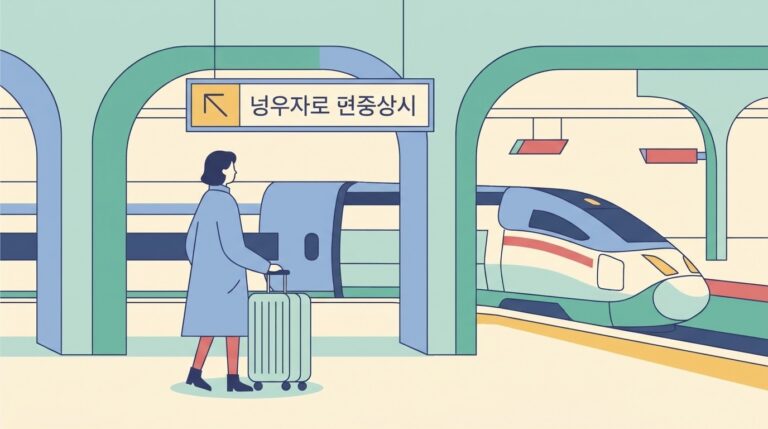
Picture this: You are standing in the grand, bustling hall of Seoul Station. Commuters are rushing past with iced americanos, wheeled suitcases are clacking rhythmically against the polished floor, and a giant digital board above is flipping between destinations: Busan, Gangneung, Mokpo, and Yeosu. You have your KTX ticket clutched in your hand, but as the clock ticks closer to departure, a sudden wave of panic hits you—Wait, which platform do I actually walk down to?
If this scene sounds like the frantic opening of a K-drama, don’t worry! You are definitely not alone. Every single traveler visiting South Korea has had that dizzying moment at least once. Station signs can feel overwhelming when you’re in a hurry, especially when the departure announcement chimes with that cheerful electronic chime. But here is the good news: asking for your platform in Korean is surprisingly simple and requires only a few magic words. Based on the real-world experiences of hundreds of beginner learners in our Daily Hangul community, mastering this one sentence will instantly melt away station anxiety and give you the confidence of a seasoned local traveler. Let’s make sure you never miss your train or bus!
Phase 2: 3 Key Expressions Deep Dive
1. 몇 번 타는 곳으로 가야 해요? (Myeot beon taneun goseuro gaya haeyo?)
- Pronunciation: [Myeot beon ta-neun go-seu-ro ga-ya hae-yo?] (Think: “Myut bun” like a delicious bun, “tah-noon”, “go-seu-ro ga-ya hae-yo”)
- Meaning: Literal: “To which boarding place must I go?” | Natural: “Which platform number should I go to?”
- K-Culture Moment: You will hear this in travel variety shows like 2 Days & 1 Night whenever the cast is handed a secret mission envelope at an express bus terminal and frantically searches for their bus bay.
- Editor’s Insight: The phrase “타는 곳” (taneun got) literally translates to “riding place” (boarding area/platform). Adding “몇 번” (myeot beon = which number) makes this the ultimate survival line in any Korean terminal.
- Situation Spectrum: Casual: ⚠️ (needs informal ending) | Semi-formal: ✅ | Formal: ✅
- 🤔 Think About It: In English, we separate “gate”, “track”, and “platform”, but Korean beautifully simplifies them into the practical compound noun “타는 곳” (boarding place). How does this descriptive approach help you visualize what you are looking for?
2. 이 기차 부산 가요? (I gicha Busan gayo?)
- Pronunciation: [I gi-cha Bu-san ga-yo?] (Think: “Ee” like cheese, “ghee-cha”, “Boo-sahn gah-yo”)
- Meaning: Literal: “This train, Busan goes?” | Natural: “Does this train go to Busan?”
- K-Culture Moment: Just like characters verifying their ride before jumping onto the train in movies and K-dramas, this quick double-check prevents boarding the wrong express carriage!
- Editor’s Insight: As an A1 learner, you don’t need complex grammar here. Just say the noun + destination + “가요?” (gayo? / goes?). It is grammatically polite, crisp, and instantly understood by station attendants.
- Situation Spectrum: Casual: ⚠️ | Semi-formal: ✅ | Formal: ✅
- 🤔 Think About It: Korean often drops subject and object particles in fast, everyday speech. Why do you think native speakers prefer concise questions in high-speed transit settings?
3. 표 보여드릴게요 (Pyo boyeodeurilgeyo)
- Pronunciation: [Pyo bo-yeo-deu-ril-ge-yo] (Think: “Pyoh boy-yaw-doo-ril-geh-yo”)
- Meaning: Literal: “Ticket, I will show to you (humbly).” | Natural: “Let me show you my ticket.”
- K-Culture Moment: Seen whenever a traveler approaches the information counter (안내소) with their Korail mobile app open to ask for directions.
- Editor’s Insight: The ending “-드릴게요” (-deurilgeyo) shows polite respect toward the listener. It immediately signals that you are ready to cooperate so the staff can help you fast.
- Situation Spectrum: Casual: 🚫 | Semi-formal: ✅ | Formal: ✅
- 🤔 Think About It: Showing your ticket screen is an international gesture, but pairing it with this polite phrase shows thoughtful cultural awareness. How does using honorific verbs change how locals respond to you?
Phase 3: Textbook Korean vs. Real Korean
Situation 1: Asking which platform to use
- 📖 교과서 한국어 (Textbook): 탑승구가 몇 번입니까? (Tapseungguga myeot beonimnikka? – Which number is the boarding gate?)
- 🗣️ 진짜 한국어 (Real-Life): 몇 번에서 타요? (Myeot beoneseo tayo? – Where/which number do I board from?)
- 💡 Why the difference? “탑승구” (tapseunggu) is formal Sino-Korean vocabulary frequently found on printed signs or airport flight boards. In daily verbal speech at train and bus stations, native Koreans opt for the lighter, native verb-based question “몇 번에서 타요?”.
Situation 2: Asking if a bus goes to your destination
- 📖 교과서 한국어 (Textbook): 이 버스는 강릉행 버스입니까? (I beoseuneun Gangneunghaeng beoseu-imnikka? – Is this bus bound for Gangneung?)
- 🗣️ 진짜 한국어 (Real-Life): 이거 강릉 가요? (Igeo Gangneung gayo? – Does this go to Gangneung?)
- 💡 Why the difference? The suffix “-행” (-haeng / bound for) is stiff and formal. In real life, simply pointing to the bus and asking “이거 [Destination] 가요?” is standard, natural, and polite.
Phase 4: K-Culture Deep Dive & Non-Verbal Manners
4-1. 눈치 (Nunchi) & Polite Transit Gestures
When approaching a station attendant or ticket counter in Korea, your body language speaks volumes before you even open your mouth:
* The Two-Handed Phone Offer: If you are asking a staff member to look at your mobile ticket on the KorailTalk app, gently hold your phone with both hands (or support your right forearm with your left hand). This shows instant politeness and humility.
* Open-Hand Direction Pointing: Notice how station staff point toward platforms using an open flat palm rather than an index finger. Mirror this respectful gesture when asking: “저쪽이에요?” (Jeojjog-ieyo? / Over that way?).
* The Quick Bow: A gentle 15-degree nod when receiving directions conveys sincere gratitude without slowing down the flow of a crowded terminal.
4-2. Cultural Code: The High-Speed Train Culture
In South Korea, high-speed rail like KTX and SRT isn’t just transportation—it’s a lifestyle rooted in the nation’s “빨리빨리” (ppalli-ppalli / quick-quick) efficiency. Trains depart down to the exact second. Unlike airports where boarding takes 40 minutes, KTX doors close right before departure, and passengers quietly slip into their assigned seats. Inside KTX carriages, observing “정숙” (jeongsuk / quietness) is considered essential train etiquette: phones are switched to vibrate, and phone calls are stepped outside to the vestibules between cars. Knowing your exact platform early ensures you board calmly without disturbing fellow passengers!
Phase 5: Real-Life Roleplay Scenario
Setting: The main departure lobby of Seoul Station. You are holding your phone showing your mobile ticket, approaching staff member Min-soo at the information booth.
Characters: You (A1 Traveler) & Min-soo (민수 – Station Guide)
- You: 저기요, 실례합니다. (Jeogiyo, sillyehamnida.)
🎭 Walk up to the counter and offer a gentle nod. - Min-soo: 네, 고객님. 무엇을 도와드릴까요? (Ne, gogaeknim. Mueoseul dowadeurilkkayo?)
🎭 Smiles warmly and looks at you attentively. - You: 표 보여드릴게요. (Pyo boyeodeurilgeyo.)
🎭 Politely show your phone screen using two hands. - Min-soo: 아, 부산 가는 열차표네요! (A, Busan ganeun yeolchapyo-neyo!)
🎭 Glances at your ticket and points toward the digital board. - You: 몇 번 타는 곳으로 가야 해요? (Myeot beon taneun goseuro gaya haeyo?)
🎭 Tilt your head slightly with an eager, questioning expression. - Min-soo: 5번 타는 곳으로 내려가시면 됩니다. (O-beon taneun goseuro naeryeogasimyeon doemnida.)
🎭 Extends his right hand with an open palm toward escalator number 5. - You: 5번 타는 곳이요? 감사합니다! (O-beon taneun gos-iyo? Gamsahamnida!)
🎭 Nod clearly to confirm the number, smiling in relief. - Min-soo: 네, 좋은 여행 되세요! (Ne, joeun yeohaeng doeseyo!)
🎭 Bows politely as you head toward the platform escalator.
🔀 Interactive Choice Point
You arrive at Platform 5, but there are two trains parked on opposing tracks. What do you say to the conductor standing near the door?
- Option A: “야! 부산?” (Ya! Busan?)
- Option B: “이 기차 부산 가요?” (I gicha Busan gayo?)
- Option C: “비행기 어디예요?” (Bihaenggi eodieyo?)
Feedback:
* Option A [Bad]: “야” (Ya) means “Hey!” in rude, informal slang used only with very close friends. Using this with an attendant will shock them!
* Option B [Best]: Spot on! It’s polite, natural, short, and gets an instant “네, 맞습니다” (Ne, matseumnida / Yes, that’s right) confirmation.
* Option C [Risk]: “비행기” (Bihaenggi) means airplane! Asking for an airplane on a train platform will leave the conductor utterly confused.
Phase 6: 10-Second Emotion Shadowing Drill
Practice these lines out loud with the designated pauses (/) and emotional tone!
- [😰 Urgently asking for help]:
저기요, / 몇 번 타는 곳으로 / 가야 해요?
(Jeogiyo, / myeot beon taneun goseuro / gaya haeyo?) -
[😊 Relieved and repeating the number]:
아, 3번 타는 곳이요? / 정말 감사합니다!
(A, sam-beon taneun gos-iyo? / Jeongmal gamsahamnida!) -
[🧐 Quick double check before stepping on the train]:
실례합니다, / 이 기차 / 부산 가요?
(Sillyehamnida, / i gicha / Busan gayo?)
Phase 7: K-Culture Mini Dictionary
- 타는 곳 (Taneun got) | Boarding platform / Track
- Real-world usage: Printed prominently on bright yellow signs across Korean train stations and express bus terminals.
- 호차 (Ho-cha) | Carriage number / Train car
- Real-world usage: Refers to the specific train car (e.g., “3호차” = Car 3). Essential to match before you board your KTX.
- 승차권 (Seungchagwon) | Boarding ticket
- Real-world usage: Formal term for your travel ticket, often written at the top of your paper receipt or mobile app.
- 고속버스 터미널 (Gosokbeoseu Teomineol) | Express Bus Terminal
- Real-world usage: Often shortened to “고터” (Goteo) by locals, referring to regional intercity bus hubs.
Phase 8: Traveler’s Survival Kit
Survival Phrases TOP 3
- 몇 번이에요? (Myeot beon-ieyo?) – “Which number is it?”
Pro Tip: Perfect when pointing at your ticket destination if full sentences slip your mind. - 여기 맞아요? (Yeogi majayo?) – “Is this the right place?”
Pro Tip: Use this while standing on the platform looking at the overhead monitor. - 도와주세요 (Dowajuseyo) – “Please help me.”
Pro Tip: A gentle, polite distress call that will instantly bring friendly Koreans to your aid.
Editor’s Travel Note
- Digital Tool: Before heading to the station, make sure you download the KorailTalk mobile application to reserve seats and check real-time track assignments.
- Express Bus Hubs: In Seoul, remember that the Express Bus Terminal (Gangnam) has two wings: Gyeongbu/Yeongdong Line and Honam Line (Central City). Always verify your departure building first!
- Platform Logic: At KTX stations, the track number usually appears on the main concourse board roughly 15 minutes before train departure. Don’t worry if it’s blank an hour early!
Phase 9: “One Step Deeper” (Reflective Question)
In Korean culture, the rapid modernization of transit highlights the value of collective harmony (정, Jeong). When someone looks lost at a busy train station, you will often find an elderly local or a busy commuter stopping in their tracks to walk you right up to your escalator. Even in a society famous for speed and efficiency, the willingness to guide a traveler remains deeply rooted. Have you ever experienced unexpected warmth from a stranger in a foreign city?
💬 Your Turn: Which Korean city are you dreaming of visiting by KTX—Busan, Gyeongju, or Jeonju? Let us know in the comments below!
Phase 10: FAQ & Avoiding Misunderstandings
Q: What is the difference between “플랫폼” (Platform) and “타는 곳” (Taneun got)?
A: They mean the exact same thing! “플랫폼” (peullaetpom) is an English loanword frequently heard in casual conversation, while “타는 곳” (taneun got) is the official, pure Korean term shown on all major station signage.
Q: Do I need to show my ticket to an attendant before entering the platform at KTX stations?
A: No! South Korea’s KTX operates on an honor barrier-free system without turnstiles or gate ticket checkers. You simply walk straight down to “타는 곳”. Conductors have a digital seat chart on their handheld devices and only check tickets if someone is sitting in an unreserved seat.
Q: How do I say bus platform number versus train platform number?
A: Both use the same format: Number + 번 (beon / number) + 타는 곳 (taneun got). For example: “1번 타는 곳” (Il-beon taneun got / Platform/Bay 1).
🚨 Common Mistakes Alert (TOP 3)
- Mistake: Confusing “호차” (Carriage) with “타는 곳” (Platform).
- Correct Action: “타는 곳” is the platform track (downstairs), while “호차” is the specific car door number of the train.
- Mistake: Asking “이 기차 어디예요?” (Where is this train?).
- Correct Action: Specify your destination! Say “부산 가는 기차 어디서 타요?” (Busan ganeun gicha eodiseo tayo? / Where do I catch the train to Busan?).
- Mistake: Using Sino-Korean numbers for train car seat rows.
- Correct Action: Platforms and car numbers use Sino-Korean numbers (1번, 2번, 3호차), but seat rows combine numbers with alphabet letters (e.g., 12A).
Phase 11: Action Missions
- 🥉 Bronze Mission (Solo Practice): Stand in front of your mirror and repeat “몇 번 타는 곳으로 가야 해요?” three times smoothly without looking at the notes.
- 🥈 Silver Mission (Social Share): Share our phrase of the day on your Instagram Story or study notes, tagging your favorite K-travel destination!
- 🥇 Gold Mission (Real Life Action): The next time you visit a transit hub or practice with your Korean tutor, use “표 보여드릴게요” before showing your ticket.
- 🎮 K-Culture Mission: Watch an episode of a travel K-drama (like Run On or Crash Landing on You) and listen closely for announcements in train stations. See if you can catch the word “열차” (yeolcha / train) or “타는 곳” (taneun got)!
Phase 12: Interactive Quiz Challenge
Test what you’ve learned before your trip!
1. Situation Challenge: You have a ticket for KTX Car 4, Platform 7. Which phrase do you use to ask an attendant where to stand for the train?
* A) 몇 번 타는 곳으로 가야 해요? (Myeot beon taneun goseuro gaya haeyo?)
* B) 얼마예요? (Eolmayeyo?)
* C) 안녕히 계세요. (Annyeonghi gyeseyo.)
2. Fill in the Blank:
이 기차 [ _______ ] 가요? (Does this train go to Seoul?)
* Hint: Insert the Korean word for Seoul.
3. True or False:
At Korean KTX train stations, you must scan your barcode at an electronic turnstile before walking to the platform. (True / False)
👉 Click here for answers & detailed explanations!
Answers:
1. A – “몇 번 타는 곳으로 가야 해요?” means “Which platform number should I go to?”. (Option B means “How much is it?”, and Option C means “Goodbye”).
2. 서울 (Seoul) – “이 기차 서울 가요?” (I gicha Seoul gayo?).
3. False – Korea’s train stations have an open, barrier-free system. You walk straight to the platform and find your reserved car/seat!







