

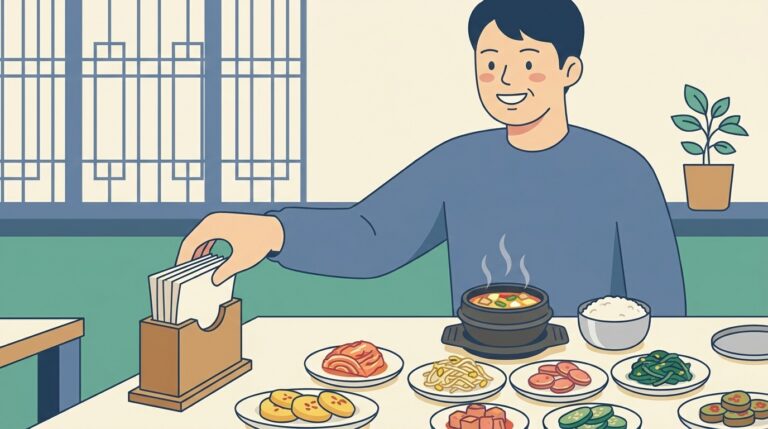
Never Freeze at a Korean Restaurant Again: How to Ask for Napkins and Refills Like a Local
Phase 1: Empathy (Welcome to the Real K-Dining Scene!)
안녕하세요! 매일한글 에디터입니다. (Hello! I’m your Daily Hangul editor.)
Picture this: You are seated in a bustling, fragrant Korean barbecue restaurant in Hongdae on a Friday night. Sizzling pork belly is snapping on the grill, cold barley tea is poured, and you take your first mouthwatering bite of spicy tteokbokki. And then—splat! A drop of bright red chili sauce lands right on your pristine white shirt and your fingers.
You glance across the table for a napkin box, but it is bone-dry. Not a single paper sheet in sight. Your heart rate ticks up. Waiters are darting around carrying scalding stone bowls of Kimchi-jjigae. You want to ask for help, but your mind goes blank. How do you call them over without sounding rude or loud? What if you mispronounce the word and end up asking for toilet paper?
Take a deep breath! As someone who has navigated Korea’s dining culture for over a decade, I can assure you that every single Korean learner has lived through this exact moment of restaurant paralysis. Dining out in Korea is vibrant, fast-paced, and incredibly generous—once you know the secret codes. In this guide, you will master the essential A1 survival phrases to request napkins, summon servers with confidence, and score bottomless refills of delicious side dishes like a seasoned Seoul resident.
Phase 2: Core Expressions (핵심 표현 3선)
Here are the top three expressions you will use in literally every Korean restaurant you step into.
1. 냅킨 좀 더 주세요 (Naepkin jom deo juseyo)
- Pronunciation: Naep-kin jom duh joo-seh-yo (Sound metaphor: “jom” sounds like the first syllable of zombie with a soft ‘j’, and “deo” sounds just like duh in English!)
- Meaning: Literal: “Napkin a little more give please” vs Nuance: “Could I please have some more napkins?”
- K-Culture Moment: Seen in countless slice-of-life K-dramas (like Weightlifting Fairy Kim Bok-joo) where the main characters wipe barbecue sauce off each other’s faces after sharing an enthusiastic meal!
- Editor’s Insight: The tiny word 좀 (jom) literally means “a little,” but functionally it is pure magic. It acts as a polite shock-absorber that transforms a direct command (“Give me napkins”) into an endearing, humble request.
- Situation Spectrum: Casual (⚠️ slightly too stiff with close friends) | Semi-formal (✅ Perfect for all restaurants) | Formal (✅)
- 🤔 Think About It: In English, we frame requests as hypothetical questions (“Could you possibly bring…?”). Why do you think Korean expresses politeness through softening adverbs like 좀 (jom) rather than hypotheticals?
2. 여기요 (Yeogiyo)
- Pronunciation: Yeo-gi-yo (Sound metaphor: Sounds like “Yaw-gee-yo”, rhyming with Tokyo!)
- Meaning: Literal: “Over here!” vs Nuance: “Excuse me, waiter!”
- K-Culture Moment: The universal audio track of any Korean food street or variety show like Jinny’s Kitchen. You will hear customers cheerfully call this out all evening.
- Editor’s Insight: Forget snapping fingers or waving both arms like an airport signalman. A single raised hand at chin level combined with a bright, crisp “여기요!” is standard etiquette.
- Situation Spectrum: Casual (✅) | Semi-formal (✅ Standard) | Formal (⚠️ In five-star hotel fine dining, wait for eye contact instead)
- 🤔 Think About It: Calling out “Over here!” might feel blunt in Western table culture, but in Korea, it is considered proactive and considerate because it saves the server from hovering over you unnecessarily.
3. 반찬 좀 더 주세요 (Banchan jom deo juseyo)
- Pronunciation: Ban-chan jom duh joo-seh-yo (Sound metaphor: “Ban” rhymes with “bon” in bonbon, and “chan” rhymes with “chun” in chunk).
- Meaning: Literal: “Side dish a little more give please” vs Nuance: “Could we get a refill on the side dishes, please?”
- K-Culture Moment: Visiting a traditional soup diner (Gukbap shop). Asking for another plate of crunchy kkakdugi (radish kimchi) signals to the cook that their food is delicious!
- Editor’s Insight: In South Korea, side dishes (banchan) are virtually always free and unlimited. Never hesitate to ask for a refill; doing so is an unspoken compliment to the kitchen!
- Situation Spectrum: Casual (⚠️ Use 반말 with close pals) | Semi-formal (✅ Ideal) | Formal (✅)
- 🤔 Think About It: How does the custom of complimentary, communal side dishes reshape the dining experience compared to paying for every side item back home?
Phase 3: Textbook Korean vs Real Korean
Let us bridge the gap between classroom theory and real Seoul streets.
Situation 1: Calling the Waitstaff
- 📖 교과서 한국어: 실례합니다, 종업원님! (Sillyehamnida, jongeobwonnim! – Excuse me, employee!)
- 🗣️ 진짜 한국어: 저기요! (Jeogiyo!) or 여기요! (Yeogiyo! – Excuse me / Over here!)
- 💡 왜 다를까?: “종업원 (employee)” is a bureaucratic term found in legal contracts or manuals. Real humans never address servers with this title; “저기요” (over there) or “여기요” (here) is universally accepted.
Situation 2: Asking for Paper Napkins
- 📖 교과서 한국어: 화장지를 가져다주시겠습니까? (Hwajangjireul gajyeodajusigesseumnikka? – Would you bring me toilet paper?)
- 🗣️ 진짜 한국어: 냅킨 좀 더 주세요! (Naepkin jom deo juseyo! – More napkins, please!)
- 💡 왜 다를까?: “화장지 (toilet tissue)” implies bathroom paper rolls! In dining spots, asking for 화장지 might get you funny looks. Locals naturally use the English loanword 냅킨 (naepkin) or ask for 물티슈 (multisyu – wet wipes).
Phase 4: K-Culture Deep Dive & Non-verbal Manners
4-1. 눈치 (Nunchi) & The Secret Table Drawer
Before you open your mouth to call the staff, pause and use your 눈치 (Nunchi – quick situational awareness)! Look closely along the wooden rim directly beneath your tabletop. In about 80% of modern Korean eateries, you will find a concealed sliding drawer.
Slide it open: behold! Neatly stacked napkins, metal spoons, and chopsticks (sujeo). If you shout “여기요! 냅킨 주세요!” and the busy auntie rushes over only to pull open the drawer right by your stomach, your cheeks will burn hotter than buldak sauce! Always check the table edge first.
4-2. The Power of “이모님 (Imonim)”
In traditional diners and BBQ establishments run by middle-aged women, addressing the host as 이모님 (Imonim – maternal aunt) instead of a cold “저기요” works like an instant charisma potion. It projects warmth, family-style respect, and instant friendship. Do not be surprised if calling them Imonim earns you a free can of soda (service/서비스) or a mountain of extra scallion salad!
Phase 5: Real-Life Roleplay Scenario
Setting: You are enjoying grilled Samgyeopsal at a busy dining hall in Myeongdong. The server, an energetic Imo (auntie), is deftly turning the meat with metal tongs.
- You: 저기요! (Jeogiyo!) – Excuse me!
🎭 Raising your right hand slightly and making polite eye contact - Server (Imo): 네, 손님! 뭐 필요하세요? (Ne, sonnim! Mwo pil-yohaseyo?) – Yes, dear customer! What do you need?
🎭 Pauses with tongs and looks at you warmly - You: 냅킨 좀 더 주세요. (Naepkin jom deo juseyo.) – Please give me some more napkins.
🎭 Pointing gently to the empty container on your table - Server (Imo): 아, 냅킨 테이블 옆 서랍에 있어요! (A, naepkin te-i-beul yeop seo-rab-e iss-eo-yo!) – Ah, napkins are in the drawer on the side of the table!
🎭 Chuckles affectionately and taps the side of your table - You: 아, 진짜요? 감사합니다! (A, jinjjayo? Gamsahamnida!) – Oh, really? Thank you!
🎭 Slides the drawer open with an amused, relieved smile - You: 그리고 김치 좀 더 주실 수 있나요? (Geurigo gimchi jom deo jusil su innayo?) – And could we also get some more kimchi, please?
🎭 Holding up the empty white side plate with two hands - Server (Imo): 물론이죠! 듬뿍 갖다 줄게요. (Mullon-ijyo! Deumbbuk gat-da julgeyo.) – Of course! I will bring you a generous heap.
🎭 Takes the plate happily with a nod - You: 감사합니다, 이모님! (Gamsahamnida, imonim!) – Thank you so much, Auntie!
🎭 Giving a courteous 15-degree bow
🔀 Interactive Choice: What do you say when you need wet wipes for oily fingers?
- Choice A: “야! 물티슈 내놔!” (Ya! Multisyu naenwa!)
- Feedback: 🚨 Risk! Extreme offense. “야” is a harsh informal “Hey!” and “내놔” means “hand it over.” You will shock the whole restaurant!
- Choice B: “실례합니다만 물티슈를 제공해주시겠습니까?” (Sillyehamnidaman multisyureul jegonghaejusigesseumnikka?)
- Feedback: ⚠️ Bad/Stiff. Sounds like a written corporate memorandum from 1985. Overly stiff for eating pork belly.
- Choice C: “이모님, 물티슈 하나만 더 주세요~” (Imonim, multisyu hanaman deo juseyo~)
- Feedback: 🌟 Best! Soft, melodic, culturally authentic, and perfectly polite. You will instantly win over the staff!
Phase 6: 10-Second Emotion Shadowing Drill
Read these aloud, pausing at the slashes (/) and matching the emotional cues!
- [🙋♂️ 차분하고 또렷하게 – Calm and clear]
저기요! / 여기 / 냅킨 / 없어요.
(Jeogiyo! / yeogi / naepkin / eopseoyo.)
“Excuse me! / Over here / napkins / there are none.” -
[🥺 조심스럽고 공손하게 – Gentle and polite]
냅킨 / 좀 / 더 / 주세요!
(Naepkin / jom / deo / juseyo!)
“Napkins / a little / more / please give me!” -
[😋 신나고 밝게 – Cheerful and appreciative]
이모님! / 김치 / 리필 / 부탁드려요!
(Imonim! / gimchi / ripil / butakdeuryeoyo!)
“Auntie! / Kimchi / refill / I kindly request!”
Phase 7: K-Culture Mini Dictionary
- 냅킨 (Naepkin) | Napkin | The standard English loanword used in all eateries, cafes, and street food stalls.
- 물티슈 (Multisyu) | Wet wipe / Wet tissue | A compound of “물 (water)” and “티슈 (tissue)”. Essential for wiping your hands before eating chicken or BBQ.
- 셀프바 (Selpeuba) | Self-service bar | A designated refrigerator counter where diners can freely ladle their own pickled radishes, sauces, and kimchi.
- 호출벨 (Hochulbel) | Table call button | A small round button embedded in the corner of your table. Press it once and a gentle bell chime alerts the counter!
Phase 8: Traveler’s Survival Kit
TOP 3 Dining Survival Phrases
- 물 좀 주세요 (Mul jom juseyo) – “Please give me some water.”
- Pro Tip: If the staff points to a water dispenser and says “물은 셀프입니다 (Water is self-service),” simply walk over and fill a small stainless metal cup yourself!
- 이거 더 주세요 (Igeo deo juseyo) – “Please give me more of this.”
- Pro Tip: If you don’t know the exact Korean name of a specific side dish, simply lift the empty dish slightly, point at it, and say this magic sentence.
- 계산해 주세요 (Gyesanhae juseyo) – “The bill, please / I’d like to pay.”
- Pro Tip: In Korea, servers rarely bring credit card machines to your dining table. Grab the order receipt slip placed by your table and pay at the front cash register near the exit door.
Editor’s Travel Note
Before heading out on your food tour across Seoul, make sure to download the Naver Map navigation app. It provides accurate real-time hours, user photos of whether places offer a “셀프바 (Self-bar),” and direct transit routes. Remember: tipping is nonexistent across Korea, so warm politeness and a clear “감사합니다 (Thank you)” are the greatest currency you can offer!
Phase 9: One Step Deeper (한 발 더 깊이)
In many global dining cultures, asking for extra helpings of appetizers without paying extra can feel imposing or even stingy. In South Korea, however, communal food sharing is deeply rooted in 정 (Jeong)—an intangible cultural bond of affection, generosity, and hospitality.
Side dishes (banchan) were historically a host’s way of ensuring no guest ever left the table hungry, regardless of wealth. When you finish your side dishes and ask for a refill with a bright smile, the restaurant owners feel genuine satisfaction knowing you relish their cooking. You aren’t being greedy; you are engaging in a shared cultural ritual of warmth.
💬 Your Turn: What is the most memorable side dish you have ever tasted in a Korean restaurant, and did you have the courage to ask for a refill? Tell us your dining stories in the comments below!
Phase 10: FAQ & Common Mistakes
Q: Is it rude to press the call bell multiple times if nobody comes right away?
A: Yes! One single press triggers a chime and displays your table number on the kitchen wall screen. Staff members hear it instantly; they might just be flipping meat or carrying hot broth. Give them 30 to 45 seconds before pressing again.
Q: Can I take unused napkins or wet wipes home from the table?
A: Tucking one or two wet wipes into your daypack for emergencies while sightseeing is harmless, but grabbing fistfuls of paper napkins from the dispenser is frowned upon. Take only what you need for your meal!
Q: How do I know if side dish refills are self-service or staff-served?
A: Look along the restaurant walls. If you see signs saying “추가 반찬은 셀프입니다” (Additional side dishes are self-service) or spot a stainless buffet cart with tongs and small dishes, grab your plate and help yourself!
🚨 Common Mistakes Alert
- Calling any woman “아줌마 (Ajumma)” | Mistake: Shouting “아줌마!” across a modern restaurant. | Correct Action: While common in vintage cinema, it carries an abrasive tone today. Use 저기요 (Excuse me), 사장님 (Boss), or 이모님 (Auntie) instead.
- Asking for “화장지 (Hwajangji)” at the dining table | Mistake: “화장지 주세요!” | Correct Action: Keep 화장지 for the restroom! Always ask for 냅킨 (naepkin) or 물티슈 (multisyu).
- Dumping trash into your leftover soup bowl | Mistake: Stuffing used paper napkins into a half-empty bowl of hot stew. | Correct Action: While done with good intentions to tidy up, it creates soggy unhygienic waste that is difficult to scrape into composting bins. Neatly fold or scrunch napkins and leave them on the dry tabletop.
Phase 11: Action Mission & Engagement
- 🥉 Bronze Mission (Solo Drill): Look into your mirror, raise one hand gracefully to chest level, and say “여기요, 냅킨 좀 더 주세요!” three times out loud.
- 🥈 Silver Mission (Social Share): Snap a photo of your next Korean meal, tag
@DailyHangul, and post it with the caption: “반찬 좀 더 주세요! 🥢” - 🥇 Gold Mission (Real-world Challenge): The next time you visit a Korean restaurant or K-town food stall, do not search for the English-speaking server. Ask for extra napkins or your favorite side dish using only Korean!
- 🎮 K-Culture Mission: Watch an episode of a Korean reality food show (such as Jinny’s Kitchen or Street Food Fighter) and count how many times you spot a table drawer or hear customers say “주세요”!
Phase 12: Interactive Quiz Challenge
Test your new K-dining superpowers!
1. Situational Judgment
You are eating spicy Bibimbap, your mouth is on fire, and your water cup is empty. You look at the wall and see a sign: 물은 셀프. What should you do?
* A) Press the table bell and demand cold water immediately.
* B) Stand up, locate the water purifier machine, grab a cup, and pour your own water.
* C) Shout “아줌마, 물!” at the top of your lungs.
2. Fill-in-the-Blank
Fill in the blank with the polite softening word that means “a little”:
“냅킨 (_____) 더 주세요.”
3. True or False
True or False: In Korean dining culture, asking the server for a free second round of Kimchi or pickled radish is considered impolite because you are wasting their time.
👉 Click here to reveal the answers and explanations!
- Answer: B
Explanation:물은 셀프 (Water is self-service)means you can freely walk over to the filtration machine and help yourself to cold water anytime! - Answer: 좀 (jom)
Explanation: “냅킨 좀 더 주세요 (Naepkin jom deo juseyo)” uses 좀 to soften the request delightfully. - Answer: False
Explanation: Side dish refills (banchan refill) are almost universally complimentary and treated as a warm sign that you genuinely love the restaurant’s cooking!






