

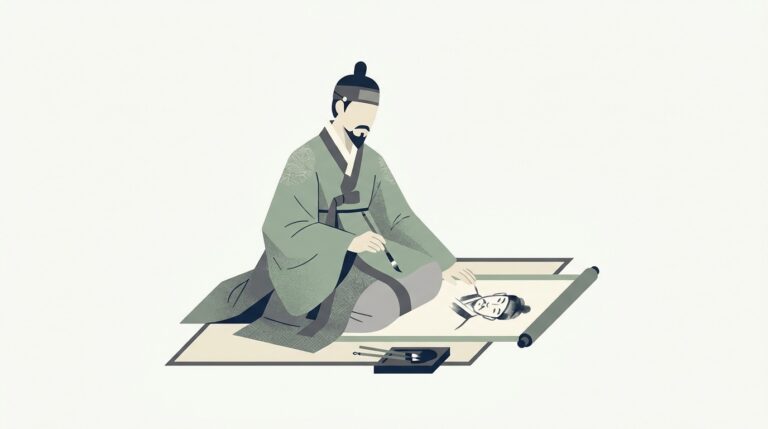
The Soul Behind the Canvas: Cracking Korea’s ‘Jeonsinsajo’ and the Aesthetics of Inner Vitality
Phase 1: Empathy (Story-Driven Opening)
안녕하세요! 매일한글 에디터입니다. (Hello! It is your Daily Hangul editor.)
Have you ever stood in front of an ancient Joseon portrait at the National Museum of Korea in Yongsan, transfixed by a fierce pair of eyes peering through centuries of silk? Or perhaps you were watching an intense monologue by an acting titan in a prestige K-drama like Mr. Sunshine, where the screen fell completely silent, yet the emotional gravity crushed the room. You wanted to express this breathtaking sensation to your Korean intellectual friends, but the only words that came to mind were basic praises like “그림이 정말 예뻐요” (The painting is really pretty) or “연기를 참 잘하네요” (Their acting is really good).
It feels like trying to describe a profound metaphysical thunderstorm with child’s watercolor, doesn’t it? As an advanced Korean speaker navigating the C2 threshold, your goal is no longer mere communicative survival; it is cultural and intellectual resonance. This guide was crafted directly from real mentoring debriefs with foreign curators, art historians, and cultural critics working in Seoul. By mastering the philosophical principle of 전신사조(傳神寫照)—the immortal tenet that capturing outward likeness without inner vitality results in nothing more than a lifeless shell—you will transform from an enthusiastic observer into an articulate connoisseur capable of dissecting the soul (jeonsin) of Korean art, cinema, and character.
Phase 2: Core 3 Expressions Deep Dive
[Core Aesthetic Lexicon]
1. 전신사조 (傳神寫照) : Transmitting the spirit through form
2. 기운생동 (氣韻生動) : Vitality bursting from spiritual resonance
3. 겉만 번지르르하다 : Slick on the surface, hollow within
1. 전신사조 (傳神寫照)
- Pronunciation: [Jeon-sin-sa-jo] (Think: “John-seen-sah-joh”)
- Meaning:
- Literal: Transmitting the divine spirit (jeonsin) by reflecting the external form (sajo).
- Real Nuance: True artistic mastery lies not in photographic replication, but in capturing the subject’s unseen moral dignity, psychological state, and inner vitality.
- K-Culture Moment: Art critics use this when dissecting historical drama performances. When an actor playing King Yeongjo does not just wear the gonryongpo (royal robe) but radiates the tragic paranoia of a tortured monarch through his piercing gaze (눈빛), critics exclaim that the actor achieved jeonsinsajo.
- Editor’s Insight: In Joseon portraiture, painters even rendered smallpox scars and blemishes faithfully because erasing flaws was seen as erasing the subject’s true life trajectory. If you paint only idealized beauty, you produce a corpse, not a human.
- Situation Spectrum: Casual 🚫 | Semi-formal ⚠️ | Formal ✅
- 🤔 Think About It: Does Western classical portraiture prioritize external physical idealization or psychological exposure? How does this alter our visual definition of “truth”?
2. 기운생동 (氣韻生動)
- Pronunciation: [Gi-un-saeng-dong] (Sounds like: “Gee-oon-sang-dong”)
- Meaning:
- Literal: Spiritual rhythm and cosmic energy (giun) actively breathing and alive (saengdong).
- Real Nuance: The highest compliment for brushwork, music, or choreography, meaning the work vibrates with living, autonomous energy rather than static technique.
- K-Culture Moment: You will hear this constantly in Korean contemporary art circles, such as BTS RM’s discussions of Dansaekhwa (Korean monochrome painting) or master calligraphers moving with whole-body commitment.
- Editor’s Insight: Gi (energy) and un (resonance/musicality) combine to suggest that ink lines on mulberry paper are not static pigment—they are the frozen pulse of the artist’s breath.
- Situation Spectrum: Casual 🚫 | Semi-formal ⚠️ | Formal ✅
- 🤔 Think About It: In your native tongue, is vitality described as an internal mechanical force or an invisible cosmic rhythm?
3. 겉만 번지르르하다
- Pronunciation: [Geot-man beon-ji-reu-reu-ha-da] (Think: “Gut-mahn bun-jee-reu-reu-hah-dah”)
- Meaning:
- Literal: Only the exterior is glossy/slippery.
- Real Nuance: All style and no substance; visually slick but spiritually vacuous.
- K-Culture Moment: A sharp, colloquial critique used by film buffs when a blockbuster film boasts lavish CGI and celebrity casting, but lacks emotional narrative or philosophical depth.
- Editor’s Insight: This is the exact modern colloquial antithesis of jeonsinsajo. When someone mimics form without grasping the underlying spirit, native speakers dismiss it with this phrase.
- Situation Spectrum: Casual ✅ | Semi-formal ✅ | Formal ⚠️
- 🤔 Think About It: Why does Korean visual philosophy treat sheer surface perfection with suspicion rather than admiration?
Phase 3: Textbook Korean vs. Real Native Korean
Situation 1: Critiquing a visually stunning but emotionally hollow piece
- 📖 교과서 한국어 (Textbook):
이 그림은 외모를 똑같이 그렸지만 깊은 감정이 없습니다.
(I geurimeun oemoleul ttokgati geuryeotjiman gipeun gamjeongi eopseumnida. / This painting copied the appearance identically, but lacks deep emotion.) - 🗣️ 진짜 한국어 (Real C2):
형태적 묘사에만 매몰되어 정작 인물의 정신과 기운을 놓쳤네요. 전형적인 ‘형사(形似)’에 그친 죽은 그림입니다.
(Hyeongtaejeok myosa-eman maemoldoeeo jeongjak inmului jeongsingoa giuneul nochyeonne-yo. Jeonhyeongjeogin ‘hyeongsa’e geuchin jugeun geurimimnida. / It is so consumed by formal likeness that it missed the subject’s spirit and vital energy. It is a dead painting limited to mere superficial imitation.) - 💡 왜 다를까? (Why the difference?):
At a C2 level, you abandon pedestrian descriptors like eolgul (face) or gamjeong (emotion) in favor of the classical aesthetic dichotomy: 형사 (形似, superficial physical resemblance) versus 신사 (神似, spiritual resemblance).
Situation 2: Praising an actor’s quiet, emotionally resonant performance
- 📖 교과서 한국어 (Textbook):
배우가 눈빛으로 감정을 훌륭하게 전달했습니다.
(Baeuga nunbicheuro gamjeongeul hullyunghage jeondalhaessumnida. / The actor excellently conveyed emotion through their eyes.) - 🗣️ 진짜 한국어 (Real C2):
대사 한마디 없는 여백 속에서도 서늘한 안광(眼光) 하나로 인물의 내면을 온전히 전신(傳神)해내더군요.
(Daesa hanmadi eomneun yeobaek sogeseodo seoneulhan angwang hanaro inmului naemyeoneul onjeonhi jeonsinhaenaedeogun-yo. / Even amid the negative space of absolute silence without a single line, they thoroughly transmitted the subject’s inner soul with a chilling ocular intensity.) - 💡 왜 다를까? (Why the difference?):
Sophisticated Korean treats silence and stillness as active elements—여백 (餘白, negative space)—rather than absences, highlighting the eyes (안광) as the metaphysical window of jeonsin.
Phase 4: K-Culture Deep Dive & Non-Verbal Manners
[Joseon Portraiture Rulebook]
- Il-ho-bul-sa, Pyeon-si-ta-in (一毫不似 便是他人) : "If even a single hair is unfaithful, it is someone else."
- The Canvas : Bare silk or hanji without decorative background, forcing complete focus on the subject's eyes.
- The Demeanor : Viewing art requires measured physical distance, silent contemplation, and a bowed posture.
4-1. 눈치 (Nunchi) & Viewing Posture in Korean Galleries
In high-end Korean cultural spaces—such as the Kansong Art Museum or private gallery vernissages in Samcheong-dong—exhibiting visual literacy involves non-verbal etiquette. You do not point with an outstretched finger at traditional calligraphic hanging scrolls; doing so disrupts the painting’s gi (energy field). Instead, rest your hands clasped loosely in front of you (gongsu, 공수), lean slightly backward to take in the 여백의 미 (beauty of empty space), and let out a gentle, low murmur of contemplative appreciation (음… or 과연…). When discussing an artwork’s depth, maintain a steady, restrained eye contact with your interlocutor to mirror the very discipline of jeonsinsajo.
4-2. Cultural Code: The Gaze of Yun Du-seo
Consider the celebrated Self-Portrait of Yun Du-seo (National Treasure No. 240). Yun painted his face floating in stark void without shoulders or torso (though faint charcoal lines remain beneath the surface), leaving his whiskers rendered with surgical precision and his pupils radiating an uncanny, searing clarity. In traditional Korean thought, the eyes are where the human soul condenses. If an artist flatters the patron by glossing over a cast in the eye or an irregular tooth, it is seen as moral cowardice. This ethos permeates modern Korean storytelling: Korean audiences instinctively reject “flawless but shallow” characters in favor of layered, gritty figures who reveal their inner turmoil through their nubit (눈빛).
Phase 5: Real Roleplay Scenario
Setting: An intimate exhibition opening at an art gallery in Insa-dong. You are reviewing Joseon-era portraits alongside Min-woo Han, an exacting senior curator.
[Characters]
- Me: A culturally astute global art critic / collector.
- Curator Han: A seasoned, meticulous art historian in his late 40s wearing round tortoiseshell glasses.
[Turn 1] Curator Han:
(안경을 고쳐 쓰며 묵묵히 영정화를 응시한다)
(Angyeongeul gocheo sseumyeo mungmukhi yeongjeonghwaneul eungsihanda)
(🎭 Adjusting his glasses, silently gazing at the ancestral portrait)
“외형적인 필선 자체는 대단히 유려하지만, 이상하게 시선이 머물지 않네요. 어떻게 보십니까?”
(“Oe-hyeongjeogin pilseon jache-neun daedanhi yuryeohajiman, isanghage siseoni meomulji anne-yo. Eotteoke bosimnikka?”)
“The brushstrokes outlining the form are undeniably fluid, but strangely, my eyes don’t linger. How do you see it?”
[Turn 2] Me:
(작품과 세 걸음 물러서서 여백과 인물의 동공을 가늠하며)
(Jakpumgwa se georeum mulleoseoseo yeobaekgwa inmului donggongeul ganeumhamyeo)
(🎭 Stepping back three paces, sizing up the negative space and the subject’s pupils)
“네, 붓끝의 기교는 화려하나 전신(傳神)의 경지에는 미치지 못한 듯합니다.”
(“Ne, butkkeut-ui gigyo-neun hwaryeohana jeonsin-ui gyeongji-eneun michiji mothan deut-hamnida.”)
“Indeed. While the virtuosity of the brush tip is flashy, it seems to fall short of transmitting the spirit.”
[Turn 3] Curator Han:
(흥미롭다는 듯 고개를 살짝 돌려 나를 바라보며)
(Heungmiropdaneun deut gogaereul saljjak dollyeo nareul barabomyeo)
(🎭 Turning his head slightly toward me with genuine curiosity)
“오호, ‘전신’이라… 구체적으로 어떤 대목에서 그 결여를 느끼셨나요?”
(“Oho, ‘jeonsin’-ira… Guchejeoguro eotteon daemog-eseo geu gyeol-yeoreul neukkisyeonnayo?”)
“Aha, ‘transmitting the spirit’… At what specific point did you feel that deficiency?”
[Turn 4] Me:
(차분한 손짓으로 화폭의 빈 공간과 수염의 묘사를 조용히 짚으며)
(Chabunhan sonjiseuro hwapogui bin gonggan-gwa suyeomui myosareul joyonghi jipeumyeo)
(🎭 Calmly gesturing toward the void and the rendering of the facial hair)
“터럭 하나는 치밀하게 베꼈으되, 눈동자 속 서린 인물의 고뇌와 기운생동(氣韻生動)하는 생명력이 탈각되어 있습니다.”
(“Teoreok hananeun chimilhage bekkyeosseudoe, nundongja sok seorin inmului gonoe-wa giunsaengdonghaneun saengmyeongnyeogi talgakdoe-eo itseumnida.”)
“Every single whisker is meticulously copied, yet the subject’s brooding inner anguish and the resonance of vital energy have been completely shed.”
[Turn 5] Curator Han:
(옅은 탄성을 내뱉으며 고개를 끄덕인다)
(Yeoteun tanseongeul naebaeteumyeo gogaereul kkeodeoginda)
(🎭 Uttering a soft sigh of admiration, nodding in agreement)
“정곡을 찌르셨군요. 바로 그겁니다. ‘일호불사 편시타인’이라 했는데, 이는 형체의 복제를 넘어선 인격의 투영을 뜻하니까요.”
(“Jeonggog-eul jjireusyeotgun-yo. Baro geugeomnida. ‘Il-ho-bul-sa pyeon-si-ta-in’-ira haenneunde, ineun hyeongche-ui bokjereul neomeoseon ingyeog-ui tuyeong-eul tteuthannikkayo.”)
“You struck the exact bullseye. Precisely. The ancients said, ‘If a single hair is unfaithful, it is another person,’ which signifies the projection of moral character beyond mere physical reproduction.”
[Turn 6] Me:
(작품 주변의 여백을 응시하며 미소를 머금고)
(Jakpum jubyeonui yeobaegeul eungsihamyeo misoreul meogeumgo)
(🎭 Gazing into the negative space surrounding the figure, holding a subtle smile)
“맞습니다. 그 여백조차 대상의 침묵을 품어내지 못하고 단순한 여지로 방치되어 있어 못내 아쉽습니다.”
(“Matseumnida. Geu yeobaekjocha daesang-ui chimmug-eul pumeonaeji mothago dansunhan yeojiro bangchidoeeo monnae aswipseumnida.”)
“Exactly. Even that negative space fails to cradle the subject’s contemplative silence, left neglected as mere empty paper—a real pity.”
[Turn 7] Curator Han:
(만족스러운 미소를 지으며 가볍게 목례한다)
(Manjokseureoun misoreul jieumyeo gabyeopge mongnyehanda)
(🎭 Smiling with quiet satisfaction, offering a slight respectful bow)
“혜안이 남다르시네요. 다음 전시 도록 서문 집필 때 자문을 꼭 부탁드려야겠습니다.”
(“Hye-ani namdareusine-yo. Daeum jeonsi dorok seomun jippil ttae jamuneul kkok butakdeuryeoyagetseumnida.”)
“Your aesthetic discernment is extraordinary. I must formally ask for your consultation when drafting the preface for our next catalog.”
[Turn 8] Me:
(공손히 두 손을 모으고 화답하며)
(Gongsonhi du soneul moeugo hwadaphamyeo)
(🎭 Folding both hands respectfully and reciprocating)
“과찬이십니다, 관장님. 좋은 작품 덕에 맑은 혜안을 빌려갈 뿐입니다.”
(“Gwachanisimnida, gwanjangnim. Joeun jakpum deog-e malgeun hye-aneul billyeogal ppunimnida.”)
“You flatter me, Director. I merely borrowed a moment of clarity thanks to such stimulating discourse.”
🔀 Interactive Decision Branch
Curator Han asks: “현대 미디어에서 외형의 화려함만 좇는 세태를 동양철학적으로 어떻게 경계해야 할까요?” (“How should we critique the modern tendency of contemporary media to chase only superficial visual glamor from an East Asian philosophical lens?”)
- Choice A: “요즘 영상들은 너무 겉만 번지르르해서 재미가 없어요.” (These days videos are just flashy on the surface so they aren’t fun.)
- Outcome: Bad. Far too informal and simplistic. While not grammatically wrong, it destroys the intellectual parity established during the exchange.
- Choice B: “껍데기만 흉내 내는 것은 결국 영혼 없는 복제에 불과하니, 형태를 비우고 기운생동과 전신사조의 본질로 회귀해야 합니다.” (Imitating only the outer shell is ultimately nothing more than soulless reproduction; we must empty the form and return to the essence of spirit resonance and transmitting the soul.)
- Outcome: Best! Synthesizes classical aesthetic terminology with modern cultural critique, asserting undeniable C2 mastery.
- Choice C: “조선시대 화법을 법적으로 의무화해서 모든 미디어에 적용해야 한다고 봅니다.” (I believe Joseon-style painting doctrines should be made legally mandatory across all media platforms.)
- Outcome: Risk! Culturally bizarre and authoritarian; confuses aesthetic philosophy with rigid administrative regulation.
Phase 6: 10-Second Emotional Shadowing Drill
Practice these lines using the cadence markers (/) and emotional directions to capture authentic Korean vocal depth.
[1. Critical Insight Drill - Sharp & Contemplative]
"터럭 하나는 치밀하게 베꼈으되, / 눈동자 속 서린 기운생동의 생명력은 / 온전히 담아내지 못했습니다."
(Teoreok hananeun chimilhage bekkyeosseudoe, / nundongja sok seorin giunsaengdongui saengmyeongnyeogeun / onjeonhi damanaeji mothaetseumnida.)
[🧐 Emote: Analytical, restrained, delivering a devastating academic critique with elegance]

[2. Aesthetic Awe Drill - Quiet Reverence]
"적막한 여백 사이로 / 인물의 서늘한 안광(眼光)이 번져 나오니, / 이것이야말로 진정한 전신사조로군요."
(Jeokmakhan yeobaek sa-iro / inmului seoneulhan angwangi beonjyeo naoni, / igeosi-yamallo jinjeonghan jeonsinsajorogun-yo.)
[😮 Emote: Breathless admiration, speaking in hushed awe before a masterpiece]

[3. Witty Cultural Judgment Drill - Dry Irony]
"외형만 그럴듯하게 치장했을 뿐, / 내면의 서사가 텅 비어 있다면 / 그저 박제된 껍데기일 뿐이지요."
(Oehyeongman geureoldeuthage chijanghaesseul ppun, / naemyeonui seosaga teong bi-eo itdamyeon / geujeo bakjedoen kkeopdeg-il ppun-ijiyo.)
[😏 Emote: Sophisticated cynicism, critiquing superficial mainstream art with dry wit]
Phase 7: K-Culture Mini Dictionary
┌────────────────────────────────────────────────────────────────────────┐
│                     AESTHETIC CRITIC MINI-GLOSSARY                     │
├────────────────────────────────────────────────────────────────────────┤
│ 1. 전신 (傳神, Jeonsin)                                                 │
│    - Definition: Transmitting the spirit/soul.                        │
│    - Real-World Usage: Used in fine art and method acting. Signifies   │
│      that an actor or portrait captures the psychological truth of     │
│      a subject rather than mere caricature.                            │
├────────────────────────────────────────────────────────────────────────┤
│ 2. 일필휘지 (一筆揮之, Ilpilhwiji)                                      │
│    - Definition: Writing or painting with a single, unbroken stroke.   │
│    - Real-World Usage: Applied to masterful calligraphy or decisive,   │
│      effortless creative output executed without second-guessing.      │
├────────────────────────────────────────────────────────────────────────┤
│ 3. 여백의 미 (餘白의 美, Yeobaek-ui mi)                                  │
│    - Definition: The aesthetic sublimity of empty / unpainted space.   │
│    - Real-World Usage: Used broadly across Korean architecture,        │
│      interior design, cinema pacing, and conversation—valuing what is  │
│      left unsaid over clutter.                                         │
├────────────────────────────────────────────────────────────────────────┤
│ 4. 안광 (眼光, Angwang)                                                │
│    - Definition: The penetrating gleam or light in someone's eyes.     │
│    - Real-World Usage: Describes an individual who radiates intense   │
│      focus, spiritual resilience, and visionary intellect.             │
└────────────────────────────────────────────────────────────────────────┘
Phase 8: Survival Kit for Travelers & Art Aficionados
Cultural Survival Expressions TOP 3
- “이 초상화에서 전신사조의 정수가 고스란히 느껴지네요.”
(I chosanghwa-eseo jeonsinsajoui jeongsuga goseuranhi neukkyeojine-yo.)
Pro Tip: Drop this line at the National Museum of Korea when touring the portrait hall; docents and curators will immediately treat you like a colleague. - “여백을 억지로 채우지 않아 오히려 사유의 깊이가 더해집니다.”
(Yeobaegeul eokjiro chae-uji ana ohiryeo sayu-ui gip-iga deohaejimnida.)
Pro Tip: The premier phrase to use when visiting minimalist tea houses or traditional Hanok gardens in Bukchon. - “외형적 묘사보다는 인물의 내면적 서사에 더 눈길이 갑니다.”
(Oehyeongjeok myosabodaneun inmului naemyeonjeok seosa-e deo nun-giri gamnida.)
Pro Tip: Use this at an indie film Q&A in BIFF (Busan International Film Festival) to comment on character-driven cinema.
Editor’s Travel Note: The Art Navigator’s Route
- Where to Go: Make a pilgrimage to the Seoul Museum of Craft Art (SeMoCA) in Anguk-dong or the Gansong Art Museum in Seongbuk-dong during their rare seasonal public exhibitions.
- Essential Navigation: Do not rely on international map engines which often glitch with Korean addresses. Make sure to prepare ahead by installing the Naver Map application on mobile to search for secluded art spaces, tea pavilions, and hidden studio alleys in Insa-dong.
- Vernissage Tip: Entrance to public museum collections often requires advance reservation through museum portals—bring your ARC (Alien Registration Card) or passport for identity verification on site.
Phase 9: “One Step Deeper” (Philosophical Essay)
In contemporary Western digital culture, hyper-realism and aesthetic optimization have become the default; filters erase skin texture, and CGI manufactures impossible perfection. Joseon Korea’s philosophical framework of Neo-Confucianism (성리학) regarded such artifice as fundamentally dishonest. To our ancestors, painting an individual’s portrait was a sacred moral audit. The tenet ‘일호불사 편시타인’ (一毫不似 便是他人 – If even a single hair is unfaithfully rendered, it becomes someone else) was not an obsession with mechanical photorealism; it was an uncompromising pursuit of moral truth. The empty space (yeobaek) surrounding the figure was not wasteland—it was the cosmic breath (gi) in which the person lived, struggled, and thought. When you look into a Joseon portrait, you are not gazing at an idol; you are witnessing an unshielded human soul stripped of vanity.
💬 Your Turn: Have you ever experienced a piece of modern art, acting performance, or music that felt technically flawless yet emotionally completely hollow? How did that emptiness feel to you? Share your reflections below using our C2 aesthetic terms!
Phase 10: FAQ & Misconceptions
Q: Can ‘전신사조’ be used to describe landscape paintings as well?
A: Strictly speaking, jeonsinsajo originates as a portraiture doctrine (transmitting the spirit of a person). For landscapes, classical Korean art theory uses the term 기운생동 (氣韻生動, vital resonance of energy) or 사의 (寫意, conveying the inner concept/idea of nature) rather than jeonsinsajo.
Q: Is ‘여백’ (empty space) the exact same concept as Western ‘minimalism’?
A: No. Western minimalism typically focuses on reductive formal design, functional simplicity, and geometric purity. In contrast, East Asian 여백 (yeobaek) is rooted in Daoist and Buddhist metaphysics where emptiness (무, 無) is not a void, but a fertile womb brimming with latent potentiality and cosmic breath (gi).
Q: Can I use ‘겉만 번지르르하다’ in an academic paper or formal critique?
A: It is slightly too colloquial and barbed for a strictly academic thesis. In formal research papers, replace it with “형식적 완성도에 비해 내용적 심도가 결여되었다” (Compared to its formal perfection, substantive depth is lacking) or “피상적 묘사에 편중되었다” (Overly weighted toward superficial depiction).
🚨 COMMON MISTAKES BOARD: DON'T TRIP HERE!
┌───────────────────────────────────────────────┬───────────────────────────────────────────────┐
│ ❌ WRONG COGNITION                             │ ✅ CORRECT C2 ACTION                          │
├───────────────────────────────────────────────┼───────────────────────────────────────────────┤
│ Calling empty space "빈 화면" (empty screen)    │ Refer to it as "여백" (yeobaek) or "비움의 미학"│
│ in artistic critique.                         │ (the aesthetics of intentional emptying).     │
├───────────────────────────────────────────────┼───────────────────────────────────────────────┤
│ Praising a portrait with "예쁘게 그렸다"       │ Evaluate whether it achieved "전신(傳神)" or    │
│ (drawn prettily) in serious settings.         │ captured the subject's "안광" (ocular aura).  │
├───────────────────────────────────────────────┼───────────────────────────────────────────────┤
│ Assuming "일호불사" means photorealistic     │ Understand it as moral integrity: reflecting  │
│ vanity portraiture.                           │ warts, scars, and authentic character.        │
└───────────────────────────────────────────────┴───────────────────────────────────────────────┘
Phase 11: Action Missions
[Level-Up Quest Board]
🥉 BRONZE MISSION (Self-Paced):
   Stand in front of a mirror. Recite the Turn 4 line from Phase 5 focusing on
   maintaining a disciplined, unwavering gaze (안광) without shifting your eyes.

🥈 SILVER MISSION (Social / Study Group):
   Pick your favorite K-drama actor's most intense scene. Post a 1-sentence
   Korean critique on social media using the terms '전신사조' and '눈빛'.

🥇 GOLD MISSION (Real-World Execution):
   Visit a traditional Korean art exhibition or an art cinema screening in Korea.
   During the Q&A or discussion, formulate one question evaluating the work's
   balance of '여백' (negative space) and '내면의 서사' (internal narrative).
🎮 K-Culture Mission: Watch the classic Korean historical film The Painter of the Wind (바람의 화원) or Chihwaseon (취화선). Identify the moment where the master painter destroys an outwardly flawless canvas because it lacks giun (spiritual energy). Take note of the exact Korean adjectives used in the dialogue!
Phase 12: Interactive Quiz Challenge
Question 1 (Contextual Judgment):
You are reviewing an oil portrait by a prominent contemporary artist. The skin is porcelain smooth, the clothes are hyper-detailed, but the subject’s face appears expressionless and dead inside. Which evaluation reflects true C2 aesthetic sophistication?
* A) 기법이 너무 엉망이라 다시 그려야 합니다.
* B) 형태적 유사성은 성취했으나, 전신(傳神)에 실패하여 생명력을 결한 박제품에 가깝습니다.
* C) 여백이 너무 많아서 겉만 번지르르합니다.
👉 Click to Reveal Answer & Commentary
Correct Answer: B
Explanation: Option B articulates the classical critique of jeonsinsajo—distinguishing between physical resemblance (형태적 유사성) and true spiritual transmission (전신). Option A is crude and disrespectful, while Option C nonsensically conflates negative space with being slick.
Question 2 (Fill in the Blank):
“조선 초상화에서는 인물의 눈동자와 터럭 하나까지 있는 그대로 기록함으로써, 외형의 복제를 넘어 인물의 내면과 인격을 화폭에 담아내는 ____________ 미학을 중시했다.”
* A) 기상천외 (Gisangcheon-oe)
* B) 일필휘지 (Ilpilhwiji)
* C) 전신사조 (Jeonsinsajo)
👉 Click to Reveal Answer & Commentary
Correct Answer: C (전신사조 / 傳神寫照)
Explanation: Capturing the inner spirit and moral character through unsparingly faithful depiction of eyes and features is the textbook definition of Jeonsinsajo.
Question 3 (Cultural True or False):
In traditional Korean aesthetics, an artwork filled to the brim with detailed illustrations from edge to edge without any empty space was traditionally considered superior because it showed maximum effort and financial prestige. (True / False)
👉 Click to Reveal Answer & Commentary
Correct Answer: False
Explanation: In Joseon East Asian aesthetics, crowding the canvas without negative space (여백) was regarded as suffocating and vulgar. Leaving intentional, unpainted space is essential for allowing the gi (vital breath) to circulate.







