

안녕하세요! 매일한글 에디터입니다.
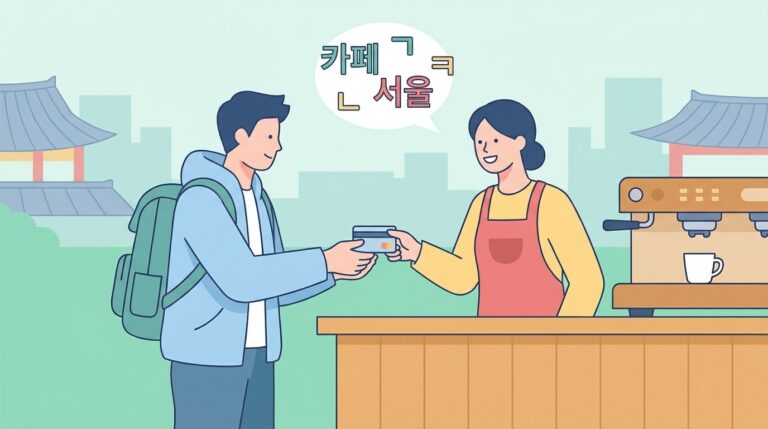
Imagine this: You are standing in a trendy, minimalist aesthetic cafe in Seongsu-dong, Seoul. The air smells of freshly toasted salt bread and rich espresso. You’ve just placed your order for an iced Americano (아아) and a warm pastry. The barista smiles warmly, enters the amount, and points to the card terminal. You proudly pull out your trusty overseas Visa or Mastercard and tap or insert it.
Then… BEEP. BEEP. BEEP. The terminal flashes a red warning box with error codes. Behind you, a queue of stylish locals starts to grow. Your palms sweat, your heart races, and your mind goes completely blank. You wonder: Do they not take international cards? Did my bank block it? What do I even say right now?!
Take a deep breath! You are definitely not alone. While South Korea is practically a 100% cashless society where even street vendors often accept digital payments, older card terminals or specific domestic payment gateways in small mom-and-pop shops sometimes struggle with international credit cards. Based on feedback from hundreds of our “Daily Hangul” learners, mastering just two or three simple, polite Korean payment phrases will turn this high-stress panic moment into a smooth, delightful local interaction. Let’s make sure you never freeze at the checkout counter again!
Phase 2: 3 Core Expressions in-depth
1. 해외 카드 돼요? (Haeoe kadeu dwaeyo?)
- Pronunciation: [Hae-oe ka-deu dwae-yo?] (Sound tip: “Hae-oe” sounds like saying “meh” without the m, followed by “way”; “dwaeyo” sounds like “dway-yo”!)
- Meaning: Literally “Overseas card works?” / Nuance: “Do you accept foreign cards?”
- K-Culture Moment: You will hear variations of this constantly when international characters or visiting idols travel in reality vlogs and K-dramas like King the Land or Crash Landing on You when making unexpected purchases.
- Editor’s Insight: Notice how simple this is! In Korean, you don’t need a clunky sentence like “Is it legally and technically permissible for me to execute a transaction with an international card?” Simply take the noun 해외 카드 (foreign card) and add the magic conversational verb 돼요? (does it work / is it okay?).
- Situation Spectrum: Casual ⚠️ | Semi-formal ✅ | Formal ✅
- 🤔 Think About It: English relies heavily on personal pronouns like “Do you accept my card?” Korean omits both “you” and “me,” focusing entirely on whether the card works in the environment. Why do you think Korean prioritizes situational harmony over individual agency?
2. 다른 카드로 해볼게요 (Dareun kadeuro haebolgeyo)
- Pronunciation: [Da-reun ka-deu-ro hae-bol-ge-yo] (Sound tip: “Dareun” sounds like “da-run”; “haebolgeyo” flows like “hae-bol-gay-yo”.)
- Meaning: Literally “With another card, I will try.” / Nuance: “Let me try a different card.”
- K-Culture Moment: Seen in almost every rom-com convenience store scene where the protagonist’s first card gets declined for dramatic effect, and they quickly switch cards before anyone notices.
- Editor’s Insight: The ending ~ㄹ게요 (~lgeyo) is a gentle promise of future action made directly to the listener. It immediately reassures the cashier that you are actively solving the problem, preventing awkward silences.
- Situation Spectrum: Casual ⚠️ | Semi-formal ✅ | Formal ✅
- 🤔 Think About It: Adding “I will try” (~해보다) softens the entire mood compared to blunt commands. How does your native language handle polite de-escalation at cash registers?
3. 현금으로 낼게요 (Hyeongeumeuro naelgeyo)
- Pronunciation: [Hyeon-geum-eu-ro nael-ge-yo] (Sound tip: “Hyeon-geum” rhymes with “sun-gum” with a soft ‘h’ at the start.)
- Meaning: Literally “With cash, I will pay.” / Nuance: “I’ll pay with cash.”
- K-Culture Moment: Traditional night markets (like Gwangjang Market) where savory bindaetteok (mung bean pancakes) sizzle and cash or bank transfer is still the warmest, fastest exchange.
- Editor’s Insight: The particle ~으로 (~euro) means “by means of” or “using.” Pairing it with 현금 (cash) and 낼게요 (I will pay) solves 100% of payment terminal errors instantly.
- Situation Spectrum: Casual ⚠️ | Semi-formal ✅ | Formal ✅
- 🤔 Think About It: While Seoul is nearly paperless, keeping a crisp 10,000 KRW bill in your wallet is considered a polite traveler’s ultimate backup plan.
Phase 3: Textbook Korean vs. Real Korean
Scenario 1: Asking if a foreign card can be used
- 📖 Textbook Korean: 외국 신용카드로 결제할 수 있습니까? (Oeguk sinyongkadeuro gyeoljehal su itseumnikka?)
- 🗣️ Real Korean: 해외 카드도 돼요? (Haeoe kadeudo dwaeyo?)
- 💡 Why is it different? The textbook phrase sounds like an official written contract or a customs declaration form! Real Koreans shorten “외국 신용카드” (foreign credit card) to everyday 해외 카드 and swap stiff passive constructions for the friendly particle ~도 (“also/too”) + 돼요? (“works?”).
Scenario 2: Asking if Apple Pay or contactless tap works
- 📖 Textbook Korean: 이곳에서 애플페이 지불 방식을 사용할 수 있습니까? (Igoseseo aepeulpei jibul bangsigeul sayonghal su itseumnikka?)
- 🗣️ Real Korean: 혹시 애플페이 돼요? (Hoksi aepeulpei dwaeyo?)
- 💡 Why is it different? Adding the magic conversation starter 혹시 (hoksi – by any chance) instantly brings warmth and politeness without needing heavy formal grammar.
Phase 4: K-Culture Deep Dive & Non-verbal Manners
4-1. Nunchi (눈치) & Two-Handed Etiquette
In Korea, payment is not merely a financial transaction; it is a micro-exchange of mutual respect. When you hand over your credit card:
1. The Two-Hand Rule: Never fling, slide across the counter, or hand your card over with one careless hand. Hold the card between the thumbs and index fingers of both hands, or support your right wrist/forearm lightly with your left hand.
2. The Soft Eye-Contact Nod: Make gentle eye contact, offer a slight 15-degree head bow, and place or hand the card over. When the clerk returns your card and receipt, receive it with both hands as well. This single gesture shows supreme cultural awareness and will earn you warm smiles anywhere in the country.
4-2. The Cashless Society & Tech Ecosystem
South Korea operates on a lightning-fast payment infrastructure. However, domestic credit cards run on national processing networks (BC Card, Shinhan, KB Kookmin). While flagship convenience stores, department stores, and subway stations effortlessly read global networks (Visa, Mastercard, AMEX), independent boutiques in traditional neighborhoods might have terminals unequipped for overseas chip verification. Knowing this removes all personal worry—it’s never you; it’s just the terminal network!
Phase 5: Real-life Roleplay Scenario
- Location: Scent of Ikseon, a charming handmade perfume workshop in a narrow Hanok alleyway.
- Characters:
- Min-ji (민지): A stylish, friendly college student working part-time.
- Alex (알렉스): An eager traveler holding a bottle of cedarwood room spray.
- Turn 1 (Min-ji):
- 🎭 Smiling behind the register and scanning the barcode
- “모두 이만 오천 원입니다!” (Modu iman ocheon-won-imnida!)
- “That comes to 25,000 won in total!”
- Turn 2 (Alex):
- 🎭 Holding out a blue overseas credit card politely
- “저기요, 혹시 해외 카드도 돼요?” (Jeogiyo, hoksi haeoe kadeudo dwaeyo?)
- “Excuse me, by any chance, do foreign cards work too?”
- Turn 3 (Min-ji):
- 🎭 Nodding encouragingly and inserting the card into the reader
- “네, 한번 넣어볼게요. 잠시만 기다려 주세요.” (Ne, hanbeon neoeobolgeyo. Jamsiman gidaryeo juseyo.)
- “Yes, let me insert it once. Please wait just a moment.”
- Turn 4 (Min-ji):
- 🎭 The reader beeps with an error tone; she tilts her head apologetically
- “어머, 오류가 나네요. 승인이 안 돼요.” (Eomeo, oryuga naneyo. Seung-ini an dwaeyo.)
- “Oh dear, an error popped up. It won’t authorize.”
- Turn 5 (Alex):
- 🎭 Smiling comfortably without panic and reaching into wallet
- “아, 괜찮아요! 다른 카드로 해볼게요.” (A, gwaenchanayo! Dareun kadeuro haebolgeyo.)
- “Ah, that’s okay! Let me try with another card.”
- Turn 6 (Min-ji):
- 🎭 Relieved by Alex’s calm attitude, taking the second card with two hands
- “감사합니다. 이건 결제 잘 되네요!” (Gamsahamnida. Igeon gyeolje jal doeneyo!)
- “Thank you. This one goes through perfectly!”
- Turn 7 (Min-ji):
- 🎭 Handing the shopping bag and card back with both hands
- “영수증 필요하세요?” (Yeongsujeung piryohaseyo?)
- “Do you need a receipt?”
- Turn 8 (Alex):
- 🎭 Bowing head gently with a bright smile
- “아니요, 버려주세요. 감사합니다!” (Aniyo, beoryeojuseyo. Gamsahamnida!)
- “No thanks, please discard it. Thank you!”
🔀 Interactive Choice Point
What if the second card failed too? What would you do?
* Choice A: Say “현금으로 낼게요!” (Hyeongeumeuro naelgeyo!) with a warm smile and hand over cash.
* 👉 Feedback: BEST! Clear, instant resolution, completely relieves any register pressure.
* Choice B: Wave your smartphone aggressively while shouting in English, “Why doesn’t this shop take Visa?!”
* 👉 Feedback: BAD. Creates high tension and makes the cashier lose face (체면) over technical issues beyond their control.
* Choice C: Whisper nothing, drop the items on the counter, and turn around to walk out.
* 👉 Feedback: RISK. Highly awkward, leaves the shop assistant confused and distressed.
Phase 6: 10-Second Emotional Shadowing Drill
Practice these lines aloud, syncing your intonation to the pause slashes (/) and emotional cues:
[😊 조심스럽고 다정하게 - Polite and gentle]- 저기요, / 해외 카드도 / 돼요?
- (Jeogiyo, / haeoe kadeudo / dwaeyo?)
[🥺 미안하고 싹싹하게 - Friendly and quick-witted]- 어머, / 다른 카드로 / 해볼게요!
- (Eomeo, / dareun kadeuro / haebolgeyo!)
[😌 안도하며 깔끔하게 - Calm and resolved]- 그럼, / 현금으로 / 낼게요!
- (Geureom, / hyeongeumeuro / naelgeyo!)
Phase 7: K-Culture Mini Dictionary
- 해외 카드 (Haeoe kadeu) | Foreign / Overseas Card
- Real Usage: Essential noun for asking if international credit or debit cards can be processed at POS terminals.
- 일시불 (Il-si-bul) | One-time full payment (Lump sum)
- Real Usage: When paying over 50,000 KRW, clerks often ask “할부 or 일시불?” (Installments or full payment?). For foreign cards, always say 일시불 (Il-si-bul)!
- 영수증 (Yeongsujeung) | Receipt
- Real Usage: Cashiers ask if you want it after every transaction. Common reply: “버려주세요” (Please throw it away).
- 간편결제 (Ganpyeon-gyeolje) | Simple mobile payment
- Real Usage: Broad term for Samsung Pay, Apple Pay, Kakao Pay, and Naver Pay.
Phase 8: Survival Kit for Travelers
Survival Expressions TOP 3
- 카드 돼요? (Kadeu dwaeyo?) – Can I pay by card?
- Pro Tip: The ultra-short version for food trucks and market stalls.
- 영수증 버려주세요 (Yeongsujeung beoryeojuseyo) – Please throw away the receipt.
- Pro Tip: Keep checkout lines moving fast like a true Seoulite.
- 따로 계산할게요 (Ttaro gyesanhalgeyo) – We will pay separately.
- Pro Tip: Perfect when dining out with travel buddies.
Editor’s Travel Note: Smooth Payments in Korea
- Get a dedicated travel card: Pick up a prepaid hybrid card such as the [WOWPASS Prepaid Card Service] at Incheon Airport. It functions as both a domestic debit card accepted across 100% of Korean shops and a T-money transit card.
- Digital Navigation: Use the [Naver Map Navigation App] to check whether cozy cafes and restaurants specify payment details or accept reservations in advance.
- Keep Emergency Cash: Always carry between 20,000 and 30,000 KRW in cash for street snack carts (bungeoppang, tteokbokki) and coin laundromats!
Phase 9: “One Step Deeper” (Cultural Reflection)
Have you noticed how Koreans frequently use the verb 되다 (dwoeda – to become / to work / to be permissible) rather than active phrases like “Do you have the ability to accept this?” In Korean society, linguistic politeness stems from situational harmony and indirectness. Asking 해외 카드 돼요? doesn’t corner the cashier or test their store’s capabilities; it gently inquires whether the current environment allows the transaction to unfold naturally. Language mirrors society: harmony over confrontation, context over ego.
💬 Your Turn: Have you ever experienced an awkward card-declined moment while traveling abroad? How did you solve it? Share your story in the comments below!
Phase 10: FAQ & Common Mistakes
Q: Why do Korean cashiers sometimes look puzzled when I tap my phone for Apple Pay?
A: Apple Pay was only recently introduced to Korea and currently relies predominantly on specific networks (like Hyundai Card). Many local store terminals only support magnetic secure transmission (MST) or domestic IC chips, so Apple Pay support varies. Always carry a physical card just in case!
Q: What should I say if the terminal screen asks for a signature?
A: You don’t need to ask anything! For purchases over 50,000 KRW, the cashier will point to a digital signature pad and say “서명해 주세요” (Seomyeong-hae juseyo). Simply sign your name with the stylus pen.
Q: What does “IC칩 아래로 넣어주세요” mean?
A: It means “Please insert the card with the IC chip facing downward.” Most Korean payment machines require chip insertion rather than swiping.
🚨 Common Mistakes Alert Board
- ❌ Mistake 1: Tossing the card onto the counter counter plate.
- ✅ Correct Action: Hand it directly using both hands or with your right hand supported at the wrist.
- ❌ Mistake 2: Asking for installment payments (할부) on an overseas card.
- ✅ Correct Action: Foreign credit cards cannot process Korean installment plans. Always answer “일시불 (Il-si-bul)” if asked.
- ❌ Mistake 3: Tapping your transit card (T-Money) on regular cafe card readers.
- ✅ Correct Action: T-money is primarily for transit and designated convenience stores. Use your regular bank card for cafes.
Phase 11: Action Mission & Engagement
- 🥉 Bronze Mission: Stand in front of your mirror, hold out an expired credit card with both hands, and say “해외 카드 돼요?” five times with a bright, friendly smile.
- 🥈 Silver Mission: Save this guide, record yourself shadowing Phase 6’s 3 intonation drills, and practice matching the exact pauses (
/). - 🥇 Gold Mission: On your next trip to Korea (or at a local K-mart in your hometown), ask the cashier “혹시 카드 돼요?” in natural Korean!
- 🎮 K-Culture Mission: Watch any episode of a contemporary K-drama (like Business Proposal or Work Later, Drink Now). Spot the exact moment someone pays at a pojangmacha (street tent) vs. a cafe. Do they hand the card with two hands?
Phase 12: Interactive Quiz Challenge
Test your real-world readiness below!
1. [Situational Judgment] Your foreign credit card terminal emits a loud rejection beep at a bustling bakery in Hongdae. What is the most polite and natural phrase to say immediately?
* A) 왜 안 돼요? (Wae an dwaeyo? – Why doesn’t it work?)
* B) 다른 카드로 해볼게요! (Dareun kadeuro haebolgeyo! – I will try with another card!)
* C) 그냥 갈게요. (Geunyang galgeyo. – I’ll just leave.)
2. [Fill in the Blank] Fill in the particle that means “by means of / with”:
* 현금(____) 낼게요. (I’ll pay with cash.)
3. [True / False Cultural Check] In South Korea, it is considered rude to ask the cashier to throw away your paper receipt (“영수증 버려주세요”). (True / False)
👉 Click here to check answers & explanations!
- Question 1 Answer: B! Saying 다른 카드로 해볼게요 reassures the clerk and solves the issue smoothly without blaming anyone.
- Question 2 Answer: 으로 (euro)! Since 현금 ends with a consonant (ㅁ), we attach ~으로 to indicate the method of payment.
- Question 3 Answer: False! Over 80% of Koreans regularly decline paper receipts to save time and paper by saying “버려주세요” (Please discard it). Cashiers appreciate it!







