

Deploy Like a Pro: How to Halt Rollouts and Report Hotfixes in Korean Tech
Phase 1: Empathy & The Pangyo Friday Night Nightmare
안녕하세요! 매일한글 에디터입니다. (Hello! This is your Daily Hangul editor.)
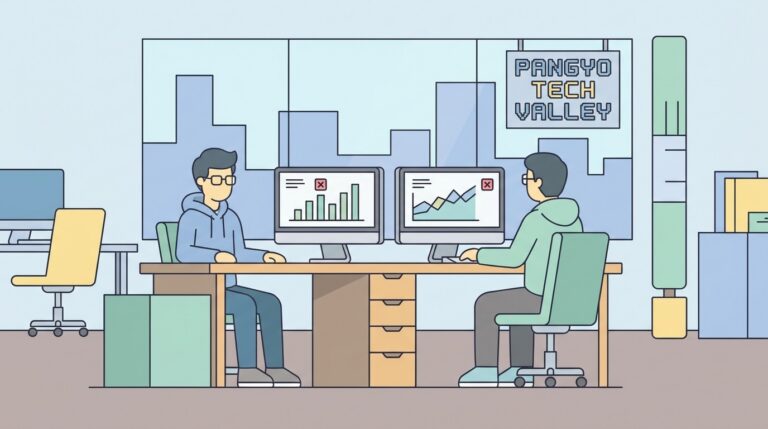
Picture this: It is 6:45 PM on a crisp Friday evening in Pangyo Techno Valley—Korea’s buzzing Silicon Valley. You and your team are celebrating the launch of version 2.4. You trigger a 10% staged rollout on Google Play and Apple App Store, grab an Iced Americano (A-A), and smile like Nam Do-san from the hit K-Drama Start-Up. Then, disaster strikes.
Your Slack channels turn into a sea of red notifications. Sentry is firing off alerts: NullPointerException on the main onboarding screen! The app crashes instantly for newly updated users. Your Team Lead rushes over with wide eyes, asking what the blast radius is and whether the build has hit production. Panic sets in—not because you don’t know how to code, but because your mind blanks on how to explain this in natural, high-stakes Korean workplace language without sounding reckless.
In Korean tech workplaces, the first five minutes of an incident response dictate your reputation. If you fumble with overly casual textbook Korean or robotic dictionary translations, people assume the situation is out of control. But when you calmly say that you paused the phased release and isolated the null pointer crash, everyone exhales. Based on real feedback from international developers working at Kakao, Coupang, and fast-growing Korean startups, this guide will equip you with the exact B2-level phrases and cultural nunchi (tact) needed to handle urgent hotfix situations like a seasoned Pangyo insider.
Phase 2: Top 3 Core Tech Expressions
1. 단계적 배포를 일시 중지하다 (Dangyejeok baeporeul ilsi jungjihada)
- Pronunciation: [Dang-ye-jeok bae-po-reul il-si jung-ji-ha-da] (Sound tip: Imagine climbing stairs “Dan-gye” step-by-step, then a referee shouting “Jung-ji!” for a sudden halt).
- Meaning:
- Literal: To temporarily stop staged deployment.
- Real Nuance: To immediately freeze a phased rollout or staged release before the bug spreads to more users (“contain the blast radius”).
- K-Culture Moment: In high-stress startup dramas, you often see a team lead running into the dev bullpen shouting: “배포 멈춰!” (Stop deployment!). In modern corporate settings, using “일시 중지” shows poise and control.
- Editor’s Insight: The word “배포” (baepo) comes from distribution, but in IT, it specifically means deployment/release. Pairing it with “일시 중지” (temporary pause) conveys that this is a tactical containment move rather than a catastrophic failure.
- Situation Spectrum: Casual 🚫 | Semi-formal ⚠️ | Formal ✅
- 🤔 Think About It: Notice how Korean uses Sino-Korean compound words (단계적 + 배포 + 일시 + 중지) in crisis mode. Why do you think Korean professionals switch from native Korean words to Sino-Korean nouns during technical emergencies?
2. 원인이 된 오류를 수정했어요 (Won-ini doen oryureul sujeonghaesseoyo)
- Pronunciation: [Won-in-i doen o-ryu-reul su-jeong-haess-eo-yo] (Sound tip: “Won-in” sounds like “one in a million cause”; “Sujeong” rhymes with crisp, polished perfection).
- Meaning:
- Literal: I modified/fixed the error that became the cause.
- Real Nuance: I traced the bug, isolated the root cause, and successfully patched it.
- K-Culture Moment: Seen in post-incident meetings when a developer delivers reassuring news after hours of frantic typing while surrounded by empty energy drink cans.
- Editor’s Insight: In casual dev banter, Koreans often use the English loanword “픽스하다” (pikseuhada), but when reporting up the ladder to your PM, PO, or CTO, combining “원인” (root cause) with “수정하다” (to correct/fix) demonstrates thorough engineering discipline.
- Situation Spectrum: Casual ⚠️ | Semi-formal ✅ | Formal ✅
- 🤔 Think About It: English developers often say “I patched the bug.” Korean focuses on “원인이 된 오류” (the error that was the cause). How does identifying causality alter the emotional weight of your update?
3. 전체 사용자에게 퍼지지 않도록 조치했습니다 (Jeonche sayongja-ege peojiji antorok jochihaessseumnida)
- Pronunciation: [Jeon-che sa-yong-ja-e-ge peo-ji-ji an-to-rok jo-chi-haet-seum-ni-da] (Sound tip: “Jochi” snaps sharply off your tongue like taking decisive executive action).
- Meaning:
- Literal: I took measures so that it does not spread to all users.
- Real Nuance: The blast radius has been contained; no further damage will occur.
- K-Culture Moment: The signature line delivered by a reliable senior developer right before the CEO enters the emergency war room.
- Editor’s Insight: “조치하다” (to take measures/counteraction) is a power verb in Korean corporate culture. It implies not just passive observation, but proactive damage mitigation.
- Situation Spectrum: Casual 🚫 | Semi-formal ⚠️ | Formal ✅
- 🤔 Think About It: Why does Korean workplace culture prioritize stating the prevention of future damage before explaining the technical intricacies of the bug itself?
Phase 3: Textbook Korean vs. Real Korean
Scenario 1: Halting a roll-out in the developer Slack channel
- 📖 교과서 한국어 (Textbook Korean):
- “롤아웃 진행을 정지하였습니다.” (Rola-ut jinhaeng-eul jeongjihayeossseumnida.)
- 🗣️ 진짜 한국어 (Real Pangyo Tech Korean):
- “추가 피해 없게 단계적 배포 바로 중단 걸었어요.” (Chuga pihae eopge dangyejeok baepo baro jungdan georeosseoyo.)
- 💡 왜 다를까? (Why the difference?):
Textbook Korean uses sterile dictionary phrases like “정지하였습니다.” Real engineers emphasize the proactive outcome (“추가 피해 없게” – so there is no extra damage) and use active colloquial phrasing like “중단 걸다” (to put a hold/stop on something).
Scenario 2: Explaining a crash caused by a Null Pointer Exception
- 📖 교과서 한국어 (Textbook Korean):
- “널 포인터 예외가 발생하여 프로그램이 꺼졌습니다.” (Neol pointeo yewoe-ga balsaenghayeo peurogeuraem-i kkeojyeossseumnida.)
- 🗣️ 진짜 한국어 (Real Pangyo Tech Korean):
- “널(Null) 값 참조해서 크래시 난 거 잡아서 핫픽스 올렸어요.” (Neol gap chamjohaeseo keuraesi nan geo jabaseo hatpikseu ollyeosseoyo.)
- 💡 왜 다를까? (Why the difference?):
Textbook phrases sound like an academic paper. Korean software engineers routinely use vivid action verbs like “잡다” (to catch/fix a bug) and “올리다” (to push/upload a build), seamlessly blending English loanwords like “크래시” and “핫픽스”.
Phase 4: K-Culture Deep Dive & Non-Verbal Manners
4-1. Incident Room Nunchi (눈치) & Body Language
When a release breaks in a Korean company, body language speaks before your words do:
* Lower your vocal pitch and eliminate nervous chuckles: A casual “아, 실수했네요~” (Oops, my bad!) will instantly destroy trust. Treat a crash with gravity.
* The “Both Hands at Ready” Posture: When reporting to your team lead or Product Owner, stand or sit upright with hands visible, holding your laptop or tablet with both hands. This non-verbally communicates: “I am actively monitoring the pipeline.”
* Acknowledge and Pivot (인정과 전환): Never deflect blame to Apple App Store reviewers or QA in the first breath. First, acknowledge the incident (“네, 확인했습니다”), state the containment (“배포 중단 걸었습니다”), then explain the fix.
4-2. The “Pangyo Dialect” (판교어) Phenomenon
In South Korea’s tech hubs like Pangyo and Teheran-ro, developers speak a unique sociolect called Pangyo-eo (판교어). It weaves English product-management jargon into polite Korean grammar structures. Rather than translating every term, developers naturally say “싱크 맞추다” (sync up), “얼라인하다” (align), “롤백하다” (roll back), and “핫픽스 태우다” (deploy a hotfix on the train). Embracing this balance shows you’re not an outsider reciting a grammar textbook, but a true peer in the engine room.
Phase 5: Real-World Roleplay Scenario
Setting: 7:15 PM at an open-plan FinTech startup in Gangnam. Sentry alert sound just chimed across the office. Empty takeout coffee cups clutter the desk.
Characters:
* 민호 (Min-ho): Senior Backend / DevOps Lead (sharp, calm, protective of the product).
* 지우 (Ji-woo): You (Mid-level Mobile App Engineer handling the release).
— dialogue —
1. 민호: 지우 님, 지금 2.4 버전 롤아웃 시작하고 나서 크래시 율(Crash Rate) 급증하는데 모니터링되고 있나요?
(Ji-woo nim, jigeum 2.4 beojeon rol-a-ut sijakhago naseo keuraesi yul geupjeunghaneunde moniteoringdoego innayo?)
(🎭 leaning over your desk, pointing at the Grafana dashboard with a concerned look)
“Ji-woo, the crash rate is spiking after starting the 2.4 rollout. Are you tracking this?”
2. 지우: 네, 민호 님! 전체 사용자에게 퍼지지 않도록 즉시 단계적 배포 일시 중지 걸었습니다.
(Ne, Min-ho nim! Jeonche sayongja-ege peojiji antorok jeuksi dangyejeok baepo ilsi jungji georeosseumnida.)
(🎭 speaking clearly and calmly, keeping eyes on the terminal)
“Yes, Min-ho! I immediately paused the staged rollout so it doesn’t spread to all users.”
3. 민호: 빠른 판단 좋네요. 현재 유저 유입 몇 프로까지 나간 상태예요?
(Ppareun pandan jon-neyo. Hyeonjae yujeo yuip myeot peurokkaji nagan sangtaeyeyo?)
(🎭 crossing arms, visibly relaxing shoulders upon hearing the rollout is halted)
“Great quick judgment. What percentage of users received the build before the stop?”
4. 지우: 5% 선에서 바로 끊어서 blast radius는 최소화했습니다.
(O peosenteu seoneseo baro kkeun-eoseo blast radiusneun choesohwahayeossseumnida.)
(🎭 showing the deployment console on your secondary monitor)
“I cut it off right at 5%, so we’ve minimized the blast radius.”
5. 민호: 다행이네요. 크래시 로그 찍힌 원인은 파악됐어요?
(Dahaeng-ineyoyo. Keuraesi rogeu jik-hin won-ineun pa-akdwaesseoyo?)
(🎭 leaning closer to inspect the stack trace)
“Thank goodness. Did you identify the cause from the crash log?”
6. 지우: 온보딩 화면에서 유저 프로필 조회할 때 널 포인터 오류가 난 거였어요. 원인이 된 코드 바로 수정했습니다.
(Onboding hwamyeon-eseo yujeo peurofil johoehal ttae neol pointeo oryuga nan geoyeosseoyo. Won-ini doen kodeu baro sujeonghaesseoyo.)
(🎭 highlighting the patched line in the pull request)
“A NullPointerException was thrown when fetching user profiles on the onboarding screen. I’ve already patched the root cause code.”
7. 민호: 역시 빠르시네요. QA 팀에 긴급 검증 요청하고 바로 핫픽스 빌드 올리죠.
(Yeoksi ppareusineyo. QA time gingeup geomjeung yocheonghago baro hatpikseu bildeu ollijyo.)
(🎭 nodding approvingly and giving a light shoulder tap)
“Fast as always. Let’s request an urgent verification from the QA team and push the hotfix build right away.”
8. 지우: 네, 핫픽스 빌드 생성되는 대로 슬랙 채널에 공지 올리겠습니다!
(Ne, hatpikseu bildeu saengseongdoeneun daero seullaek chaeneore gongji olligessseumnida!)
(🎭 typing the build trigger command with confidence)
“Understood! As soon as the hotfix build generates, I will post an update in the Slack channel!”
🔀 Interactive Decision Fork
Imagine your Team Lead Min-ho asks: “지우 님, 방금 터진 크래시 배포 상황 어떻게 됐나요?” (Ji-woo, what’s the status of the crash rollout?)
- Choice A (Best): “네, 전체 사용자에게 퍼지지 않도록 단계적 배포 중단했고요, 널 포인터 오류 수정해서 핫픽스 테스트 중입니다!”
- Feedback: 100/100 (Best!): Professional, proactive, and reassures the team that the issue is contained while providing the technical diagnosis.
- Choice B (Bad): “아, 널 포인터 에러 때문인데 별거 아니에요. 다시 배포하면 돼요.”
- Feedback: 30/100 (Bad): Dismissive. Calling production crashes “별거 아니다” (no big deal) terrifies tech leads and damages credibility.
- Choice C (Risk): “죄송합니다! 제가 코드를 잘못 봐서 큰일 났네요… 어떡하죠?”
- Feedback: 50/100 (Risk): Overly emotional and helpless. In Korean workplaces, apologize quickly if necessary, but follow up immediately with containment actions rather than asking “어떡하죠?” (what do I do?).
Phase 6: 10-Second Emotion Shadowing Drill
Practice these high-frequency emergency lines with the exact pauses (/) and emotional tone:
[💼 침착하고 신속하게 - Calm, crisp, and authoritative]- 전체 사용자에게 / 퍼지지 않도록 / 즉시 배포를 중단했습니다.
(Jeonche sayongja-ege / peojiji antorok / jeuksi baeporeul jungdanhaesseumnida.) - “I halted the deployment immediately / so it wouldn’t spread / to all users.”
- 전체 사용자에게 / 퍼지지 않도록 / 즉시 배포를 중단했습니다.
[🔍 집중하며 원인을 짚을 때 - Focused, analytical, reassuring]- 널 포인터 참조 오류를 확인하여 / 원인이 된 코드를 / 모두 픽스했습니다.
(Neol pointeo chamjo oryureul hwaginhayeo / won-ini doen kodeureul / modu pikseuhaesseumnida.) - “After identifying the null pointer dereference error / I patched all / the root cause code.”
- 널 포인터 참조 오류를 확인하여 / 원인이 된 코드를 / 모두 픽스했습니다.
[🤝 든든하고 신뢰감 넘치게 - Supportive and professional]- 긴급 핫픽스 빌드 추출 후 / 스토어에 심사 긴급 요청 / 넣겠습니다.
(Gingeup hatpikseu bildeu chuchul hu / seoto-e simsa gingeup yocheong / neokgetseumnida.) - “After generating the urgent hotfix build / we will submit an expedited review request / to the store.”
- 긴급 핫픽스 빌드 추출 후 / 스토어에 심사 긴급 요청 / 넣겠습니다.
Phase 7: K-Culture Mini Dictionary
- 핫픽스 (Hat-pik-seu) | Emergency Hotfix
- Context: Used identically to English, but grammatically treated as a noun you “put up” or “ride”: “핫픽스 배포 올리다” or “핫픽스 태우다”.
- 리젝 (Ri-jek) | Store Review Rejection
- Context: From the English “Reject.” When Apple or Google review teams reject an app update, Koreans say: “애플에서 리젝 먹었어요” (We got “eaten” by an Apple rejection).
- 불끄기 (Bul-kku-gi) | Firefighting / Incident Remediation
- Context: Literally “extinguishing fires.” Used metaphorically in tech when an unexpected bug disrupts roadmap priorities: “오늘 오전 내내 불끄기 하느라 다른 개발을 못 했어요.” (I spent all morning firefighting, so I couldn’t do feature development).
- 초동 대처 (Cho-dong dae-cheo) | Initial Incident Containment Response
- Context: An essential business-Korean term referring to actions taken in the golden window right after an emergency to prevent escalation.
Phase 8: Professional Tech Survival Kit
TOP 3 Survival Phrases
- “배포 잠깐만 홀드해 주세요!” (Baepo jamkkanman holdeuhae juseyo!)
- Pro Tip: Use this when you spot an issue right at deployment time. “홀드하다” (to hold) is universally understood across Korean product teams.
- “원인 파악 끝났고, 수정 커밋 올렸습니다.” (Won-in pa-ak kkeun-natgo, sujeong keomit ollyeosseumnida.)
- Pro Tip: The golden phrase to paste into Slack. It communicates both diagnosis and the resolution commit.
- “스토어에 긴급 심사(Expedited Review) 요청 넣겠습니다.” (Seoto-e gingeup simsa yocheong neokgetseumnida.)
- Pro Tip: Used when an iOS release must bypass standard multi-day review queues due to a catastrophic crash.
Editor’s Travel & Tech Note
If you ever visit South Korea for hackathons, business trips, or tech meetups in Pangyo, skip international platforms and download the essential local apps. Check out our [KakaoMap transit guide for Pangyo Techno Valley] to navigate the massive corporate campuses like Kakao and NCSoft without getting lost. For checking tech salaries, company workplace culture, and real engineer gossip, bookmark the [Blind app community culture overview]—it’s the virtual watercooler where Korean software engineers discuss hotfixes, rejections, and startup survival.
Phase 9: Step Deeper (한 발 더 깊이)
In Western software cultures, post-mortems often lean heavily toward individual technical autonomy—the person who pushed the code is expected to patch the code. In Korea, however, software releases are seen through the lens of collective responsibility (공동체 의식). When a production incident breaks out, the focus is never solely on who made the typo; rather, the team rallies around “우리 서비스” (our service) and how effectively the 초동 대처 (initial containment) was executed. By stepping up and announcing, “전체 사용자에게 퍼지지 않도록 배포를 중단했습니다”, you demonstrate that you guard the team’s shared perimeter. It transforms an engineering slip-up into proof of your reliability under fire.
💬 Your Turn: Have you ever experienced a production bug on a Friday afternoon? How would you translate your most memorable incident response story into Korean? Share your experience in the comments below!
Phase 10: FAQ & Common Mistakes
Q: Can I use the English word “Rollout” instead of “단계적 배포”?
A: Yes! In modern Korean tech companies, saying “롤아웃 일시 중지했어요” is very common and understood. However, when writing incident reports (장애 보고서), executive summaries, or communicating with cross-functional stakeholders who aren’t engineers, “단계적 배포 일시 중지” is the respected standard.
Q: What is the difference between “오류” (Oryu), “버그” (Beogeu), and “에러” (E-reo)?
A: “버그” (bug) and “에러” (error) are casual, conversational loanwords used constantly in dev talk. “오류” (Sino-Korean for error/flaw) is the more formal, professional term used in client-facing release notes, internal post-mortems, and formal management briefings.
Q: How do I say “blast radius” in Korean without using English?
A: While “블라스트 래디우스” (blast radius) is used in hyper-globalized Korean tech firms, the native equivalent is “영향 범위” (yeong-hyang beom-wi, impact scope) or “피해 범위” (pi-hae beom-wi, damage scope). Example: “영향 범위를 5%로 한정했습니다.” (We limited the impact scope to 5%).
🚨 흔한 실수 (Common Mistakes) Checklist
- Mistake: Saying “제가 앱을 죽였습니다” (I killed the app).
- Correct Action: Don’t translate English developer humor literally. Say “크래시가 발생했습니다” (A crash occurred) or “비정상 종료 오류가 났습니다”.
- Mistake: Using “미안합니다” (Mianhamnida) to your manager during a crash.
- Correct Action: In professional environments, “미안합니다” sounds inappropriate or childish. Use “죄송합니다. 즉시 조치하겠습니다” (I apologize. I will take action immediately).
- Mistake: Saying “배포 취소했습니다” when you actually paused a staged rollout.
- Correct Action: “취소” means permanent cancellation/abort. If you paused a rollout, specify “일시 중지” (temporary halt) so your team knows it can be resumed.
Phase 11: Action Mission & Engagement
- 🥉 Bronze Mission (Solo Practice): Read the Phase 6 Shadowing Drills aloud 3 times, timing yourself to deliver all 3 sentences cleanly within 25 seconds.
- 🥈 Silver Mission (Community Drill): Open your favorite IDE or notes app and write a 2-line Slack incident containment message in Korean using the words 단계적 배포, 일시 중지, and 수정.
- 🥇 Gold Mission (Real-world Challenge): Next time you watch a tech-themed K-Drama like Start-Up or encounter a bug at work, use the phrase “원인이 된 오류를 찾았습니다!” aloud.
- 🎮 K-Culture Mission: Search YouTube for “판교 개발자의 하루” (A Day in the Life of a Pangyo Developer). Notice how many times they say 배포 (baepo), 이슈 (issue), and 조치 (jochi) during their daily standups!
Phase 12: Interactive Quiz Challenge
1. Situational Judgment
Your app update caused an authentication crash for 10% of users. Your PO asks: “지금 배포 상황 어떻게 되고 있나요?” What is the most reassuring and professional answer?
* A) “모르겠어요, 서버 문제인 것 같아요.”
* B) “전체 유저에게 퍼지지 않도록 단계적 배포 일시 중지 걸어두었습니다.”
* C) “어차피 10%만 받은 거라 괜찮습니다.”
👉 Click to Reveal Answer & Explanation
Correct Answer: B
Explanation: Option B demonstrates proactive containment (단계적 배포 일시 중지) and calms the team. Option A deflects without proof, and Option C dismisses customer impact, which violates professional workplace ethics.
2. Fill-in-the-Blank
Complete the sentence to mean: “I patched the root-cause code so that it doesn’t spread to all users.”
* 전체 사용자에게 퍼지지 않도록 원인이 된 코드를 [ _______ ]했어요.
👉 Click to Reveal Answer & Explanation
Correct Answer: 수정 (or 픽스)
Full Sentence: “전체 사용자에게 퍼지지 않도록 원인이 된 코드를 수정했어요.” (or 픽스했어요.)
3. Culture & Manners True/False
Statement: In Korean IT workplaces, it is considered best practice to immediately write a long personal apology email explaining your emotions before pausing the faulty deployment pipeline.
👉 Click to Reveal Answer & Explanation
Correct Answer: False (F)
Explanation: Action precedes emotion in Korean incident management. Taking immediate containment action (초동 대처) to stop the rollout comes first; retrospectives and formal reports follow only after the bleeding stops!







