

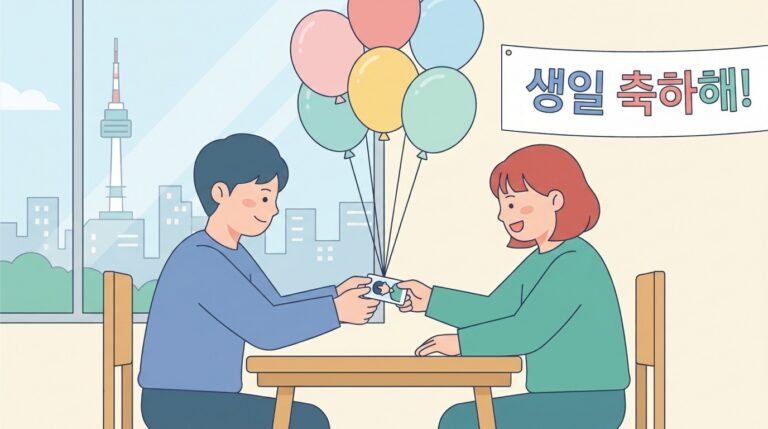
Trade Photocards Like a Local at Korean Birthday Cafes
Phase 1: Empathy & Story-Driven Opening
안녕하세요! 매일한글 에디터입니다. (Hello! I’m your Daily Hangul editor.)
Imagine stepping into a charming, flower-filled cafe near Hongik University Station in Seoul. Cutout stands of your favorite idol beam at you, pastel balloon arches line the ceiling, and the sound of their hit songs fills the air. You just made it to a real saeng-ka (아이돌 생일 카페 – Idol Birthday Cafe)!
Your heart beats fast as you insert coins into the Lucky Draw (럭키드로우, or “럭드”) machine. Click-clack! Out roll two shiny plastic sleeves. You slide the photocard out with trembling hands, only to discover… you pulled the exact same card twice! A double! Meanwhile, right at the table beside you, another fan gasps with delight, holding the rare card of your choe-ae (최애 – ultimate bias), looking wistfully around for someone to swap with.
You want to speak to them so badly, but your mind goes completely blank. What if your Korean sounds awkward? What if you sound rude?
Don’t worry at all! Trading photocards on the spot is a beloved K-pop ritual where strangers turn into friends in seconds. Based on real feedback from our Daily Hangul learners, mastering just three polite, natural phrases will turn your awkward hesitation into a warm, unforgettable memory. Let’s make sure you walk away with your dream photocard!
Phase 2: Core Expressions Deep Dive (A2 Level)
1. 혹시 교환 가능할까요? (Hoksi gyohwan ganeunghalkkayo?)
- Pronunciation: [Hok-shi gyo-hwan ga-neung-hal-kka-yo?] (Think of “Hok-shi” as a soft knock on an imaginary door—gentle and polite.)
- Meaning: Literal: “By any chance, is exchange possible?” | Actual Nuance: “Excuse me, would you be open to trading photocards?”
- K-Culture Moment: Heard constantly at concert venues, pop-up stores, and birthday cafe trading tables when fans approach each other with their card binders.
- Editor’s Insight: The magic word here is 혹시 (hoksi). Starting with “혹시” instantly softens your request, giving the other person an easy, pressure-free way to respond.
- Situation Spectrum:
- Casual (반말): ⚠️ (Only with close personal friends)
- Semi-formal (존댓말 – 아/어요): ✅ (Ideal for friendly peer-to-peer fan interactions!)
- Formal (하십시오체): ✅ (Polite, but can feel slightly stiff in a cafe setting)
- 🤔 Think About It: In English, you might casually say, “Wanna swap?” Why do Korean speakers use conditional phrasing like “Is it possible?” when speaking to people their own age?
2. 저 이거 중복이라서요. (Jeo igeo jungbogiraseoyo.)
- Pronunciation: [Jeo ee-geo joong-bo-gi-ra-seo-yo] (Say “jung-bok” with a crisp tap on the ‘k’ sound.)
- Meaning: Literal: “Because this one is a duplicate for me…” | Actual Nuance: “I ended up pulling a duplicate of this card.”
- K-Culture Moment: Placing your duplicate card gently on your napkin sleeve-first to show what you have available for trade.
- Editor’s Insight: Notice how the sentence ends with -(이)라서요 (-iraseoyo). In Korean everyday conversation, trailing off with a gentle reason creates a modest, polite impression rather than saying a blunt statement like “I have two of these.”
- Situation Spectrum:
- Casual: ⚠️ (Use ‘나 이거 중복이야’ only with close pals)
- Semi-formal: ✅ (The golden standard for trading on-site)
- Formal: ✅
- 🤔 Think About It: Why does explaining why you want to trade (having a duplicate) feel friendlier than immediately demanding the card you want?
3. 누구 찾으세요? (Nugu chajeuseyo?)
- Pronunciation: [Noo-goo cha-jeu-se-yo?] (“Noo-goo” rhymes with “new glue”.)
- Meaning: Literal: “Whom are you searching for?” | Actual Nuance: “Which member are you looking to get?”
- K-Culture Moment: You are holding a couple of spare photocards, and another fan lingers nearby looking at your table with hopeful eyes.
- Editor’s Insight: Adding the honorific infix -시- (-si-) shows high respect to fellow fans, even if you share the exact same fandom level.
- Situation Spectrum:
- Casual: 🚫 (Sounds dismissive if said to someone you don’t know)
- Semi-formal: ✅ (Warm and welcoming)
- Formal: ✅
- 🤔 Think About It: Notice how Korean speakers don’t need to specify “Which photocard member”. The context alone carries the full meaning!
Phase 3: Textbook Korean vs. Real-Life Korean
Situation A: Asking to trade cards
- 📖 교과서 한국어 (Textbook):
- 이 사진과 저 사진을 바꿉시다. (I sa-jin-gwa jeo sa-jin-eul ba-kkup-si-da.)
- “Let us exchange this photo and that photo.”
- 🗣️ 진짜 한국어 (Real-Life):
- 혹시 포카 교환하실래요? (Hoksi poka gyohwanhasilraeyo?)
- “By any chance, would you like to trade photocards?”
- 💡 왜 다를까? (Why is it different?): Textbooks teach generic words like 사진 (photo) and stiff imperative endings like -ㅂ시다 (let’s). Real fans always use the cultural term 포카 (poka – short for photocard) and friendly inquiry endings.
Situation B: Stating that you drew an identical card
- 📖 교과서 한국어 (Textbook):
- 저는 같은 것이 두 개 있습니다. (Jeoneun gateun geosi du gae issseumnida.)
- “I possess two items of the same kind.”
- 🗣️ 진짜 한국어 (Real-Life):
- 저 이거 중복 나왔어요! (Jeo igeo jungbok nawasseoyo!)
- “I got a duplicate of this one!”
- 💡 왜 다를까? (Why is it different?): In gacha and lucky draw culture, Koreans use the verb 나오다 (naoda – to come out / to be pulled) to emphasize the spontaneous thrill of random draws.
Phase 4: K-Culture Deep Dive & Non-Verbal Manners
4-1. Nunchi (눈치) & Gesture Etiquette
- The Two-Handed Offer (양손 예절): Always hand over your photocard using both hands, holding it delicately by the protective plastic sleeve (슬리브) or toploader (탑로더). Never touch the bare surface of the photocard with bare fingertips!
- The Head Nod (목례): When someone accepts your trade proposal, give a light 15-degree bow of gratitude. It signifies instant fan-solidarity (덕후 연대).
- The Cafe Napkin Display: If you want to trade passively, place your extra cards on top of a clean paper napkin face-up on your cafe table. In Korean 생카 etiquette, this signals: “I am open for trades!”
4-2. Cultural Code: The Magic of 생카 (Saeng-ka)
- Birthday cafes are completely fan-organized. Fans rent a local cafe for 2-3 days, design custom cup sleeves (컵홀더), stickers, and mini exhibition prints.
- The Lucky Draw (럭드) machine is usually set up with randomized scratch tickets or plastic capsules costing 1,000–3,000 KRW each. Because duplicates happen frequently, the cafe floor transforms into a mini stock market of kindness, where everyone wants everyone else to leave happy.
Phase 5: Real-Life Roleplay Scenario
Setting: A warm, bustling cafe in Mapo-gu covered in baby-blue ribbons. You just finished your Lucky Draw and sit at the communal wooden bench.
Character: Minji (민지), a friendly local fan holding a binder full of photocards, smiling shyly.
- Turn 1 (You): 🎭 Looking at your duplicate card, then making gentle eye contact with Minji
저기요, 혹시 교환 가능할까요? (Jeogiyo, hoksi gyohwan ganeunghalkkayo?)
(Excuse me, by any chance, would you be open to trading?) - Turn 2 (Minji): 🎭 Perking up with wide eyes and a welcoming smile
네! 누구 찾으세요? (Ne! Nugu chajeuseyo?)
(Yes! Who are you looking for?) - Turn 3 (You): 🎭 Pointing gently at your duplicate on the table
저 민규 중복이라서 원우 찾고 있어요. (Jeo Mingyu jungbogiraseo Wonwoo chatgo isseoyo.)
(I got a duplicate of Mingyu, so I’m looking for Wonwoo.) - Turn 4 (Minji): 🎭 Gasping happily, clapping hands once
어, 진짜요? 저 원우 중복 나왔어요! (Eo, jinjjayo? Jeo Wonwoo jungbok nawasseoyo!)
(Oh, really? I pulled a duplicate of Wonwoo!) - Turn 5 (You): 🎭 Smiling with relief
우와, 대박! 그럼 교환할까요? (Uwa, daebak! Geureom gyohwanhalkkayo?)
(Wow, amazing! Then shall we trade?) - Turn 6 (Minji): 🎭 Carefully holding her photocard by the plastic sleeve with both hands
네, 좋아요! 여기 있어요. (Ne, joayo! Yeogi isseoyo.)
(Yes, sounds great! Here you go.) - Turn 7 (You): 🎭 Handing your card with both hands and receiving hers
감사합니다! 조심히 가세요. (Gamsahamnida! Josimhi gaseyo.)
(Thank you so much! Have a safe trip home.) - Turn 8 (Minji): 🎭 Bowing slightly and waving
생일 축하해요! 좋은 하루 보내세요! (Saeng-il chukahaeyo! Joeun haru bonaeseyo!)
(Happy idol birthday! Have a wonderful day!)
🔀 Interactive Decision Point
Suppose Minji says: “죄송해요, 저는 이미 민규가 있어요…” (I’m sorry, I already have Mingyu…). How do you respond?
- Option A: “아, 괜찮아요! 확인해 주셔서 감사합니다!” (Ah, gwaenchanayo! Hwaginhae jusyeoseo gamsahamnida! / Oh, no problem! Thank you for checking!)
Feedback: [BEST] Pure class! This leaves a polite, sunny impression and keeps the fandom atmosphere sweet and comfortable. - Option B: “왜 안 바꿔요? 제발 바꿔줘요.” (Wae an bakkwoyo? Jebal bakkwojwoyo. / Why won’t you trade? Please swap.)
Feedback: [BAD] Rude and pressuring. Photocard trades must always be mutually consensual without coercion. - Option C: Silence, turning your back immediately without saying anything.
Feedback: [RISK] Walking away abruptly causes awkward tension in a small cafe where you will likely bump into each other again.
Phase 6: 10-Second Emotion Shadowing Drill
Practice reading these out loud with realistic feeling and micro-pauses (/)!
[😊 설레며 다정하게 - Excited & Gentle]
저기요, / 혹시 / 교환 가능할까요?
(Jeogiyo, / hoksi / gyohwan ganeunghalkkayo?)-
[🥺 아쉽고 쑥스럽게 - Slightly Shy & Modest]
저 / 이거 / 중복이라서요…
(Jeo / igeo / jungbogiraseoyo…) -
[🎉 감격하며 반갑게 - Thrilled & Relieved]
우와, / 대박! / 교환해 주셔서 / 진짜 감사해요!
(Uwa, / daebak! / Gyohwanhae jusyeoseo / jinjja gamsahaeyo!)
Phase 7: K-Culture Mini Dictionary
- 포카 (Po-ka)
Short for 포토카드 (Photocard). The holy grail of K-pop merchandise. These collectible selfie cards are included inside album albums and distributed during cafe Lucky Draws. - 럭드 (Reok-deu)
Short for 럭키드로우 (Lucky Draw). A gacha lottery machine or scratch-card event at pop-ups and birthday cafes offering exclusive photocard prints. - 중복 (Jung-bok)
Duplicate / Overlap. Used when you unbox or draw two or more identical cards from blind packaging. - 최애 (Choe-ae)
Ultimate Bias. The member of the group you adore above all others. Your number two favorite is called 차애 (cha-ae).
Phase 8: Traveler’s Survival Kit
Survival Expressions TOP 3
- 포카 슬리브 있어요? (Poka seullibeu isseoyo?)
Romanization: [Poka seul-li-beu iss-eo-yo?]
Pro Tip: If you don’t have a protective film, ask the counter staff or a nearby stationery shop. Keeping cards mint condition is essential for trades! - 럭키드로우 코인 어디서 사요? (Reokkideurou koin eodiseo sayo?)
Romanization: [Reok-ki-deu-ro-u ko-in eo-di-seo sa-yo?]
Pro Tip: Most cafes require you to buy Lucky Draw tokens at the cash register when ordering your drink. - 사진 한 장 찍어도 될까요? (Sajin han jang jjigeodo doelkkayo?)
Romanization: [Sa-jin han jang jji-geo-do doel-kka-yo?]
Pro Tip: Use this polite line when asking to photograph someone’s gorgeous decorated photocard holder.
Editor’s Travel Note
- Route Planning: Birthday cafes are heavily concentrated in Hongdae, Hapjeong, and Seongsu. Make sure to consult the Naver Map app download for cafe hopping to save your customized cafe tour bookmarks.
- Cash vs. Card: While counter orders accept credit cards or travel cards (like WOWPASS), some older Lucky Draw coin changers specifically require crisp 1,000 KRW bills. Keep 5,000 to 10,000 KRW in cash in your wallet!
Phase 9: “One Step Deeper” (Reflective Essay)
In many parts of the world, approaching a complete stranger in a cafe to negotiate a trade might feel overly forward or risky. Yet in Seoul’s idol birthday cafes, the barrier between strangers vanishes instantly. This phenomenon stems from the concept of 덕후 연대 (deokhu yeondae – fan solidarity): the implicit agreement that everyone in that room shares the exact same joy, passion, and respect for an artist. By using polite honorifics (존댓말), fans establish mutual safety, allowing generosity to flow freely. Trading duplicate cards isn’t a transactional barter; it’s an act of communal goodwill where fans genuinely want to help one another complete their sets.
💬 Your Turn: Have you ever experienced unexpected warmth or solidarity from a stranger while traveling or bonding over a hobby? Share your story in the comments below!
Phase 10: FAQ & Mistake Prevention
Q: What if I don’t speak enough Korean to negotiate a complex photocard trade?
A: Don’t stress! You only need to say: “혹시 교환 가능할까요?” (Hoksi gyohwan ganeunghalkkayo?) while holding up your card. If they speak quickly, you can gently say “한국어 조금만 할 수 있어요” (Hangugeo jogeumman hal su isseoyo – I can only speak a little Korean). Fans are remarkably patient and often use translation apps to help you.
Q: Can I trade unofficial fan-made photocards with official Lucky Draw photocards?
A: Generally, no. Official event cards (럭드) should only be traded for other official cards of the same tier. Fan-made gifts given out with drinks are known as 특전 (teukjeon – special cafe freebies) and are traded separately.
Q: How do I know if someone sitting at a table wants to trade or just wants to be left alone?
A: Look at their table! If their cards are neatly packed inside a closed binder, they are likely just enjoying their drink. If their photocards are laid out openly on napkins or plastic stands facing outwards, that is the universal sign inviting trades.
🚨 Common Mistakes Warning Board
- Mistake: Touching the glossy surface of another fan’s card with bare fingers.
Correct Action: Always hold cards by the outer protective sleeve edges. - Mistake: Using 반말 (informal talk) like “바꿔!” (Swap!) just because the other fan looks younger.
Correct Action: Always use polite 존댓말 (e.g., “교환하실래요?”) with strangers regardless of their age. - Mistake: Pressuring someone after they politely decline.
Correct Action: Bow slightly and say “네, 괜찮습니다! 좋은 하루 보내세요!” (Yes, that’s fine! Have a nice day!).
Phase 11: Action Missions & Engagement
- 🥉 Bronze Level (Solo Drill): Practice saying “저 이거 중복이라서요” 5 times in front of your mirror while holding any card with both hands.
- 🥈 Silver Level (Social Check): Share a photo of your favorite K-pop card on your Instagram Story or X (Twitter) with the caption: “포카 교환하고 싶어요!” (I want to trade photocards!)
- 🥇 Gold Level (Real-World Test): Visit an idol birthday cafe or pop-up store, approach a fan with an open trade display, and successfully ask: “혹시 교환 가능할까요?”
🎮 K-Culture Mission: Watch a recent “Photocard Unboxing” (포카 깡) vlog of your favorite K-pop idol on YouTube. Listen closely and comment the exact minute-and-second timestamp where the creator shouts “중복 나왔어!”!
Phase 12: Interactive Quiz Challenge
Q1. (Scenario Judgment)
You pulled an extra card at a Lucky Draw and notice someone holding the member you want. What is the most natural and polite opening phrase?
* A) 이거 내놔요. (Igeo naenwayo.)
* B) 저기요, 혹시 교환 가능할까요? (Jeogiyo, hoksi gyohwan ganeunghalkkayo?)
* C) 사진 바꿉시다. (Sajin ba-kkup-si-da.)
Q2. (Fill-in-the-Blank)
Complete the natural explanation:
“저 이거 _________이라서 원우 찾고 있어요.” (I got a duplicate of this, so I’m looking for Wonwoo.)
* A) 중복 (jungbok)
* B) 선물 (seonmul)
* C) 비밀 (bimil)
Q3. (True or False Cultural Manners)
When trading photocards in Korea, it is considered polite to hand over the card using only one hand while waving with the other.
* True / False
👉 Click to view answers & explanations
- Q1 Answer: B. “혹시 교환 가능할까요?” is the gold standard for polite, friendly communication among fans. (Option A is an aggressive demand, and Option C is unnaturally stiff).
- Q2 Answer: A (중복 – duplicate). “저 이거 중복이라서…” perfectly explains why you are offering that specific card.
- Q3 Answer: False. Always use both hands (양손) when giving and receiving photocards to show respect and avoid dropping delicate collectibles!







