

Phase 1: Empathy (Story-driven Opening)
안녕하세요! 매일한글 에디터입니다. (Hello! This is your Daily Hangul editor!)
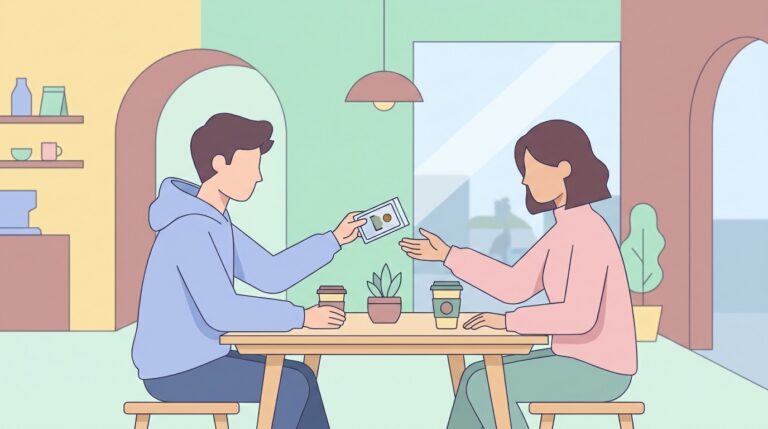
Picture this: You are standing in a trendy cafe in Hongdae covered in giant posters and delicate banners of your favorite idol. You just bought three tokens for the “lucky draw” (럭키드로우) machine. Your hands shake as the plastic capsules drop. You peel them open… and gasp. All three are the exact same photocard! Right across the table, another fan is holding the card you desperately wanted, looking at her pile with a small sigh. You want to offer a trade, but your voice catches in your throat. What if I sound impolite? What if I use the wrong words?
Don’t panic! On-the-spot photocard trading is an everyday ritual in Korea’s birthday cafe scene. With just three friendly A2-level sentences, you can trade duplicates with zero stress and maybe even make a new friend. This guide breaks down real Korean phrases gathered from our learners who survived the birthday cafe rush!
Phase 2: Core Expressions in Depth
1. 혹시 교환 가능할까요? (Hoksi gyohwan ganeunghalkkayo?)
- Pronunciation: Hoke-shee gyo-hwan gah-neung-hal-kkah-yo? (Think of “Hoksi” like asking “By any chance…?” softly with a polite smile.)
- Meaning: Literal: “By any chance, is an exchange possible?” | Nuance: “Excuse me, would you be interested in trading?”
- K-Culture Moment: You see someone opening their lucky draw photocard envelopes on the counter next to you. Before leaning in, you open with this polite phrase.
- Editor’s Insight: Adding 혹시 (hoksi) softens the entire sentence instantly. In Korean culture, jumping straight to a request can sound abrupt; 혹시 creates a cushion of respect.
- Situation Spectrum: Casual ⚠️ | Semi-formal ✅ | Formal ✅
- 🤔 Think About It: Why does Korean emphasize softening words like hoksi before asking strangers for help, whereas in English we often get straight to “Can we trade?”
2. 누구 찾으세요? (Nugu chajeuseyo?)
- Pronunciation: Noo-goo chah-jeuh-seh-yo? (Sounds like “who-goo”, ending gently like asking a favor.)
- Meaning: Literal: “Who are you searching for?” | Nuance: “Who are you collecting?” or “Which member do you want?”
- K-Culture Moment: After someone stops by your table seeing your photocard display, you look up warmly and ask this to check if you have their bias.
- Editor’s Insight: The verb 찾다 (chatda) means “to find/search.” Using the honorific form 찾으세요 (-euseyo) shows friendliness without being overly familiar.
- Situation Spectrum: Casual ⚠️ | Semi-formal ✅ | Formal ✅
- 🤔 Think About It: In English fandom, we ask “Who is your bias?” In Korea, fans treat idol photocards like treasures on a treasure hunt, using the action verb “looking for” (찾다)!
3. 저 이거 중복 나와서요. (Jeo igeo jungbok nawaseoyo.)
- Pronunciation: Juh ee-guh joong-bohk nah-wah-suh-yo. (Pronounce “jungbok” with a short, neat “k” snap at the end.)
- Meaning: Literal: “As for me, a duplicate of this came out.” | Nuance: “I got a duplicate of this one, that’s why I’m asking!”
- K-Culture Moment: Holding up two identical photocards and explaining shyly why you are initiating a trade.
- Editor’s Insight: The ending -아/어서요 (-a/eoseoyo) gives a soft reason. It explains your context naturally so the other person understands your intention immediately.
- Situation Spectrum: Casual ⚠️ | Semi-formal ✅ | Formal ✅
- 🤔 Think About It: Koreans frequently leave off the main clause (“…so please trade with me”) and just state the background reason. It allows the listener the space to respond comfortably.
Phase 3: Textbook Korean vs. Real Korean
Situation 1: Asking to trade cards
- 📖 교과서 한국어 (Textbook Korean): 저와 사진을 교환해 주시겠습니까? (Jeowa sajineul gyohwanhae jusigesseumnikka? / Would you please exchange pictures with me?)
- 🗣️ 진짜 한국어 (Real Korean): 혹시 포카 교환하실래요? (Hoksi poka gyohwanhasillaeyo? / By any chance, would you like to trade photocards?)
- 💡 왜 다를까?: Real fans rarely say “사진” (sajin – photo); they say “포카” (poka – photocard). The ending “-하실래요?” sounds friendly and inviting rather than stiff.
Situation 2: Asking who their favorite member is
- 📖 교과서 한국어 (Textbook Korean): 당신이 가장 좋아하는 멤버는 누구입니까? (Dangsini gajang joahaneun membeoneun nugu-imnikka? / Who is the member that you like most?)
- 🗣️ 진짜 한국어 (Real Korean): 혹시 최애가 누구세요? (Hoksi choe-aega nuguseyo? / By any chance, who is your ultimate bias?)
- 💡 왜 다를까?: “당신” (dangsin) sounds unnatural and confrontational when speaking in person. Fans instantly connect through the magic fandom word “최애” (choe-ae / ultimate favorite).
Phase 4: K-Culture Deep Dive & Non-Verbal Manners
4-1. 눈치 (Nunchi) & Gestures
- Two-Handed Delivery: When showing or handing over a photocard, always hold it with both hands or support your right wrist with your left hand. It shows respect and protects the card’s corners.
- Sleeve Etiquette: Never trade a bare photocard! Korean fans always keep cards in clear protective plastic sleeves (슬리브). Handing over an unsleeved card can cause awkward silence.
- Gentle Eye Contact & Small Bow: A slight 15-degree head bow accompanied by a grateful smile immediately dissolves any awkward tension.
4-2. Culture Code Analysis: The Birthday Cafe Phenomenon
Birthday cafes (생일 카페, nicknamed “생카” Saeng-ka) are fan-organized pop-up events held in rented cafes to celebrate an idol’s birthday. Fans buy special drinks to collect custom cup sleeves, stickers, and enter the “lucky draw” (럭키드로우). Because lucky draws dish out random photocards, trading tables naturally form. It is not viewed as bothersome; it is celebrated as fandom solidarity (덕후들의 연대)! Fans love helping fellow fans complete their collection.
Phase 5: Real-Life Roleplay Scenario
- Setting: A buzzing cafe near Mangwon Station decorated with pastel balloons and photocards.
- Character: Minji (민지), a friendly local fan organizing her photocard binder at a corner table.
-
Turn 1 (You): 실례합니다. 혹시 교환 가능할까요? (Sil-rye-ham-ni-da. Hoksi gyohwan ganeunghalkkayo?)
English: Excuse me. By any chance, would an exchange be possible?
🎭 Action: [Holding two sleeved duplicate cards politely with both hands] -
Turn 2 (Minji): 아, 네! 누구 찾으세요? (A, ne! Nugu chajeuseyo?)
English: Ah, yes! Who are you looking for?
🎭 Action: [Turns her photocard binder toward you with an open smile] -
Turn 3 (You): 저 민호 찾고 있어요! (Jeo Min-ho chatgo isseoyo!)
English: I’m looking for Minho!
🎭 Action: [Points gently with an index finger resting softly on your chest] -
Turn 4 (Minji): 민호요? 저 민호 중복 있어요! 어떤 거 가지고 계세요? (Minhoyo? Jeo Minho jungbok isseoyo! Eotteon geo gajigo gyeseyo?)
English: Minho? I have duplicate Minhos! Which one do you have?
🎭 Action: [Eyes light up as she flips a pocket page] -
Turn 5 (You): 저 이거 중복 나와서요. 혹시 이거 있으세요? (Jeo igeo jungbok nawaseoyo. Hoksi igeo isseuseyo?)
English: I pulled duplicates of this one. By any chance, do you have this?
🎭 Action: [Shows your duplicate photocard right side up at eye level] -
Turn 6 (Minji): 헐, 저 이 포카 없어요! 대박! 바꿔요! (Heol, jeo i poka eopseoyo! Daebak! Bakkwoyo!)
English: OMG, I don’t have this photocard! Amazing! Let’s trade!
🎭 Action: [Carefully pulls out her card in a protective toploader] -
Turn 7 (You): 정말 감사합니다! (Jeongmal gamsahamnida!)
English: Thank you so much!
🎭 Action: [Accepts the card using both hands while bowing slightly] -
Turn 8 (Minji): 저도 감사해요! 생카 투어 재밌게 하세요! (Jeodo gamsahaeyo! Saeng-ka tueo jaemitge haseyo!)
English: Thank you too! Have fun on your birthday cafe tour!
🎭 Action: [Waves cheerfully as you pack your binder]
🔀 Interactive Branching Decision
You pull a duplicate photocard and see a fan sitting alone checking her cards. How do you approach her?
- Option A: Wave your card right in front of her face and say “야, 이거 바꿔!” (Ya, igeo bakkwo!)
- Feedback: [Bad] “야” is extremely rude to strangers and drop honorifics. She will feel shocked and defensive!
- Option B: Stand behind her silently staring at her table until she looks up at you.
- Feedback: [Risk] Uncomfortable staring creates extreme awkwardness (부담스러워요). She might quickly pack up her belongings and leave.
- Option C: Approach at a polite distance, make eye contact, bow slightly, and say “저기요, 혹시 교환 가능할까요?”
- Feedback: [Best] Perfect tone, respectful body language, and gives her a comfortable chance to accept or decline politely!
Phase 6: 10-Second Emotion Shadowing Drill
[😊 Shy yet polite]실례합니다 / 혹시 / 교환 가능할까요?
(Sil-rye-ham-ni-da / hok-si / gyo-hwan gah-neung-hal-kkah-yo?)[🥺 Explaining with gentle cuteness]저 이거 / 중복 나와서요… / 누구 찾으세요?
(Jeo ee-guh / joong-bok nah-wah-suh-yo… / noo-goo chah-jeuh-seh-yo?)[✨ Bursting with excitement & gratitude]헐 대박! / 교환해 주셔서 / 정말 감사합니다!
(Heol dae-bak! / gyo-hwan-hae joo-syuh-suh / jeong-mal gahm-sah-hahm-ni-da!)
Phase 7: K-Culture Mini Dictionary
- 생카 (Saeng-ka) | Short for ‘생일 카페’ (Birthday Cafe). Cafes decorated by fans to celebrate an idol’s birthday with limited-edition cups, photo cards, and goodies.
- 럭드 (Reok-deu) | Short for ‘럭키드로우’ (Lucky Draw). A coin or raffle machine event at cafes offering randomized photo cards or merchandise.
- 포카 (Po-ka) | Short for ‘포토카드’ (Photocard). The standard collectible selfie card included in albums and lucky draws.
- 중복 (Jung-bok) | Duplicate. In fandom context, pulling two or more identical photocards from an album or lucky draw.
Phase 8: Traveler’s Survival Kit
Top 3 Survival Phrases
- 이거 얼마예요? (Igeo eolmayeyo?) | How much is this?
Pro Tip: Lucky draw tokens usually cost 2,000 to 3,000 KRW each. Ask before buying! - 럭키드로우 코인 주세요. (Reokkideurou koin juseyo.) | Lucky draw coins, please.
Pro Tip: Order your drink first at the register, then ask for your desired number of lucky draw coins. - 사진 찍어도 돼요? (Sajin jjigeodo dwaeyo?) | May I take photos?
Pro Tip: Always check before filming other fans or the staff. Birthday displays are free to photograph!
Editor’s Travel Note
- App Guide: Download the Naver Map navigation app to search for specific cafe names in Korean. For locating active birthday cafes, search on X (Twitter) using the idol’s Korean name plus “생카” (e.g.,
#민호_생카). - Payment Tip: While cafe drinks can be bought with foreign credit cards, some lucky draw coin machines require cash (1,000 KRW bills). Always keep 10,000 KRW cash in your wallet!
Phase 9: “One Step Deeper”
In Korean society, speaking to a stranger on the street is rarely done due to strong social boundaries. However, inside a birthday cafe, the rules change entirely. Shared fandom creates an instant bond of 정 (Jeong – affection and camaraderie). Fans view one another not as strangers, but as “fellow travelers on the same path” (같은 길을 걷는 덕메). Trading a photocard is an act of mutual generosity, where both sides help each other complete their happiness.
💬 Your Turn: What item or photocard in your collection took the most effort to get? Have you ever traded collectibles with a stranger before? Share your story in the comments below!
Phase 10: FAQ & Avoiding Misunderstandings
Q: Can I trade if I don’t speak fluent Korean?
A: Absolutely! As long as you know “혹시 교환 가능할까요?” and show your cards in protective sleeves, other fans will happily understand and point to what they need.
Q: Is it okay to decline a trade offer if I don’t want the card?
A: Yes! Simply bow slightly, smile, and say: “죄송해요, 그 포카는 이미 있어서요.” (I’m sorry, I already have that photocard.) Nobody will be offended.
Q: Do people trade cards for money at cafes?
A: No! Cash transactions (현금 거래) inside birthday cafes are strictly frowned upon and can get you kicked out. Only 1:1 photocard trades are customary.
🚨 흔한 실수 (Common Mistakes)
- Mistake 1: Handing over a photocard without a protective plastic sleeve.
Correct Action: Always bring clear sleeves (슬리브) and a toploader to protect the card’s surface. - Mistake 2: Calling the other fan “너” (you) or “언니” (unnie) immediately.
Correct Action: Avoid calling them by any title. Stick to polite -요 endings without direct pronouns. - Mistake 3: Touching another fan’s binder cards without permission.
Correct Action: Always ask “봐도 될까요?” (May I look?) before touching anyone’s photocard book.
Phase 11: Action Mission & Engagement
- 🥉 Bronze Mission: Say “혹시 교환 가능할까요?” aloud three times in front of the mirror with a polite two-handed card gesture.
- 🥈 Silver Mission: Take a photo of your favorite photocard, post it on social media, and write: “저 이거 중복 나와서요! 누구 찾으세요?”
- 🥇 Gold Mission: Visit a Korean birthday cafe or K-pop pop-up store, approach a fellow fan, and initiate a real trade using our dialogue drill!
- 🎮 K-Culture Mission: Watch a birthday cafe vlog on YouTube, listen for the terms “럭드” and “중복”, and leave a comment identifying the timestamps!
Phase 12: Interactive Quiz Challenge
Quiz 1: Situational Judgment
You want to ask another fan which member they want to trade for. Which sentence is the most natural and polite?
* 1) 당신 누구 좋아해? (Dangsin nugu joahae?)
* 2) 누구 찾으세요? (Nugu chajeuseyo?)
* 3) 포토카드 내놔. (Potokadeu naenwa.)
Quiz 2: Fill in the Blank
Complete the sentence meaning “I got a duplicate of this one”:
저 이거 ________ 나와서요. (Jeo igeo ________ nawaseoyo.)
Quiz 3: True / False Cultural Check
- (T/F) In Korean birthday cafes, it is completely normal and acceptable to sell photocards to other fans for cash.
Click here for Answers & Explanations
- Quiz 1 Answer: 2) 누구 찾으세요?
Explanation: “당신” is awkward and rude to strangers, and Option 3 means “Hand over the photocard” (demanding!). Option 2 is polite and natural. - Quiz 2 Answer: 중복 (jungbok)
Explanation: “중복” means duplicate or overlap. “저 이거 중복 나와서요” is the go-to line when showing double pulls! - Quiz 3 Answer: False
Explanation: Selling photocards for cash inside cafes is considered bad etiquette. Stick strictly to friendly 1:1 photocard trades!






