

Mastering the Heartbeat of Sijo: The Poetic Architecture of the Jongjang Climax
Phase 1: Empathy (Story-Driven Opening)
안녕하세요! 매일한글 에디터입니다. (Hello! I’m your Daily Hangul editor.)
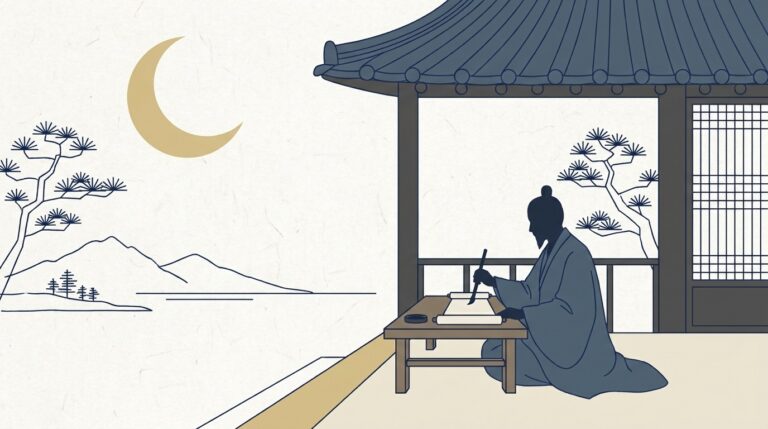
Picture this: You are watching a high-stakes Korean historical drama (sageuk). A noble scholar sits before an inkstone in a moonlit hanok, holding a brush suspended in quiet contemplation. He is composing a sijo (시조)—the pinnacle of three-line classical Korean poetry. Line one sets the cosmic stage. Line two introduces a brooding tension. But when he inks the third and final line—the jongjang (종장)—his voice tightens into a crisp, unyielding three-syllable exhalation, before swelling into an elongated, five-syllable wave of emotion, and finally settling into an understated cadence.
If you have ever tried analyzing classical Korean verse at an advanced C2 level, you have likely encountered this exact wall of frustration: Why does this ancient poetic form feel so rigidly mathematical yet emotionally volcanic? Many advanced learners grasp the standard 3-4 / 3-4 / 4-4 metric feet (eumbo, 음보), only to stumble upon the final line. It feels like an unpredictable rupture. But here is the secret that Korean literary scholars cherish: that sudden 3-syllable lock followed by a protracted 5-plus-syllable surge is not an accident of history. It is a masterclass in pagyeok (파격)—deliberate structural disruption designed to synthesize tension into profound cathartic equilibrium (gyunhyeong, 균형).
This guide was forged through years of analyzing classical manuscripts and mentoring scholars who wanted more than textbook definitions. By mastering this aesthetic pivot, you will not only unlock the rhythmic DNA of Joseon-era poetry, but also decode the profound rhetorical cadence that still governs high-level Korean speech, screenwriting, and lyricism today.
Phase 2: Core Expressions Deep Dive
1. 종장의 파격 (Jongjang-ui pagyeok)
- Pronunciation: [Jong-jang-ui pa-gyeok] (Think of ‘jong’ like a struck bronze bell, followed by ‘pa-gyeok’ sounding like a crisp snapping of dry bamboo).
- Meaning: Literal: “Rupture of the final line” | Cultural Nuance: The deliberate breaking of rhythmic expectations in the closing line to generate aesthetic catharsis.
- K-Culture Moment: Used by literary critics and directors when discussing the climatic twist of a sophisticated historical screenplay like The Red Sleeve (옷소매 붉은 끝동).
- Editor’s Insight: In Korean aesthetics, perfection without asymmetry is considered lifeless. Pagyeok is the calculated flaw—the sudden metric deviation where the poet’s raw human emotion breaks free from Confucian decorum.
- Situation Spectrum: Casual 🚫 | Semi-formal ⚠️ | Formal ✅ (Literary critique, advanced cultural discourse)
- 🤔 Think About It: Does Western sonnet form rely on a similar volta (the turn), or does the English sonnet resolve tension through rhyme rather than structural syllable expansion?
2. 낙구의 감탄사 (Nakgu-ui gamtansa)
- Pronunciation: [Nak-gu-ui gam-tan-sa] (Flows smoothly: nahk-goo-eui gahm-tahn-sah, evoking a sharp gasp of wonder).
- Meaning: Literal: “The falling line’s interjection” | Cultural Nuance: The initial three-syllable exclamatory word (e.g., 어즈버 / Eojeubeo, 아희야 / Aheuiya) that arrests the reader’s breath at the beginning of the final line.
- K-Culture Moment: Hear it echoed when grand actors in sageuk dramas pause dramatically, letting out a measured sigh before delivering their legacy-defining monologue.
- Editor’s Insight: This three-syllable anchor is non-negotiable. Even if the rest of the poem bends, these three syllables stand like an immovable pillar, grounding the listener before the emotive explosion.
- Situation Spectrum: Casual 🚫 | Semi-formal ⚠️ | Formal ✅
- 🤔 Think About It: How does starting a climax with a fixed phonemic constraint sharpen the listener’s anticipation compared to free-form prose?
3. 여운을 남기다 (Yeo-un-eul namgida)
- Pronunciation: [Yeo-un-eul nam-gi-da] (Pronounce ‘yeo-un’ softly, like an acoustic echo rippling across an empty courtyard).
- Meaning: Literal: “To leave a lingering resonance behind” | Cultural Nuance: Allowing an artistic thought to drift off gracefully, leaving the audience to complete the emotional resolution in their own minds.
- K-Culture Moment: The signature hallmark of Korean cinematic endings (such as Park Chan-wook’s Decision to Leave), where silence speaks louder than overt resolution.
- Editor’s Insight: The final four syllables of a Sijo rarely explain everything. Instead, they gently tether the sprawling emotion, ensuring that what remains is not loud finality, but quiet lingering echo (여운).
- Situation Spectrum: Casual ✅ | Semi-formal ✅ | Formal ✅
- 🤔 Think About It: Why does Korean art prize unfinished emotional resonance over total dramatic closure?
Phase 3: Textbook Korean vs. Real Korean
Situation 1: Analyzing the climatic shift in a Sijo poem
- 📖 교과서 한국어 (Textbook Style):
“시조 종장의 첫째 구는 3음절로 제한되며, 둘째 구는 5음절 이상으로 구성되어 시적 긴장감을 고조시킵니다.”
(Sijo jongjang-ui cheotjjae gu-neun sam-eumjeol-ro jehandoemyeo, dultjae gu-neun o-eumjeol isang-euro guseongdoeeo sijeok ginjanggameul gojosikimnida. / The first phrase of the Sijo final line is restricted to 3 syllables, and the second phrase consists of 5 or more syllables, heightening poetic tension.) - 🗣️ 진짜 한국어 (Literary Literati / Critic Style):
“종장 첫 음보에서 딱 3음절로 호흡을 턱 틀어막았다가, 그다음 음보를 5음절 이상으로 길게 뽑아내면서 감정을 터뜨리는 완급조절이 기가 막히죠.”
(Jongjang cheot eumbo-eseo ttak sam-eumjeol-ro hoheubeul teok teureomagattdaga, geuda-eum eumbo-reul o-eumjeol isang-euro gilge ppobaenaemyeonseo gamjeongeul teotteurineun wangeupjojeori giga mak-hijo. / It literally locks your breath with exactly three syllables at the opening metric foot, only to unleash this staggering emotional swell by stretching the next foot into five syllables or more—the pacing is simply sublime.) - 💡 왜 다를까? (Why the Difference?):
Scholarly Korean in real intellectual conversations relies on visceral somatic metaphors like “호흡을 틀어막다” (choking the breath) and “완급조절” (masterful tempo modulation) rather than sterile rule descriptions.
Situation 2: Praising the lingering aesthetic balance of an artwork or verse
- 📖 교과서 한국어 (Textbook Style):
“이 작품은 형식적 파격과 전체적 균형을 동시에 성취하고 있습니다.”
(I jakpumeun hyeongsikjeok pagyeok-gwa jeonchejeok gyunhyeongeul dongsi-e seongchwihago itseumnida. / This work simultaneously achieves formal disruption and overarching balance.) - 🗣️ 진짜 한국어 (Literary Literati / Critic Style):
“형식을 과감하게 깨부수면서도 결국엔 절묘한 균형감 속으로 수렴되잖아요. 이게 바로 한국 고전 미학의 묘미죠.”
(Hyeongsigeul gwagamhage kkaebusumyeonseodo gyeolgugen jeolmyohan gyunhyeonggam sogeuro suryeomdoejanhayo. Ige baro hanguk gojeon mihagui myomijo. / It daringly shatters the form, yet ultimately converges into an exquisite sense of equilibrium. That right there is the subtle brilliance of classical Korean aesthetics.) - 💡 왜 다를까? (Why the Difference?):
Cultured native speakers use dynamic active verbs like “깨부수다” (shatter) balanced with Sino-Korean philosophical terms like “수렴되다” (converge) to display C2-level rhetorical sophistication.
Phase 4: K-Culture Deep Dive & Non-Verbal Nuances
4-1. 눈치 (Nunchi) & The Poetic Pause
When reciting classical Sijo or delivering a high-register speech in Korean, bodily pacing dictates meaning. The transition between the second line (jungjang, 중장) and the third line (jongjang, 종장) requires a pregnant caesura.
* The Breath Shift: Before enunciating the immutable 3-syllable opening of the final line (e.g., “어즈버” / Eojeubeo), drop your shoulders, steady your gaze, and allow a full two-second silence. Native literary speakers call this “숨을 고르다” (gathering one’s breath).
* Vocal Modulation (Sigimsae, 시김새): Deliver the first 3 syllables with crisp, centered abdominal resonance—sharp and absolute. Then, on the second metric foot (the 5+ syllables), raise the pitch slightly, letting the vowels vibrate with vibrato (tteolim) before gently tapering off into serene restraint on the final metric foot.
4-2. Cultural Code Analysis: The Cinematic Heritage
Modern Korean media relies heavily on this “Compression -> Explosion -> Restraint” dynamic born from Sijo. Notice how the dialogue in acclaimed dramas like Mister Sunshine or songs by BTS (e.g., Suga/Agust D’s traditional-instrument-infused Daechwita) often utilizes sharp tripartite rhythm. They draw the audience in with familiar steady phrasing, suddenly disrupt expectations with a striking, contracted hook, expand into an intense emotional verse, and conclude with an understated whisper. Understanding the 3-5-4-3 architecture of Sijo is your backstage pass to understanding why Korean storytelling feels so dynamic yet disciplined.
Phase 5: Real-World Roleplay Scenario
Setting: An intimate evening salon at a restored hanok in Bukchon Hanok Village. You are conversing with Master Yi, a renowned scholar of classical Korean poetics, examining a hanging scroll featuring a 16th-century Sijo by Han Ho (Han Seok-bong).
- Master Yi: 이 시조의 종장을 가만히 소리 내어 읊어보게. 무엇이 먼저 느껴지시는가?
(I sijo-ui jongjangeul gamanhi sori naeeo eulpeoboge. Mueosi meonjeo neukkyeojisineunga? / Try reciting the final line of this Sijo out loud. What strikes you first?)
🎭 Looking intently at the brushstrokes while gently tapping his wooden fan on his palm. -
You: 첫머리의 ‘청산(靑山)도’ 세 글자에서 호흡이 단단하게 멎는 듯합니다.
(Cheotmeori-ui ‘Cheong-sando’ se geulja-eseo hoheubi dandanhage meotneun deut-hamnida. / At the opening three syllables, ‘Cheong-san-do’, my breath seems to come to a firm, resolute halt.)
🎭 Pausing respectfully, keeping eyes fixed on the calligraphy. -
Master Yi: 정확히 보셨네! 종장의 첫 3음절은 시적 자아의 흔들림 없는 각성이자 전환점이지. 그다음 구는 어떤가?
(Jeonghwakhi bosyeotne! Jongjang-ui cheot sam-eumjeoreun sijeok ja-a-ui heundeullim eomneun gakseong-ija jeonhwanjeom-iji. Geuda-eum gu-neun eotteonga? / Precisely observed! The first three syllables of the final line are the steadfast awakening and turning point of the poetic self. What about the next phrase?)
🎭 Nodding with a warm, approving smile. -
You: ‘절로절로 늘어간들’로 이어지며 음절이 파도처럼 넘쳐납니다.
( ‘Jeollojeollo neureogandeul’-lo ieojimyeo eumjeori padocheoreom neomcheonamnida. / It flows into ‘jeol-lo-jeol-lo neu-reo-gan-deul’, where the syllables swell and spill over like an emotional wave.)
🎭 Using an open hand gesture to trace the melodic rise in the air. -
Master Yi: 그렇지. 5음절 이상으로 길게 늘이며 감정을 극한으로 몰아붙이는 거라네. 파격의 극치지.
(Geureotji. O-eumjeol isang-euro gilge neurimyeo gamjeongeul geukhan-euro mora-buchineun georane. Pagyeogui geukchiji. / Indeed. By stretching it past five syllables, it pushes the emotional tension to its ultimate limit. It is the very height of calculated metric rupture.)
🎭 Closing the fan with a resounding snap to punctuate the point. -
You: 하지만 마지막 구절에서 다시 3~4음절로 차분하게 갈무리되는군요.
(Hajiman majimak gujeor-eseo dasi sam-sa-eumjeol-ro chabunhage galmuridoeneungunyo. / Yet in the closing foot, it calms down into three or four syllables, neatly gathering the emotion.)
🎭 Lowering vocal pitch slightly, mirroring the calm cadence. -
Master Yi: 바로 그거야. 긴장과 이완, 파격과 균형이 한 줄 안에서 완성되는 것일세.
(Baro geugeoya. Ginjang-gwa iwan, pagyeok-gwa gyunhyeongi han jul an-eseo wanseongdoeneun geosilse. / Exactly that. Tension and release, rupture and balance, all resolved within a single line.)
🎭 Pouring freshly brewed wild chrysanthemum tea into your porcelain cup. -
You: 정형시의 엄격함 속에 이런 폭발적인 유연성이 숨어있을 줄은 몰랐습니다.
(Jeonghyeongsi-ui eomgyeokham soge ireon pokbaljeogin yuyeonseongi sumeoisseul jureun mollasseumnida. / I never imagined such explosive flexibility could reside within the strict confines of structured verse.)
🎭 Receiving the teacup with both hands as a mark of deep scholastic gratitude.
🔀 Interactive Branching Moment
Master Yi asks you: “그렇다면 현대 한국 사회에서 이러한 종장의 미학은 어디에 남아있다고 보는가?” (Where then do you think this aesthetic of the Jongjang still lingers in contemporary Korean society?)
- Choice A: “현대 K-팝 가사의 킬링 파트 직전에 등장하는 급격한 브릿지 구간과 닮았습니다.” (It resembles the sudden dramatic bridge section right before the killing part in modern K-pop lyrics.)
- Choice B: “일상 대화에서 자기주장을 말할 때 쓰는 문법 규칙에 그대로 남아있습니다.” (It remains literally as a grammatical rule used when stating opinions in casual conversation.)
- Choice C: “그저 옛 사대부들의 죽은 문자 놀음일 뿐, 현대 사회에는 아무런 영향이 없습니다.” (It was merely a dead word game of Joseon aristocrats and holds no lingering influence today.)
Feedback:
* Choice A (Best!): Master Yi’s eyes widen with delight! You have correctly identified that the psychological pacing of Sijo (Restraint -> Surging Climax -> Lingering Aftertaste) forms the rhythmic substrate of modern Korean musical arrangements.
* Choice B (Risk): While everyday Korean has stylistic cadence, attributing Sijo’s strict 3-5 metric architecture directly to conversational syntax confuses metric poetics with standard colloquial rhythm.
* Choice C (Bad): Misses the cultural continuum entirely! High-context culture deeply informs modern rhetorical structures in film, public speaking, and art.
Phase 6: 10-Second Emotional Shadowing Drill
Read these lines aloud, strictly observing the / caesura marks and internalizing the emotional stage directions.
[🧐 진중하고 비장하게 / Grave and Resolute]
어즈버 / (pause) / 낙화(落花)가 비처럼 흩날리니 / 가슴이 미어지는도다.
(Eojeubeo / nakhwaga bicheoreom heunnallini / gaseumi mieojineudoda. / Alas! / Fallen blossoms scatter like rain / my heart tears asunder.)-
[🕊️ 고요하고 초연하게 / Serene and Transcendent]
아희야 / (pause) / 무릉도원이 어디메뇨 / 나는 알 길 없어라.
(Aheuiya / mureungdowoni eodimeno / naneun al gil eopseora. / Child! / Where lies the mythical peach blossom spring / I have no way of knowing.) -
[💥 격정적으로 터뜨리듯 / Passionate and Explosive]
두어라 / (pause) / 덧없는 세상 부귀공명인들 / 부러워 무엇하리.
(Dueora / deoeomneun sesang bugwigongmyeong-indeul / bureowo mueothari. / Let it be! / Vain earthly riches and honors / why should I ever envy them?)
Phase 7: K-Culture Mini Dictionary
- 음보 (Eumbo, 音步): Metric Foot. In Korean verse, an eumbo is a rhythmic breath unit usually consisting of 3 to 4 syllables. Sijo classically maintains a 4-eumbo structure per line.
- 종장 (Jongjang, 終章): The Final Stanza/Line. The closing line of a Sijo where the philosophical question or emotional tension introduced in the first two lines undergoes a dramatic dialectical turn.
- 파격 (Pagyeok, 破格): Intentional Transgression of Form. Breaking a rigid artistic convention precisely to highlight the core aesthetic truth—a foundational concept in Korean fine arts and architecture.
- 여백의 미 (Yeobaek-ui mi, 餘白의 美): The Aesthetics of Empty Space. Leaving portions of canvas, speech, or melody unoccupied so that the observer’s imagination completes the artistic masterpiece.
Phase 8: Survival Kit for Travelers & Cultural Wanderers
TOP 3 Cultural Survival Expressions
- 운치가 정말 남다르네요. (Unchiga jeongmal namdareuneyo.)
- Pronunciation: [Oon-chi-ga jeong-mal nahm-dah-reu-ne-yo]
- Meaning: “The poetic ambiance and classical mood here is truly extraordinary.”
- Pro Tip: Use this when visiting historic locations like Changdeokgung Huwon (Secret Garden) or traditional tea houses to stun local cultural docents with your refined vocabulary.
- 마치 한 편의 시조를 감상하는 것 같아요. (Machi han pyeon-ui sijoreul gamsanghaneun geot gat-ayo.)
- Pronunciation: [Mah-chi hahn pyeon-eui shi-jo-reul gahm-sahng-hah-neun geot gah-tah-yo]
- Meaning: “It feels just like appreciating a masterwork of Sijo poetry.”
- Pro Tip: Perfect compliment for art curators, traditional musicians (gugak performers), or scenic countryside views.
- 마지막 문장의 여운이 깊게 남습니다. (Majimak munjang-ui yeo-uni gipge namseumnida.)
- Pronunciation: [Mah-ji-mahk moon-jahng-eui yeo-oon-ee geep-geh nahm-seum-ni-dah]
- Meaning: “The resonance of the final sentence lingers deeply.”
- Pro Tip: The ultimate praise after attending an academic lecture, play, or formal banquet speech.
Editor’s Travel Note
When you visit Seoul, bypass the crowded souvenir shops and head directly to the National Museum of Korea in Yongsan. Before stepping in, remember to reserve your National Museum of Korea special exhibition tickets in advance to explore their classical literary archives. Afterward, navigate through Naver Map app download toward the traditional tea pavilions of Samcheong-dong. Ordering a cup of warm Omija tea while reading classical Sijo surrounded by traditional wooden rafters provides a sensory immersion that no textbook can replicate.
Phase 9: “One Step Deeper” (Critical Thinking)
Traditional Joseon society was bound by the unyielding ideological gravity of Neo-Confucian propriety (Ye, 禮), which strictly dictated bodily movements, social hierarchies, and speech levels. Yet, human emotion (Jeong, 情) cannot be held indefinitely in a metric cage. The jongjang of Sijo is Korean literary civilization’s most ingenious philosophical valve: by enshrining a three-syllable boundary, it bows respectfully to cosmic order; but by immediately blowing open the second foot into five or more unrestrained syllables, it allows the human soul to cry out in grief, ecstasy, or laughter before bowing out with dignity. It proves that discipline and raw passion are not mortal enemies, but symbiotic partners.
💬 Your Turn: In your native language’s poetic traditions, how do poets handle the conflict between rigid rhyme/meter and explosive personal emotion? Share your thoughts below!
Phase 10: FAQ & Mistake Prevention
Q: Does every single Sijo strictly adhere to the 3-syllable rule in the Jongjang?
A: Yes! While the first line (chojang) and second line (jungjang) allow considerable syllabic elasticity (3-4 syllables can freely become 4-4 or 2-4), the first foot of the jongjang is mathematically frozen at 3 syllables. If this rule is broken, scholars classify the poem as having lost its foundational Sijo identity.
Q: Why must the second foot of the Jongjang be at least 5 syllables?
A: It creates an intentional acoustic asymmetry. After the sudden, sharp arrest of the 3-syllable pivot, having 5, 6, or even 7 syllables forces the reader’s breath to elongate, physically reproducing the sensation of an emotional surge or a lingering sigh.
Q: Is Sijo meant to be silently read or sung?
A: Historically, Sijo was meant to be sung aloud as Changga (시조창) accompanied by a piri (flute) and janggu (hourglass drum). The elongated 5-syllable foot allowed the singer to showcase virtuosic vocal melisma (sigimsae), sustaining notes across extended vibratos.
🚨 Common Mistakes Warning Board
- Mistake: Assuming the 3-syllable opening is just a decorative filler word.
- Correction: Recognize that this word (nakgu-ui gamtansa) acts as the psychological hinge of the entire poem. Treat it with vocal gravitas.
- Mistake: Rushing through the transition between lines 2 and 3.
- Correction: Sijo requires dynamic pacing. Never read it at an invariant tempo; insert a pregnant pause before the Jongjang.
- Mistake: Over-vocalizing the final metric foot.
- Correction: The final foot (typically 3 or 4 syllables) should fade out gracefully. Do not shout or punctuate it forcefully; let it dissolve into yeo-un (lingering echo).
Phase 11: Action Missions
- 🥉 Bronze Mission (Solo Mastery): Practice reciting the classic Sijo final line: “어즈버 / 내 병이야 / 이 님의 탓이로다” (Alas / my sickness / is all this love’s doing). Nail the sharp 3-syllable pause on Eojeubeo and stretch the second foot across three full seconds.
- 🥈 Silver Mission (Community Engagement): Share a short social post or voice memo analyzing your favorite Korean drama quote that uses a sudden 3-syllable rhetorical pause to turn the plot around.
- 🥇 Gold Mission (Creative Production): Write your own original 3-line Sijo in Korean! Keep your lines close to 3-4-3-4, but make sure your jongjang hits that authentic 3 / 5+ / 4 / 3 metric resolution.
- 🎮 K-Culture Mission: Watch the classic sageuk movie The King and the Clown (왕의 남자) or The Throne (사도). Identify the exact scene where royal poetry or rhymed dialogue marks a tragic character transition.
Phase 12: Interactive Quiz Challenge
1. Situational Judgment
You are participating in a graduate seminar on classical East Asian verse at a Korean university. The professor asks how the final line of a traditional Pyeong-sijo establishes balance. Which answer demonstrates C2-level insight?
* (A) “초장과 중장의 길이를 무조건 똑같이 맞춘 후 종장을 가장 짧게 줄입니다.”
* (B) “첫 3음절로 긴장감을 응축시킨 뒤, 5음절 이상의 확장으로 감정을 분출시키고 마지막에 갈무리합니다.”
* (C) “모든 구절의 음절 수를 동일하게 4글자로 통일하여 시적 안정감을 줍니다.”
👉 Click to Reveal Answer & Analysis
Correct Answer: (B)
* Explanation: Option (B) captures the dialectic mechanics of pagyeok and balance: the first 3 syllables lock and condense tension, the 5+ syllables unleash emotional expansion, and the concluding foot provides graceful closure. Option (A) is inaccurate regarding line lengths, and (C) describes a sterile metric uniformity foreign to Korean poetic aesthetics.
2. Fill-in-the-Blank
Complete the critical terminology sentence:
“시조 종장의 첫 음보는 형식의 일탈을 허용하지 않는 엄격한 ( ___ )음절로 고정되어 시상(詩想)의 전환을 선언한다.”
👉 Click to Reveal Answer & Analysis
Correct Answer: 3 (삼)
* Explanation: The opening foot of the Jongjang is unequivocally anchored at exactly 3 syllables, serving as the immutable structural signpost of classical Sijo.
3. True or False Cultural Concept
True or False: The lingering ending (여운) of Sijo’s final line was considered an aesthetic flaw by Joseon scholars because it failed to provide dogmatic moral finality.
👉 Click to Reveal Answer & Analysis
Correct Answer: False
* Explanation: Far from a flaw, yeo-un (the lingering echo of empty space and understated resolution) was regarded as the highest pinnacle of refined taste (pungryu, 풍류), embodying humility and emotional restraint.







