

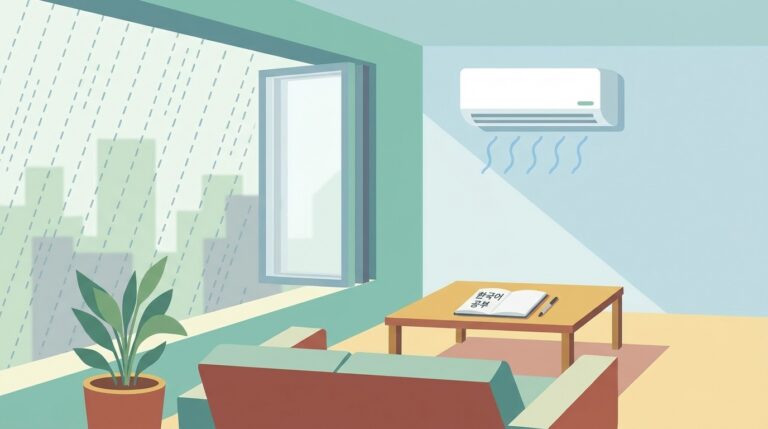
Keeping Your Korean Home Fresh: How to Banish Monsoon AC Odor
Phase 1: Empathy (Story-Driven Opening)
안녕하세요! 매일한글 에디터입니다. (Hello! This is your Daily Hangul editor.)
Picture this: It is early July in Seoul. You have just survived a torrential downpour during 장마 (Jangma, the summer monsoon season). Your sneakers are soaked, your jeans feel heavy with humidity, and you finally slide open the digital door lock of your cozy Hongdae studio apartment. You collapse onto your bed and grab the white air conditioner remote, desperately hitting the power button for sweet, icy relief.
Then, ten seconds later, it hits you—a blast of stale, damp, sour air that smells like wet laundry forgotten in a plastic bag for three days. You wrinkle your nose in disgust. Has the air conditioner gone bad? Is there mold lurking inside the vents? Are you doomed to live through a humid Korean summer smelling damp vinegar socks?
Take a deep breath (away from the vent!)—your AC isn’t broken. You are just experiencing the classic rite of passage for every expat and resident living in a Korean studio apartment (원룸). In Korea’s intense summer climate, moisture gets trapped inside the cooling coils the moment you turn the unit off, creating a breeding ground for mildew. But seasoned locals know a magical secret: running the fan mode for 30 minutes before shutting it off keeps everything bone-dry and fresh.
Today, we are mastering the exact expression that will save your lungs, your home, and your relationship with your Korean landlord: 에어컨을 끄기 전에 송풍 모드로 30분 동안 내부를 말려 주면 퀴퀴한 냄새가 안 나요 (Running fan mode for 30 minutes to dry the inside before turning off the AC prevents musty odors). Let’s make you sound like a savvy Seoul local!
Phase 2: 3 Core Expressions Deep Dive
1. 송풍 모드로 내부를 말려 줘요 (Song-pung mo-deu-ro nae-bu-reul mal-lyeo jwo-yo)
- Pronunciation: [Song-pung mo-deu-ro nae-bu-reul mal-lyeo jwo-yo] (Sound analogy: “Song-poong” sounds like singing a “song” while a cool “pooh” wind blows; “mal-lyeo” rhymes with “calier”.)
- Meaning: Literally “Dry the inside using fan mode” vs. Nuance: “Run the fan-only cycle to air out the moisture inside the unit.”
- K-Culture Moment: Seen on variety shows like 나 혼자 산다 (I Live Alone) when celebrity bachelors clean their cramped studio apartments during summer.
- Editor’s Insight: 송풍 (Songpung) means “supplying/blowing wind without refrigeration.” In Korea, modern split-unit remotes feature buttons like 냉방 (cooling), 제습 (dehumidifying), and 송풍 (fan). Using 송풍 uses virtually no electricity while drying the internal condensation!
- Situation Spectrum: Casual: ✅ | Semi-formal: ✅ | Formal: ⚠️
- 🤔 Think About It: In English, we simply say “run the fan.” Why do you think Korean specifically uses the active verb 말리다 (to dry something out), emphasizing the physical result rather than just running a setting?
2. 퀴퀴한 냄새가 나요 (Kwi-kwi-han naem-sae-ga na-yo)
- Pronunciation: [Kwi-kwi-han naem-sae-ga na-yo] (Sound analogy: “Kwi-kwi” sounds crisp and tight like clicking a key quickly twice; “naem-sae” sounds like “name-say”.)
- Meaning: Literally “A musty/stale smell comes out” vs. Nuance: “It smells damp, stale, and mildly mildewy in here.”
- K-Culture Moment: Frequently heard in K-dramas when someone walks into a basement storage room or opens an old closet in an old boarding house (하숙집).
- Editor’s Insight: Korean has wonderfully expressive sensory words for smells. 퀴퀴하다 specifically captures the enclosed, damp, moldy odor of damp clothes or closed spaces, unlike 비린내 (fishy smell) or 구린내 (foul smell).
- Situation Spectrum: Casual: ✅ | Semi-formal: ✅ | Formal: ✅
- 🤔 Think About It: Notice how English often borrows from taste or nature (“musty”, “moldy”), while Korean uses sound-symbolic onomatopoeic adjectives (퀴퀴하다, 꿉꿉하다) to convey the physical sensation of dampness.
3. 곰팡이 생기지 않게 조심하세요 (Gom-pang-i saeng-gi-ji an-ke jo-sim-ha-se-yo)
- Pronunciation: [Gom-pang-i saeng-gi-ji an-ke jo-sim-ha-se-yo] (Sound analogy: “Gom” like “gummy” without the -my; “pang-i” like “pong-ee”.)
- Meaning: Literally “Be careful so that mold does not form” vs. Nuance: “Make sure to prevent mold from growing.”
- K-Culture Moment: Spoken by caring Korean landlords (집주인 아주머니) when handing over keys to university students before summer vacation.
- Editor’s Insight: 곰팡이가 생기다 uses 생기다 (to arise/come into existence). Koreans view mold not just as dirt to wipe, but as something that “appears and grows” if vigilance drops during the monsoon season.
- Situation Spectrum: Casual: ⚠️ | Semi-formal: ✅ | Formal: ✅
- 🤔 Think About It: Why does Korean combine the causative connective
-게with조심하다(to be careful) instead of issuing a direct command like “clean your mold”?
Phase 3: Textbook Korean vs. Real Korean
Situation 1: Complaining about the AC odor to a friend
- 📖 교과서 한국어 (Textbook): 공조 장비에서 곰팡이 악취가 발생하고 있습니다. (Gongjo jangbieseo gompang-i akchwiga balsaenghago itseumnida. / Mold malodor is occurring from the air conditioning equipment.)
- 🗣️ 진짜 한국어 (Real-life): 에어컨 켤 때마다 퀴퀴한 냄새 장난 아니에요. (E-eo-keon kyeol ttae-ma-da kwi-kwi-han naem-sae jang-nan a-ni-e-yo. / Every time I turn on the AC, the musty smell is no joke!)
- 💡 왜 다를까? (Why the difference?): Real Koreans use vivid idioms like “장난 아니다” (it’s no joke / it’s extreme) combined with sensory words like “퀴퀴하다” rather than technical terms like “공조 장비” (HVAC equipment) or “악취 발생” (occurrence of stench).
Situation 2: Giving summer apartment life advice
- 📖 교과서 한국어 (Textbook): 에어컨 전원을 차단하기 전에 송풍 기능을 30분간 작동하십시오. (E-eo-keon jeon-won-eul cha-dan-ha-gi jeon-e song-pung gi-neung-eul sam-sip-bun-gan jak-dong-ha-sip-si-o. / Prior to disconnecting the power of the air conditioner, please operate the ventilation function for 30 minutes.)
- 🗣️ 진짜 한국어 (Real-life): 끄기 전에 송풍으로 30분만 싹 말려 줘요! (Kkeu-gi jeon-e song-pung-eu-ro sam-sip-bun-man ssak mal-lyeo jwo-yo! / Just blow-dry it completely with fan mode for 30 minutes before turning it off!)
- 💡 왜 다를까? (Why the difference?): Native speakers use the adverb “싹” (cleanly/completely) and the friendly polite request ending “-아/어 줘요” to offer practical neighborly advice without sounding like an operating manual.
Phase 4: K-Culture Deep Dive & Non-Verbal Manners
4-1. 눈치 (Nunchi) & Polite Living Room Etiquette
When living with Korean housemates, staying at a guest house, or hosting Korean friends in your studio apartment, turning off appliances involves subtle social awareness (눈치, nunchi).
* The AC Remote Courtesy: If you abruptly turn off the cooling mode when someone leaves, condensation immediately sits in the dark, warm chamber. Instead of just clicking “Power Off” (전원 끄기), pick up the remote, show the display to your roomie, and say with a gentle smile: “송풍으로 30분만 돌려놓을게요!” (I will leave it on fan mode for 30 minutes!).
* The Subtle Nose Crinkle: If you notice a damp smell, avoid showing intense facial disgust (which can embarrass the host or landlord). Instead, tilt your head slightly, take a small whiff, and say lightly: “조금 꿉꿉하네요? 환기 한번 할까요?” (It’s a bit humid, right? Shall we air it out?).
4-2. The Korean Summer Survival Phenomenon: “물먹는 하마”
If you walk into any Korean convenience store, Daiso, or supermarket in June, you will see whole aisles stacked with bright blue plastic tubs labeled “물먹는 하마” (Water-Eating Hippo)—Korea’s most iconic moisture absorber. Because traditional Korean apartments (빌라 and 원룸) prioritize winter heat retention (단열) via heavy double-paned windows, they are notorious for trapping moisture in the summer. Learning how to manage humidity with fan mode and dehumidifiers is considered a true mark of mature adult living (자취 내공).
Phase 5: Real-World Roleplay Scenario
Setting: A sunny afternoon inside a shared officetel in Mapo-gu. Outside, the rain has paused, but the humidity is 88%. You and your Korean flatmate, Min-woo (민우), are sitting at the kitchen counter with iced coffees.
- 민우 (Min-woo):
🎭 (Wiping his forehead, picking up the remote)밖에는 비 그쳤는데 집 안이 너무 꿉꿉하다. 에어컨 냉방 세게 틀게! (Bak-e-neun bi geu-chyeot-neun-de jip an-i neo-mu kkup-kkup-ha-da. E-eo-keon naeng-bang se-ge teul-ge! / The rain stopped outside, but it is so humid inside the house. I will turn on the AC cooling high!) - You:
🎭 (Nodding in agreement)네, 좋아요! 시원하게 틀어요. (Ne, jo-a-yo! Si-won-ha-ge teul-eo-yo. / Yes, sounds good! Turn it on cool.) - 민우 (Min-woo):
🎭 (Wrinkling his nose as the air starts blowing)으… 에어컨에서 뭔가 퀴퀴한 냄새 나지 않아? (Eu… e-eo-keon-eseo mwon-ga kwi-kwi-han naem-sae na-ji an-a? / Ugh… isn’t there kind of a musty smell coming from the AC?) - You:
🎭 (Sniffing gently)맞아요, 약간 곰팡이 냄새 같아요. 필터 문제일까요? (Maj-a-yo, yak-gan gom-pang-i naem-sae gat-a-yo. Pil-teo mun-je-il-kka-yo? / You are right, it smells a bit like mold. Could it be a filter issue?) - 민우 (Min-woo): 얼마 전에 청소했는데 왜 이러지? 그냥 꺼버릴까? (Eol-ma jeon-e cheong-so-haet-neun-de wae i-reo-ji? Geu-nyang kkeo-beo-ril-kka? / I cleaned it not long ago, why is it like this? Should I just turn it off?)
- You:
🎭 (Gently waving your hand to stop him, pointing at the remote)잠깐만요! 에어컨을 끄기 전에 송풍 모드로 30분 동안 내부를 말려 주면 퀴퀴한 냄새가 안 나요. (Jam-kkan-man-yo! E-eo-keon-eul kkeu-gi jeon-e song-pung mo-deu-ro sam-sip-bun dong-an nae-bu-reul mal-lyeo ju-myeon kwi-kwi-han naem-sae-ga an na-yo. / Wait a second! If you dry the inside with fan mode for 30 minutes before turning off the AC, it prevents musty odors.) - 민우 (Min-woo):
🎭 (Eyes widening with surprise and admiration)아, 진짜? 냉방 끄고 송풍으로 돌려서 습기를 말리는 거구나! (A, jin-jja? Naeng-bang kkeu-go song-pung-eu-ro dol-lyeo-seo seup-gi-reul mal-li-neun geo-gu-na! / Oh, really? So you turn off cooling and run fan mode to dry the moisture!) - You:
🎭 (Smiling proudly)네, 그렇게 하면 곰팡이도 안 생겨요. 오늘부터 그렇게 해 봐요! (Ne, geu-reoh-ge ha-myeon gom-pang-i-do an saeng-gyeo-yo. O-neul-bu-teo geu-reoh-ge hae bwa-yo! / Yes, if you do that, mold won’t form either. Let’s try that from today!)
🔀 Interactive Choice Point
Min-woo asks: “그럼 지금 송풍으로 바꿀까, 아니면 방 좀 시원해진 다음에 바꿀까?” (Then should we switch to fan mode now, or after the room cools down a bit?) How do you respond?
- Option A: “지금은 더우니까 냉방으로 1시간 켜 두고, 끄기 전에 송풍 모드로 예약해 둬요.” (It’s hot now, so let’s run cooling for an hour, and set a timer for fan mode before turning it off.)
- Feedback (Best): Perfect B1 natural response! You balance comfort with practical appliance care while showing command of time connectives.
- Option B: “냄새 나니까 지금 당장 에어컨 코드를 뽑아 버려요!” (Because it smells, pull the AC power cord out right now!)
- Feedback (Bad): Too drastic and rude. Unplugging the unit suddenly leaves moisture trapped inside, making mold worsen!
- Option C: “창문 다 열고 에어컨을 제일 세게 트세요.” (Open all windows and turn the AC to the strongest setting.)
- Feedback (Risk): Risk of high electricity bills (전기세 폭탄) and letting outdoor monsoon moisture straight into the house.
Phase 6: 10-Second Emotion Shadowing Drill
Practice these natural rhythm pauses (/) and emotional deliveries out loud:
[😮 놀라며 코를 찡긋거리듯 / Surprised with a slight nose crinkle]
에어컨에서 / 퀴퀴한 냄새가 / 확 올라와요!
(E-eo-keon-eseo / kwi-kwi-han naem-sae-ga / hwak ol-la-wa-yo!)
“A musty smell is suddenly bursting out from the AC!”-
[💡 다정하게 생활 꿀팁을 전수하듯 / Warmly sharing a helpful life hack]
끄기 전에 / 송풍 모드로 30분만 / 말려 보세요.
(Kkeu-gi jeon-e / song-pung mo-deu-ro sam-sip-bun-man / mal-lyeo bo-se-yo.)
“Try drying it on fan mode for just 30 minutes before turning it off.” -
[😌 상쾌하고 자신감 넘치게 / Refreshed and confident]
습기를 말려 주면 / 곰팡이 걱정은 / 전혀 없어요!
(Seup-gi-reul mal-lyeo ju-myeon / gom-pang-i geok-jeong-eun / jeon-hyeo eop-seo-yo!)
“If you dry out the moisture, you have zero worries about mold!”
Phase 7: K-Culture Mini Dictionary
- 장마철 (Jang-ma-cheol) | Monsoon Season
The intense rainy period in Korea running from late June to late July. Used in everyday life to plan indoor dates, prepare laundry strategies, and discuss weather forecasts. - 송풍 (Song-pung) | Fan Mode / Air Circulation Mode
Literally “supplying wind.” It circulates room air through the AC unit without engaging the compressor (실외기), consuming minimal power while drying internal condensation. - 꿉꿉하다 (Kkup-kkup-ha-da) | Clammy / Humid / Muggy
A classic Korean descriptive adjective representing the sticky, clammy sensation on your skin or bedsheets caused by high indoor humidity. - 물먹는 하마 (Mul-meok-neun Ha-ma) | Dehumidifier Box (Literally: Water-Eating Hippo)
A household staple brand name used generically in Korea (like Kleenex or Band-Aid) for disposable calcium chloride moisture-absorbing tubs placed in closets and shoe racks.
Phase 8: Traveler & Resident Survival Kit
Top 3 Survival Phrases for Summer in Korea:
- 에어컨 리모컨에 송풍 버튼이 어디에 있어요?
(E-eo-keon ri-mo-keon-e song-pung beot-eun-i eo-di-e its-eo-yo?)
Where is the fan mode button on the AC remote?
Pro Tip: On Korean remotes, look for the ‘운전선택’ (Mode selection) button and cycle until you see ‘송풍’. - 방이 너무 꿉꿉해서 제습기 좀 빌릴 수 있을까요?
(Bang-i neo-mu kkup-kkup-hae-seo je-seup-gi jom bil-ril su its-eul-kka-yo?)
The room is too clammy; could I possibly borrow a dehumidifier?
Pro Tip: Great phrase when staying at a guesthouse or communicating with an Airbnb host. - 창문 닫고 제습 모드로 켜 둘게요.
(Chang-mun dat-go je-seup mo-deu-ro kyeo dul-ge-yo.)
I will close the windows and leave it on dehumidify mode.
Pro Tip: Demonstrates thoughtful energy and moisture management to Korean flatmates.
Editor’s Travel & Living Note:
When summer hits Korea, monitor real-time weather alerts via the 기상청 날씨누리 기상예보 웹사이트 to anticipate days with extreme humidity (습도 90%+). If you live in an officetel or villa, beware of leaving the cooling mode on 18°C 24/7, which can trigger an unexpected electricity surcharge known as 전기세 누진세 (progressive electric bill tax). Using cooling to bring the temperature down, followed by fan mode to maintain circulation and dry coils, saves both cash and equipment!
Phase 9: “A Step Deeper” (Cultural Reflection)
Korean domestic living culture is deeply rooted in communal sensitivity and climate adaptation. Traditional Korean architecture (Hanok) balanced radiant floor heating (Ondol) for freezing winters with open wooden porches (Maru) that caught gentle breezes during humid summers. In modern high-density apartments and compact studio flats, moisture management remains a communal duty. Mold doesn’t stay confined; its spores travel through shared ventilation shafts, affecting neighbors. Taking care of your room by drying the AC unit and wiping window sills isn’t just personal cleanliness—it is considered everyday courtesy (배려, baeryeo) toward everyone sharing the building.
💬 Your Turn: How does your home country handle extreme humidity or seasonal mold? Have you ever had a funny or frustrating experience with appliances while traveling abroad? Share your story in the comments below!
Phase 10: FAQ & Avoiding Common Mistakes
Q: Does running 송풍 (fan mode) consume a lot of electricity?
A: Not at all! The heavy electricity consumer in an air conditioner is the outdoor compressor unit (실외기). Fan mode (송풍) operates only the internal blow fan inside your room, consuming roughly the same minimal power as a standard standing desk fan (about 20–40W).
Q: Can I just use the automatic cleaning (자동건조) function instead?
A: Yes! Many modern Korean wall units (such as LG Whisen or Samsung WindFree) have a function called 자동건조 (Auto Clean/Dry). When activated, the unit automatically runs the fan for 10–30 minutes after you hit power off, displaying a countdown (e.g., 01~99%). If your unit has this, keep it turned on permanently!
Q: What is the difference between 꿉꿉하다 and 퀴퀴하다?
A: 꿉꿉하다 describes the tactile feeling of clamminess and dampness (e.g., sticky bedsheets or clothes that didn’t dry properly). 퀴퀴하다 describes the unpleasant olfactory smell of enclosed dampness, mildew, or aged mustiness.
🚨 Common Mistakes Alert:
| Common Mistake | Why It Causes Trouble | Correct Korean Action |
|---|---|---|
| Shutting the AC off immediately after running heavy cooling | Trapped condensation turns into visible black mold inside the fan blades within 48 hours | Turn on 송풍 (Fan mode) for 20–30 minutes before leaving home |
| Leaving windows open while running AC dehumidify (제습) mode | Sucks in endless outdoor monsoon humidity, overworking the unit and spiking the electric bill | Close all windows tightly, run cooling or dehumidifying, then switch to fan mode |
| Spraying heavy perfume or room mist directly into the AC vents | Chemical fragrances bind with mildew bacteria, creating an even worse sour smell | Clean the mesh filter (필터 청소) with warm water and dry it completely in the shade |
Phase 11: Action Missions & Community Challenge
- 🥉 Bronze Mission (Solo Practice): Go to your air conditioner (or look at a picture of a Korean remote). Practice saying aloud three times: “끄기 전에 송풍 모드로 30분 말려요!”
- 🥈 Silver Mission (Social Share): Take a photo of your AC remote or your room’s dehumidifier setup, post it on your Instagram Story or language journal, and caption it with: #장마철 #송풍모드 #퀴퀴한냄새안녕.
- 🥇 Gold Mission (Real-life Execution): Next time you talk with a Korean friend, language exchange partner, or landlord, use the sentence: “요즘 장마철이라 집이 꿉꿉한데, 에어컨 송풍 모드로 말리니까 냄새가 안 나요!”
🎮 K-Culture Mission: Watch an episode of a Korean reality show like 나 혼자 산다 or 구해줘! 홈즈 (Where is My Home). Spot whether the hosts check the ceiling AC vents for mold stains (곰팡이 자국) or mention the word 꿉꿉하다!
Phase 12: Interactive Quiz Challenge
Test your real-world readiness with these three quick scenarios:
1. Situational Judgment:
You just finished cooking dinner in your Korean studio on a humid July evening. The room is hot and smells of food and moisture. What is the most effective sequence of actions?
* A) Open windows, turn AC on cooling mode 18°C, and leave it on overnight with windows open.
* B) Ventilate food smoke with the window open, close windows, turn on cooling, and switch to 송풍 for 30 minutes before bed.
* C) Spray room freshener directly into the AC vents and turn the unit off immediately.
2. Fill-in-the-Blank:
“에어컨을 끄기 전에 송풍 모드로 30분 동안 내부를 ______ 주면 퀴퀴한 냄새가 안 나요.”
* A) 닫아 (close)
* B) 말려 (dry)
* C) 얼려 (freeze)
3. True or False:
“송풍 (Songpung) mode uses the outdoor compressor (실외기) constantly, leading to a massive jump in your summer electricity bill.”
* True / False
👉 Click to view Answers & Explanations!
-
Answer: B
Explanation: Opening windows while the AC cools wastes electricity. Ventilating cooking smells first, cooling with closed windows, and drying internal condensation with 송풍 is the gold-standard Korean method. -
Answer: B (말려)
Explanation: The base verb is 말리다 (to dry something). Combined with-어 주다(to do for someone/benefit), it becomes 말려 주면 (if you dry it out for it). -
Answer: False
Explanation: 송풍 mode only runs the indoor fan, without activating the heavy-load compressor. It consumes very little power, making it both cost-effective and essential for mold prevention!







