

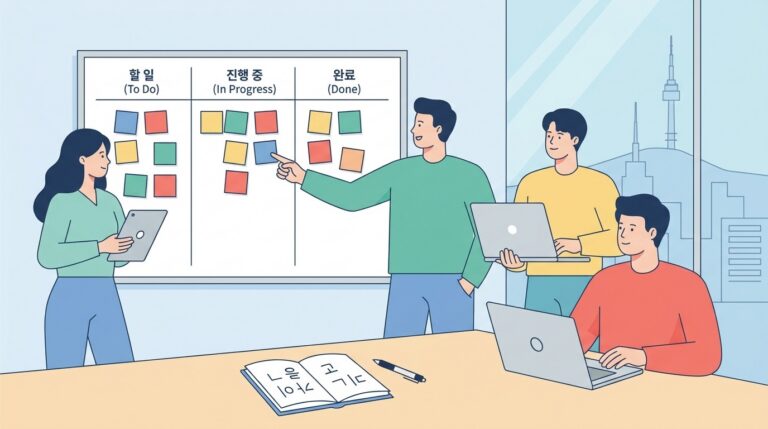
Agile Squad Talks: How to Run Sprint Planning in a Korean Tech Startup
Phase 1: Empathy (Welcome to the Squad!)
안녕하세요! I am your Daily Hangul editor and local culture navigator! Imagine this: You just joined a fast-growing tech startup in Pangyo Techno Valley—Korea’s buzzing Silicon Valley—or in a trendy red-brick shared office in Seongsu-dong. You are sitting at a standup table with Jiyoon (the Product Owner), Minho (the backend engineer), and Sora (the UI/UX designer). A massive Figma canvas is projected on the screen alongside a messy Jira backlog. Jiyoon turns to the room with an iced Americano in hand and says, “이번 스프린트에서는 이거 먼저 쳐내고, 나머지는 다음 이터레이션으로 넘길까요?”
Your mind freezes. Did she just say “strike down” (쳐내다)? Are we fighting someone? Is backlog grooming a martial art now?
Don’t worry, you are not alone! Many global developers and designers tell us that while they know standard textbook Korean honorifics, stepping into a fast-paced Korean agile squad feels like landing on another planet. Korean startups combine ultra-fast execution (빨리빨리, ppallippalli) with flattened organizational culture, creating a unique hybrid of English tech loanwords and vivid Korean idioms. In this guide, tailored specifically for intermediate learners (CEFR B1), we will equip you with the exact phrases, cultural radar (눈치, nunchi), and unspoken manners to voice your opinions clearly, prioritize tickets confidently, and build trust across product, design, and engineering teams.
Phase 2: 3 Core Expressions In-Depth Analysis
Here are three essential expressions you will hear in every single sprint planning meeting across Korean tech companies.
1. 이번 스프린트에서는 이거 먼저 쳐내시죠. (Ibeon seupeurinteueseoneun igeo meonjeo cheonaesijo.)
- Pronunciation: I-beon seu-peu-rin-teu-e-seo-neun i-geo meon-jeo cheo-nae-si-jo. (Think of cheo-nae like “chopping away” dead branches or briskly sweeping items off a table).
- Meaning: “Let’s knock this one out first in this sprint.” (Literal: “In this sprint, let’s strike this out first.”)
- K-Culture Moment: In the hit drama Start-Up, when the Samsan Tech squad faces a tight demo deadline, the team leader cuts down non-essential feature requests with this exact phrase to keep the MVP lean.
- Editor’s Insight: 쳐내다 (cheonaeda) literally means to slash or prune away. In tech squads, it means aggressively clearing high-priority tickets or eliminating blocker tasks so the squad can move fast. Adding -시죠 (-sijo) softens the proposal while keeping it decisive.
- Situation Spectrum: Casual: ⚠️ (Use 쳐내자 with peers) | Semi-formal: ✅ (Perfect for squad sprint grooming) | Formal: 🚫 (Too colloquial for board meetings or external client proposals).
- 🤔 Think About It: In English, we say “knock out tasks” or “prune the backlog.” Notice how both cultures borrow physical, action-oriented verbs to describe digital workload management.
2. 백로그 우선순위 다시 싱크 맞춰볼까요? (Baengnogeu useonsunwi dasi singkeu matchwobolkkayo?)
- Pronunciation: Baeng-no-geu u-seon-sun-wi da-si sing-keu mat-chwo-bol-kka-yo? (Singkeu sounds just like “sync”, while matchwobolkkayo rhymes with “match-wo-ball-car-yo”).
- Meaning: “Shall we sync up on backlog priorities again?”
- K-Culture Moment: You will hear this in open-space tech hubs in Pangyo whenever design specs and backend database models start drifting apart during mid-sprint.
- Editor’s Insight: Korean startups love adopting English agile terms as verbs paired with 맞추다 (matchuda, to align/fit together). 싱크 맞추다 (singkeu matchuda) means getting everyone on the exact same page without scheduling a lengthy 2-hour formal meeting.
- Situation Spectrum: Casual: ✅ | Semi-formal: ✅ (Startup gold standard) | Formal: ⚠️ (In traditional conglomerates, prefer 의견을 조율하다 / uigyeoneul joyulhada).
- 🤔 Think About It: Why do modern Korean startups prefer 싱크 맞추다 over the traditional 회의하다 (hoeuihada, to have a meeting)? Because 회의 sounds bureaucratic, while 싱크 highlights speed and mutual alignment.
3. 일단 MVP로 빠르게 배포하고 피드백 봐요. (Ildan em-v-pi-ro ppareuge baepohago pideubaek bwayo.)
- Pronunciation: Il-dan em-bwi-pi-ro ppa-reu-ge bae-po-ha-go pi-deu-baek bwa-yo. (Ppareuge sounds like a quick “pa-reu-gay”).
- Meaning: “Let’s release it as an MVP first and check the user feedback.”
- K-Culture Moment: Reminiscent of Toss or Karrot Market documentary videos on YouTube where product squads test hypotheses within two weeks rather than building a monolithic product for six months.
- Editor’s Insight: 일단 (ildan, for now / first of all) is the holy grail word for agile compromises. When designers want perfection and developers worry about technical debt, POs use 일단 … 하고 피드백 봐요 to alleviate everyone’s anxiety and avoid analysis paralysis.
- Situation Spectrum: Casual: ✅ | Semi-formal: ✅ | Formal: ⚠️
- 🤔 Think About It: 일단 reduces finality. It signals to your colleagues: “Your concerns are valid, but we will iterate soon.” It protects team harmony while prioritizing rapid delivery.
Phase 3: Textbook Korean vs. Real Korean
| Context | 📖 Textbook Korean | 🗣️ Real Korean Squad Talk |
|---|---|---|
| 1. Proposing Backlog Priority | 기능 목록의 우선순위를 재검토합시다. (Gineung mongnogui useonsunwireul jaegeomtohapsida.) “Let us review the priority of the feature list.” |
이거 티켓 우선순위 먼저 쳐내고 가요. (Igeo tiket useonsunwi meonjeo cheonaego gayo.) “Let’s knock down this ticket priority first before moving on.” |
| 💡 Why Different? | Textbook Korean uses heavy Sino-Korean vocabulary (재검토, 기능 목록) that sounds stiff and authoritarian. Korean squads use lightweight terms like 티켓 (ticket) and 쳐내다 to keep communication fast and energetic. | |
| 2. Asking for a 5-Minute Quick Alignment | 원활한 소통을 위해 잠시 회의를 개최하겠습니다. (Wonhwalhan sotong-eul wihae jamsi hoeuireul gaechoehagesseumnida.) “I will hold a brief conference for smooth communication.” |
5분만 가볍게 싱크 맞출 수 있을까요? (Obunman gabyeopge singkeu matchul su isseulkkayo?) “Could we sync up lightly for just 5 minutes?” |
| 💡 Why Different? | Startups actively avoid formal words like 개최 (convene/host). Asking for a 가벼운 싱크 (light sync) feels non-threatening, collaborative, and respects your coworker’s deep-focus time. |
Phase 4: K-Culture Deep Dive & Non-Verbal Manners
4-1. Nunchi & Startup Body Language
- The Slack Status Check Before Tapping Shoulders: In modern Korean tech offices, physical eye contact is accompanied by digital 눈치 (nunchi, situational awareness). Before asking for an ad-hoc sync, glance at their Slack status (e.g., headphones emoji or “Huddle”) and send a quick DM: “민호님, 지금 5분 싱크 괜찮으세요?” (Minho-nim, jigeum obun singkeu gwaenchaneuseyo? / “Minho, is a 5-minute sync okay right now?”).
- Nodding with Soft Gaze during Screen-Shares: When someone presents their Figma wireframe or Jira board, active listening is signaled through light, continuous head nodding and verbal feedback tokens such as “네네” (ne-ne) or “좋네요” (jonneyo, looks good), rather than staying completely silent until the end.
- The Respectful “-님” System: Most startups have discarded traditional titles like 팀장님 (Team Lead) or 부장님 (Department Head). Instead, they address everyone—from junior intern to CEO—with Name + 님 (-nim) or an English name + 님 (e.g., Alex님, Sarah님). Combine this with polite informal grammar (-해요 style) to strike the perfect balance of professional warmth and flat hierarchy.
4-2. The Seongsu & Pangyo Culture Code: “Coffee Chat” (커피챗)
If backlog prioritization hits a deadlock—say, Frontend wants clean API endpoints but Backend wants to ship quickly with existing schemas—never fight it out defensively on a squad-wide Jira ticket. Instead, use the ubiquitous Korean startup ritual: “커피 한잔하면서 얘기할까요?” (Keopi hanjanhamyeonseo yaegihalkkayo? / “Shall we grab a coffee and talk?”). A 10-minute walk to a nearby cafe breaks down defensive walls and allows Korean coworkers to find a harmonious middle ground.
Phase 5: Real-World Roleplay Scenario
Setting: A glass-walled conference room at a fintech startup in Gangnam. Post-it notes cover the wall, and a Jira sprint backlog is visible on screen.
Characters:
* Jiyoon (PO): Fast-talking, outcome-focused product manager.
* Minho (Backend Dev): Pragmatic developer who cares about database stability.
* Alex (You / Frontend Dev): Advocating for responsive user UI and seamless interaction.
- Jiyoon (PO): 여러분, 이번 스프린트 목표는 간편 결제 기능 론칭이에요. 백로그 우선순위부터 싱크 맞춰볼까요?
(Yeoreobun, ibeon seupeurinteu mokpyoneun ganpyeon gyeolje gineung ronching-ieyo. Baengnogeu useonsunwibuteo singkeu matchwobolkkayo?)
🎭 Looking around the room with an encouraging smile while pointing to the backlog list.
“Everyone, our goal for this sprint is launching the quick-pay feature. Shall we sync up on the backlog priorities first?” -
Minho (Backend): 결제 API 연동은 금방 끝나는데, 이상 거래 감지 로직은 공수가 꽤 커요. 이번 스프린트에 다 넣기는 무리예요.
(Gyeolje API yeondong-eun geumbang kkeunnaneunde, isang georae gamji rojig-eun gongsuga kkwae keoyo. Ibeon seupeurinteue da neokigineun muriyeo.)
🎭 Scratching his chin thoughtfully while reviewing the backend story points.
“Connecting the payment API will be quick, but the fraud detection logic requires quite a bit of story points (engineering effort). Cramming all of it into this sprint is unrealistic.” -
Alex (You / Frontend): 맞아요, 프론트엔드도 결제 UI 구현이랑 애니메이션 작업 공수가 제법 들어요.
(Majayo, peurontuendeudo gyeolje UI guhyeon-irang aenimeisyeon jageop gongsuga jebeop deureoyo.)
🎭 Nodding in agreement with Minho while showing the multi-step Figma prototype on your laptop.
“Agreed, frontend also needs substantial effort for implementing payment UI and transition animations.” -
Jiyoon (PO): 음, 그러면 핵심 결제 플로우 먼저 쳐내고, 복잡한 애니메이션은 다음 스프린트로 넘길까요?
(Eum, geureomyeon haeksim gyeolje peullou meonjeo cheonaego, bokjapan aenimeisyeoneun daeum seupeurinteuro neomgilkkayo?)
🎭 Moving the animation sub-task card into the next milestone column on Jira.
“Hmm, then should we knock out the core payment flow first, and push the complex animations to the next sprint?” -
Alex (You / Frontend): 좋은 생각이에요! 일단 MVP로 빠르게 배포하고 사용자 전환율 피드백 봐요.
(Joeun saenggag-ieyo! Ildan em-v-pi-ro ppareuge baepohago sayongja jeonhwan-yul pideubaek bwayo.)
🎭 Giving a firm, confident thumbs up to validate the PO’s practical compromise.
“Great idea! Let’s ship it as an MVP first and check the user conversion rate feedback.” -
Minho (Backend): 저도 그 방향이 안전할 것 같아요. 감지 로직도 기본 룰셋만 먼저 배포할게요.
(Jeodo geu banghyang-i anjeonhal geot gat-ayo. Gamji rojikdo gibon rulsetman meonjeo baepohalgeyo.)
🎭 Sighing in relief and quickly assigning the primary API ticket to himself.
“I think that direction is much safer too. For fraud detection, I’ll deploy just the basic rule set first.” -
Jiyoon (PO): 좋아요! 그럼 이번 스프린트 스코프는 이렇게 픽스하고 바로 개발 들어가시죠.
(Joeoyo! Geureom ibeon seupeurinteu seukopeuneun ireoke pikseuhago baro gaebal deureogasijo.)
🎭 Clapping hands once cheerfully to wrap up the sprint planning.
“Awesome! Then let’s lock this sprint scope as is and jump straight into development.” -
Alex (You / Frontend): 네, 오늘 바로 프론트 컴포넌트 세팅 시작하겠습니다!
(Ne, oneul baro peuronteu keomponeonteu seting sijakhagesseumnida!)
🎭 Closing the laptop screen with a bright smile, ready to code.
“Sounds good, I’ll start setting up the frontend components today right away!”
🔀 Interactive Decision Point: What Should You Say Next?
Suppose Jiyoon unexpectedly asks you: “알렉스님, 혹시 이번 주말까지 결제 QA 테스트 페이지 미리 열어둘 수 있나요?” (Can you open the payment QA test page by this weekend?)
- Option A: “안 돼요. 주말 근무는 제 계약서에 없습니다.” (An dwaeyo. Jumal geonmuneun je gyeyakseoe eopseumnida. – “No. Weekend work is not in my contract.”)
- Option B: “주말 배포는 리스크가 커서요. 월요일 오전에 바로 확인하실 수 있게 금요일 퇴근 전까지 스테이징에 올려둘게요!” (Jumal baeponeun riseukeuga keoseoyo. Woryoil ojeone baro hwaginhasi su itge geumyoyil toegeun jeonkkaji seuteijing-e ollyeodulgeyo!)
- Option C: “네, 무조건 다 해놓겠습니다! 밤새면 됩니다.” (Ne, mujogeon da haenokgesseumnida! Bamsaemyeon doemnida. – “Yes, I will unconditionally do it all! I can just pull an all-nighter.”)
Feedback:
* Option A (Risk / Bad): While contract boundaries are real, refusing so bluntly sounds confrontational and ruins squad camaraderie in a Korean workplace.
* Option B (Best Choice): 🌟 Outstanding! You highlight the engineering risk of weekend deployments (배포 리스크) while offering a reliable alternative timeline (staging ready by Friday evening for Monday morning testing). Professional, agile, and culturally fluent.
* Option C (Danger / Burnout): Never overpromise out of politeness. In agile squads, predictability is more important than unsustainable heroism.
Phase 6: 10-Second Emotion Shadowing Drill
Practice these high-frequency sprint sentences aloud. Pay close attention to the pause slashes (/) and emotional tone!
[🤝 Collaborative & Constructive]
백로그 우선순위부터 / 다시 싱크 맞춰볼까요?
(Baengnogeu useonsunwibuteo / dasi singkeu matchwobolkkayo?)
“Shall we sync up / on backlog priorities first?”-
[🔥 Pragmatic & Decisive]
이번 스프린트에서는 / 이 티켓 먼저 쳐내시죠!
(Ibeon seupeurinteueseoneun / i tiket meonjeo cheonaesijo!)
“In this sprint, / let’s knock out this ticket first!” -
[🚀 Fast & Reassuring]
일단 MVP로 배포하고 / 유저 피드백 먼저 봐요.
(Ildan em-v-pi-ro baepohago / yujeo pideubaek meonjeo bwayo.)
“Let’s deploy as an MVP for now / and check user feedback first.”
Phase 7: K-Culture Mini Dictionary (Startup Jargon)
- 싱크 (Singkeu) | Sync / Alignment
Used like a noun or verb (싱크 맞추다, 싱크하다). It refers to brief status updates between cross-functional squad members to remove blockers. - 쳐내다 (Cheonaeda) | To knock out / prune / clear tasks
Originating from the verb “to slash off,” developers and PMs use it to describe processing an overwhelming list of tasks or backlogged user stories. - 공수 (Gongsu) | Man-hours / Effort / Story Points
Literally “labor input.” When a developer says “공수가 많이 들어요” (Gongsuga mani deureoyo), it translates to: “This will take significant dev bandwidth/time.” - 배포 (Baepo) | Deployment / Release
Standard term for shipping code. Common collocations include 상용 배포 (production deploy), 스테이징 배포 (staging deploy), and 핫픽스 배포 (hotfix deploy).
Phase 8: Traveler & Expat Survival Kit
If you are working remotely from Korea or dropping by a Seoul branch for sprint planning, keep these in your back pocket:
- Survival Phrase 1: 티켓 공수가 얼마나 들까요? (Tiket gongsuga eolmana deulkkayo? / “How many story points/hours will this ticket take?”)
Pro Tip: Use this during grooming to ask devs for estimates politely. - Survival Phrase 2: 이 부분 블로커(Blocker) 해결되었습니다. (I bubun beullokeo haegyeoldoeeosseumnida. / “The blocker on this part has been resolved.”)
Pro Tip: Drop this in your squad’s Slack channel for instant high praise. - Survival Phrase 3: 이번 스프린트 스코프 픽스할게요. (Ibeon seupeurinteu seukopeu pikseuhalgeyo. / “We will lock the scope for this sprint.”)
Pro Tip: Use this when scope creep starts happening mid-meeting. -
Editor’s Workation Note: Need a productive place to work between sprints? Check out Naver Map’s top-rated laptop-friendly cafes in Gangnam and Seongsu. Shared spaces like FastFive and Sparkplus also offer reliable day passes with unlimited high-speed Wi-Fi and complimentary roasted drip coffee.
Phase 9: “One Step Deeper” (Cultural Reflection)
Traditional Korean corporate culture has long been defined by hierarchy, seniority (선후배), and deferential vertical approval processes (결재). However, the rise of agile tech squads in Korea has triggered a fascinating linguistic revolution. In companies like Toss, Viva Republica, Line, and Coupang, hierarchical titles have been dismantled in favor of 님 or English nicknames, enabling junior frontend devs to openly challenge a senior PO’s priority backlog.
Yet, beneath this flat structure lies the enduring Korean cultural value of 정 (jeong, mutual bonding) and 화합 (hwahap, team harmony). Fast decision-making is not about winning an intellectual argument; it is about reaching a collective alignment where no single teammate feels abandoned with unrealistic deadlines.
💬 Your Turn: In your home country, how do developers and product managers resolve disagreements during sprint planning? Do people express disagreement directly, or do they cushion their feedback? Share your thoughts below!
Phase 10: FAQ & Avoiding Misunderstandings
Q: Can I use the word “쳐내다” (cheonaeda) with my department director or client?
A: Avoid it in formal corporate settings! While perfectly normal and popular inside a casual startup squad, 쳐내다 sounds too slangy and aggressive for enterprise corporate meetings or formal presentations to executives. In formal contexts, replace it with “신속하게 처리하겠습니다” (Sinsokhage cheorihagesseumnida / “We will process this promptly”).
Q: What is the difference between “회의” (hoeui) and “싱크” (singkeu)?
A: 회의 implies a formal meeting with an agenda, slide decks, and designated meeting minutes. 싱크 implies a nimble, agile catch-up—often standing up or over a 5-minute huddle on Slack—aimed purely at syncing current progress and blockers.
Q: Why do Koreans mix so much English into startup conversations (e.g., 스코프, 픽스, 공수)?
A: Modern software engineering methodologies were imported through global agile frameworks. Korean tech professionals adopt English technical nouns (스프린트, 백로그, 배포) because they are globally recognized, but seamlessly conjugate them with Korean auxiliary verbs (-하다, -맞추다, -들다) for rapid, hyper-contextual communication.
🚨 Common Mistakes Alert
- Mistake: Saying “이거 먼저 죽여요” (translating “let’s kill this task” literally).
Correct Action: Say “이 티켓 먼저 쳐내요” or “이 기능은 백로그에서 뺄게요” (Let’s remove this feature from the backlog). - Mistake: Calling your Korean team member “야” (Ya!) or just their first name without honorifics because the company is “flat.”
Correct Action: Always attach -님 (e.g., 민호님, 지윤님) even if you are speaking English or casual polite Korean. - Mistake: Remaining completely silent when a sprint scope seems impossible.
Correct Action: Speak up early using the magic word 공수 (“공수가 좀 빠듯할 것 같아요” – “The bandwidth seems a bit tight”). Korean startups value early risk flags over silent delays.
Phase 11: Action Mission & Engagement
Take action today and solidify what you just learned!
- 🥉 Bronze Mission (Solo Practice): Stand in front of your mirror or record a voice note saying: “일단 MVP로 빠르게 배포하고 피드백 봐요!” Repeat it 5 times until the transition between 배포하고 and 피드백 flows naturally.
- 🥈 Silver Mission (Squad Chat Practice): The next time you have a project sync or Slack chat with Korean friends or colleagues, use the phrase: “잠깐 5분만 싱크 맞출 수 있을까요?”
- 🥇 Gold Mission (Live Action): Watch a Korean tech conference talk (such as Toss Simplicity or Woowa Tech on YouTube) and spot at least two words from today’s Mini Dictionary (배포, 싱크, 공수, 쳐내다).
🎮 K-Culture Mission: Watch Episode 5 of the K-Drama Start-Up on Netflix. Observe how the characters interact during their 48-hour Hackathon pitch preparation—notice the body language and how they address each other under pressure!
Phase 12: Interactive Quiz Challenge
Test your startup Korean fluency!
1. Scenario Judgment
During sprint planning, the designer brings 15 detailed animation screens, but the sprint ends in 3 days. What is the most culturally savvy and agile response for Alex (the developer)?
* A) “디자인이 너무 비효율적이에요. 다시 하세요.” (The design is too inefficient. Do it again.)
* B) “애니메이션 공수가 커서요, 일단 핵심 플로우 먼저 쳐내고 다음 이터레이션에 반영할까요?”
* C) “저는 개발자니까 디자인은 상관없습니다.” (I am a developer so I don’t care about design.)
2. Fill in the Blank
Complete the sentence for proposing a quick team alignment:
“백로그 우선순위 다시 ______ 맞춰볼까요?”
(Hint: 2 syllables, English loanword meaning synchronization)
3. True / False Culture Check
- Statement: In modern Korean startups that use English names and a flat “-님” culture, it is considered polite to drop honorific speech (반말) with your colleagues immediately on your first day. (True / False?)
👉 Click to reveal answers & explanations!
- Answer: B
Explanation: Option B politely explains the engineering bandwidth (공수가 커서요), suggests knocking out core functionality first (먼저 쳐내고), and defers the secondary feature to the next iteration gracefully. - Answer: 싱크 (Singkeu)
Explanation: 싱크 맞추다 is the everyday startup idiom for syncing up priorities. - Answer: False
Explanation: Even in flat startups where everyone uses English names, colleagues speak to each other in polite 존댓말 (-요 style) to show mutual respect. Dropping into informal 반말 without an explicit mutual agreement (말 놓기) is a major social faux pas!







