

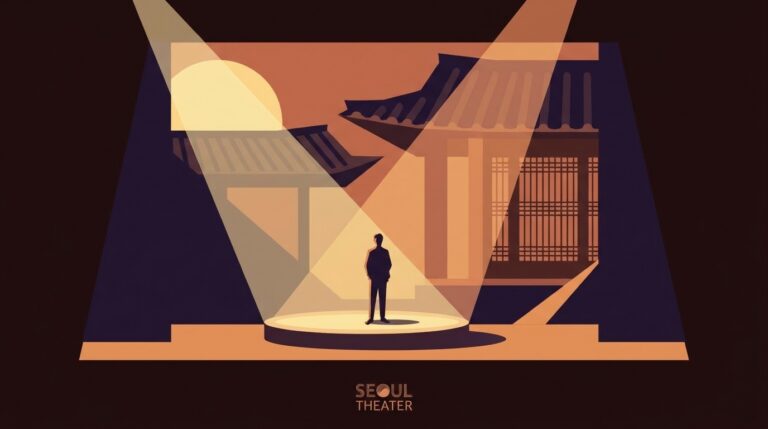
Phase 1: Empathy (Story-driven Hook)
안녕하세요! 매일한글 에디터입니다. (Annyeonghaseyo! It’s your Daily Hangul editor!)
Picture this: You have just stepped out of an intimate, dimly lit black-box theater tucked away in the brick alleys of Daehangno (대학로), Seoul’s bustling performing arts hub. The lights fade up, the silence lingers for three breathtaking seconds, and the audience erupts into applause. You just witnessed an avant-garde adaptation of Shakespeare’s Hamlet, recontextualized into modern Korean corporate dystopia. The lighting was stark, the lead actor contorted their body in agonizing grief, and every prop screamed alienation.
You sit down at a cozy Marronnier Park café with your Korean theater-major friends. Your brain is racing with philosophical interpretations. But when it’s your turn to chime in, you stumble and blurt out: “배우가 연기를 잘했고, 무대가 예뻤어요.” (Baeuga yeon-gireul jalhaessgo, mudaega yeppeosseoyo. / The actor acted well, and the stage was pretty.)
Instantly, your heart sinks. You sounded like an elementary school student reviewing a puppet show, when inside, you were formulating an existential essay! I have guided dozens of advanced international students through this exact creative plateau. Transitioning from B2 conversational fluency to C1 critical discourse means ditching generic adjectives and embracing the precise vocabulary of aesthetic critique—textual deconstruction, spatial dynamics, and visceral embodiment. This guide was built specifically from real critique salons and stage review workshops in Seoul so you can express your brilliant artistic perspectives without losing an ounce of nuance.
Phase 2: Deep Dive into 3 Core Expressions
1. 원작을 파격적으로 재해석하다 (Wonjageul pagyeokjeogeuro jaehaeseokhada)
- Pronunciation: [Won-ja-geul pa-gyeok-jjeo-geu-ro jae-hae-seok-ha-da] (Think of ‘pa’ as the crisp puff of air in ‘pop’, and ‘gyeok’ like the sudden snap of ‘crick’.)
- Meaning: Literally “To reinterpret the original work by breaking conventional rules,” meaning to radically and boldly deconstruct or adapt a canonical text.
- K-Culture Moment: Used routinely in serious arts journals like The Musical or culture segments on JTBC when discussing directors like Koh Sun-woong who adapt classic Greek tragedies into Korean pansori-style theater.
- Editor’s Insight: 파격적 (pagyeokjeok) comes from Hanja (破格) meaning to smash established molds. It is distinctly complimentary when critiquing contemporary art, signaling brave creative vision rather than disrespectful distortion.
- Situation Spectrum: Casual ⚠️ | Semi-formal ✅ | Formal ✅
- 🤔 Think About It: Does your native culture view altering classic literature as rebellious vandalism or creative genius? Notice how Korean theater critiques celebrate 파격 as a sign of contemporary vitality.
2. 무대 미장센이 극적 긴장감을 고조시키다 (Mudae mijangsenni geukjeok ginjanggameul gojosikida)
- Pronunciation: [Mu-dae mi-jang-se-ni geuk-jjeok gin-jang-ga-meul go-jo-si-ki-da] (Flow smoothly from the French-derived ‘mijangsen’ into the crisp, taut Korean rhythm of ‘gin-jang-gam’.)
- Meaning: Literally “The stage mise-en-scène heightens dramatic tension,” indicating that lighting, set composition, and blocking create an electric, suspenseful atmosphere.
- K-Culture Moment: Heard among cinephiles and theater critics reviewing dark, atmospheric Korean plays like The Crucible or thriller musicals at the Hongik University Daehangno Art Center.
- Editor’s Insight: Rather than merely stating “the lighting was cool,” combining 미장센 (mise-en-scène) with 고조시키다 (to escalate or heighten to a climax) instantly frames your analysis as professional and visually attuned.
- Situation Spectrum: Casual ⚠️ | Semi-formal ✅ | Formal ✅
- 🤔 Think About It: How does spatial arrangement change psychological pressure in Western black boxes versus traditional Korean round-stage madang theaters?
3. 배우의 압도적인 신체성이 돋보이다 (Baeu-ui apdojeogin sincheseong-i dotboida)
- Pronunciation: [Bae-u-ui ap-tto-jeo-gin sin-che-seong-i dot-ppoi-da] (Hit the double-sound tension on ‘ap-ddo’ as if expressing genuine physical weight.)
- Meaning: Literally “The actor’s overwhelming physicality stands out,” meaning the performer uses physical movement, bodily tension, and breath control to dominate the stage space.
- K-Culture Moment: Frequently employed when reviewing experimental physical theater, contemporary choreography, or tour-de-force solo performances like Hedwig and the Angry Inch in Seoul.
- Editor’s Insight: 신체성 (sincheseong – physicality) elevates acting critiques away from basic facial expressions or line delivery toward corporeal presence and movement discipline.
- Situation Spectrum: Casual ⚠️ | Semi-formal ✅ | Formal ✅
- 🤔 Think About It: In an era dominated by close-up cinema, why do theater scholars in Korea place such heavy philosophical value on raw physical presence (신체성)?
Phase 3: Textbook Korean vs. Real Korean
Situation 1: Critiquing a Reimagined Classical Narrative
- 📖 Textbook Korean: 줄거리가 원작과 달라서 신선하고 연출이 멋있었습니다. (Julgeoriga wonjakgwa dallaseo sinseonhago yeonchuri meos-isseossseumnida. / Because the plot was different from the original, it was fresh and the directing was cool.)
- 🗣️ Real C1 Korean: 원작의 서사를 비틀면서도, 무대 연출의 밀도가 굉장했어요. (Wonjaui seosareul biteulmyeonseodo, mudae yeonchului mildoga goengjanghaesseoyo. / While subverting the original narrative, the spatial and structural density of the direction was extraordinary.)
- 💡 Why the Difference? Native critics rarely use 멋있다 (cool) or basic conjunctions like 달라서 (because it’s different) when discussing dramaturgy. Instead, they pair 서사를 비틀다 (to twist/subvert narrative expectations) with 연출의 밀도 (density of the staging) to demonstrate an understanding of dramaturgical weight.
Situation 2: Describing an Actor’s Commanding Energy
- 📖 Textbook Korean: 배우가 소리를 잘 지르고 몸을 아주 잘 씁니다. (Baeuga sorireul jal jireugo momeul aju jal sseumnida. / The actor screams well and uses their body very well.)
- 🗣️ Real C1 Korean: 배우의 폭발적인 에너지와 동선 처리가 무대 전체를 장악하더라고요. (Baeu-ui pokbaljeogin eneojiwa dongseon cheoriga mudae jeonchereul jang-akhadeoragoyo. / The actor’s explosive energy and spatial blocking completely commanded the entire stage.)
- 💡 Why the Difference? Saying an actor “uses their body well” sounds juvenile. Replacing it with 동선 처리 (management of blocking/path of movement) and 무대를 장악하다 (to dominate/command the stage) displays sharp aesthetic perception.
Phase 4: K-Culture Deep Dive & Non-Verbal Manners
4-1. Nunchi & Post-Show Etiquette in Daehangno
Korean theater culture in Daehangno (대학로) is uniquely intimate. The small, subterranean theaters often share stairwells, restrooms, and lobbies with the audience, actors, and directing crew.
* The Low-Voice Critical Nunchi: After the curtain falls, wait until you are well clear of the venue—or seated in an off-street café—before delivering sharp critical judgments. The director or the lead actor’s family could literally be walking two steps behind you on the staircase!
* Constructive Posture: When discussing high-level critiques with Korean colleagues, avoid aggressive hand gestures or dogmatic proclamations. Nod slowly (고개를 끄덕이며 경청), lightly rest your chin on your thumb in contemplative thought, and use the soft softener suffix -더라고요 (-deoragoyo) or -는 인상을 받았어요 (-neun insang-eul bad-asseoyo / “I received the impression that…”) to temper even your sharpest artistic insights.
4-2. Cultural Code: The Daehangno Creative Theater Ecosystem
Korea holds one of the most vibrant performing arts scenes in the world. Daehangno boasts over 150 independent theaters clustered in a single neighborhood—unmatched in density globally. The Korean audience prides itself on being 연뮤덕 (yeonmyudeok – enthusiastic theater and musical geeks) who see productions multiple times (회전문 관람 / revolving door viewing) to dissect microscopic casting differences (캐스팅 페어), lighting adjustments, and interpretive evolutions.
Phase 5: Real-World Roleplay Scenario
Setting: A quiet indie café near Marronnier Park, 10 minutes after watching a critically acclaimed, modern adaptation of Macbeth.
Characters:
* Min-seo (민서): A 28-year-old Korean theater dramaturge with sharp aesthetic standards.
* You (학습자): A passionate arts enthusiast eager to deliver a nuanced, C1-level critique.
Dialogue:
1. Min-seo: 오늘 공연 어떻게 봤어요? 솔직히 원작 텍스트를 너무 심하게 해체한 건 아닌가 싶기도 한데요. (Oneul gong-yeon eotteoke bwasseoyo? Soljikhi wonjak tekseuteureul neomu simhage haechehan geon anin-ga sipgido handeyo. / How did you find today’s show? To be honest, I wonder if they deconstructed the original text a bit too aggressively.)
2. You: 🎭 Leaning forward thoughtfully, resting hands gently on the table.
글쎄요, 저는 오히려 원작을 파격적으로 재해석해서 현대 사회의 불안을 직관적으로 드러냈다고 봐요. (Geulsseyo, jeoneun ohiryeo wonjageul pagyeokjeogeuro jaehaeseokhaeseo hyeondae sahoe-ui buran-eul jik-gwanjeogeuro deureonaetdago bwayo. / Well, I actually think that by radically reinterpreting the original work, they intuitively exposed the anxiety of modern society.)
3. Min-seo: 아, 현대적 불안이요? 어떤 연출적 장치에서 그걸 느끼셨는데요? (Ah, hyeondaejeok buran-iyo? Eotteon yeonchuljeok jangchieseo geugeol neukkisyeonneundeyo? / Ah, modern anxiety? From what directorial device did you feel that?)
4. You: 🎭 Tracing a light square on the table with your finger to visualize the stage.
미니멀한 무대 미장센이 극적 긴장감을 끝까지 고조시키더라고요. 특히 조명의 명암 대비가 인상적이었어요. (Minimeolhan mudae mijangsenni geukjeok ginjanggameul kkeutkkaji gojosikideoragoyo. Teukhi jomyeong-ui myeong-am daebiga insangjeogieosseoyo. / The minimal stage mise-en-scène heightened the dramatic tension right to the end. In particular, the chiaroscuro contrast in lighting was remarkable.)
5. Min-seo: 듣고 보니 그렇네요. 레이디 맥베스 독백 장면에서도 조명이 정말 칼 같았죠. (Deutgo boni geureonneyo. Reidi maekbeseu dokbaek jangmyeon-eseodo jomyeong-i jeongmal kal gat-atjyo. / Come to think of it, you’re right. The lighting in Lady Macbeth’s soliloquy was razor-sharp.)
6. You: 🎭 Nodding intently with genuine admiration.
맞아요. 게다가 배우의 압도적인 신체성이 그 텅 빈 무대를 빈틈없이 꽉 채우지 않았나요? (Maj-ayo. Gedaga baeu-ui apdojeogin sincheseong-i geu teong bin mudaereul binteum-eopsi kkwak chae-uji anhatnayo? / Exactly. Furthermore, didn’t the actor’s overwhelming physicality pack that hollow stage without leaving a single gap?)
7. Min-seo: 와, 맞아요! 단순한 대사 전달을 넘어서 몸의 뒤틀림 자체가 비극의 무게를 전하더군요. (Wa, maj-ayo! Dansunhan daesa jeondareul neomeoseo momui dwiteullim jachega bigeugui mugereul jeonhadeogunyo. / Wow, spot on! Transcending mere dialogue delivery, the contortion of the body conveyed the sheer weight of tragedy.)
8. You: 🎭 Smiling gently, raising your coffee mug in mutual artistic resonance.
텍스트와 미장센, 그리고 신체성이 절묘하게 맞물린 수작이었던 것 같아요. (Tekseuteuwa mijangsen, geurigo sincheseong-i jeolmyohage manmullin sujag-ieotdeon geot gat-ayo. / I believe it was a masterwork where the text, mise-en-scène, and physicality meshed together exquisitely.)
🔀 Interactive Decision Point
Min-seo asks: “맥베스가 마지막에 칼 대신 거울을 떨어뜨리는 장면은 어떻게 해석하셨어요?” (How did you interpret the scene at the end where Macbeth dropped a mirror instead of a sword?)
- Option A: “그냥 소리가 커서 깜짝 놀랐는데 좀 멋있었어요.” (Geunyang soriga keoseo kkamjjak nollatneunde jom meos-isseosseoyo. / I just got surprised because the sound was loud, but it looked cool.)
- Option B: “물리적 권력의 상실보다 자기 파멸과 분열된 자아를 마주하는 내면의 붕괴로 읽혔어요.” (Mullijeok gwollyeogui sangsilboda jagi pamyeol-gwa bunyeoldoen ja-areul maju-haneun naemyeonui bung-goero ilkhyeosseoyo. / I read it as an internal collapse facing self-destruction and a fractured ego, rather than merely a loss of physical power.)
- Option C: “감독이 쓸데없이 예술가인 척 젠체하려고 넣은 작위적인 장면 같았어요.” (Gamdogi sseuldeeopsi yesulgain cheok jenchehayeogo neoeun jak-wijeogin jangmyeon gat-asseoyo. / It felt like an artificial scene thrown in just because the director wanted to pretentious acts like an artist.)
💡 Choice Feedback:
- Option A (Bad): Drops you right back to A2 conversational Korean. It completely overlooks dramaturgical symbolism and cuts the intellectual dialogue short.
- Option B (Best): Pure C1 critical brilliance! Using 내면의 붕괴로 읽히다 (read as internal collapse) and 분열된 자아 (fractured ego) instantly establishes deep literary perception and invites further respectful analysis.
- Option C (Risk): While stylistically native (젠체하다, 작위적), calling a director pretentiously fake with biting slang can come across as unnecessarily cynical and aggressive in polite Korean critique circles.
Phase 6: 10-Second Emotion Shadowing Drill
Practice these with natural cadences, pausing at / and adopting the specified emotion:
[🧐 진지하고 사색적으로 / Deeply contemplative and scholarly]
원작의 고전적 서사를 / 현대적 맥락으로 비틀어 낸 점이 / 대단히 인상적이었습니다.
(Wonjaui gojeonjeok seosareul / hyeondaejeok maengnageuro biteureo naen jeomi / daedanhi insangjeog-ieossseumnida.)-
[😲 전율에 찬 찬사 / Awestruck admiration]
무대 위를 가로지르는 / 배우의 압도적인 신체성이 / 객석 전체를 압도하더군요!
(Mudae wireul garojireuneun / baeu-ui apdojeogin sincheseong-i / gaekseok jeonchereul apdohadeogunyo!) -
[⚖️ 균형 잡힌 비평적 어조 / Balanced and analytical tone]
미장센의 조형미는 뛰어났으나, / 텍스트와의 유기적 결합은 / 다소 아쉬움이 남습니다.
(Mijangsennui johyeongmineun ttwieonasseuna, / tekseuteu-waui yugijeok gyeolhabeun / daso aswi-umi namsseumnida.)
Phase 7: K-Culture Mini Dictionary
- 미장센 (Mijangsen – Mise-en-scène): Adopted from French, commonly utilized in Korean theater and cinema reviews to cover the entire visual staging—lighting, sets, props, and actor positioning.
- 신체성 (Sincheseong – Corporeality / Physicality): A core critical term analyzing how an actor expresses narrative, trauma, or subtext through bodily weight, movement, and physical stamina rather than spoken lines.
- 입체적 (Ipchejeok – Three-dimensional / Multi-layered): Contrasted with 평면적 (flat). Used to praise complex character psychology, dynamic stage directing, or multi-faceted dramaturgical adaptations.
- 암전 (Amjeon – Stage Blackout): A theatrical stage blackout. Often analyzed critically: 잦은 암전 (frequent blackouts) indicates fragmented directing, while 감각적인 암전 (sensory blackout) enhances tension.
Phase 8: Traveler’s Survival Kit
Survival Expressions TOP 3 for the Seoul Theater Enthusiast
- 혹시 오늘 시야 제한석 현장 판매분 있나요?
(Hoksi oneul siya jehanseok hyeonjang panmaebun itnayo? / Excuse me, are there any rush tickets for obstructed-view seats sold on-site today?)
Pro Tip: High-demand indie plays in Daehangno often release discount rush tickets (시야제한석) 1 hour before curtain call. - 오늘 커튼콜 촬영 가능한 날인가요?
(Oneul keoteunkol chwallyeong ganeunghan narin-gayo? / Is curtain call photography permitted for today’s performance?)
Pro Tip: In Korea, taking photos or recording during a show is strictly forbidden under zero-tolerance etiquette, but special 커튼콜 데이 (Curtain Call Days) permit phone photography during final bows. - 프로그램북이랑 대본집 재고 남아있나요?
(Peurogeuraembuk-irang daebonjip jaego nama-itnayo? / Do you still have program books and printed script collections in stock?)
Pro Tip: Daehangno theatergoers collect official published stage plays (대본집), which often sell out within the first opening week.
Editor’s Travel Note
To experience Seoul’s theatrical scene firsthand, bypass tourist agencies and dive into native ticketing. Download and navigate the 인터파크 티켓 앱 다운로드 (Interpark Ticket App Download) or Yes24 Ticket. Head directly to Hyehwa Station (혜화역, Line 4), Exit 1 or 2. If you don’t have reservations, stop by the public Marronnier Ticket Booth (마로니에공원 좋은공연 안내센터) for same-day discount tickets to celebrated experimental productions.
Phase 9: “한 발 더 깊이” (A Deeper Cultural Reflection)
Traditional Korean performing arts historically found their power not in static, distant proscenium stages, but in the muddy circle of Madang-geuk (마당극), where actors broke the fourth wall to commune directly with spectators. This heritage infuses modern Korean stagecraft with an obsession for raw, embodied catharsis. When Korean critics evaluate 신체성 (physicality) and 파격 (bold deconstruction), they are often assessing whether the contemporary performance revives that communal spirit of 신명 (ecstatic release) and collective 한 (deep-seated sorrow). By critiquing theater in Korean, you are not merely evaluating a show; you are participating in a living ritual of cultural catharsis.
💬 Your Turn: Think of a famous theater play, movie, or musical you love. How would you describe its staging using the concept of 미장센? Leave your practice sentence in the comments below, and I’ll personally review your critical nuance!
Phase 10: FAQ & Common Mistakes
Q: Can I use the French word ‘미장센’ in casual conversation with Korean friends?
A: Absolutely! 미장센 (mijangsen) is completely naturalized in Korea among anyone who enjoys arts, indie films, or theater. However, when talking about everyday casual matters like room decor, stick to 방 꾸미기 or 인테리어 instead.
Q: How do I express constructive criticism without sounding rude or arrogant?
A: Always anchor your critique around subjective impressions rather than objective absolutes. Instead of saying “연출이 엉망이었어요” (The directing was a mess), phrase it as: “연출 의도는 흥미로웠으나 텍스트와의 결합 면에서는 다소 아쉬움이 남았습니다” (The directorial intention was intriguing, though the cohesion with the text left something to be desired).
Q: What is the difference between 연기력 (acting skill) and 신체성 (physicality)?
A: 연기력 is the broad umbrella term for acting competence (vocal clarity, emotional resonance, line delivery). 신체성 specifically isolates corporeal execution—how an actor uses posture, breath, movement dynamics, and spatial physical presence to convey subtext.
🚨 Common Mistakes TOP 3
- Mistake: Saying “무대가 너무 드라마틱했어요” (The stage was too dramatic).
- Correct Action: In Korean, 드라마틱하다 usually refers to sudden life events or plot developments. When analyzing visual or psychological stage atmosphere, use 극적 긴장감이 넘치다 (brimming with dramatic tension).
- Mistake: Calling actors’ movements simply “액션” (Action).
- Correct Action: 액션 sounds like Hollywood martial arts stunts. In theater analysis, use 동선 (blocking/movement paths) or 신체 언어 (body language).
- Mistake: Reviewing a show’s message as “교훈이 좋았다” (The moral lesson was good).
- Correct Action: Unless reviewing a children’s fairytale, 교훈 sounds like a primary school moral lecture. Use 작품이 던지는 화두 (the thematic discourse/question posed by the work) or 동시대적 메시지 (contemporary message).
Phase 11: Action Missions
- 🥉 Bronze Mission (Solo Shadowing): Read aloud Dialogue Turn 4 and Turn 6 from Phase 5 three times each until you can articulate 극적 긴장감 and 압도적인 신체성 without hesitation.
- 🥈 Silver Mission (Social Review): Post an Instagram story or note reviewing a movie, K-Drama, or play you recently watched. Write one full sentence using the formula:
[작품명]은/는 원작을 파격적으로 재해석하여 무대 미장센의 밀도를 극대화했다. - 🥇 Gold Mission (Real World Application): Visit an indie theater in Daehangno (or watch a recorded stage play on Naver TV Performing Arts) and formulate three distinct critical sentences analyzing text, mise-en-scène, and acting physicality.
- 🎮 K-Culture Mission: Search for an interview of your favorite Korean musical or theater actor on YouTube using the keywords
[배우 이름] + 인터뷰 + 무대 장악력. Find at least one sentence where the critic or host praises their physical staging.
Phase 12: Interactive Quiz Challenge
1. Context Judgment
Which sentence demonstrates the most sophisticated C1-level critique of an experimental theater performance?
* (A) 배우가 소리를 엄청 크게 질러서 정말 신기했어요.
* (B) 원작의 서사를 과감하게 비틀어 동시대적 화두를 설득력 있게 제시했습니다.
* (C) 연극 내용이 교과서 같아서 너무 착한 교훈을 주었습니다.
🔍 Click to Reveal Answer & Analysis
Correct Answer: (B)
Analysis: (B) utilizes high-register critical discourse: 서사를 과감하게 비틀다 (boldly subvert the narrative), 동시대적 화두 (contemporary thematic discourse), and 설득력 있게 제시하다 (convincingly present). (A) sounds childish, and (C) inappropriately applies juvenile moral vocabulary (착한 교훈) to adult theater critique.
2. Fill in the Blank
Complete the sentence with the appropriate aesthetic term:
조명과 무대 세트의 배치로 완성된 뛰어난 무대 ( )이 극적 긴장감을 고조시켰다.
(The outstanding stage [ ] completed by lighting and set arrangement heightened dramatic tension.)
🔍 Click to Reveal Answer & Analysis
Correct Answer: 미장센 (Mise-en-scène)
Analysis: The combination of set arrangement, spatial lighting, and props forming visual stage beauty is called 무대 미장센.
3. True or False Cultural Quiz
- Statement: In Daehangno indie theaters, it is customary to loudly praise or criticize the director and actors in the lobby right outside the auditorium immediately after the performance ends.
🔍 Click to Reveal Answer & Analysis
Correct Answer: False (X)
Analysis: Due to the intimate physical nature of Daehangno theater spaces, actors, directors, and their families often share the same exits and small lobbies. Courteous theatergoers practice 눈치 (nunchi) and wait until they reach an outside café to engage in deep analytical critiques.







