

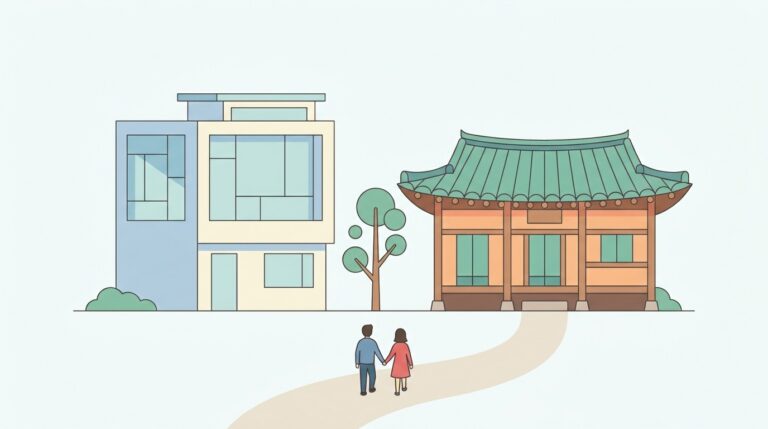
안녕하세요! 매일한글 에디터입니다. (Annyeonghaseyo! It’s your Daily Hangul editor.)
Think back to the iconic alleyway scenes of Reply 1988. When a neighbor ran out of coal briquettes or an uncle fell on hard times, nobody drafted a municipal assistance application. Instead, aunts swapped bulging side-dish containers (반찬), and extended relatives pooled cash in discreet white envelopes. For decades, Korea’s rapid economic ascent relied on an unspoken, ironclad social contract: the state focused strictly on building export infrastructure, while the family served as the unpaid, non-negotiable 1st line of defense for sickness, unemployment, and eldercare.
Fast forward to today’s Seoul. One in three households is now a solo household (1인 가구), high-rise studio flats (원룸) dominate urban skylines, and national newspapers headline fears of godoksa (고독사, lonely deaths). Modern Koreans find themselves stranded between lingering Confucian duties and hyper-individualistic economic survival.
If you are aiming for advanced fluency (C1), navigating this conversation is a rite of passage. Foreign learners often tell me, “Whenever Koreans discuss aging parents or living alone, I either sound like a robotic sociology paper or I accidentally say something culturally offensive!” Don’t worry. Drawing from over a decade of coaching advanced expatriates and deep cultural observation, this master guide will equip you to discuss familism, welfare gaps, and modern alienation with genuine cultural sensitivity and native-level poise.
1. 1차 안전망 역할을 하다 (il-cha an-jeon-mang yeok-hal-eul ha-da)
- Pronunciation: [il-cha an-jeon-mang yeok-har-eul ha-da] (Think of ‘eel-cha’ like first gear, followed by ‘ahn-jeon-mang’ rhythmic like safety-net)
- Meaning: Literal: “To play the role of the primary safety net” | Nuance: Acting as the foundational buffer that absorbs devastating financial or medical crises before any public welfare kicks in.
- K-Culture Moment: Seen frequently in hard-hitting investigative journalism shows like PD Notebook (PD수첩) or grounded dramas like My Mister (나의 아저씨), where characters describe relatives carrying debt that the government ignores.
- Editor’s Insight: While this originates as an academic phrase, modern educated Koreans in their 30s to 50s regularly use it over drinks when debating social policies or reflecting on their aging parents’ retirement.
- Situation Spectrum: Casual: ⚠️ | Semi-formal: ✅ | Formal: ✅
- 🤔 Think About It: In your home country, is the family expected to be the primary safety net, or do citizens instinctively look to institutional state welfare first?
2. 가족에게 짐이 되다 (ga-jok-e-ge jim-i doe-da)
- Pronunciation: [ga-jog-e-ge jim-i doe-da] (Pronounce ‘jim’ with a heavy, grounded ‘j’, rhyming with gym)
- Meaning: Literal: “To become luggage/a burden to one’s family” | Nuance: The heartbreaking, visceral dread felt by aging parents or struggling youths of dragging their loved ones down financially or emotionally.
- K-Culture Moment: In the tear-jerking drama Dear My Friends (디오마), elderly mothers openly break down, confessing they would rather live isolated in a rural home than 가족에게 짐이 되다.
- Editor’s Insight: The word 짐 (burden/luggage) carries enormous psychological weight in Korea. It does not just mean an inconvenience; it implies causing your family to compromise their own social survival.
- Situation Spectrum: Casual: ✅ | Semi-formal: ✅ | Formal: ⚠️
- 🤔 Think About It: Why does Korea’s collective family consciousness make the fear of being a ‘burden’ so much more intense than in individualistic societies?
3. 각자도생의 시대 (gak-ja-do-saeng-ui si-dae)
- Pronunciation: [gak-jja-do-saeng-ui si-dae] (Crisp ‘gak’, followed by smooth ‘ja-do-saeng’)
- Meaning: Literal: “The era of each person seeking their own survival” | Nuance: A bitter, contemporary idiom capturing the sentiment that neither family nor the state can save you anymore—it’s every person for themselves.
- K-Culture Moment: Cynical workplace dialogues in Misaeng (미생) or news commentary analyzing why young Koreans refuse marriage, children, and multi-generational housing.
- Editor’s Insight: This four-character idiom (사자성어-inspired modern phrase) surged in popularity during recent economic crunches. Using it signals an astute, C1-level grasp of current Korean public sentiment.
- Situation Spectrum: Casual: ✅ | Semi-formal: ✅ | Formal: ✅
- 🤔 Think About It: Does modern independence feel empowering, or does it feel like lonely abandonment disguised as freedom?
Let’s compare how a textbook approaches this topic versus how an articulate native speaker actually speaks in real life:
Situation 1: Discussing the burden of eldercare
- 📖 교과서 한국어 (Textbook): “저는 연로하신 부모님을 부양할 경제적 책임이 있습니다.” (Jeoneun yeonrohasin bumonimeul buyanghal gyeongjejeok chaegimi itseumnida. – I have the financial duty to support my elderly parents.)
- 🗣️ 진짜 한국어 (Real Native): “부모님 돌봄을 온전히 개인이 짊어지기엔 솔직히 너무 버거워요.” (Bumonim dolbomeul onjeonhi gaeini jil-eojigien soljikhi neomu beogeowoyo. – Honestly, it’s just too overwhelming for an individual to shoulder eldercare all on their own.)
- 💡 왜 다를까? (Why the difference?): While “부양” (legal support) sounds like an official courtroom deposition, real natives use tactile, expressive verbs like “짊어지다” (to heave a physical burden on one’s back) and “버겁다” (to be beyond one’s capacity) to convey genuine personal distress.
Situation 2: Remarking on the demise of the traditional safety net
- 📖 교과서 한국어 (Textbook): “한국의 전통적인 대가족 복지 제도는 이미 붕괴되었습니다.” (Hangugeui jeontongjeogin daegajok bokji jedoneun imi bunggoedoe-eotseumnida. – Korea’s traditional extended family welfare system has already collapsed.)
- 🗣️ 진짜 한국어 (Real Native): “예전처럼 가족이 다 품어주고 받쳐주던 시절은 이제 완전히 지난 셈이죠.” (Yejeoncheoreom gajogi da pumeojugo batchyeojudeon sijeoreun ije wanjeonhi jinan sem-ijyo. – The days when family embraced and propped everyone up are pretty much gone now.)
- 💡 왜 다를까? (Why the difference?): Advanced natural Korean avoids blunt academic nouns like “붕괴” (collapse) in favor of warm metaphors like “품어주다” (to embrace/shelter) coupled with softening discursive endings like “-ㄴ 셈이죠” (it practically amounts to).
4-1. 눈치 (Nunchi) & Non-Verbal Manners: The Eldercare Hesitation
When Koreans discuss aging parents or solitary relatives, observe their physical posture. It is considered deeply unrefined to say bluntly, “Why doesn’t your father just go to a nursing home (요양원)?” The term 요양원 still carries a historic, unspoken taboo of filial abandonment (고려장 뉘앙스).
- The Heavy Sigh (한숨): When an interlocutor looks down, takes a quiet breath, and touches the back of their neck, they are wrestling with the guilt of wanting their own life while feeling obligated to provide care. Match their tone by nodding slowly and softening your gaze.
- Hedge Your Opinions: Instead of declaring solutions, use empathetic rhetorical softeners like “참 쉽지 않은 문제 같아요” (It’s truly not an easy problem).
4-2. Cultural Code: From Reply 1988 to My Liberation Notes
In Reply 1988, the neighborhood alley functioned as a shared living room. If a child was sick, neighbors watched them; if a mother needed emergency cash, gold rings were lent without receipts. This was the traditional safety net in its golden twilight.
Contrast this with My Liberation Notes (나의 해방일지). The three siblings commute two exhausting hours from rural Gyeonggi to Seoul every morning, eating dinner in heavy, weary silence. Their aging parents work themselves to exhaustion on the farm without social safety guarantees. The drama reveals modern Korea’s hidden reality: when family remains the sole safety net in a hyper-competitive economy, the net becomes an anchor pulling everyone underwater.
- Setting: A low-lit traditional pub (주막) in Jongno, Seoul. Rain beats against the window. Empty pajeon platters sit between you and Ji-hoon (35), an overworked project manager.
- Character NPC: Ji-hoon (지훈), visibly drained after spending his weekend running between his solo studio apartment and his father’s hospital in Incheon.
지훈: 요즘 주말마다 인천 본가 내려가서 아버지 병간호하고 오는데, 진짜 멘탈이 나가더라.
(Yojeum jumalmada Incheon bonga naeryeogaseo abeoji byeongganhohago oneunde, jinjja mentari nagadeora.)
(🎭 Slumps his shoulders, turning his soju glass between his fingers)
“Honestly, going down to my dad’s house in Incheon every weekend to nurse him is driving me crazy.”
You: 아버지 혼자 계시니까 신경 쓰일 게 한두 가지가 아니겠어요.
(Abeoji honja gyesinikka singyeong sseuil ge handu gajiga anigesseoyo.)
(🎭 Leaning in with an understanding nod, keeping your voice low)
“Since your father lives alone, there must be so many things weighing on your mind.”
지훈: 응. 옛날엔 대가족이라 형제들끼리 나눠서 모셨다지만, 난 외동이잖아. 국가 복지 혜택은 기준이 까다로워서 해당도 안 된대.
(Eung. Yennaren daegajogira hyeongjedeolkkiri nanwoseo mosyeotdajiman, nan oedong-ijana. Gukga bokji haetaegeun gijuni kkadarowoseo haedangdo an doendae.)
(🎭 Sighs deeply, staring down at the table)
“Yeah. In the past, big families split the care among siblings, but I’m an only child. The state welfare criteria are so strict my dad doesn’t even qualify.”
You: 전통적으로는 가족이 1차 안전망 역할을 해왔지만, 지금은 상황이 너무 달라졌잖아요.
(Jeontongjeogeoroneun gajogi il-cha an-jeon-mang yeok-hal-eul hae-wat-jiman, jigeumeun sanghwang-i neomu dallajyeotjanayo.)
(🎭 Offering a sympathetic half-smile, matching his thoughtful pace)
“Traditionally, the family served as the primary safety net, but circumstances are completely different today.”
지훈: 맞아. 솔직히 아버지가 나한테 미안해하시면서 ‘내가 너한테 짐이 되는구나’ 하시는데 가슴이 찢어지더라.
(Maja. Soljikhi abeojiga nahante mianhehasimyeonseo ‘naega neohante jimi doeneunguna’ hasineunde gaseumi jjijeojideora.)
(🎭 Furrows his brow, taking a bitter sip of soju)
“Exactly. Honestly, when my dad apologized and whispered, ‘I’m becoming a burden to you,’ it tore my heart to pieces.”
You: 아버님도 참 마음이 복잡하시겠어요. 혼자서 모든 짐을 다 짊어지려고 하지 마세요.
(Abeonimdo cham maeumi bokjaphasigesseoyo. Honjaseo modeun jimeul da jil-eojiryeogo haji maseyo.)
(🎭 Gently pouring tea into his spare cup)
“Your father must feel so torn as well. Please don’t try to shoulder the entire weight all by yourself.”
지훈: 고맙다. 주변 친구들 봐도 다들 각자도생하느라 부모님 돌볼 여력이 없대. 앞으로 1인 가구가 더 늘 텐데 고독사 같은 문제도 남 일 같지 않아.
(Gomapda. Jubyeon chingudeul bwado dadeul gakjadosaenghaneura bumonim dolbol yeoryeogi eopdae. Apeuro il-in gaguga deo neul tende godoksa gateun munjedo nam il gatji ana.)
(🎭 Gazing quietly out the window at the rainy street)
“Thanks. Looking at my friends, everyone is struggling in survival mode just keeping themselves afloat. With solo households rising, things like lonely deaths don’t feel like stranger’s problems anymore.”
You: 맞아요. 이제는 개인이 버티는 걸 넘어서 새로운 사회적 관계망을 만들어야 할 때인 것 같아요.
(Majayo. Ijeneun gaeini beotineun geol neomeoseo saeroun sahoejeok gwan-gyemang-eul mandeureoya hal ttae-in geot gat-ayo.)
(🎭 Nodding firmly in sincere agreement)
“I agree. We’ve reached the point where individual endurance isn’t enough; we need to build new social networks.”
🔀 Your Next Move! What do you say to Ji-hoon?
- Choice A (Best): “주민센터에 가면 1인 가구 긴급 돌봄 서비스나 지역사회 연계 프로그램이 꽤 있대요. 내일 같이 한번 알아볼까요?”
- Feedback: Best! Demonstrates actionable empathy and practical knowledge of Korea’s local community welfare (주민센터).
- Choice B (Risk): “그러게 진작에 요양병원으로 모셨어야죠. 왜 사서 고생을 해요?”
- Feedback: Risk! While pragmatic, telling him he is “volunteering to suffer” (사서 고생) by not sending his dad to a nursing hospital ignores immense filial sensitivity and feels cold.
- Choice C (Bad): “부모니까 자식이 끝까지 모시는 게 당연한 도리 아닌가요?”
- Feedback: Bad! Preaching outdated Confucian filial duty (도리) to a friend already on the verge of physical and financial burnout will deeply alienate him.
Practice reading these aloud with raw emotional cadence. Pay attention to the breath pauses (/)!
[🥺 씁쓸하고 답답한 마음으로 - Bitter and heavy-hearted]
“부모님 돌봄을 / 온전히 개인이 짊어지기엔 / 현실적으로 너무 버거워요.”
(Bumonim dolbomeul / onjeonhi gaeini jil-eojigien / hyeonsiljeogeuro neomu beogeowoyo.)-
[💔 가슴 아프고 미안한 어조로 - Heartbroken with filial regret]
“부모님이 / ‘내가 너한테 짐이 되는구나’ 하실 때 / 가슴이 찢어지는 것 같았어요.”
(Bumonimi / ‘naega neohante jimi doeneunguna’ hasil ttae / gaseumi jjijeojineun geot gat-asseoyo.) -
[🤝 단호하지만 따뜻한 격려로 - Resolute yet warm solidarity]
“이제는 각자도생이 아니라 / 사회가 함께 받쳐주는 / 든든한 안전망이 필요해요.”
(Ijeneun gakjadosaengi anira / sahoega hamkke batchyeojuneun / deundeunhan anjeonmangi piryohaeyo.)
- 독거노인 (Dok-geo-no-in)
- Definition: A senior citizen living alone without immediate family support.
- Usage: Essential term when reading news broadcasts or discussing public elder welfare initiatives and winter heat-subsidies in Korea.
- 고독사 (Go-dok-sa)
- Definition: Lonely death (dying alone in isolation and remaining undiscovered for an extended period).
- Usage: A major societal topic in contemporary Korea, sparking city-wide installation of IoT electricity-monitoring and smart water meters in solo-resident flats.
- 효도 계약서 (Hyo-do Gye-yak-seo)
- Definition: A “Filial Piety Contract.”
- Usage: A modern legal phenomenon where parents deed real estate to adult children under written contractual terms requiring weekly visits and healthcare support—symbolizing the commercialization of filial care.
- 사회적 가족 (Sa-hoe-jeok Ga-jok)
- Definition: Social family / Chosen family.
- Usage: Progressive legal and cultural buzzword designating trusted cohabiting partners, close friends, or neighborhood cooperatives stepping in to provide mutual emergency care in place of blood relatives.
If you live in Korea or find yourself assisting an elderly acquaintance, landlord, or friend living alone:
- Survival Expression 1: 혹시 혼자 계신 어르신 지원 프로그램이 있나요? (Hoksi honja gyesin eoreusin jiwon peurogeuraemi innayo? – Are there any support programs for seniors living alone?) -> Pro Tip: Use this at local district offices when inquiring about community help.
- Survival Expression 2: 1인 가구 안심 서비스를 신청하고 싶어요. (Il-in gagu ansim seobiseureul sincheonghago sipeoyo. – I’d like to apply for the Single-Household Reassurance Service.) -> Pro Tip: Seoul offers safety locks, CCTV, and door sensors for solo renters.
- Survival Expression 3: 위급할 때 연락할 수 있는 비상 연락망을 공유해 주시겠어요? (Wigeuphal ttae yeollakhal su inneun bisang yeollangmang-eul gong-yuhae jusigesseoyo? – Could you share an emergency contact network for urgent moments?)
Editor’s Living Note: You don’t have to face crises alone. The Korean government runs the 129 Health and Welfare Call Center (보건복지상담센터), available 24/7 with English translation services. You can also visit your neighborhood center directly; check your local boundaries using the Kakao Map local community office finder and search for ‘주민센터’ to consult dedicated social welfare officers (사회복지공무원).
South Korea underwent what sociologists call “compressed modernization” (압축 성장), completing three centuries of Western industrialization in a mere fifty years. In doing so, the state deliberately leaned on the Confucian family unit to absorb the human fallout of rapid economic growth—freeing public budgets for industrial development.
Yet, as hyper-urbanization broke multi-generational clans into nuclear units and then into 1-person micro-studios, the old safety net snapped before a modern public welfare structure was fully constructed. Today, Korean society is experiencing the growing pains of redefining what family means: moving past patriarchal bloodlines toward neighborhood networks, communal co-living, and public responsibility.
💬 Your Turn: In your home culture, who carries the moral weight of caring for the elderly and vulnerable—the family, the individual, or the state? Let’s discuss in the comments below!
Q: Why do Korean dramas feature so many disputes over inheritance and parents living with their eldest sons?
A: Traditionally, Korean Confucian custom dictated that the eldest son (장남, jangnam) inherited the lion’s share of family property in exchange for the absolute lifelong responsibility of housing and caring for elderly parents. While modern Korean inheritance law legally grants equal shares to all children regardless of birth order or gender, the cultural baggage of expecting sons or family to shoulder senior care still sparks deep generational friction.
Q: Is the term ‘고독사’ (lonely death) used only for the elderly?
A: Surprisingly, no. While it historically referred to isolated rural seniors (독거노인), modern Korean news frequently references ‘청년 고독사’ (youth lonely deaths) and ‘중장년 고독사’ (middle-aged men living alone after divorce or job loss). It highlights how solitary isolation is cutting across all age demographics in modern Korea.
Q: Can foreign residents benefit from community safety nets in Korea?
A: Yes! Foreign residents registered with Korean National Health Insurance (NHIS) can access local Community Service Centers (주민센터) for crisis referrals, multicultural family support programs, and community volunteer check-ins.
🚨 Common Mistakes Warning Board
- Mistake: Assuming asking “부모님은 어디 사세요?” (Where do your parents live?) is completely neutral small talk.
Correct Action: Be mindful. If their parents live alone in the countryside or in a care facility, they may feel awkward or judged. Soften your inquiry: “부모님은 본가에 계세요?” (Are your parents at your family hometown?). - Mistake: Translating “burden” directly as “부담” in personal emotional contexts (e.g., “내가 부담이 되다”).
Correct Action: Use “짐이 되다” for emotional/existential filial burden, and keep “부담스럽다” for feeling awkward or financially strained by an expensive gift or favor. - Mistake: Referring to solo living strictly as “외로움” (loneliness).
Correct Action: Solo living in Korea is nuanced—differentiate between empowered solo life (1인 가구 / 독립) versus painful systemic isolation (사회적 고립 / 단절).
- 🥉 Bronze Mission (Solo Shadowing): Stand in front of your mirror and practice our Phase 6 shadowing sentences twice, focusing on making the sigh sound genuine and heavy.
- 🥈 Silver Mission (Community Sharing): Leave a comment down below using the phrase “각자도생의 시대” to describe a reality in modern society.
- 🥇 Gold Mission (Real-world Immersion): Look up your local Korean neighborhood’s 주민센터 website or visit in person, finding the notice board section for ‘1인 가구 지원 사업’ (Solo-Household Support Projects).
- 🎮 K-Culture Mission: Watch Episode 1 of My Liberation Notes (나의 해방일지) and spot how physical distance, silence, and commuting highlight the fraying lines of Korea’s family safety net.
1. 상황 판단 (Situational Judgment):
A close Korean colleague is visibly distressed because her solo father slipped in the bathroom and she had to leave work early. Which response shows the highest level of C1 cultural empathy?
* A) “아버님이 부주의하셨네요. 다음엔 조심하시라고 하세요.”
* B) “혼자 계셔서 걱정이 크셨겠어요. 모든 걸 혼자 다 짊어지려 하지 말고 주변 지원도 알아봐요.”
* C) “국가에 신고하면 다 알아서 해줄 텐데 왜 직접 가셨어요?”
2. 빈칸 채우기 (Fill-in-the-Blank):
“현대 한국 사회는 가족이 복지를 책임지던 시대를 지나, 누구나 스스로 살아남아야 하는 ( )의 시대에 직면해 있다.”
3. True or False 문화 퀴즈:
“In traditional Korea, state-funded nursing homes were widely established before economic development took place.” (True / False)
👉 Click to reveal answers & explanations
-
Answer: B
Explanation: Option B perfectly balances acknowledging the emotional dread of an elderly parent living alone with gentle reassurance against shouldering the entire burden (짊어지다). Option A is insensitive victim-blaming, and Option C betrays a naive misunderstanding of Korean bureaucratic criteria. -
Answer: 각자도생 (Gak-ja-do-saeng)
Explanation: Represents the contemporary societal sentiment of “every individual seeking their own survival” in an era of waning familial and public safety nets. -
Answer: False
Explanation: State-funded institutional welfare was virtually non-existent during Korea’s primary growth decades; the traditional family bore virtually 100% of the burden as the 1st safety net.







