

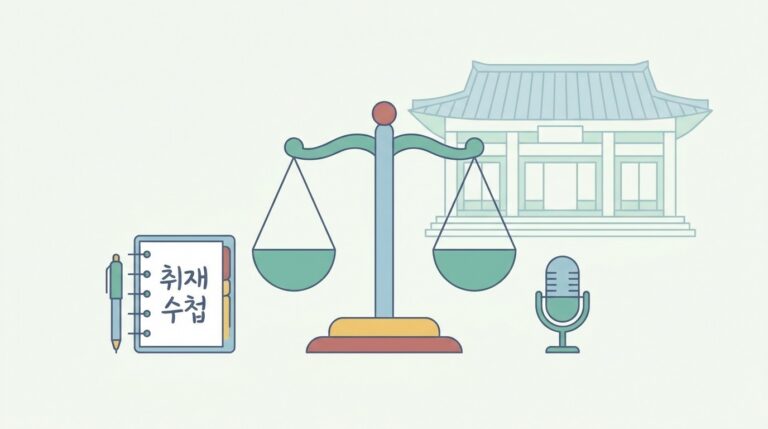
Phase 1: Empathy (Opening Story)
안녕하세요! 매일한글 에디터입니다.
If you have ever binged high-stakes Korean legal thrillers or investigative newsroom dramas like Argon or Stranger (비밀의 숲), you have probably witnessed this electrifying scene: a relentless journalist breaks a career-defining story exposing high-level corporate corruption, only for the culprit’s slick attorney to sneer through their teeth: “명예훼손으로 고소할 테니 법정에서 봅시다!” (I will sue you for defamation, so see you in court!).
For many of our advanced learners, this moment triggers absolute bewilderment. In many Western legal jurisdictions, truth serves as an absolute, impenetrable shield against defamation. However, in South Korea, Criminal Act Article 307 explicitly recognizes truth-based defamation (사실적시 명예훼손). Yes, you can technically be dragged into court for publicizing an indisputable fact if it harms someone’s social reputation!
So, how on earth does investigative journalism survive in Seoul? The secret lies in a monumental legal tightrope governed by Article 310: precluding illegality (위법성 조각) on the grounds of public interest (공공의 이익) and substantial justification (상당한 이유). Navigating this boundary is where Korean journalism, constitutional law, and corporate ethics collide. Today’s C2 masterclass breaks down this sophisticated legal and societal gatekeeping mechanism, drawing directly from real legal precedents and newsroom battles, so you can articulate top-tier commentary like an elite Korean legal analyst or chief editor.
Phase 2: Top 3 Core Expressions in Depth
1. 위법성 조각사유 (Wibeopseong jogaksayu)
- Pronunciation: [wi-beop-seong jo-gak-sa-yu] (Think of it like saying: Wee-bup-sung joh-gahk-sah-yoo)
- Meaning: Grounds for precluding illegality (Legal justification / Immunity defense)
- K-Culture Moment: You will hear this heavy legal phrasing in court dramas when defense attorneys prove that an investigative exposé was legitimate and therefore exempt from criminal defamation liability under Article 310 of the Korean Criminal Act.
- Editor’s Insight: The Sino-Korean word 조각 (阻却) does not mean “a piece” (彫刻/條閣); it combines ‘block’ (阻) and ‘reject’ (却). It refers specifically to statutory provisions that erase the unlawful character of an act that otherwise fits a criminal profile.
- Situation Spectrum: Casual 🚫 | Semi-formal ⚠️ | Formal ✅
- 🤔 Think About It: Does your native legal system separate the “fulfillment of an offense’s constituent elements” from “justification” as rigidly as civil law systems like Korea’s do?
2. 공공의 이익 (Gonggong-ui i-ik)
- Pronunciation: [gong-gong-ui i-ik] (Pronounced smoothly as: Gohng-gohng-wee ee-eek)
- Meaning: The public interest / Public welfare
- K-Culture Moment: Editorial board meetings in newsroom dramas where the editor-in-chief barks at a junior reporter: “이 특종이 단순한 사생활 폭로야, 아니면 공공의 이익을 위한 거야?” (Is this exclusive a petty privacy leak, or is it truly for the public interest?).
- Editor’s Insight: Korean courts distinguish sharply between pure public interest and private vengeance, morbid curiosity, or cyber-gossip. The legal standard demands that the primary motivation of the reporting benefits society as a whole.
- Situation Spectrum: Casual ⚠️ | Semi-formal ✅ | Formal ✅
- 🤔 Think About It: How does Korean collectivist social responsibility influence the threshold of what judges consider “beneficial to the broader community” compared to individualist cultures?
3. 상당한 이유 (Sangdanghan iyu)
- Pronunciation: [sang-dang-han i-yu] (Sounds like: Sahng-dahng-hahn ee-yoo)
- Meaning: Probable cause / Demonstrable, reasonable grounds for belief based on rigorous verification
- K-Culture Moment: Used by seasoned producers of landmark investigative programs like SBS’s Unanswered Questions (그것이 알고 싶다) when showing files of double-checked testimonies, forensics, and legal cross-examinations.
- Editor’s Insight: Even if a reported fact contains minor factual discrepancies in retrospect, Korean courts will grant defamation immunity if the journalist performed rigorous, bona fide fact-checking prior to publishing.
- Situation Spectrum: Casual 🚫 | Semi-formal ⚠️ | Formal ✅
- 🤔 Think About It: Should journalists be punished if a report turns out false, even when they exhausted every reasonable channel to verify it? Korean courts say no—if “상당한 이유” is demonstrated.
Phase 3: Textbook Korean vs. Real Native Korean
Scenario 1: Discussing whether a controversial scoop will survive a defamation lawsuit
- 📖 교과서 한국어: “이 보도는 형법 제310조에 따라 처벌을 면할 수 있습니다.” (I b战略neun hyeongbeop je-sambek-sip-jo-e ttara cheobeor-eul myeonhal su itseumnida. / This report can avoid punishment according to Criminal Act Article 310.)
- 🗣️ 진짜 한국어: “취재원 교차검증 확실히 해뒀으니까 공익성과 상당한 이유로 위법성 조각 받아낼 수 있어요.” (Chwijaewon gyocha-geomjeung hwaksilhi haedwosseunikka gong-ikseong-gwa sangdanghan iyuro wibeopseong jogak badanael su isseoyo. / We thoroughly cross-verified our sources, so we can definitely get an illegality exemption based on public interest and demonstrable verification.)
- 💡 왜 다를까?: Native practitioners rarely quote bare statute numbers in editorial strategy sessions; they highlight the exact evidentiary thresholds (교차검증, 상당한 이유) that persuade judges.
Scenario 2: Warning a junior investigative reporter about unvetted leaks
- 📖 교과서 한국어: “사실을 말해도 명예훼손죄로 처벌받을 수 있으니 조심하세요.” (Sasir-eul malhaedo myeong-yehweson-joero cheobeolbadeul su isseuni josimhaseyo. / Please be careful because you can be punished for defamation even if you tell the truth.)
- 🗣️ 진짜 한국어: “아무리 팩트라도 게이트키핑 삐끗하면 사실적시 명예훼손에 바로 걸려 넘어져요.” (Amuri paekteurado geiteukiping ppikkeuthamyeon sasirjeoksi myeong-yehwesone baro geollyeo neomeojyeoyo. / Even if it’s 100% facts, if our gatekeeping slips up for a second, we’ll get tripped up by true-statement defamation immediately.)
- 💡 왜 다를까?: High-level media jargon combines loanwords like “팩트” (fact) and “게이트키핑” (gatekeeping) with colorful idiomatic warnings like “걸려 넘어지다” (to trip and fall over legal tripwires).
Phase 4: K-Culture Deep Dive & Non-verbal Manners
4-1. 눈치 (Nunchi) & Professional Composure
In Korean corporate, legal, and newsroom environments, defending an investigative decision requires supreme emotional restraint and deliberate physical precision. When an editor or legal counsel questions your sources, do not wave your hands or raise your voice. Instead, maintain steady eye contact, keep both elbows rested gently on the table with clasped hands, and present your documentary evidence with both hands (두 손으로 자료 건네기). When delivering solemn legal assertions, lowering your vocal pitch and incorporating measured nodding indicates unwavering confidence in your verification trail.
4-2. The Cultural Battle: Investigative Journalism vs. “Cyber Wreckers”
Korean society holds a dual perspective on exposés. On one hand, deep investigative reporting by legacy media (like MBC’s PD Note or JTBC’s investigative desks) commands enormous historical respect for breaking authoritarian censorship and uncovering national chaebol scandals. On the other hand, the explosive rise of “사이버 렉카” (cyber wreckers—sensationalist YouTubers who scavenge private controversies for views) has sparked intense societal backlash. This cultural tension has prompted Korean courts to elevate the threshold of “공공의 이익”—penalizing sensationalized personal invasions while strictly shielding responsible journalists who demonstrate robust institutional gatekeeping.
Phase 5: Real-Life Roleplay Scenario
Setting: The late-night editorial desk of Daehan Daily in Gwanghwamun, Seoul. Senior Editor Kang (강 부장) and Senior Reporter Min-jun (민준 기자) are making the final call on an explosive pharmaceutical scoop.
- 강 부장: 민준 씨, 이번 신약 임상 조작 의혹 보도, 데스크에 올리기 전에 확실히 짚고 넘어갑시다. (Min-jun ssi, ibeon sin-yak imsang jojak uihok bodo, deseuke-e olligi jeone hwaksilhi jipgo neomeogapsida.)
🎭 [Glasses perched on his nose, staring critically at the draft with red-ink annotations]
“Min-jun, regarding this clinical trial manipulation allegation, let’s thoroughly review it before sending it up to the central desk.” -
민준 기자: 네, 부장님. 해당 제약사 법무팀에서 사실적시 명예훼손으로 형사 고소하겠다고 이미 내용증명까지 보냈습니다. (Ne, bujangnim. Haedang jeyaksa beommutim-eseo sasirjeoksi myeong-yehwesoneuro hyeongsa gosohagetdago imi naeyongjeungmyeong-kkaji bonaesseumnida.)
🎭 [Pulling out an official courier folder and placing it flat on the desk]
“Yes, Director. The pharma company’s legal team has already served a certification of contents threatening a criminal suit for factual defamation.” -
강 부장: 뻔한 압박 카드지. 관건은 법정에서 위법성 조각이 완벽히 입증되느냐야. 공공의 이익 요건은 충분해? (Ppeonhan apbak kadeuji. Gwangeon-eun beopjeong-eseo wibeopseong jogag-i wanbyeokhi ipjeungdoeneunyaya. Gonggong-ui i-ik yogeon-eun chungbunhae?)
🎭 [Tapping his pen firmly on the desk while leaning forward]
“A predictable intimidation tactic. The real crux is whether grounds for precluding illegality can be perfectly established in court. Is our public interest justification airtight?” -
민준 기자: 국민 건강 및 의약품 안전에 직결된 사안이라 공익성 소명은 충분합니다. (Gukmin geon-gang mit uiyakpum anjeon-e jikgyeoldoen sa-an-ira gong-ikseong somyeong-eun chungbunhamnida.)
🎭 [Nodding with calm, unshakeable confidence]
“It directly impacts national health and pharmaceutical safety, so our case for the public interest is rock-solid.” -
강 부장: 그렇다면 ‘상당한 이유’는? 취재원의 일방적 폭로에만 의존한 건 아니겠지? (Geureotamyeon ‘sangdanghan iyu’neun? Chwijaewon-ui ilbangjeok pongno-eman uijonhan geon anigetji?)
🎭 [Frowning with sharp scrutiny, probing for vulnerabilities]
“Then what about ‘substantial justification’? You didn’t just rely on a whistleblower’s one-sided claim, did you?” -
민준 기자: 내부 고발자의 진술 외에도 식약처 비공개 실태조사 문건과 3인의 독립 전문가 교차검증 녹취록을 첨부했습니다. (Naebu gobalja-ui jinsul oe-edo sig-yakcheo bigong-gae siltae-josa mun-geon-gwa sam-in-ui dongnip jeonmun-ga gyocha-geomjeung nokchwirogeul cheombuhaesseumnida.)
🎭 [Unfolding three color-coded binders filled with timestamped records]
“In addition to the whistleblower statement, I have attached undisclosed Ministry of Food and Drug Safety audit papers and cross-verified transcripts from three independent specialists.” -
강 부장: 좋아. 취재 과정에서 합리적 확인 노력을 다했다는 소명 자료가 이 정도면 법원도 면책을 인정할 수밖에 없겠어. (Joa. Chwijae gwajeong-eseo hamnijeok hwagin noryeog-eul dahaetdaneun somyeong jaryoga i jeongdomyeon beobwondo myeonchaegeul injeonghal subakke eopgesseo.)
🎭 [Sighing with relief and signing his initials boldly on the cover sheet]
“Good. With this degree of proof showing we exhausted every reasonable verification effort during reporting, the court will have no choice but to grant immunity.” -
민준 기자: 네, 게이트키핑 최종 완료됐으니 내일 아침 1면 톱기사로 송고하겠습니다. (Ne, geiteukiping choejong wanryodwaesseuni naeil achim ilmyeon top-gisaro songgohagetseumnida.)
🎭 [Packing the verified evidence with crisp, decisive movements]
“Understood. Gatekeeping is finalized; I’ll submit it as tomorrow’s front-page lead.”
🔀 Interactive Decision Point
If the pharmaceutical company offers an exclusive off-the-record interview only if you delay the broadcast by one week, what should you reply to your editor?
* Option A: “부장님, 반론권 보장 차원에서 공식 서면 질의서를 보내고 48시간의 기한을 주되, 보도는 예정대로 갑시다.” (Director, to guarantee their right of reply, let’s send an official written inquiry giving them 48 hours, but proceed with the broadcast on schedule.)
* Option B: “법정 싸움 피하려면 제약사 요구대로 방송을 미루고 그들이 주는 해명자료만 기다리죠.” (To avoid litigation, let’s postpone the broadcast as they demand and wait for their explanation packet.)
* Option C: “취재원 보호고 뭐고 다 까발리고 SNS에 선공개해서 여론전부터 펼치시죠!” (Forget source protection; let’s leak everything on SNS right now to win the court of public opinion!)
Feedback:
* Option A (Best): Superb journalistic gatekeeping! Providing a structured right of reply (반론권 보장) within a clear timeline solidifies your “상당한 이유” without being held hostage by corporate stalling tactics.
* Option B (Bad): Caving to corporate delays risks having your scoop killed or suppressed, while undermining your independent investigative integrity.
* Option C (Risk): Reckless! Dumping raw leaks without structured verification strips away your Article 310 legal defense and exposes you to irreversible criminal liability.
Phase 6: 10-Second Emotion Shadowing Drill
Master the subtle rhythm, cadence, and vocal emphasis used in Korean formal debates and editorial conferences. Follow the slash marks (/) for micro-pauses.
[🏛️ 단호하고 학술적인 어조로 / Firm and judicial]
우리 법원은 / 보도의 목적이 오로지 공공의 이익에 있을 때 / 명예훼손의 책임을 면제합니다.
(Uri beobwon-eun / bodo-ui mokjeog-i oroji gonggong-ui i-ige isseul ttae / myeong-yehweson-ui chaegim-eul myeonjehamnida.)
“Our courts / only when the report’s purpose rests solely on the public interest / grant exemption from defamation liability.”-
[🧐 신중하고 날카롭게 / Analytical and piercing]
진실이라고 믿을 만한 / ‘상당한 이유’를 증명하지 못하면 / 법적 리스크를 피할 수 없습니다.
(Jinsirirago mideul manhan / ‘sangdanghan iyu’reul jeungmyeonghaji mothamyeon / beopjeok riseukeureul pihal su eopseumnida.)
“If we cannot substantiate / ‘reasonable grounds’ to believe it as true / we cannot dodge legal risk.” -
[⚖️ 결의에 차서 / Resolute and principled]
취재원의 보호와 알 권리 사이에서 / 흔들림 없는 게이트키핑을 / 유지해야 합니다.
(Chwijaewon-ui boho-wa al gwonni sa-i-eseo / heundeullim eomneun geiteukiping-eul / yujihayeoya hamnida.)
“Between source protection and the public’s right to know / we must maintain / steadfast gatekeeping.”
Phase 7: K-Culture Mini Dictionary
- 게이트키핑 (Geiteukiping)
- Translation: Gatekeeping (News filtering & institutional curation)
- Usage: Refers to the rigorous editorial screening process through which senior editors verify sources, legality, and ethics before greenlighting investigative reporting.
- 인격권 (In-gyeok-gwon)
- Translation: Personality rights / Right to personal honor and privacy
- Usage: Heavily championed in Korean civil courts. Often stands in direct constitutional tension with the press’s right to inform (알 권리).
- 교차검증 (Gyocha-geomjeung)
- Translation: Cross-verification / Triangulation of sources
- Usage: Essential metric in proving “상당한 이유.” Judges expect reporters to have cross-referenced confidential testimony with empirical records or third-party audits.
- 취재원 비닉권 (Chwijaewon binik-gwon)
- Translation: Journalist’s privilege / The right to keep sources confidential
- Usage: While recognized ethically, Korean criminal procedural law does not provide an absolute statutory shield, requiring journalists to defend sources through airtight legal acumen.
Phase 8: Survival Kit for High-Context Living & Media Tracking
Top 3 Survival Phrases for Legal & Media Navigation
- “공익 제보자 보호 신청이 가능한 사안인가요?”
(Gong-ik jeboja boho sincheong-i ganeunghan sa-an-in-gayo?)
Pro Tip: Use this when inquiring if a whistleblower’s identity is eligible for official state protection under the Anti-Corruption and Civil Rights Commission. - “정정 보도 청구 전에 반론 보도문부터 게재해 주십시오.”
(Jeongjeong bodo cheong-gu jeone ballon bodomun-buteo gejaehae jusipsio.)
Pro Tip: Standard procedural phrasing when dealing with the Press Arbitration Commission (언론중재위원회), differentiating a correction (정정) from an alternative counter-statement (반론). - “취재 윤리 강령을 준수하며 사실 확인을 거쳤습니다.”
(Chwijae yunni gangnyeong-eul junsuhamyeo sasil hwanin-eul geocheotseumnida.)
Pro Tip: An unimpeachable formal assertion to state in interviews or court briefs to emphasize compliance with media codes of ethics.
Editor’s Travel & Living Note
If you reside in Korea or work with Korean corporate/journalistic entities, understanding where statutory information is updated is vital. Bookmark the official Korean Law Information Center mobile app download to reference real-time judicial precedents (대법원 판례) directly on your device. When visiting the Seoul High Court or attending public press trials in Seocho-dong, foreign nationals must present an alien registration card or passport at the security desk before entry.
Phase 9: “One Step Deeper” (Societal Insight)
South Korean jurisprudence regarding defamation presents a fascinating philosophical paradox to international observers. Grounded in a profound cultural reverence for social dignity, personal integrity (인격권), and relational harmony, Korean law treats an individual’s public standing as an asset worthy of criminal legal protection—even against undeniable truths. Yet, this protective impulse is counterbalanced by an exceptionally vibrant democratic impulse: the public’s right to know (국민의 알 권리). The delicate balancing act performed by Korean judges under Article 310 does not represent an attempt to curb free speech, but rather an ongoing cultural effort to demand exceptional institutional responsibility from the fourth estate.
💬 Your Turn: How does your home country balance personal reputation against the freedom of the press? Would you support or oppose a legal system that criminalizes spreading true private facts without public benefit? Share your perspectives in the comments!
Phase 10: FAQ & Common Pitfalls
Q: Can an investigative blogger or YouTuber claim Article 310 immunity in Korea?
A: Yes, in principle! The Supreme Court of Korea does not limit “공익성” (public interest) solely to traditional legacy broadcasters. However, independent creators face an uphill battle: judges scrutinize their monetization motives, editorial standards, and whether they gave the other party sufficient opportunity to reply (반론권).
Q: What is the exact difference between 위법성 조각 (preclusion of illegality) and 무죄 (acquittal)?
A: An act may satisfy all technical components of a crime (구성요건 해당성), yet its criminality is canceled or “carved out” (조각) because a recognized higher interest (e.g., public interest under Article 310, or self-defense) justified it. The resulting verdict is an acquittal (무죄), but the legal reasoning specifically flows through justification.
Q: Does having a recording (녹취) automatically provide “상당한 이유”?
A: Not automatically. Korean courts examine the credibility of the speaker in that recording. If the recorded party was speculating, venting, or known to have personal bias, the court expects the journalist to have verified those statements against documentary records before relying on them.
🚨 Common Mistakes Alert (Top 3 Pitfalls)
- ❌ Mistake 1: Assuming truth is an automatic defense. Saying: “진실이니까 명예훼손이 성립 안 돼요” (It’s the truth, so defamation can’t exist).
✔️ Correct Action: Say: “진실이라도 공익성이 결여되면 처벌받을 수 있으니 공공의 이익을 적극 소명해야 합니다.” (Even if true, it can be penalized without public interest, so we must actively prove public benefit.) - ❌ Mistake 2: Confusing criminal defamation (형사 명예훼손) with civil compensation (민사 손해배상). Overlooking that an acquittal in criminal court does not automatically bar a civil lawsuit for emotional distress.
- ❌ Mistake 3: Treating “상당한 이유” as casual reasonableness. It is a strict evidentiary standard requiring dated memos, witness checks, and diligent inquiry.
Phase 11: Action Missions
- 🥉 Bronze Level: Read aloud the Phase 6 Shadowing Drills 5 times, paying close attention to pausing at the slashes (
/) to embody the measured gravity of a senior legal affairs analyst. - 🥈 Silver Level: Find a recent Korean news article covering a court dispute (search keywords:
명예훼손,위법성 조각,상당한 이유) and summarize the court’s core rationale in 2 Korean sentences on social media or in your personal study log. - 🥇 Gold Level: Draft an editorial pitch for a hypothetical investigative report. Explicitly list 3 evidentiary measures you took to satisfy the “상당한 이유” benchmark under Korean law.
- 🎮 K-Culture Mission: Watch an episode of an investigative K-drama (like Argon or Pinocchio) and count how many times the terms 알 권리 (right to know), 취재 윤리 (reporting ethics), or 팩트체크 (fact check) appear!
Phase 12: Interactive Quiz Challenge
1. Situational Judgment
A reporter uncovers that a high-ranking public official embezzled public education funds. The reporter interviews multiple accountants, reviews internal bank ledgers, and gives the official 72 hours to respond. The official sues for defamation. How will a Korean court likely rule under Article 310?
* A) Guilty, because any exposure of a government official harms national dignity.
* B) Not guilty, because the subject matter serves the public interest and the reporter demonstrated substantial verification grounds.
* C) Guilty, because investigative reports must always be cleared by the police first.
🔍 Click to Reveal Answer & Analysis
Correct Answer: B
Analysis: The misappropriation of taxpayer funds by a public figure squarely satisfies the criteria for “공공의 이익” (public interest), and the thorough vetting of ledgers and source inquiries satisfies “상당한 이유” (reasonable verification effort), leading to the preclusion of illegality (위법성 조각).
2. Fill-in-the-Blank
Fill in the missing legal terms:
우리 법원은 보도 내용이 진실하지 않더라도, 언론인이 이를 진실이라고 믿을 만한 (____) (____)가 증명될 때 형법 제310조에 따라 (____) (____)을 인정한다.
🔍 Click to Reveal Answer & Analysis
Correct Answer: 상당한 이유 / 위법성 조각
Sentence Translation: Even if the contents of a report are not entirely true in hindsight, Korean courts recognize the preclusion of illegality under Criminal Act Article 310 when ‘substantial grounds’ for believing it true are proven.
3. True or False Cultural Quiz
True or False: In South Korea, if you publicly post true facts about your neighbor’s private marital infidelity purely to humiliate them, you are immune from criminal defamation prosecution because the statement is completely true.
🔍 Click to Reveal Answer & Analysis
Correct Answer: False (F)
Analysis: True-statement defamation (사실적시 명예훼손) exists in Korea! Because revealing a neighbor’s private infidelity serves personal humiliation rather than “공공의 이익” (public interest), Article 310 immunity will not apply, making the perpetrator criminally liable under Article 307 Clause 1.






