

Survived the Korean Clinic? How to Ace the Pharmacy Counter in Seoul
Phase 1: Empathy & Storytelling Opening
안녕하세요! 매일한글 에디터입니다. (Hello! This is your Daily Hangul editor.)
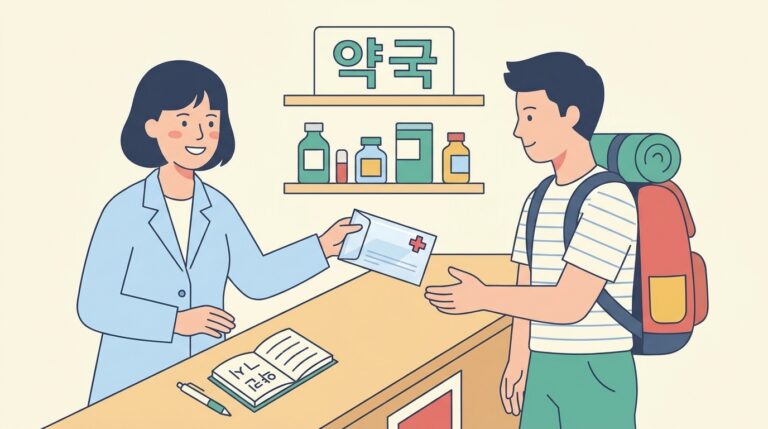
Picture this: You are exploring the vibrant streets of Seoul, snacking on delicious street food, when suddenly a nasty seasonal throat cold strikes. You bravely navigate a local clinic, get a slip of paper called a 처방전 (cheobangjeon – prescription), and walk into the green cross-marked pharmacy (약국 – yakguk) next door. You hand over the paper, feeling accomplished. But then the pharmacist starts speaking rapidly, pointing at little individual paper pouches:
“항생제가 들어 있어서 증상이 좋아져도 끝까지 다 드셔야 해요!”
Your feverish brain scrambles. Did they say stop? Did they say keep eating? What happens if my sore throat disappears tomorrow? Many of our learners tell us this is the exact moment freeze-mode kicks in. In K-dramas, whenever someone catches a cold, a caring friend swoops in with warm porridge and carefully laid-out pills. In real life, however, you have to decode dosage instructions right at the counter. Understanding phrases like “finish the full course” isn’t just about passing a language test—it protects your health, prevents antibiotic resistance, and gives you total confidence when traveling or living in Korea. This guide is crafted from real student experiences to make sure you never feel lost at a Korean pharmacy counter again!
Phase 2: Core Expressions Deep Dive
1. 처방전 여기 있어요. (Cheobangjeon yeogi isseoyo.)
- Pronunciation: [Cheo-bang-jeon yeo-gi ee-ssoe-yo] (Sounds like Chaw-bang-jun yaw-ghee ee-so-yo)
- Meaning: “Here is my prescription.” (Literal: Prescription here exists.)
- K-Culture Moment: In slice-of-life dramas like Hospital Playlist, patients immediately slide their paper slip over the counter basket as soon as they walk in.
- Editor’s Insight: You don’t need a long sentence. Handing over the paper while saying this is the universal green light for the pharmacist to start preparing your medicine.
- Situation Spectrum: Casual ⚠️ | Semi-formal ✅ | Formal ✅
- 🤔 Think About It: In many Western countries, prescriptions are sent electronically directly to the pharmacy. In Korea, you are almost always given a physical paper slip to carry into any pharmacy you choose. How does holding physical medical documents change how you communicate at the counter?
2. 끝까지 다 드셔야 해요. (Kkeutkkaji da deusyeoya haeyo.)
- Pronunciation: [Kkeut-kka-ji da deu-syeo-ya hae-yo] (Rhymes roughly with Koot-gah-jee dah duh-shuh-yah hae-yo)
- Meaning: “You must take all of it until the end.” (Literal: To the very end, all, you must honorably consume.)
- K-Culture Moment: That concerned pharmacist or grandmother figure in Korean webtoons wagging their finger so you don’t stash leftover pills in a drawer!
- Editor’s Insight: “드시다 (deusida)” is the polite honorific form of “먹다 (meokda – to eat/take medicine)”. When you hear “끝까지 (to the end)” + “다 (all)”, pay close attention: it almost always means antibiotics (항생제) are involved.
- Situation Spectrum: Casual 🚫 | Semi-formal ✅ | Formal ✅
- 🤔 Think About It: Korean medical staff frequently use high-honorific care language (-셔-) even when giving firm instructions. How does polite phrasing soften medical commands in your native tongue?
3. 졸릴 수 있어요? (Jollil su isseoyo?)
- Pronunciation: [Jol-lil su ee-ssoe-yo?] (Sounds like Johl-leel soo ee-so-yo?)
- Meaning: “Could this make me sleepy? / Can it cause drowsiness?”
- K-Culture Moment: A busy office worker in Misaeng asking if cold medicine will knock them out before an important presentation.
- Editor’s Insight: Korean cold and rhinitis medicines often contain antihistamines that trigger strong drowsiness. Asking this simple question allows the pharmacist to offer non-drowsy alternatives or adjust daytime packets.
- Situation Spectrum: Casual ⚠️ | Semi-formal ✅ | Formal ✅
- 🤔 Think About It: Korea’s work and study culture values high alertness throughout the day. Drowsiness warnings are therefore one of the most critical parts of the pharmacist’s consultation.
Phase 3: Textbook Korean vs. Real Korean
Situation 1: Handing in your prescription
- 📖 교과서 한국어 (Textbook): 이 처방전을 조제해 주십시오. (I cheobangjeoneul jojehae jusipsio. – Please dispense this prescription.)
- 🗣️ 진짜 한국어 (Real Life): 처방전 드릴게요~ (Cheobangjeon deurilgeyo~ – Here is my prescription!)
- 💡 왜 다를까? (Why is it different?): The textbook phrase sounds like an official legal contract from the 1980s. Real locals use the soft, polite “-드릴게요 (-deurilgeyo: I will give to you)” with a friendly upward lilt.
Situation 2: Asking if you should take it right after eating
- 📖 교과서 한국어 (Textbook): 식사 후 삼십 분에 복용합니까? (Siksa hu samsip bune bogyonghamnikka? – Do I ingest this thirty minutes post-meal?)
- 🗣️ 진짜 한국어 (Real Life): 밥 먹고 바로 먹어요? (Bap meokgo baro meogeoyo? – Do I take it right after eating?)
- 💡 왜 다를까? (Why is it different?): Sino-Korean words like “복용 (bogyong – medication intake)” and “식사 후 (siksa hu)” sound very rigid. Everyday conversation defaults to “밥 먹고 (after eating rice/meal)” and “바로 (right away)”.
Phase 4: K-Culture Deep Dive & Non-Verbal Manners
4-1. 눈치 (Nunchi) & Counter Gestures
When handing over your prescription card or paper, hold it with both hands (or place your left hand gently under your right wrist). This two-handed respect gesture shows appreciation for the pharmacist’s expertise. While they explain the dosage, maintain soft eye contact and nod with an affirming “아, 네~ (Ah, ne~)”.
When receiving your medication, you will notice it packaged in a transparent plastic strip of individually sealed paper pockets called 약포지 (yakpoji). Never rip all the packets open at once in the pharmacy! Take the strip, nod slightly, and place it into your bag.
4-2. Cultural Code Analysis: The Magic Prescription Bag (약봉투)
In Korea, pharmacy bags (약봉투 – yakbongtu) are wonders of practical design. Instead of separate booklets, the clear paper pouch holding your medicine has your full dosage schedule, drug names, visual pill photos, side effect warnings, and payment receipt printed directly onto the front surface!
Korean healthcare places huge emphasis on speed and convenience (빨리빨리 – ppalli-ppalli), so pharmacists provide rapid, high-density counseling. If an antibiotic is prescribed, they know patients often stop taking pills the moment their fever drops. Because of this, pharmacists treat finishing antibiotics as a communal health responsibility, reminding you sternly yet warmly to finish every single packet.
Phase 5: Real-Life Roleplay Scenario
Setting: A cozy neighborhood pharmacy in Sinchon, Seoul. Pharmacist Park (a friendly, bespectacled lady in her 40s) stands behind a pristine counter filled with energy tonics and vitamin drinks.
- Turn 1 (Pharmacist Park): 어서 오세요! 처방전 주시겠어요? (Eoseo oseyo! Cheobangjeon jusigesseoyo?)
🎭 Smiles warmly, extending a small tray.
“Welcome! May I have your prescription?” -
Turn 2 (Traveler Alex): 네, 처방전 드릴게요. (Ne, cheobangjeon deurilgeyo.)
🎭 Hands the prescription over using both hands.
“Yes, here is my prescription.” -
Turn 3 (Pharmacist Park): 네, 잠시만 앉아서 기다려 주세요. … 알렉스 님, 약 나왔습니다! (Ne, jamsiman anjaseo gidaryeo juseyo. … Alex-nim, yak nawassseumnida!)
🎭 Calls your name gently after 2 minutes.
“Yes, please take a seat and wait a moment. … Mr. Alex, your medicine is ready!” -
Turn 4 (Traveler Alex): 네! 어떻게 먹어야 해요? (Ne! Eotteoke meogeoya haeyo?)
🎭 Steps forward and points attentively to the paper pouch.
“Yes! How should I take this?” -
Turn 5 (Pharmacist Park): 하루 세 번, 밥 먹고 바로 드세요. 그리고 항생제가 들어 있어서 증상이 좋아져도 끝까지 다 드셔야 해요. (Haru se beon, bap meokgo baro deuseyo. Geurigo hangsaengjega deureo isseoseo jeungsangi joajyeodo kkeutkkaji da deusyeoya haeyo.)
🎭 Highlights the antibiotic pill on the bag with a red ballpoint pen.
“Three times a day, take it right after meals. And since it contains antibiotics, you must finish the whole course even if symptoms improve.” -
Turn 6 (Traveler Alex): 아, 다 나아도 남기면 안 돼요? (Ah, da naado namgimyeon an dwaeyo?)
🎭 Tilts head slightly in curiosity.
“Ah, even if I’m fully recovered, I shouldn’t leave any leftover?” -
Turn 7 (Pharmacist Park): 네, 내성이 생길 수 있으니까 끝까지 다 드세요. 조금 졸릴 수도 있어요! (Ne, naeseongi saenggil su isseunikka kkeutkkaji da deuseyo. Jogeum jollil sudo isseoyo!)
🎭 Taps the bag reassuringly.
“Right, antibiotic resistance can develop, so please finish everything. It might also make you slightly drowsy!” -
Turn 8 (Traveler Alex): 네, 알겠습니다. 끝까지 다 먹을게요. 감사합니다! (Ne, algesseumnida. Kkeutkkaji da meogeulgeyo. Gamsahamnida!)
🎭 Bows politely and takes the medicine bag with both hands.
“Yes, understood. I will finish all of it. Thank you!”
🔀 Interactive Choice Point
The pharmacist points out: “이 약은 빈속에 드시면 속이 쓰릴 수 있어요 (If you take this on an empty stomach, it may cause heartburn).” How do you respond?
- Choice A: “빈속에 그냥 먹을게요.” (Bin-soge geunyang meogeulgeyo. – I will just take it on an empty stomach.)
Feedback: ❌ Bad. The pharmacist will be alarmed! Korean medication for infections is potent and often upsets an empty stomach. - Choice B: “밥 꼭 챙겨 먹고 먹을게요!” (Bap kkok chaenggyeo meokgo meogeulgeyo! – I will be sure to eat a meal before taking it!)
Feedback: 🌟 Best! Perfect, natural response. Shows you understood the instruction and respect the advice. - Choice C: “안 먹을래요.” (An meogeullae-yo. – I don’t want to take it then.)
Feedback: ⚠️ Risk. Refusing prescribed medicine abruptly sounds impolite and leaves your illness untreated.
Phase 6: 10-Second Emotion Shadowing Drill
Practice these lines out loud! Follow the pause markers (/) and adopt the indicated emotional tone:
[🤒 아프지만 또박또박하게 / Tired but polite and clear]
처방전 여기 있어요. / 졸릴 수 있어요?
(Cheobangjeon yeogi isseoyo. / Jollil su isseoyo?)-
[💊 진지하고 꼼꼼하게 / Attentive and focused]
항생제가 들어 있어서 / 끝까지 / 다 드셔야 해요.
(Hangsaengjega deureo isseoseo / kkeutkkaji / da deusyeoya haeyo.) -
[😊 안심하고 감사하며 / Relieved and cooperative]
네! / 다 나아도 / 끝까지 다 먹을게요!
(Ne! / Da naado / kkeutkkaji da meogeulgeyo!)
Phase 7: K-Culture Mini Dictionary
-
항생제 (Hang-saeng-je) | Antibiotics
Usage: Whenever doctors treat acute bacterial infections (bronchitis, tonsillitis, skin infections), this word will appear on your medical bill and pharmacy envelope. -
식후 30분 (Sik-hu sam-sip-bun) | 30 minutes after a meal
Usage: The traditional Korean dosage standard. Modern doctors often say “식후 바로 (immediately after eating)” to prevent patients from forgetting, but you will still see “식후 30분” printed on most medication bags. -
졸음 (Jor-eum) | Drowsiness / Sleepiness
Usage: Look for the word “졸음 주의 (Warning: Drowsiness)” accompanied by a small car or eye icon on cold and allergy medications. -
약봉투 (Yak-bong-tu) | Medicine envelope/packet
Usage: In Korea, do not throw this away! It serves as your official legal pharmacy receipt (영수증), tax deduction proof, and dosage instructions all in one.
Phase 8: Traveler’s Survival Kit
Top 3 Survival Phrases
- 식후에 먹나요, 식전에 먹나요? (Sik-hu-e meong-nayo, sik-jeon-e meong-nayo?)
Meaning: Do I take this after meals or before meals?
Pro Tip: “식후 (Sik-hu)” = after eating; “식전 (Sik-jeon)” = before eating. - 하루에 몇 번 먹어요? (Haru-e myeot beon meogeoyo?)
Meaning: How many times a day do I take this?
Pro Tip: Pharmacists usually write numerals (e.g., “3회 / 3일분” = 3 times a day for 3 days) right on the envelope. - 물 많이 마셔야 해요? (Mul mani masyeoya haeyo?)
Meaning: Should I drink a lot of water with this?
Pro Tip: Great to ask when taking pain relievers, cold remedies, or antibiotics that might dry out your mouth.
Editor’s Travel Note
- Need to find a pharmacy open late at night or on Sundays? Check the nationwide registry through the Emergency Medical Portal Service or search for “휴일지킴이약국” on your smartphone.
- When mapping your route to a nearby hospital or pharmacy, remember that Google Maps has limited walking directions in South Korea. We strongly suggest using the Naver Map application download to search for “약국 (pharmacy)” nearby.
- General cold medicines (감기약), basic painkillers (진통제), and digestive drinks (소화제) are also available at convenience stores (편의점) under “안전상비의약품” (Safe Household Medicines), but true antibiotics always require a clinic prescription!
Phase 9: “One Step Deeper” (Reflective Question)
In Korean society, healthcare professionals rarely treat patient care as purely transactional. When a pharmacist emphasizes, “증상이 좋아져도 끝까지 다 드셔야 해요 (Even if symptoms improve, you must finish everything),” it reflects 정 (Jeong)—a cultural underpinning of reciprocal warmth, protection, and collective well-being. They want you to recover completely, without recurrence or antibiotic resistance.
💬 Your Turn: In your home country, do pharmacists strictly emphasize finishing antibiotic courses in person, or do they leave it up to printed warning stickers? Share your cultural pharmacy experiences in the comments below!
Phase 10: FAQ & Avoiding Misunderstandings
Q: Can I take antibiotics with coffee or Korean iced americano?
A: No! Avoid taking Korean prescription medication with caffeinated drinks, energy tonics (like Bacchus), or milk. Always take medication with a full glass of lukewarm water (미온수), as caffeine can amplify side effects like heart palpitations and stomach irritation.
Q: What should I do if my stomach feels uncomfortable after taking antibiotics?
A: Return to the pharmacy or clinic and say: “속이 좀 쓰려요 (Sogi jom sseuryeoyo – My stomach burns/hurts).” Doctors in Korea often prescribe a protective stomach pill (위장약 – wijangyak) alongside antibiotics, and they can easily adjust your formula.
Q: Can I keep leftover prescription medication in Korea for next time?
A: Never keep leftover antibiotics. Prescriptions in Korea are custom-tailored for your exact symptoms at that moment. Once your treatment period ends, discard leftover medicines properly at a local pharmacy disposal box (폐의약품 수거함).
🚨 흔한 실수 (Common Mistakes) Warning Board
- Mistake: Throwing away the pharmacy bag (약봉투) immediately.
Correct Action: Keep it! It has your exact dosage schedule, pill photo guides, and emergency contact numbers printed on it. - Mistake: Stopping antibiotic pills on day two because the sore throat disappeared.
Correct Action: Remember the key phrase: “끝까지 다 드셔야 해요!” Take every single packet until the prescribed date concludes. - Mistake: Handing prescriptions or cash across the counter using only one hand.
Correct Action: Always present your prescription paper and payment card with both hands to show basic Korean etiquette.
Phase 11: Action Missions & Community Engagement
- 🥉 Bronze Mission (Solo Shadowing): Stand in front of the mirror and repeat “끝까지 다 먹을게요! (I’ll take it all until the end!)” three times with a confident nod.
- 🥈 Silver Mission (Notebook Practice): Write down the 3 core words: 처방전 (Prescription), 항생제 (Antibiotics), and 졸음 (Drowsiness) on a sticky note and label your daily vitamin pack.
- 🥇 Gold Mission (Real-World Master): Next time you visit a Korean pharmacy, hand over your paper or ask for OTC medicine completely in Korean without switching to English!
- 🎮 K-Culture Mission: Watch an episode of a modern medical K-drama (like Hospital Playlist or Doctor Romantic). Listen carefully for when someone says “약 챙겨 먹어! (Don’t forget to take your medicine!)” and notice how characters care for one another.
Phase 12: Interactive Quiz Challenge
1. Situation Judgment Quiz
You have been taking prescription medicine for two days. Your fever is gone and you feel 100% energized, but you still have two days worth of antibiotic packets left. What should you do?
(A) Stop taking the pills immediately and save them for your next cold.
(B) Take all remaining packets as instructed until the end.
(C) Take double the dose at once to finish quickly.
2. Fill-in-the-Blank
Complete the sentence to tell the pharmacist you brought a prescription:
“_______ 여기 있어요.” (Hint: Starts with 처…)
3. True or False Cultural Quiz
True or False: In Korea, you can take a prescription paper from a clinic in Seoul and fulfill it at any registered pharmacy (약국) in the country.
Click to reveal answers & explanations!
-
Answer: (B)
Explanation: Remember the golden rule: “증상이 좋아져도 끝까지 다 드셔야 해요 (You must finish the whole course even if symptoms improve)” to prevent bacterial resistance! -
Answer: 처방전 (Cheobangjeon)
Explanation: “처방전 여기 있어요 (Here is the prescription)” is your go-to opener at any Korean pharmacy counter. -
Answer: True
Explanation: While it is standard and quickest to use the pharmacy right next to your clinic (because they are guaranteed to carry the exact pill stock), Korean prescriptions are legally valid at any pharmacy nationwide during their validity window (usually 3 to 7 days).







